March 25, 2018

‘We may forgive, but won’t forget’: Serbia’s commemoration of NATO bombing victims ignored by West

rt.com

'We may forgive, but won't forget': Serbia's commemoration of NATO bombing victims ignored by West — RT World News

3-4 minutes


Thousands of Serbs honored the victims of the 1999 NATO bombings with a commemoration on Saturday, attended by Serbian president and many officials, including the Russian envoy, but with a glaring absence of Western diplomats.

The main commemorative event, held under the slogan "We will forgive, if we can, we will not forget while alive," took place in the Southern town of Aleksinac which suffered heavily in the 1999 US-led NATO campaign.

Darkness and silence fell over the entire city center as the ceremony, attended by President Aleksandar Vucic and his cabinet ministers, opened with deafening sounds of air alarm sirens. At least 3,000 people gathered in front of the stage and the ruins of a building destroyed in NATO bombing, according to Sputnik's correspondent.

"What do we say today, we on whom 420,000 missiles and nearly 40,000 cluster bombs and 1,300 cruise missiles have been dropped?" Vuvic asked. He went on to speak of the deaths and destruction caused by NATO, though adding that his country still seeks a partnership with the alliance.

"Yes, we want a partnership with you, you who have perpetrated terrible crimes on us. We want from the enemy to become friends, just do not expect us to forget that you killed us, or to blame our country for it. We want a partnership, but we will not join NATO. It would be rubbing too much salt into our wounds," Vuvic said.

The Russian Ambassador to Serbia, Aleksandr Chepurin, who also attended the poignant ceremony, noted the glaring absence of representatives of Western states.

"Today once again none of the Western diplomats bothered to attend this ceremony. So they show no repentance and, moreover, believe they did everything right. Looks like the Serbs are not humans to them, but they nevertheless continue to teach us humanism," said Chepurin.

Meanwhile in the capital Belgrade, about 500 demonstrators gathered in front of the Serbian Parliament in an anti-NATO protest commemorating the 19th anniversary of the Yugoslavia bombing. Protesters waved flags and lit flares, while others held banners with anti-NATO messages.

NATO justified its intervention without any approval of the UN Security Council, by accusing the Milosevic government of ethnically cleansing the province of Kosovo. The bombings lasted 78 days, from March 24 to June 10, 1999, and officially claimed at least 758 civilian lives – though Serbian sources say the true figure may be up to five times as much.

READ MORE: 19 years after NATO bombed Serbia, most Serbs won't take apology from alliance – poll

According to a recent poll, 19 year later a majority of Serbs would not accept an apology from NATO for its military intervention, and only 10 percent would wish to see their country become a member the trans-Atlantic military bloc.

Think your friends would be interested? Share this story!


March 21, 2018

Has Russia Had Enough?


https://www.paulcraigroberts.org/2018/03/21/has-russia-had-enough/

Has Russia Had Enough?

Has Russia Had Enough?

Paul Craig Roberts

This morning I watched a briefing the Russian Foreign Ministry provided for the diplomatic community where international toxic substances experts presented information concerning the alleged nerve agent used in the alleged attack on Skripal and his daughter. This information has been known for some time, and none of it has been reported in the Western presstitute media.

In the briefing the Russians once again relied on facts and existing agreements that govern the investigation of such events and asked why the British were demanding explanations from Russia when the British refuse to comply with established procedures and refuse to produce any evidence of what the British allege to have occurred.

The response from the US and French embassy representatives was simply to state that they needed no evidence to stand in solidarity with their British friends, that Russia was guilty by accusation alone, and that they would hold Russia accountable.

The benefit of this absurd response, which the Russians declared to be shameful, is to make clear to the Russian government that it is a waste of time to try, yet again, to confront unsupported accusations from the West with facts and appeals to follow the specified legal processes. The West simply does not care. The issue is not the facts of the case. The agenda is to add another layer to the ongoing demonization of Russia.

Sooner or later the Russian government will realize that its dream of "working with its Western partners" is not to be and that the hostile actions and false accusations from the West indicate that the West is set on a course of conflict with Russia and is preparing the insouciant Western peoples to accept the consequences.

The Russian official hosting the briefing compared the Skirpal accusation with the Malaysian Airliner accusation and the many others that resulted in instant accusations against Russia and refusal to cooperate in investigations.

The Russian official also drew the parallel of the accusations against Russia with the US and UK false accusations against Serbia, which led to the bombing of Serbia, and to the false accusations against Iraq, for which Colin Powell and Tony Blair had to apologize, that resulted in the destruction of Iraq and the death and displacement of millions of Iraqis.

The Russian official also said, pointedly, that the days were gone when no one challenged statements by the US government. The world, he said, is no longer unipolar. Russia, he said, does not respond to unsupported allegations. He also said that the way the Americans, British, and French are proceeding suggests that the Skirpal affair is an orchestration created for the purpose of accusing Russia.

This conclusion is supported by the history of US and UK interventions. In recent times we have seen the West's orchestrated interventions based on obvious and blatant lies in Serbia, Iraq, Libya, Somalia, Syria, Ukraine, Yemen, and the attempts to destabilize Iran and Venezuela. History provides almost endless examples of the lies used by the US and UK to implement their agendas.

Nothing Washington and London say can ever be believed. Is it possible for Russia or any country to work with "partners" who are shameless, short on integrity and honesty, and have proven themselves unworthy of trust?


March 19, 2018

Britain’s role in the Balkans – why Boris Johnson is about to turn pro-EU

theconversation.com

Britain's role in the Balkans – why Boris Johnson is about to turn pro-EU

Othon Anastasakis

5-7 minutes


Here's a paradox from Brexit Britain. This summer, at a summit meeting in London organised by the UK's Foreign Office, a hard Brexiteer – the foreign secretary Boris Johnson – will be the designated advocate of EU membership for the Western Balkan states. A country preparing to leave the EU will preach the accession of Bosnia-Herzegovina, Albania, FYR Macedonia, Serbia, Kosovo, and Montenegro to the European Union. A country seeking to "take back control" from the heavy-handedness of Brussels will advise others to relinquish their sovereignty to that same superstate. What's going on here?

The London summit in July will host the leaders of the six Western Balkan states and those of Britain, Germany, Italy, France and Austria. It's part of the so-called Berlin Process, an intergovernmental initiative introduced by Angela Merkel in 2014 whose goal was to help the development of the Western Balkans by focusing on investment, connectivity, infrastructure and regional cooperation, with the ultimate aim of their joining the EU.

So far, as part of the process, a Regional Youth Cooperation Office has been established to "promote the spirit of reconciliation and cooperation between the youth in the region through youth exchange programmes". An agreement has also been signed for the settlement of bilateral disputes. There is also talk of a Western Balkans Economic Area, where goods, services, investments and skilled workers would be able to move without obstacles.

The Berlin Process includes, from the EU side, the five strongest and most prominent member states. Every summer, the leaders of these countries meet with the leaders from the six Western Balkan countries to reaffirm their commitment to the region's European integration. They also aim to attract pledges for investment and take a family photo during a highly publicised summit.

Delegates arrive at the 2017 summit in Trieste. EPA

Now, following a commitment made in 2014, it's Britain's turn to be the host of that summit. The 2018 meeting is an opportunity for the UK to show that it has something substantial to offer to European affairs despite Brexit. After all, every host so far has shaped the agenda by including their own expertise. In Vienna, three years ago it was civil society engagement, in Paris, two years ago, it was climate change. Last year's summit in Trieste dealt with the rule of law and the fight against corruption.

Delicate balance

Despite its imminent departure from the EU, Britain does still have a useful role to play in the Berlin Process. That might include its security expertise as a strong military nation that remains an enthusiastic member of NATO. With geopolitics becoming increasingly significant for Europe's foreign policy, the Western Balkans is one of the most vulnerable regions of the continent. From a security perspective, the region is highly exposed to risks on the periphery of Europe.

The security risks in the region include a generic fear of return to the wars of the 1990s among some post-Yugoslav states, the threat of Islamic fundamentalism, the rise of organised crime, geopolitical and geo-economic competition from China, Russia, or Turkey.

Then there are the existing bilateral disputes among post-Yugoslav states. All have unresolved border issues – some of them subject to international arbitration. And all these disputes affect stability. None of the states have threatened to use military force against each other to resolve these issues, but any security assistance from abroad to one country may be seen to antagonise the interests of the neighbouring country.

Focusing so heavily on the issue of security can also actually harm political progress. People in the region increasingly experience a backsliding of democracy.

As a recent House of Lords report noted, there is "serious concern that gains made towards good governance and the rule of law are in danger of being lost as countries in the region turn to authoritarian leadership, nationalistic politics and state capture". And a recent report by Human Rights Watch found that most countries in the region still face serious challenges in upholding human rights standards.

Because the primary concern has, for so long, been security in the Western Balkans, such anxieties have, for the most part, fallen on deaf ears in Western capitals. Geopolitical concerns have allowed local leaders and governments to enjoy lax political conditionality for the sake of security and stability – what has been labelled "stabilitocracy". As a result, liberal politics have deteriorated and advances made during the 2000s have eroded.

It's important that any security agenda embraces democracy, human rights, and rule of law – the "holy trinity" of political transformation, which itself is a necessary condition for security and stability in the region. That should be the common goal of both the Berlin Process and the European Commission, the latter having recently adopted a new enlargement strategy for the Western Balkan candidate states. The biggest challenge for Johnson and the Foreign Office, on this particular occasion, is to find ways to cooperate effectively with the European Union, aiming at the inclusion of the Western Balkan countries in the European family, at a time when the UK is excluding itself from it.


March 12, 2018

EU blackmail Serbia over Kosovo

rt.com

EU blackmail Serbia over Kosovo

16-20 minutes


The republic of Kosovo proclaimed its independence from Serbia a decade ago. What consequences has this move brought to the country - and the world? We talk to Jan Kavan, former president of the United Nations General Assembly and former Foreign Minister of the Czech Republic.

Sophie Shevardnadze: Jan Kavan, former president of the United Nations General Assembly and ex-Foreign Minister of the Czech Republic, welcome to the show, it's really great to have you with us. Mr. Kavan,10 years ago Europe had a new state born in Kosovo. Back then you said the proclamation of independence and its recognition was a big mistake. 10 years on, do you still think the same?

Jan Kavan: Yes, I'm convinced it was a mistake. I saw it from the very beginning. In fact, mistake is a very polite and soft term. I would regard the recognition of independence of Kosovo as a gross violation of international law, gross violation of the Helsinki Agreement, of the United Nations Security Council resolution 1244 that made it very clear that Kosovo at that time should have remained part of the former federal Republic of Yugoslavia. The unilateral declaration of independence clearly violated all these legal provisions and in my own opinion it set a very dangerous precedent for other minorities or secessionist movements to declare a unilateral independence. I was not surprised at all that the declaration of independence of Crimea directly referred to...

SS: That's what my next question is about. Mr. Kavan, I was going to ask you - you also said that recognising Kosovo's independence proclamation and not recognising Abkhazia or Crimea is a double standard - but the Western powers explain that by saying that all these cases are unique and shouldn't be used as precedents for each other. Do you agree with their point?

JK: In my opinion any such political moves create precedents either positive or negative ones. As far as I'm concerned and I'm not the only one, it was perceived by many of my colleagues in the Czech parliament, for example, that the unilateral declaration of independence of Kosovo created a precedent for Northern [Southern] Ossetia, for Abkhazia,  for Crimea. In the future Catalans in Spain may be inspired by this, or any other similar movements. Therefore, as a former diplomat I strongly believe in following the provisions of international law. And, therefore, if I refer to the Helsinki Agreement I like the idea that break-ups of any such entities should be a result of an agreement between both parties. If Belgrade had agreed to it at that time it would have been ok. Same as when my own country Czechoslovakia divided into the Czech Republic and Slovakia it was a result of an agreement between both parts, that, I think, corresponds to international law. But unilateral declaration of independence is wrong.   

SS: I want to talk a bit about Kosovo itself. With Kosovo's separation, the ethnic Serbs in the north vowed to ignore the new state - and for years that's what they did. Sometimes the tensions rose so high that the former president of Serbia has said he's ready to send troops in to protect the Serbian population there. Can there be a conflict between Serbia and Kosovo over the northern territories?

JK: I hope that any conflicts will not take form of a military confrontation, but a conflict that can be solved in negotiations and by political means. But upon my own information the position of the Serbian minority in Kosovo, for example, around Mitrovica, is not the one which would correspond to the EU criteria for treatment of minorities. And I do hope that when the negotiations of both Pristina and Belgrade to join the European Union will proceed further the European Union will ensure that both countries will fully conform to the Copenhagen criteria and other criteria including the criteria for treatment of minorities. Therefore, this must be reflected in the level of education, level of access to their religious buildings, churches, ceremonies etc.  

SS: But, Mr. Kavan, what gives you the hope that they will abide by the Copenhagen normatives?

JK: If they wish to join the European Union the Copenhagen criteria is one of the basic ones. I can't see how they could join the EU if, for example, the level of democracy is violated, if they are convicted or perceived as a corrupt and inefficient country which would ignore the rule of law. So for me the Copenhagen criteria is something unsurmountable. I mean they have to conform, otherwise they can't join the European Union.

SS: Most of Kosovars are ethnic Albanians. Albanian Prime Minister has already voiced the idea of a single president for both countries at some point. Do you think Albania could eventually absorb Kosovo, if the Kosovar state will not get itself together in the near future?

JK: That's a very complex question. If I'm critical of the unilateral declaration of independence of Kosovo, that doesn't mean that Kosovo should be basically taken over by Albania. I acknowledge, of course, that in both countries the population is ethnically Albanian. However it would throw into the question the very principle we're now discussing. If Kosovo is declared as a sovereign independent country then I can't quite foresee how by the international law they can become a province or part of some federal arrangement with Albania. I think, this would be unacceptable for the government of Serbia. And I hope, it would be unacceptable for most of the international community.    

SS: The Kosovo Specialist Court - a tribunal set up to investigate Kosovo Liberation Army members abuses during the conflict with Serbia - is in danger, the Kosovar parliament is considering suspending it. Since the Prime Minister, the President and the parliamentary speaker are all former commanders of the KLA, do you think there's foul play here, someone wanting to hush things down?

JK: I do hear from some of my friends who live in the region that close to the leadership or at some influential positions in Kosovo there are still members of the KLA who were in the past at least strongly suspected of having committed crimes during the military confrontation. If this is the case they should be tried. I'm a believer in the Hague court but the problem is that not all the people are brought to the Hague. Some who were brought to the Hague in the past were surprisingly released without being tried. Other people received very high and long sentences. So that creates an atmosphere in which the whole question of the application of justice is being thrown into doubt and that is not good for the atmosphere of justice.

SS: Serbia's membership in the EU is resting on Serbia's recognition of Kosovo - but for now, the public opinion in Serbia won't allow that. So Serbia will never join the EU - because it will never recognise Kosovar independence?

JK: I'm aware of this condition and I'm a strong believer in the European Union. And I do believe that both Kosovo and Serbia should become members of the European Union. But I do believe they should become members simultaneously - at the same time, facing same conditions and same criteria of fulfilment of these conditions. The conditions currently put forward by the European Union to the Serbs that they have first to recognise the independence of Kosovo before they could join the EU - I'm very unhappy about it because it gives the impression of an ultimatum, of a pressure, of even a blackmail, if you wish. This is unfair. This creates an unfair position for Serbia in comparison with the position of Kosovo. So I do very much hope that sensible politicians in the European Union will rethink this condition and look for a negotiated compromise between Kosovo and Serbia - compromise, which should be educated and arranged by the EU, by the offices of the EU. As you know, at the moment still five member countries of the European Union have not recognised Kosovo. And I do believe that if such compromise isn't reached you will not have a unanimous acknowledgement of the independence and membership of Kosovo in the European Union by all member states.       

SS: Mr. Kavan, like you've said in the first part of our programme, the EU recognised Kosovo, but lots of EU members didn't - Romania didn't, Greece didn't, Spain didn't. How is Brussels supposed to go about that when talking about a Euro future for Kosovo?

JK: Yes, in addition to the countries you've mentioned also Cyprus and Slovakia didn't recognise the independence of Kosovo. And it's understandable. If you look at those five countries common denominators between them are sizeable minorities on their territories - and therefore an obvious fear that recognition of Kosovo under the current conditions may encourage those minorities to follow the example and declare independence. And I think, Spain today is facing the problem of Catalonia and maybe in the future also with the Basques, and is fully aware of these dangers, and may be one of the countries pressurising Brussels to find a more amenable and more acceptable way of discussing the future of Kosovo. At the moment I don't see how both countries could join the European Union fulfilling the conditions put forward by the EU, i.e. Serbia acknowledging the independence of Kosovo - something which, I fully understand, is unacceptable for them and agree with them. I'm not judging the merits of the case in the past in the mutual history of the two countries. But the actual declaration of independence in my opinion was a violation of international law and I don't see why member countries of the European Union from Serbia all the way to my best friend Slovakia, Cyprus, Spain, Romania etc. should accept the violation of international law that takes place in one part of Europe and would be condemned in other parts of the world, for example, in Asia.         

SS: What do you think made the UK and Germany and France so enthusiastic about an independent Kosovo? What's in it for them?

JK: That's a very good question, but I think you should address such a question to the representatives of France, Britain and Germany. In the past, of course, Germany has been known to support the break-up of former Yugoslavia, they supported the independence of Slovenia and Croatia. Maybe they do believe that such unilateral declarations of independence are an expression of the principle of self-determination which is an important international principle, but it cannot be used to justify other forms of violation of international law. I think that former colonial powers like United Kingdom and France with a history of difficult negotiations of independence of their former colonies should be aware that simplified solutions can create problems for the future - major problems like we now see in Syria, in the Middle East etc. So I would appeal to those countries not to go for the easy solution which is to support the unilateral declaration of independence of Kosovo.     

SS: The EU was lukewarm to the idea of Scottish and Catalonian independence, even though they went about it the peaceful democratic way, yet Brussels throws all its support behind Kosovo. Why is that, why is Kosovo's independence better than the Scottish or Catalan?

JK: A very good question that goes back to what I said earlier. It creates a precedent. You can't say that something is good in Kosovo and bad for Barcelona or Crimea or whatever. Either the principle is good or the principle is bad, it has to be applied equally. And that is not being done. This is what we protest today. There are a number of members of parliament of the Czech Republic and other prominent figures who are at the moment signing a petition addressed to the Czech government, asking them to renounce their decision of 2008 to recognise the unilateral declaration of independence of Kosovo. Let's go back to the negotiating table, let's drop all the preconditions and find an acceptable compromise - whether it's a strong autonomy of Kosovo within the region or independence but with certain concessions for Serbia and so on. It's very important not only for Kosovo but in my opinion also for the future of Catalonia. I listened to the leaders of the regional government of Catalonia, I fully see their argument. And I think, the first response of the Spanish government of sending police there which brutally suppressed peaceful demonstration, peaceful expression of will of the Catalans to vote clearly helped those who declared the preference for independence. It was the result of the brutal police's actions, the support for the independence only increased. This is not a way to find a solution, this is a way to create conflicts, problems and tensions. And it's bad not only for Spain, it's bad for the Balkans and it's bad for Europe.      

SS: So, the recent EU Western Balkans strategy includes Kosovo as a potential member - but the Kosovar president Thachi says there is no clear path written out for his country. Does the EU really want Kosovo as member?

JK: It's a very good question. It very much depends on how you define the EU. The EU as the entity of 28 countries don't have a consensual view on this question because, as you know, five member states have consistently refused to recognise the independence of Kosovo. Therefore, they would oppose a membership of Kosovo in the European Union under the current conditions. And, as you know, at the moment only 116 member states of the United Nations have agreed to the independence of Kosovo and even that almost took almost 10 years. For many years it was less than one hundred, i.e. 50 per cent of the membership of the UN. So this is a major problem for Kosovo in the future but it's also a problem for the European Union. The European Union should be honest and consistent and follow its own criteria ranging from self-determination all the way to the respect for international law, respect for the UN Security Council Resolution 1244 and the respect for the final act of Helsinki.       

SS: Head of EU Rule of Law mission in Kosovo Malcolm Simmons resigned, saying "he doesn't want to take part in a farce". The mission has been there for years, but without much success in establishing the rule of law. But can a foreign party really do that in any country?

JK: No. A foreign entity cannot do that unless it's a foreign entity representing some kind of occupying power, some kind of power which is stronger than the power of the sovereign government of that country. If a country is independent, if it's truly sovereign then the foreign entity cannot impose its own perception of the rule of law. On the other hand, foreign entities willing to help to establish the rule of law can and should play a positive role in such procedure but only in cooperation with the government of the country, with the parliament of the country, in my opinion, also with the major NGOs and other bodies representing the public opinion.    

SS: I just wanted to tell you that it strikes me that Kosovo is being treated by the West as a little baby. I mean, their attitude is a little arrogant, like they're on a "civilising mission" - first NATO fought the war for it, then it stayed to make sure Kosovars don't misbehave, UN mission ruled it, then it backed the independence and is still doing the legal work, the economic work, the security work for Kosovo. How long is Kosovo going to be EU's toddler?

JK: It's also treating Kosovo as a country which should be automatically loyal to those political forces which helped them to declare unilateral independence, i.e. which helped them to divide from Serbia. But, as I believe, that act was wrong. Just very briefly, I know we don't have much time - at the time I was Minister of Foreign Affairs and I initiated what was called "Czech-Greek Peace Initiative" which was aiming not only to end the bombardment of the former Yugoslavia including Kosovo, but it wanted to create conditions for a negotiated peace that would ensure stability in Kosovo and the former Yugoslavia. And this led, in fact, or helped to lead not only to the ceasefire and the declaration of peace but it also led to the UN Security Council Resolution 1244. And I think we should return to the conditions expressed in that resolution which are still being violated. And that means that Kosovo is being treated differently from Serbia and that, I think, is wrong.   

SS: Alright, Mr. Kavan, thank you for this interview. We were talking to Jan Kavan, former president of the UN General Assembly and ex-Foreign Minister of the Czech Republic discussing whether Kosovo has become a self-reliant state ten years after declaring independence. That's it for this edition of SophieCo. I'll see you next time.


February 27, 2018

“Western Balkans could take up to 200 years to catch up with EU”

inserbia.info

"Western Balkans could take up to 200 years to catch up with EU"

InSerbia with agencies

3 minutes


Western Balkans countries need to tackle their low productivity and speed up reforms, the EBRD said on Monday, warning it could otherwise take them up to 200 years to catch up with the living standards of the EU states they hope to join.

Albania, Bosnia and Herzegovina, Macedonia, Kosovo, Montenegro and Serbia are held back by weak institutions, corruption and government dominance in some industries, the European Bank for Reconstruction and Development (EBRD) said.

The current average gross domestic product (GDP) per capita for the six countries, still scarred by ethnic wars fought in the 1990s, is only half the average in 11 EU member states of Eastern Europe, such as Poland or Hungary, and just a quarter of their more advanced western European peers.

"The fundamental problem holding back the region's economic development is low productivity," the EBRD said in its report, released at the bank's Western Balkans Investment Summit in London. "This reflects years of under-investment, weak institutions and a difficult business environment."

While the private sector was the main contributor to economic output in all of the six countries, governments often dominated key industries, with significant privatisation programmes ahead.

Private sector productivity across the Western Balkans stood at just 60% cent of EU levels overall, the report said.

In the EBRD's baseline scenario, which used average annual growth rates for 2001-2016 of 3.2% for the Western Balkans and 1.4% in the EU, the report suggested the six countries could achieve the EU's average GDP per capita in about 60 years.

However, the EBRD noted that the speed of convergence had slowed down markedly over the past seven years. The region achieved average annual growth of just 1.2% in the post-crisis 2009-2016 years compared with 5.3% in the pre-crisis period of 2001-2008.

So under a more pessimistic scenario using post-crisis growth rates it could take the Western Balkans over 200 years to converge, the bank said, with parity achieved only in 2220.

An optimistic scenario using pre-crisis growth rates would allow the Western Balkans to catch up in under 40 years, by 2053.

"The speed of catch up would depend on the pace of addressing the challenges that hamper the region from developing its full potential," the report said.

"Full EU convergence will require states to implement a determined and comprehensive reform agenda towards boosting productivity and investment," the EBRD added.

All six countries are seeking membership of the European Union, which recently launched a new integration campaign.


February 24, 2018

Russia’s Election Meddling: Worse Than a Crime a Blunder


http://www.theamericanconservative.com/articles/russias-election-meddling-worse-than-a-crime-a-blunder/


Russia's Election Meddling: Worse Than a Crime; a Blunder


U.S.-Russian hostility is now inevitable, and the results could be tragic.

Robert Merry, Journalist and Editor of The American Conservative

February 19, 2018

When Napoleon Bonaparte executed the Duc d'Enghien in 1804 for what seemed like trumped-up treason charges, the implications extended far beyond questions of French justice and even beyond the borders of France. European leaders were shocked, and the episode helped crystallize anti-Bonaparte sentiment throughout the Continent and in Britain. The famous French diplomat Charles de Talleyrand captured the moment when he said: "It was worse than a crime; it was a blunder."

That might well be said now about the Russian effort to manipulate the 2016 presidential election by using social media to undermine Democratic candidate Hillary Clinton, promote the candidacy of Donald Trump, and generally sow discord throughout the American body politic. Three Russian companies and 13 Russian citizens were indicted by U.S. authorities Friday on charges of engaging in a three-year, multimillion-dollar effort to interfere in the election. Americans naturally are shocked at this brazen effort to unravel the political fabric of their country.

But it isn't really all that shocking. To understand why it was more of a blunder than a crime—and a blunder with likely tragic consequences—it is important to absorb five fundamental realities surrounding this important development in U.S.-Russian relations.

First, countries have been doing this sort of thing for centuries. It is a fundamental part of tradecraft—the use of covert actions to undermine the internal workings of rival nations. No country likes being on the receiving end, but few refrain from such activity when they think it will thwart national security threats.

Second, no nation has been more aggressive than the United States in pursuing efforts, covert and even overt, to destabilize other regimes. In part that's because, as the leading global power since World War II, the Unites States has had more at stake in events of significance throughout the world. In part also, it's because America has had the greatest capacity for bringing the latest technology and the greatest covert capabilities to meet the challenge.

In any event, the U.S. record in this area is beyond dispute. A New York Times piece by Scott Shane over the weekend quoted a University of Georgia professor named Loch Johnson as saying, "We've been doing this kind of thing since the CIA was created in '47. We've used posters, pamphlets, mailers, banners—you name it." Among other things, he adds, the United States has planted false information in foreign newspapers and distributed "suitcases of cash" to influence foreign elections. Steven L. Hall, a 30-year CIA veteran (now retired) with extensive experience leading the Russia desk, told Shane that the United States "absolutely" engaged in such activities, "and I hope we keep doing it."

Shane cites a study by Dov H. Levin of Carnegie Mellon that sought to quantify "election influence operations" by the United States and the Soviet Union/Russia between 1946 and 2000. He counts 81 by the United States and 36 by the Soviet Union or Russia (though he figures there were more ops initiated from Russian soil than we know about).

Beyond that, there is what has become known as the "democracy industry"—legions of U.S. NGOs, many funded with federal money, that fan out through the world to remake regimes they consider insufficiently imbued with Western values. Writer and thinker David Rieff, writing in The National Interest a few years ago, attacked these democracy promotion adherents as people who "will not or cannot acknowledge either the ideological or the revolutionary character of their enterprise." He likened the democracy promoters in propaganda terms to Soviet leader Nikita Khrushchev's 1956 boast to America that "we will bury you."

Third, the greatest interference in the internal affairs of foreign nations, aside from invasion, is regime change, and here the United States is by far the leader in the post-World War II era. We know of major efforts—covert or overt, successful or not—by America to upend regimes in Iran, Guatemala, South Vietnam, Chile, Nicaragua, Grenada, Serbia, Iraq, Libya, Syria, and Ukraine.

Leaving aside the case-by-case merits, this is a powerful record, and it has implications far beyond U.S. domestic politics. Like Bonaparte's execution of the Duc d'Enghien, it generates concerns and fears among foreign leaders. In the case of America's regime change zest, it sends chills down the spines of leaders fearful that they may be next on the list of U.S. regime change targets. Certainly the resolve of North Korea's Kim Jong-un to develop nuclear weapons with a delivery capacity to the United States is partly a product of such fears.

Fourth, America and its allies bear by far the greater share of the blame for the current tensions between the West and Russia. It was all predictable back in 1998 when NATO fashioned its policy of aggressive eastward expansion toward the Russian border. George F. Kennan, the highly respected U.S. diplomat and Russia expert, predicted the outcome in particularly stark terms. He called it "the beginning of a new cold war…a tragic mistake." He foresaw that of course the Russians would react badly, as any nation would, and then the NATO expansionists would say, see, we always said the Russians were aggressive and couldn't be trusted. "This is just wrong," Kennan warned.

But if NATO expansion was a provocative policy destined to elicit a strong Russian response, the provocation was heightened hugely when America helped perpetrate a regime change initiative in Ukraine, which is not only next door to Russia but has been a crucial part of Russia's sphere of influence going back to the mid-17th century. Further, Russia lies vulnerable to invasion. The unremitting grassy steppes of the nation, extending from Europe all the way to the Far East, with hardly a mountain range or seashore or major forest to hinder encroachment by army or horde, has fostered a national obsession over the need to control territory as a hedge against incursion. Such incursions from the West occurred three times in the 19th and 20th centuries.

Ukraine is crucial in this Russian sense of territorial imperative. It's a tragically split country, with part tilting toward the West and part facing eastward toward Russia. That makes for a delicate political and geopolitical situation, but for centuries that delicate political and geopolitical situation has been overseen by Russia. Now the West wants to end that. Upending a duly elected (though corrupt) Ukrainian president was part of the plan. Getting Ukraine into NATO is the endgame.

Note that the Ukrainian revolution occurred in 2014, which just happened to be the year, according to the U.S. indictments, that Russia initiated its grand program to influence America's 2016 elections. Kennan was right: Russia inevitably would react badly to the NATO encirclement policy, and then America's anti-Russian cadres would cite that as evidence that the encirclement was necessary all along. That's precisely what's happening now.

Which brings us to the fifth and final fundamental reality surrounding the revelation of Russia's grand effort to influence the U.S. election. It was an incredible blunder. Given all that's happened in U.S.-Russian relations this century, there probably wasn't much prospect that those relations could ever be normalized, much less made cordial. But that is now utterly impossible.

Donald Trump campaigned on a platform of seeking better relations with Russia. After getting elected he repeatedly asserted in his first news conference that it would be "positive," "good," or "great" if "we could get along with Russia." Unlike most of America's elites, he vowed to seek Moscow's cooperation on global issues, accepted some U.S. share of blame for the two countries' sour relations, and acknowledged "the right of all nations to put their interests first."

This suggested a possible dramatic turn in U.S.-Russian relations—an end to the encirclement push, curtailment of the hostile rhetoric, a pullback on economic sanctions, and serious efforts to work with Russia on such nettlesome matters as Syria and Ukraine. That was largely put on hold with the narrative of Russian meddling in the U.S. election and vague allegations of campaign "collusion" with Russia on behalf of Trump's presidential ambitions.

It doesn't appear likely that investigators will turn up any evidence of collusion that rises to any kind of criminality. But it doesn't matter now, in terms of U.S.-Russian relations, because these indictments will cement the anti-Russian sentiment of Americans for the foreseeable future. No overtures of the kind envisioned by Trump will be possible for any president for a long time. It won't matter that every nation does it or that America in particular has done it or that the West's aggressive encirclement contributed to the Russian actions. The U.S.-Russian hostility is set. Where it leads is impossible to predict, but it won't be good. It could be tragic.

Robert W. Merry, longtime Washington, D.C., journalist and publishing executive, is editor of The American Conservative. His latest book, President McKinley: Architect of the American Century, was released in September.


Russia, Serbia are objects of overt pressure

tass.com

TASS: Russian Politics & Diplomacy - Russia, Serbia are objects of overt pressure

5-6 minutes


© Alexander Shcherbak/TASS

MOSCOW, February 24. /TASS/. Moscow and Belgrade are the objects of the West's overt pressure, Russia's Foreign Minister Sergei Lavrov said in an interview with the Rossiya 1 television channel on Saturday.

"This country, like Serbia, becomes an object of overt pressure," the foreign minister said referring to what his Serbian counterpart Ivica Dacic had said about the West's attempts to make use of Belgrade's interest in the European integration to "make Serbia follow an anti-Russian position."

"By the way, not many in Europe are able to use the simple language to express attitudes to what is going on," Lavrov said.

The minister spoke about how warmly the Serbians welcomed him during the recent visit. "Crowds of people, who came to the Russian embassy in Belgrade, those who in the snow and rain participated in the ceremony of laying wreaths to the memorial, devoted to Belgrade's liberators - nobody made them come, that was their own choice," he said. "These are the relations we have, as we love our countries, and the Serbians love Russia, and Russians love Serbia."

Russia's foreign minister was in Serbia on a two-day working visit on February 21-22. Serbian President Aleksandar Vucic received him on Wednesday. Lavrov held a meeting with Serbia's Prime Minister Ana Brnabic on Thursday.

In other media


February 19, 2018

The difficulties of exchanging territory in the Balkans

The Economist explains


The difficulties of exchanging territory in the Balkans

If Kosovo and Serbia swap parcels of land, the process won't end there


The Economist explains

Feb 19th 2018

by T.J.

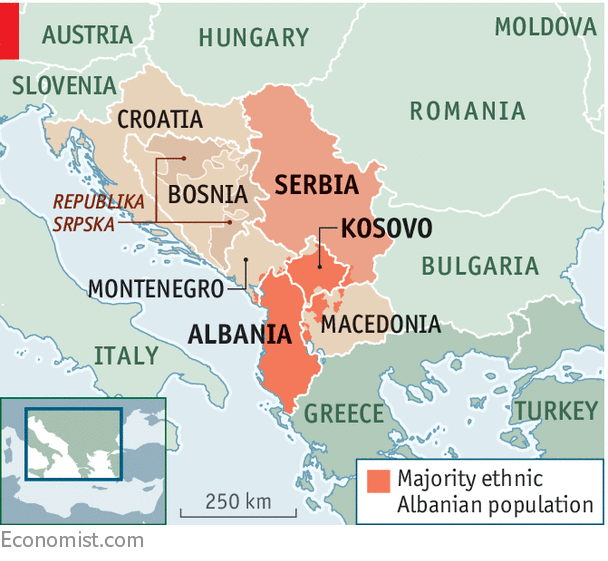
TEN years ago Kosovo declared independence from Serbia. Its Albanians, who make up the majority of the population, have been celebrating. But its Serbs, most of whom live in enclaves, have not. Serbia does not recognise Kosovo, which used to be its southern province, and Kosovo Serbs still consider themselves citizens of Serbia. The situation is typical of the Balkans, where borders are, frankly, a mess. So there are Serbs living in Kosovo and in Bosnia-Hercegovina, where they have their own republic (the Republika Srpska), Albanians and Bosniaks (Muslims) living in Serbia, and Greeks living in Albania. Recently the Serbian authorities proposed a discussion about an exchange of territory with their Kosovo Albanian counterparts. Is this a sensible idea?

In 1923 Greece and Turkey agreed to exchange some 2m people. Mostly Greek-speaking Christian Orthodox citizens of Turkey were sent to Greece, and Muslims from Greece were sent to Turkey. It was a brutal relocation, but, note its defenders, Greece and Turkey have not fought a war since. The only place where Greeks and Turks have fought is Cyprus, where their populations remained mixed. This has inspired nationalists in the western Balkans. Between 1918 and the late 1950s, many Muslims were encouraged to leave Yugoslavia for Turkey. But at the time of Yugoslavia's collapse in the 1990s it still contained a thorough mix of peoples. Leaders in those Yugoslav wars saw ethnic cleansing as the best way to create new nation-states unpeopled by troublesome minorities. By 1995 historically Serb-populated regions of Croatia were empty and hundreds of thousands of Serbs, Croats and Bosniaks had similarly been turfed out of their homes in Bosnia. But the countries that emerged from the implosion did not neatly encircle Serbs, Albanians, Croats and so on. Myriad Serbs may have fled Kosovo after its war, but some 120,000 remain. 

Latest stories


The Serbian authorities want to discuss taking Kosovo's northern part, with Albanian-inhabited regions of Serbia moving to Kosovo in exchange. Proponents of such "map-tidying" say that multi-ethnic states have failed in the Balkans. But they ignore the fact that, once governments start down this path, the process has no obvious end and pays no heed to the human rights of everyone involved. If Kosovo and Serbia begin serious talks about a redrawing of their borders, the impact on Balkan communities apart from those in the affected parts of Kosovo and Serbia could be profound. Bosnian Serb leaders would hold a referendum on the future of the Republika Srpska; Bosnian Croats would follow suit; and Bosniaks would then fight to prevent the dismemberment of their shared country. Over the border Serbia would clamp down on Bosniak nationalists in Sandzak who dream of incorporating that region into a Greater Bosnia. Meanwhile Albanians in western Macedonia and Montenegro would demand to join a Greater Albania. Proponents of that idea would also like to incorporate parts of northern Greece, whereas Greek nationalists would demand part of southern Albania.

One irony behind the mooted exchange is that most Kosovo Serbs actually live in enclaves in the south of Kosovo. So the agreement would not leave them living in Serbia, and they would probably have to leave their homes or else be driven out. But Serbian officials may be less concerned about their countrymen than about taking steps towards recognising Kosovo—and thus making their own hoped-for accession to the European Union (EU) easier. It may not concern them that an exchange of territories in the western Balkans could have huge ramifications. Hungarian nationalists, after all, remain unreconciled to the loss of Transylvania to Romania, and Romanian nationalists would like to redraw their borders to take in Moldova. There is a reason that "Balkanisation" has a bad name. As in the EU at large, lessening the relevance of national borders would seem wiser than redrawing them and, in the words of one senior EU official, "opening the gates to hell".


https://www.economist.com/blogs/economist-explains/2018/02/economist-explains-11

February 08, 2018

Exclusive: Kosovo Intelligence Agency and Police know who killed Oliver Ivanovic

gazetaexpress.com

Exclusive: Kosovo Intelligence Agency and Police know who killed Oliver Ivanovic

GazetaExpress

2 minutes


Killing of the Kosovo Serb leader, Oliver Ivanovic, who was gunned down in front of his SDP Party headquarters in Mitrovica North, is likely to be solved soon. "The KIA and Kosovo Police, possess information on who pulled the trigger and the motives behind this this killing," a reliable source told Gazeta Express. "Maybe they don't have all the information, to order the arrest of the alleged perpetrators, but there is a lead," a source told Express noting however that the KIA and Police are careful not to damage the investigation. "It is very likely that the security institutions have already informed political leaders, in both Kosovo and Serbia related to their findings," the source said.  

Oliver Ivanovic was killed on 16 January in front of his party's headquarters. Only days before he was gunned down with six bullets by unknown perpetrators, Ivanovic told media in Belgrade the he was not feeling safe. Strained relations of Ivanovic with the Government in Belgrade, and Serbian president Aleksandar Vucic, were tense. The Government during general and local elections in Kosovo held in 2017 have openly supported the Srpska List, hampering other political parties gathering Serbs in Kosovo. Media in Serbia have reported that only days before Ivanovic's killing he sent an SMS to President Vucic, but he received no answer on his concerns. Media continue speculations on alleged perpetrators of Ivanovic's killing.  


February 03, 2018

Weinbaum: Jasenovac exhibition worst I’ve ever seen

inserbia.info

Weinbaum: Jasenovac exhibition worst I've ever seen

InSerbia with agencies

3-4 minutes


"The setting in Jasenovac is one of the worst exhibitions I've ever seen. This is a true example of blurring the history of the Holocaust and Croatia is not the only country to do it," said Dr. Laurence Weinbaum, President of the World Jewish Congress, after visiting the memorial site of the infamous Ustasha Jasenovac camp. He was shocked that the way of showing the people the Ustasha tortured and killed in one of the most horrible concentration camps in Europe during the Second World War was shown in this way.

According to him, the setting was also technically badly set up and wrongly conceived, and he added that he had to kneel to see some parts of the collection.

Dr. Weinbaum is a long-time diplomat, he dealt with the suffering of the Jews, taught about the history of the Holocaust, and is one of the best connoisseurs of the events in the camps opened by the Nazis and their sympathizers, such as the quisling regime of the infamous Ante Pavelic. Weinbaum is also the chief director of the Israeli Foreign Relations Council, and after a review of the exhibition he made a series of criticism. During his visit, otherwise, there were no Croatian officials accompanying him.

"Society in Croatia today is not healthy, and unconvincingly sound claims that today's Croatia is not a follower of NDH. The celebration of the criminals is entering into Croatian society," stated Weinbaum, claiming that Jasenovac exhibition does not speak about what was happening there. The Croatian authorities should support the establishment of a mixed committee, including scientists from the world and Croatia, in order to provide answers to Holocaust issues in Croatia. According to him, the problem is in historians, because it comes "from the top". It is not about ignorance, but about negation and blurring, and a mature society is needed that will not shift responsibility on others and accuse them, but will take responsibility.

Dr. Weinbaum is also very sharp when it comes to the number of victims of Jasenovac, especially regarding the official list with which Croatian politicians most often go public. He claims that in Croatia during the Ustasha regime 30,000 Jews were killed and that this was a real reality:

"Many crazy people say that it was not like that. The health of many societies, including Croatian, depends on the relationship with the Holocaust. I hope that Croatia will have the strength to face the crimes of the NDH and will oppose those who glorify it."

Academician Vasilije Krestic says that Dr. Weinbaum's reaction is not surprising, since Croats have been trying for years to cover and diminish the crimes against the Serbs and Jews.

"Officials want things to look the way the Ustashas presented them, that they were labor camps, not death camps," comments Krestic.

"They are very persistent in denying their own crimes and this is only a proof that they do not want to face the truth. Their policies correspond to Josip Broz's policy, when everything was buried and silenced, and the number of those killed reduced and covered."

He adds that the exhibition about Jasenovac in the United Nations building has the real truth come to the fore and the whole world can see it these days.


January 30, 2018

Kosovo for “Europe”: Washington’s “Balkans Policy” and the Future of Serbia

globalresearch.ca

Kosovo for "Europe": Washington's "Balkans Policy" and the Future of Serbia | Global Research

By Dr. Vladislav B. Sotirović

19-24 minutes


The assassination of Kosovo's Serb leader Oliver Ivanović on January 16th, 2018 in the northern (the Serb) part of the divided city of Kosovska Mitrovica once again put on the agenda both the issue of contested land of Kosovo and Serbia's policy toward the West, in particular, the EU.

The Western (the USA/EU) client Serbia's government is quite long time under the direct pressure from Brussels to recognize an independence of the narco-mafia Kosovo's quasi-state in exchange for joining  the EU but not before 2025.

It is only a question of time that a Western colony of Serbia has to finally declare its position towards Kosovo's independence. All pro-Western bots and trolls in Serbia, already publicly announced their official position in regard to this question: Serbia's Government has to finally inform the Serbian nation that Kosovo is no longer an integral part of Serbia and therefore the recognition of Kosovo's independence by Belgrade is only way towards a "prosperous" Euro future of the country that is within the EU (and the NATO's pact as well). The fundamental Western quisling in Belgrade – president of Serbia Aleksandar Vučić (of the Bosnian origin from a Nazi-Croat district of Bugojno) recently clearly informed the nation not to be surprised if Serbia has to recognize the independence of Kosovo in order to join "Europe" (why Switzerland, Andorra, Lichtenstein, Monaco, Norway or Iceland are not in "Europe" he did not explain).

In the following paragraphs, the most important features of the "Kosovo Question" are going to be presented for the better understanding of the present political situation in which the Serb nation is questioned by the Western "democracies" upon both its own national identity and national pride.

Prelude

The southeastern province of the Republic of Serbia – under the administrative title of Kosovo-Metochia (in the English only Kosovo), was at the very end of the 20th century in the center of international relations and global politics due to the NATO's 78 days of "humanitarian" military intervention against the Federal Republic of Yugoslavia (the FRY composed by Serbia and Montenegro) in 1999 (March 24th–June 10th). As it was not approved and verified by the General Assembly or the Security Council of the United Nations, the US-led operation "Merciful Angel" opened among the academicians a fundamental question of the purpose and nature of the "humanitarian" interventions in the world like it was previously in Bosnia-Herzegovina in 1995, Rwanda in 1994 or Somalia in 1991−1995. More precisely, it provoked dilemmas of the misusing ethical, legal and political aspects of armed "humanitarian" interventions as the "responsibility to protect" (R2P) for the very reason that it became finally obvious in 2008 that the NATO's "humanitarian" military intervention in 1999 was primarily aimed to lay the foundation for Kosovo's independence and its separation from Serbia with transformation of the province into the US−EU's political-economic colony, what Kosovo, in fact, today is [see more in Hannes Hofbauer, Eksperiment Kosovo: Povratak kolonijalizma, Beograd: Albatros Plus, 2009].

Kosovo as contested land between the Serbs and the Albanians

The province of Kosovo-Metochia (Kosova in the Albanian) is a landlocked territory in Central Balkans having borders with Albania, the Former Yugoslav Republic of Macedonia (the FYROM), Central Serbia and Montenegro. It is almost of the same size as Montenegro but having more than four times Montenegro's population [Sabrina P. Ramet (ed.), Central and Southeast European Politics since 1989, New York: Cambridge University Press, 2010, 359]. The province, as historically contested land between the Serbs and the Albanians, did not, does not and will not have an equal significance for these two nations. For the Albanians, Kosovo was all the time just a provincial land populated by them without any cultural or historical importance except for the single historical event that the first Albanian nationalistic political league was proclaimed in the town of Prizren in Metochia (West Kosovo) in 1878 and existed only till 1881. However, both Kosovo as a province and the town of Prizren were chosen to host the First (pan-Albanian) Prizren League only for the very propaganda reason – to emphasize allegedly predominantly the "Albanian" character of both Kosovo and Prizren regardless to the very fact that at that time the Serbs were a majority of population either in Kosovo or in Prizren. Kosovo was never part of Albania and the Albanians from Albania had no important cultural, political or economic links with Kosovo's Albanians regardless the fact that the overwhelming majority of Kosovo's Albanians originally came from North Albania after the First Great Serbian Migration from Kosovo in 1690.

However, quite contrary to the Albanian case, Kosovo-Metochia is the focal point of the Serbian nationhood, statehood, traditions, customs, history, culture, church and above all of the ethnonational identity. It was exactly Kosovo-Metochia to be the central administrative-cultural part of medieval Serbia with the capital in Prizren. The administrative centre of the Serbian Orthodox Church in the medieval and later on the Ottoman-time was also in Kosovo-Metochia in the town of Peć (Ipek in the Turkish; Pejë in the Albanian). Before Muslim Kosovo's Albanians started to demolish the Serbian Christian Orthodox churches and monasteries from June 1999 onward, there were around 1.500 Serbian Christian shrines in this province. Kosovo-Metochia is even today called by the Serbs as the "Serbian Holy Land" while the town of Prizren is known for the Serbs as the "Serbian Jerusalem" and the "Imperial Town" (Tsarigrad) in which there was an imperial court of the Emperor Stefan Dušan of Serbia (1346−1355) [see more in Миладин Стевановић, Душаново царство, Београд: Књига-комерц, 2001]. The Serbs, differently to the Albanians, have a plenty of national folk songs and legends about Kosovo-Metochia, especially in regard to the Kosovo Battle of 1389 in which they lost state independence to the Ottoman Turks. For the Serbs, Kosovo-Metochia is the "cradle of the Serbs" and real "Serbia proper" while for the Albanians, Kosovo is just a peripheral province of their nationhood and culture.


Prizren – A Serbian Orthodox Church (built in 1306) of Holy Virgin of Ljevish. However, the Albanian propaganda is presenting this church as all other (Serbian) Christian Orthodox churches in Kosovo-Metochia either as the Byzantine or even as the Albanian. In March 2004 the church was set on fire and seriously damaged by local (Muslim) Albanians. The church is proclaimed as the UNESCO World Heritage Site in 2006 (Source: author)

Nevertheless, there is nothing similar in the Albanian case in regards to Kosovo. For instance, there is no single Albanian church or monastery in this province from the medieval time or any important monument as the witness of the Albanian ethnic presence in the province before the time of the administration by the Ottoman Sultanate. Even the Muslim mosques from the Ottoman time (1455−1912) claimed by the Albanians to belong to the Albanian national heritage, were, in fact, built by the Ottoman authorities but not by ethnic Albanians. The Albanian national folk songs are not mentioning the medieval Kosovo that is one of the crucial evidence that they simply have nothing in common with the pre-Ottoman Kosovo. All Kosovo's place-names (toponyms) are of the Slavic (the Serb) origin but not of the Albanian. The Albanians during the last 50 years are just renaming or adapting the original place-names according to their vocabulary what is making a wrong impression that the province is authentically the Albanian. We have not right to forget the very fact that the word Kosovo is of the Slavic (the Serb) origin meaning a kind of eagle (kos) while the same word means simply nothing in the Albanian language. Finally, in the Serbian tradition, Kosovo-Metochia was always a part of the "Old Serbia" while in the Albanian tradition Kosovo was never called as any kind of Albania.

The province became contested land between the Serbs and the Albanians when the later started to migrate from North Albania to Kosovo-Metochia after 1690 with getting a privileged status as the Muslims by the Ottoman authorities. A Muslim Albanian terror against the Christian Serbs at the Ottoman time resulted in the Albanisation of the province to such extent that the ethnic structure of Kosovo-Metochia became drastically changed in the 20th century. A very high Muslim Albanian birthrate played an important role in the process of Kosovo's Albanisation too. Therefore, after the WWII the ethnic breakdown of the Albanians in the province was around 67 percent. The new and primarily anti-Serb communist authorities of socialist Yugoslavia legally forbade to some 100.000 WWII Serb refugees from Kosovo-Metochia to return to their homes back after the collapse of the Greater Albania in 1945 of which Kosovo was an integral part. A Croat-Slovenian communist dictator of Yugoslavia, Josip Broz Tito (1892−1980), granted to the province of Kosovo-Metochia a considerable political autonomous status in 1974 with a separate government, Provincial Assembly, president, Academy of Sciences, security forces, independent University of Prishtina and even military defense system for the fundamental political reason to prepare Kosovo's independence after the death of his Titoslavia. Therefore, Kosovo-Metochia in socialist Yugoslavia was just formally part of Serbia as the province was from a political-administrative point of view an independent as all Yugoslav republics.

A fully Albanian-governed Kosovo from 1974 to 1989 resulted in both destruction of the Christian (the Serb) cultural monuments and continuation of mass expulsion of the ethnic Serbs and Montenegrins from the province to such extent that according to some estimations there were around 200.000 Serbs and Montenegrins expelled from the province after the WWII up to the abolition of political autonomy of the province (in fact, independence) by Serbia's authority in 1989 with the legal and legitimate verification by the provincial assembly of Kosovo-Metochia and the reintegration of Kosovo-Metochia into Serbia. At the same time, there were around 300.000 Albanians who illegally came to live in Kosovo-Metochia from Albania after 1945. Consequently, according to the official census, in 1991 there was only 10 percent of the Serbs and Montenegrins in Kosovo-Metochia, 87 percent of the Albanians and 3 percent of others. In one word, during one century of time, the Serbian population of Kosovo-Metochia from 65−70 percent fell down to 10 percent (according to the first Ottoman census in 1455, there was only 2 percent of the Albanians in Kosovo-Metochia) [see more in Р. Самарџић et al, Косово и Метохија у српској историји, Београд: Друштво за чување споменика и неговање традиција ослободилачких ратова Србије до 1918. године у Београду−Српска књижевна задруга, 1989; Д. Т. Батаковић, Косово и Метохија: Историја и идеологија, Београд: Чигоја штампа, 2007].

Fighting Kosovo's Albanian political terrorism and territorial secession

The revocation of Kosovo's political autonomy in 1989 by Serbia's central government in Belgrade was aimed primarily to stop further ethnic Albanian terror against the Serbs and Montenegrins and to prevent secession of the province from Serbia with the final aim to restore the WWII Greater Albania and legalize the Albanian ethnic cleansing of all non-Albanian population what practically happened in Kosovo after mid-June 1999 when the NATO's troops occupied the province and brought to the power a classical terrorist political-military organization – Kosovo's Liberation Army (the KLA). Nevertheless, the Western mainstream media, as well as academia, presented Serbia's fighting Kosovo's Albanian political terrorism and territorial secession after 1989 as Belgrade policy of discrimination against the Albanian population which became deprived of political and economic rights and opportunities [typical examples of such approach are, for instance, propaganda and shameful books based on the falsification of historical facts and a partisan interpretation of political events Noel Malcolm, Kosovo: A Short History, New York: HarperPerennial, 1999; and Sabrina P. Ramet (ed.), Central and Southeast European Politics since 1989, New York: Cambridge University Press, 2010]. The fact was that such "discrimination" was primarily a result of the Albanian policy of boycotting Serbia's state institutions and even job opportunities offered to them in order to present their living conditions in Kosovo as the governmental-sponsored minority rights oppression.


The Serbian Orthodox Church Samodrezha (second half of the 14th century) demolished by the (Muslim) Albanian mob in March 2004 (Source: author)

In the Western mainstream mass media and even in academic writings, Dr Ibrahim Rugova, a political leader of Kosovo's Albanians in the 1990s, was described as a person who led a non-violent resistance movement against alleged Milošević's policy of ethnic discrimination of Kosovo's Albanians. I. Rugova was even called as a "Balkans Gandhi". In the 1990s there were established in Kosovo-Metochia the Albanian parallel and illegal social, educational and political structures and institutions as a state within the state. The Albanians under the leadership of Rugova even three times proclaimed the independence of Kosovo. However, these proclamations of independence were at that time totally ignored by the West and the rest of the world. Therefore, Rugova-led Kosovo's Albanian national-political movement failed to promote and advance Kosovo's Albanian struggle for secession from Serbia and independence of the province with the final political task to incorporate it into a Greater Albania. I. Rugova himself, coming from the Muslim Albanian Kosovo's clan that originally migrated to Kosovo from Albania, was active in political writings on the "Kosovo Question" as a way to present the Albanian viewpoint on the problem to the Western audience and, therefore, as a former French student, he published his crucial political writing in the French language in 1994.

One of the crucial questions in regard to the Kosovo problem in the 1990s is why the Western "democracies" did not recognize self-proclaimed Kosovo's independence? The fact was that the "Kosovo Question" was absolutely ignored by the US-designed Dayton Accords of 1995 which were dealing only with the independence of Bosnia-Herzegovina. A part of the answer is probably laying in the fact that Rugova-led Albanian secession movement was, in essence, illegal and even terrorist. It is known that Rugova himself was a sponsor of a terrorist party's militia which was responsible for violent actions against Serbia's authorities and non-Albanian ethnic groups in Kosovo. For instance, in July 1988, from the graves of the village of Grace's graveyard (between Priština and Vučitrn) were excavated and taken to pieces the bodies of two Serbian babies of the Petrović's family. Nevertheless, as a response to Rugova's unsuccessful independence policy, it was established the notorious KLA which by 1997 openly advocated a full-scale of terror against everything that was the Serbian in Kosovo.

The KLA had two main open political aims:

  • To get an independence for Kosovo from Serbia with a possibility to include the province into a Greater Albania.
  • To ethnically clean the province from all non-Albanians especially from the Serbs and Montenegrins.

However, the hidden task of the KLA was to wage an Islamic Holy War (the Jihad) against the Christianity in Kosovo by committing the Islamic terror similarly to the case of the present-day Islamic State (the ISIS/ISIL) in the Middle East. Surely, the KLA was and is a part of the policy of radicalization of the Islam at the Balkans after 1991 following the pattern of the governmental (Islamic) Party of Democratic Action (Stranka demokratske akcije – the SDA) in Bosnia-Herzegovina presided by Alija Izetbegović who was a member of Islamic SS Handžar Division in the WWII and the author of a radical Islamic Declaration in 1970.

That the KLA was established as a terrorist organization is even confirmed by the Western scholars and the US administration too. About the focal point of Kosovo's War in 1998−1999 we can read in the following sentence:

"Aware that it lacked popular support, and was weak compared to the Serbian authorities, the KLA deliberately provoked Serbian police and Interior Ministry attacks on Albanian civilians, with the aim of garnering international support, specifically military intervention" [T. B. Seybolt, Humanitarian Military Intervention: The Conditions for Success and Failure, Oxford−New York: Oxford University Press, 2007, 79].

Epilogue

It was true that the KLA realized very well that the more Albanian civilians were killed as a matter of the KLA's "hit-and-run" guerrilla warfare strategy, the Western (the NATO's) military intervention against the FRY was becoming a reality. In other words, the KLA with his commander-in-chief Hashim Thaci (today president of Kosovo and still on the Interpol list of the wanted criminals) were quite aware that any armed action against Serbia's authorities and the Serbian civilians would bring retaliation against the Kosovo Albanian civilians as the KLA was using them in fact as a "human shield". That was, in fact, the price which the ethnic Albanians in Kosovo had to pay for their "independence" under the KLA's governance after the war. That was the same strategy used by Croatia's government and Bosnian-Herzegovinian Muslim authorities in the process of divorce from Yugoslavia in the 1990s [see more in Jelena Guskova, Istorija jugoslovenske krize 1990−2000, 1−2, Beograd: ИГАМ, 2003].

However, as the violence in Kosovo escalated in 1998 the EU's authorities and the US's government began to support diplomatically the Albanian course – a policy which brought Serbia's government and the leadership of the KLA to the ceasefire and withdrawal of certain Serbian police detachments and the Yugoslav military troops from Kosovo followed by the deployment of the "international" (the Western) monitors (the Kosovo Verification Mission, the KVM) under the formal authority of the OSCE. However, it was, in fact, informal deployment of the NATO's troops in Kosovo. The KVM was authorized by the UN's Security Council Resolution 1199 on September 23rd, 1998. That was the beginning of a real territorial-administrative secession of Kosovo-Metochia from Serbia sponsored by the West for the only and very reason that Serbia did not want to join the NATO and to sell her economic infrastructure to the Western companies according to the "transition" pattern of the Central and South-East European countries after the Cold War. The punishment came in the face of the Western-sponsored KLA.

Today, the Western gangsters of NATO, the EU and the USA need from Serbia only a formal verification of the results of their dirty policy in Kosovo-Metochia – an official recognition of the "independence" of the Republic of Kosovo. Nevertheless, behind Kosovo's secession from Serbia are both economic and geopolitical goals of primarily American Balkans policy. Firstly, the Americans build up in Kosovo one of their biggest military camps all over the world – Bondsteel. Secondly, the greatest part of Kosovo's natural resources and economic infrastructure are under direct control and exploitation by the US companies including and a private company of General Wesley Clark – the NATO's chief commander who bombed Serbia and Montenegro in 1999. Finally, why the West occupied Kosovo-Metochia in June 1999 and put it under direct their control one can understood from the very fact that this province has 45 percent of the lignite reserves in Europe [Sabrina P. Ramet (ed.), Central and Southeast European Politics since 1989, New York: Cambridge University Press, 2010, 359].

*

Dr. Vladislav B. Satirovic is Founder & Director of the Private Research Centre "The Global Politics" (www.global-politics.eu), Ovsishte, Serbia. Personal web platform: www.global-politics.eu/sotirovic. Contact: sotirovic@global-politics.eu.