April 24, 2018

Fake Democracy: The CIA and their NGOs Target China and Yugoslavia in the 1990s

Fake Democracy:The CIA and their NGOs Target China and Yugoslavia in the 1990s


Published time: 19 April, 2018

Failed CIA attempt to bring down the Communist state apparatus in China; George H.W. Bush's involvements in China; US influences Chinese economic policy; 1989 student pro-democracy protests in Tiananmen Square; Albert Einstein Institute; Gene Sharp's From Dictatorship to Democracy: A Conceptual Framework for Liberation; non-violence as a weapon of warfare; Soros' Fund for the Reform and Opening of China; Western media report Tiananmen massacres; fake news about a fake massacre; Operation Yellowbird; US considers independent Europe a threat; US strategy for war in the heart of Europe; controlled oil crises create unsustainable Yugoslav IMF debt; 1991 US Foreign Operations Appropriations Act; US funding of fascist organizations; Milosevic tries to prevent break-up of Yugoslavia; Izetbegovic reneges on Lisbon Treaty; Mujahideen terror-war model brought into minority Muslim Bosnia-Herzegovina; Yugoslavia civil war revives the role of NATO in Europe; Nasr Oric; Srebrenica massacre; Operation Deliberate Force against Serbia; Clinton's 79-day bombing of Belgrade; Milosevic taken down by Otpor!; Camp Bondsteel in Kosovo ... To read / listen further, click here


April 14, 2018

Limited US action against Syria suggests conflict unlikely to escalate

theguardian.com

Limited US action against Syria suggests conflict unlikely to escalate | World news

Ewen MacAskill

7-9 minutes


The US-led operation against Syria, which included contributions from the UK and France, was a modest one, limited to a short, sharp attack against targets alleged to be linked to chemical weapons.

It is intended as a one-off, with no further strikes planned unless the Syrian president, Bashar al-Assad, conducts chemical attacks in the future.

There had been speculation in advance of the attack that there was a risk it could lead to world war three. It was far from that.

The operation involved more weapons than the strike the US conducted unilaterally against a Syrian airbase last year. On that occasion, 20 Syrian planes were destroyed, estimated at 20% of the Syrian air force. The US fired 59 Tomahawk cruise missiles in that attack: no planes were used, to minimise the risk of American losses.

What you need to know about the Syria strikes – video report

The attack in the early hours of Saturday morning involved almost twice as many, 110 missiles. That is not a major escalation. There were only three targets, including a research and scientific institute on the outskirts of Damascus and a storage space west of Homs, alleged to have been used to store precursors, which was hit by the RAF.

The main overall aim, apart from sending a message to Assad to desist from chemical weapons attacks, was to keep as far away as possible from Russian and Iranian positions, to avoid widening the conflict by directly drawing in Russia or Iran.

In spite of Russian rhetoric during the week of potential retaliation in the event of the attack, in reality Russia is far short of the military strength it enjoyed as part of the Soviet Union, with Moscow as anxious as Washington to avoid conflict. In almost every area other than nuclear weapons, Russia is heavily outnumbered in terms of defence spending and equipment compared with the US.

The US spends about $550bn annually on defence compared with Russia's $70bn. To take just one indicator, Russia has one ageing aircraft carrier while the US has 20.

To help avoid conflict, the US warned the Russians in advance that the attack was coming and the air corridors that would be used, but not the targets.

'A strong deterrent': Trump announces strikes on Syria – video

The US aim in Syria, as Donald Trump indicated before the Douma attack, is to leave Syria as soon as the US judges Islamic State to have been totally defeated. The attack does not change that. It was not used to attempt regime change. Assad's presidential palace, exposed on a high hill above Damascus, was left off the target list.

Assad could well be relatively happy with the outcome and the impact on him may be even less than the US raid last year. Most of his air force, as well as helicopters allegedly used to deliver the chemical weapons, remains intact.

The US, British and French escaped unscathed. There was a risk from the relatively sophisticated air defence system that Russia has or even from the more antiquated Syrian ones. An Israeli plane crashed in February, which the Syrians claimed they had downed. The RAF had four Tornados in action, but at no point did they enter Syrian air space, instead flying close to the the RAF Akrotiri base in Cyprus, and firing the Storm Shadow missiles, which have a range of about 300 miles.

Another potential risk that failed to materialise was that an attack on chemical weapons might spread the poison, engulfing Syrian military personnel and civilians. Chemical weapons inspectors suggested such an outcome was unlikely, as a missile would blow up chemical weapons.

The other risk was for a miscalculation that led to high civilian casualties. Although the US and UK military insist missiles are more precise and intelligence better, mistakes happen. In the 1991 Iraq war, the al-Amiriyah bomb shelter in Baghdad was hit killing more than 400 civilians, and there was the bombing of the Chinese embassy in Belgrade in 1999.

Amateur footage shows missiles falling over Damascus as airstrikes begin – video

To try to avoid Russian or Iranian or civilian casualties, the US, British and French planners opted for targets they believed were far enough away to avoid such an outcome.

Trump contributed to the hysteria that the world was on the verge of WWIII with his tweet: "Russia vows to shoot down any and all missiles fired at Syria. Get ready Russia, because they will be coming, nice and new and "smart!"

In spite of rhetoric on the Russian side to match Trump's hysteria, claiming they would shoot down incoming missiles and retaliate against US and other targets, they settled only for monitoring the incoming missiles and did not attempt to shoot them down.

Moscow could respond, as it has threatened, by upgrading Syria's air defence systems, which could worry Israel. And they could yet retaliate in some other region or by using deniable hybrid warfare, such as a cyber-attack. But equally, looking to showcase the upcoming World Cup, they might opt for a period of calm.

The UN secretary general, António Guterres, had warned just hours before the raid that the cold war was back with a vengeance, potentially more dangerous because the old mechanisms for managing conflict seemed to have disappeared.

But, as the night demonstrated, the mechanisms are still in place, still intact and worked as they were meant to. The US was in communication with the Russians. And the Russians did not retaliate.

In the end, this raid was about as modest a one as the US-led coalition could mount, more symbolic than anything else.


In Third World War Now Going On, ‘Russia has No Allies,’

windowoneurasia2.blogspot.ca

Window on Eurasia -- New Series: In Third World War Now Going On, 'Russia has No Allies,' Venediktov Says

3 minutes


Paul Goble

            Staunton, April 14 – A third world war has been going on since at least NATO's bombing of Belgrade in 1999 and Russia's intervention in Georgia in 2008, Aleksey Venediktov says. But it is a very different war than those in the past, one where the participants are not trying to seize territory but rather secure influence over other states.

            In this conflict, which may go from cold to hot, the editor of  Ekho Moskvy tells Kazan's Business Gazeta in an interview portions of which were posted online today, "Russia has no allies" and thus can depend on no one but itself as events both planned and unplanned unfold (business-gazeta.ru/article/378902).

            This war or more hopefully conflict "really is a world wide one; it is simply that certain players like China are not very visible, but they are taking an active part in it."  The goal in this conflict is different than that in the past: earlier states sought to gain territory; now, however, they are seeking not the territorial re-division of the world but rather one of influence.

            Putin, Venediktov continues, constantly refers to the need to return to the Yalta-Potsdam system in which "every great power has its own sphere of influence."  But Ronald Reagan in 1987 made clear that there would never be a Yalta-type system again. That has remained US policy.

            But the important thing for Moscow to remember is that "in this war, Russia does not have any allies," the Ekho Moskvy editor says.  "Putin," he continues, "is an extraordinarily careful individual … Therefore, I think, if he were to sense the chance of a shift of the war into a hot phase, he would take measures," knowing the capacities of the Western allies and China.

            The danger of escalation even to a nuclear exchange nonetheless exists because of the possibilities of accidents. When the militaries of various countries are in one place, their commanders may respond "without waiting for a call from Moscow or Washington or Jerusalem or Damascus" and then things can go wrong.

            According to Venediktov, the forces of both Russia and the Western allies "have received orders to avoid any clash. But I am concerned because an accident is possible," one that was like the downing of a Russian plane by Turkey. If something like that happened again, then there is "a high degree of probability" that it could "lead to an escalation, political at a minimum."


April 10, 2018

In a New Cold War With Russia, Balkans Become a Testing Ground

nytimes.com

In a New Cold War With Russia, Balkans Become a Testing Ground

Steven Erlanger

11-14 minutes


A view of Sarajevo, the capital of Bosnia and Herzegovina. After years of neglect, the European Union is again turning its attention again to the Western Balkans. Andrew Testa for The New York Times

SARAJEVO, Bosnia and Herzegovina — Cradle of the First World War, the Balkans have been a flash point, a place where empires, ethnicities and religions abut and contest. Now, analysts warn, the region is becoming a battleground in what feels like a new Cold War.

Russia, they say, is expanding its influence and magnifying ethnic tensions in countries that hope to join the European Union. Its involvement has already spurred Brussels to revive dormant aims for enlargement. It is also prompting fresh attention from Washington about security risks to NATO members.

After the concerted Western response to the poisoning in Britain of a former Russian spy and his daughter, expelling around 150 Russian diplomats and intelligence officers, "the Balkans become even more important," said Mark Galeotti, a senior researcher at the Institute of International Relations in Prague.

"Russia is looking for ways to retaliate that are asymmetric and provide Moscow opportunities," he said.

In a new paper for the European Council on Foreign Relations, Mr. Galeotti says that "Russia looks to the Balkans as a battlefield in its 'political war,' " seeking "to create distractions and potential bargaining chips with the European Union."

Charles A. Kupchan, who was Europe director of the National Security Council under President Barack Obama, said that "the Russians are taking advantage of the last part of Western Europe that remains politically dysfunctional."

The situation bears distant echoes of Ukraine, where Russia originally agreed that Kiev could join the European Union — though not NATO — and then changed its mind, leading to the revolution that prompted Moscow to annex Crimea and foment secession in eastern Ukraine.

In the Balkans, the competition with Russia has the potential to sow fresh instability in a region still emerging from the vicious war of 1992-95 that broke apart the former Yugoslavia.

In Sarajevo, many of the scars of the war have been erased. The former Holiday Inn, once a nearly windowless shelter for reporters near Snipers' Alley during the Bosnia war, is restored and busy. The neo-Moorish City Hall, a monument to multiculturalism that was shelled and burned, has been burnished to a high standard.

Yet Bosnia and Herzegovina, the broken country patched together in 1995 at the end of the war, remains a fragile construct, riven by corruption, weak leadership, and ethnic and nationalist strains among communities — a metaphor for the Balkans.


Greeks demonstrating in Athens in February over neighboring Macedonia's use of that name. Valerie Gache/Agence France-Presse — Getty Images

It is one of several key entry points that Russia is seeking to exploit, Mr. Kupchan said, as the leader of the Serb semiautonomous region known as Republika Srpska, Milorad Dodik, continues to press for an independence referendum. The others include Macedonia, where relations between ethnic Albanians and ethnic Slavs remain tense, and between Kosovo and Serbia.

Wary of Russian meddling, the European Union is holding out a renewed prospect of membership to Bosnia and to the other five nations of the Western Balkans — Serbia, Montenegro, Macedonia, Albania and Kosovo — in return for fundamental structural reform.

The skepticism among these countries about Brussels is deep, however. Many doubt the sincerity of a European Union that is turning more inward, more populist, more wary about migration and more cautious, after Romania and Bulgaria, about taking in nations before they are ready for membership.

No one believes any of these countries is yet ready to join. But the urgency for reform fell away as the goal receded.

Four years ago, the head of the European Commission, Jean-Claude Juncker, said there would be no more quick enlargement of the bloc, sending the process into somnolence.

It has been, as the Macedonian foreign minister, Nikola Dimitrov, often says, like "being locked in a waiting room with no exit."

"Juncker made a mistake to say that he was not interested in enlargement," said Carl Bildt, a former Swedish foreign minister and United Nations special envoy to the Balkans. "The E.U. took its eye off the ball for several years, with detrimental effects."

But with Britain leaving the bloc and Russia playing on the fissures of the region, the European Union has now laid out a relatively detailed plan for the Balkans.

It has even gone on record to say that if all goes well, Serbia and Montenegro, the only two countries now engaged in an accession process and hence the front-runners, could join by 2025.

The bloc's strategy for the Western Balkans, published in February, laid out six initiatives: rule of law; security and migration; socio-economic development; transport and energy connectivity; digital agenda; and "reconciliation and good neighborly relations."


In Bosnia, the leader of the Serb autonomous region known as Republika Srpska, Milorad Dodik, continues to press for an independence referendum. Laura Boushnak for The New York Times

Bulgaria, the current president of the bloc, will hold a special Balkans summit meeting in May; the Balkans are on the agenda for the European Council in June; and the British will be hosts of a Western Balkans summit meeting in July, just before NATO has its own meeting in Brussels.

"It is time to finish the work of 1989," said Johannes Hahn, the European Union commissioner in charge of enlargement. "We have set 2025 as an indicative date for Serbia and Montenegro, which is realistic but also very ambitious."

Mr. Bildt said tartly: "Whether this is realistic or not remains to be seen."

Many think it is too ambitious, given that the bloc insists that all these countries settle their numerous, passionate border disputes. There are also serious internal problems, the bloc's report acknowledged.

"Today the countries show clear elements of state capture, including links with organized crime and corruption at all levels of government and administration, as well as a strong entanglement of public and private interests," it said.

There is strong evidence of "extensive political interference in and control of the media" and lack of independence in the judiciary, it noted.

Add to that uncompetitive economies and the flight of young people looking for better jobs, and prospects seem dim.

But now the Americans are suddenly more interested, too. Renewed Washington concern "stems in part from concerns about expanded Russian influence," said A. Ross Johnson, noting that Congress now demands that the Defense Department provide "an assessment of security cooperation between each Western Balkan country and the Russian Federation."

Russia has made it clear that it considers new NATO expansion to the Western Balkans as unacceptable, and Moscow was implicated in a strange coup attempt in Montenegro in 2016 before that country joined NATO.

Russia is trying to establish itself in the region, both with government and business, so that when these countries do finally enter the European Union, "they will bring Russian influence with them," Mr. Galeotti said.

The strategy is similar to what China and Russia are doing with Greece and Cyprus, widely considered places where Russian money can be laundered into euros.


The river Ibar divides the Albanian and Serbian areas in Mitrovica, Kosovo. Andrew Testa for The New York Times

Russia is also deeply engaged in local language media, both with Kremlin-owned websites like Sputnik and with bots that harp on local grievances.

Mr. Bildt points in particular to Russian investment in critical Serbian infrastructure, like energy. Though Russian investment pales compared with that of the European Union countries, Serbia has a natural affinity to its Russian Orthodox brethren and remembers Russian support during the Kosovo war.

"Is the E.U. sensitive enough to what is happening in Serbia?" Mr. Galeotti asked.

He thinks not. "E.U. policy has generally been to support whatever keeps the Western Balkans quiet," Mr. Galeotti said. "It's deeply dangerous and creates the perfect environment for Moscow to play its games."

Brussels, he and others say, should put more weight behind both the carrots and the sticks — offering genuine incentives for institutional reform and accession, and genuine sanctions if not.

A former senior United States official called the region a new Cold War battlefield, and said that Brussels was too rigid with the ways it tries to keep people on the good behavior track, while the money is not as connected as it should be to reform goals.

The official, who asked for anonymity to preserve influence in the region, said that the countries reformed only when Brussels and Washington worked together to push leaders hard to break old habits of corruption, state capture, a politicized judiciary and Russian shell companies trying to take over key infrastructure and media.

But Europe is not eager to import more problems. "The argument is that only by taking in the Balkan states are we assured to strengthen stability," said Norbert Rӧttgen, the chairman of the German Bundestag's foreign affairs committee. "But is that true?"

"If we import fragile states into the E.U., we import fragility," he added. "If we compromise on conditions, we let in fragile countries open to foreign influences, so we have to be tough on the entry requirements."

The irony of history, Mr. Bildt mused, is that had Yugoslavia remained together, it almost surely would have been in the European Union by now, having been well ahead in 1990 of current members Romania and Bulgaria.

"If the wars of dissolution hadn't happened, all of this area would have been an E.U. member," he said. "The Balkans have always lived best when integrated into a wider framework, as necessary today as in the past, and the one available today is the European Union."

Mr. Kupchan remains an optimist. "We know where this story will ultimately end, with all the former Yugoslav states integrated into the European Union," he said. "But when?"

https://www.nytimes.com/2018/04/10/world/europe/european-union-balkans.html?rref=collection%2Fsectioncollection%2Feurope&action=click&contentCollection=europe®ion=stream&module=stream_unit&version=latest&contentPlacement=2&pgtype=sectionfront


Envoyé de mon iPad

March 25, 2018

‘We may forgive, but won’t forget’: Serbia’s commemoration of NATO bombing victims ignored by West

rt.com

'We may forgive, but won't forget': Serbia's commemoration of NATO bombing victims ignored by West — RT World News

3-4 minutes


Thousands of Serbs honored the victims of the 1999 NATO bombings with a commemoration on Saturday, attended by Serbian president and many officials, including the Russian envoy, but with a glaring absence of Western diplomats.

The main commemorative event, held under the slogan "We will forgive, if we can, we will not forget while alive," took place in the Southern town of Aleksinac which suffered heavily in the 1999 US-led NATO campaign.

Darkness and silence fell over the entire city center as the ceremony, attended by President Aleksandar Vucic and his cabinet ministers, opened with deafening sounds of air alarm sirens. At least 3,000 people gathered in front of the stage and the ruins of a building destroyed in NATO bombing, according to Sputnik's correspondent.

"What do we say today, we on whom 420,000 missiles and nearly 40,000 cluster bombs and 1,300 cruise missiles have been dropped?" Vuvic asked. He went on to speak of the deaths and destruction caused by NATO, though adding that his country still seeks a partnership with the alliance.

"Yes, we want a partnership with you, you who have perpetrated terrible crimes on us. We want from the enemy to become friends, just do not expect us to forget that you killed us, or to blame our country for it. We want a partnership, but we will not join NATO. It would be rubbing too much salt into our wounds," Vuvic said.

The Russian Ambassador to Serbia, Aleksandr Chepurin, who also attended the poignant ceremony, noted the glaring absence of representatives of Western states.

"Today once again none of the Western diplomats bothered to attend this ceremony. So they show no repentance and, moreover, believe they did everything right. Looks like the Serbs are not humans to them, but they nevertheless continue to teach us humanism," said Chepurin.

Meanwhile in the capital Belgrade, about 500 demonstrators gathered in front of the Serbian Parliament in an anti-NATO protest commemorating the 19th anniversary of the Yugoslavia bombing. Protesters waved flags and lit flares, while others held banners with anti-NATO messages.

NATO justified its intervention without any approval of the UN Security Council, by accusing the Milosevic government of ethnically cleansing the province of Kosovo. The bombings lasted 78 days, from March 24 to June 10, 1999, and officially claimed at least 758 civilian lives – though Serbian sources say the true figure may be up to five times as much.

READ MORE: 19 years after NATO bombed Serbia, most Serbs won't take apology from alliance – poll

According to a recent poll, 19 year later a majority of Serbs would not accept an apology from NATO for its military intervention, and only 10 percent would wish to see their country become a member the trans-Atlantic military bloc.

Think your friends would be interested? Share this story!


March 21, 2018

Has Russia Had Enough?


https://www.paulcraigroberts.org/2018/03/21/has-russia-had-enough/

Has Russia Had Enough?

Has Russia Had Enough?

Paul Craig Roberts

This morning I watched a briefing the Russian Foreign Ministry provided for the diplomatic community where international toxic substances experts presented information concerning the alleged nerve agent used in the alleged attack on Skripal and his daughter. This information has been known for some time, and none of it has been reported in the Western presstitute media.

In the briefing the Russians once again relied on facts and existing agreements that govern the investigation of such events and asked why the British were demanding explanations from Russia when the British refuse to comply with established procedures and refuse to produce any evidence of what the British allege to have occurred.

The response from the US and French embassy representatives was simply to state that they needed no evidence to stand in solidarity with their British friends, that Russia was guilty by accusation alone, and that they would hold Russia accountable.

The benefit of this absurd response, which the Russians declared to be shameful, is to make clear to the Russian government that it is a waste of time to try, yet again, to confront unsupported accusations from the West with facts and appeals to follow the specified legal processes. The West simply does not care. The issue is not the facts of the case. The agenda is to add another layer to the ongoing demonization of Russia.

Sooner or later the Russian government will realize that its dream of "working with its Western partners" is not to be and that the hostile actions and false accusations from the West indicate that the West is set on a course of conflict with Russia and is preparing the insouciant Western peoples to accept the consequences.

The Russian official hosting the briefing compared the Skirpal accusation with the Malaysian Airliner accusation and the many others that resulted in instant accusations against Russia and refusal to cooperate in investigations.

The Russian official also drew the parallel of the accusations against Russia with the US and UK false accusations against Serbia, which led to the bombing of Serbia, and to the false accusations against Iraq, for which Colin Powell and Tony Blair had to apologize, that resulted in the destruction of Iraq and the death and displacement of millions of Iraqis.

The Russian official also said, pointedly, that the days were gone when no one challenged statements by the US government. The world, he said, is no longer unipolar. Russia, he said, does not respond to unsupported allegations. He also said that the way the Americans, British, and French are proceeding suggests that the Skirpal affair is an orchestration created for the purpose of accusing Russia.

This conclusion is supported by the history of US and UK interventions. In recent times we have seen the West's orchestrated interventions based on obvious and blatant lies in Serbia, Iraq, Libya, Somalia, Syria, Ukraine, Yemen, and the attempts to destabilize Iran and Venezuela. History provides almost endless examples of the lies used by the US and UK to implement their agendas.

Nothing Washington and London say can ever be believed. Is it possible for Russia or any country to work with "partners" who are shameless, short on integrity and honesty, and have proven themselves unworthy of trust?


March 19, 2018

Britain’s role in the Balkans – why Boris Johnson is about to turn pro-EU

theconversation.com

Britain's role in the Balkans – why Boris Johnson is about to turn pro-EU

Othon Anastasakis

5-7 minutes


Here's a paradox from Brexit Britain. This summer, at a summit meeting in London organised by the UK's Foreign Office, a hard Brexiteer – the foreign secretary Boris Johnson – will be the designated advocate of EU membership for the Western Balkan states. A country preparing to leave the EU will preach the accession of Bosnia-Herzegovina, Albania, FYR Macedonia, Serbia, Kosovo, and Montenegro to the European Union. A country seeking to "take back control" from the heavy-handedness of Brussels will advise others to relinquish their sovereignty to that same superstate. What's going on here?

The London summit in July will host the leaders of the six Western Balkan states and those of Britain, Germany, Italy, France and Austria. It's part of the so-called Berlin Process, an intergovernmental initiative introduced by Angela Merkel in 2014 whose goal was to help the development of the Western Balkans by focusing on investment, connectivity, infrastructure and regional cooperation, with the ultimate aim of their joining the EU.

So far, as part of the process, a Regional Youth Cooperation Office has been established to "promote the spirit of reconciliation and cooperation between the youth in the region through youth exchange programmes". An agreement has also been signed for the settlement of bilateral disputes. There is also talk of a Western Balkans Economic Area, where goods, services, investments and skilled workers would be able to move without obstacles.

The Berlin Process includes, from the EU side, the five strongest and most prominent member states. Every summer, the leaders of these countries meet with the leaders from the six Western Balkan countries to reaffirm their commitment to the region's European integration. They also aim to attract pledges for investment and take a family photo during a highly publicised summit.

Delegates arrive at the 2017 summit in Trieste. EPA

Now, following a commitment made in 2014, it's Britain's turn to be the host of that summit. The 2018 meeting is an opportunity for the UK to show that it has something substantial to offer to European affairs despite Brexit. After all, every host so far has shaped the agenda by including their own expertise. In Vienna, three years ago it was civil society engagement, in Paris, two years ago, it was climate change. Last year's summit in Trieste dealt with the rule of law and the fight against corruption.

Delicate balance

Despite its imminent departure from the EU, Britain does still have a useful role to play in the Berlin Process. That might include its security expertise as a strong military nation that remains an enthusiastic member of NATO. With geopolitics becoming increasingly significant for Europe's foreign policy, the Western Balkans is one of the most vulnerable regions of the continent. From a security perspective, the region is highly exposed to risks on the periphery of Europe.

The security risks in the region include a generic fear of return to the wars of the 1990s among some post-Yugoslav states, the threat of Islamic fundamentalism, the rise of organised crime, geopolitical and geo-economic competition from China, Russia, or Turkey.

Then there are the existing bilateral disputes among post-Yugoslav states. All have unresolved border issues – some of them subject to international arbitration. And all these disputes affect stability. None of the states have threatened to use military force against each other to resolve these issues, but any security assistance from abroad to one country may be seen to antagonise the interests of the neighbouring country.

Focusing so heavily on the issue of security can also actually harm political progress. People in the region increasingly experience a backsliding of democracy.

As a recent House of Lords report noted, there is "serious concern that gains made towards good governance and the rule of law are in danger of being lost as countries in the region turn to authoritarian leadership, nationalistic politics and state capture". And a recent report by Human Rights Watch found that most countries in the region still face serious challenges in upholding human rights standards.

Because the primary concern has, for so long, been security in the Western Balkans, such anxieties have, for the most part, fallen on deaf ears in Western capitals. Geopolitical concerns have allowed local leaders and governments to enjoy lax political conditionality for the sake of security and stability – what has been labelled "stabilitocracy". As a result, liberal politics have deteriorated and advances made during the 2000s have eroded.

It's important that any security agenda embraces democracy, human rights, and rule of law – the "holy trinity" of political transformation, which itself is a necessary condition for security and stability in the region. That should be the common goal of both the Berlin Process and the European Commission, the latter having recently adopted a new enlargement strategy for the Western Balkan candidate states. The biggest challenge for Johnson and the Foreign Office, on this particular occasion, is to find ways to cooperate effectively with the European Union, aiming at the inclusion of the Western Balkan countries in the European family, at a time when the UK is excluding itself from it.


March 12, 2018

EU blackmail Serbia over Kosovo

rt.com

EU blackmail Serbia over Kosovo

16-20 minutes


The republic of Kosovo proclaimed its independence from Serbia a decade ago. What consequences has this move brought to the country - and the world? We talk to Jan Kavan, former president of the United Nations General Assembly and former Foreign Minister of the Czech Republic.

Sophie Shevardnadze: Jan Kavan, former president of the United Nations General Assembly and ex-Foreign Minister of the Czech Republic, welcome to the show, it's really great to have you with us. Mr. Kavan,10 years ago Europe had a new state born in Kosovo. Back then you said the proclamation of independence and its recognition was a big mistake. 10 years on, do you still think the same?

Jan Kavan: Yes, I'm convinced it was a mistake. I saw it from the very beginning. In fact, mistake is a very polite and soft term. I would regard the recognition of independence of Kosovo as a gross violation of international law, gross violation of the Helsinki Agreement, of the United Nations Security Council resolution 1244 that made it very clear that Kosovo at that time should have remained part of the former federal Republic of Yugoslavia. The unilateral declaration of independence clearly violated all these legal provisions and in my own opinion it set a very dangerous precedent for other minorities or secessionist movements to declare a unilateral independence. I was not surprised at all that the declaration of independence of Crimea directly referred to...

SS: That's what my next question is about. Mr. Kavan, I was going to ask you - you also said that recognising Kosovo's independence proclamation and not recognising Abkhazia or Crimea is a double standard - but the Western powers explain that by saying that all these cases are unique and shouldn't be used as precedents for each other. Do you agree with their point?

JK: In my opinion any such political moves create precedents either positive or negative ones. As far as I'm concerned and I'm not the only one, it was perceived by many of my colleagues in the Czech parliament, for example, that the unilateral declaration of independence of Kosovo created a precedent for Northern [Southern] Ossetia, for Abkhazia,  for Crimea. In the future Catalans in Spain may be inspired by this, or any other similar movements. Therefore, as a former diplomat I strongly believe in following the provisions of international law. And, therefore, if I refer to the Helsinki Agreement I like the idea that break-ups of any such entities should be a result of an agreement between both parties. If Belgrade had agreed to it at that time it would have been ok. Same as when my own country Czechoslovakia divided into the Czech Republic and Slovakia it was a result of an agreement between both parts, that, I think, corresponds to international law. But unilateral declaration of independence is wrong.   

SS: I want to talk a bit about Kosovo itself. With Kosovo's separation, the ethnic Serbs in the north vowed to ignore the new state - and for years that's what they did. Sometimes the tensions rose so high that the former president of Serbia has said he's ready to send troops in to protect the Serbian population there. Can there be a conflict between Serbia and Kosovo over the northern territories?

JK: I hope that any conflicts will not take form of a military confrontation, but a conflict that can be solved in negotiations and by political means. But upon my own information the position of the Serbian minority in Kosovo, for example, around Mitrovica, is not the one which would correspond to the EU criteria for treatment of minorities. And I do hope that when the negotiations of both Pristina and Belgrade to join the European Union will proceed further the European Union will ensure that both countries will fully conform to the Copenhagen criteria and other criteria including the criteria for treatment of minorities. Therefore, this must be reflected in the level of education, level of access to their religious buildings, churches, ceremonies etc.  

SS: But, Mr. Kavan, what gives you the hope that they will abide by the Copenhagen normatives?

JK: If they wish to join the European Union the Copenhagen criteria is one of the basic ones. I can't see how they could join the EU if, for example, the level of democracy is violated, if they are convicted or perceived as a corrupt and inefficient country which would ignore the rule of law. So for me the Copenhagen criteria is something unsurmountable. I mean they have to conform, otherwise they can't join the European Union.

SS: Most of Kosovars are ethnic Albanians. Albanian Prime Minister has already voiced the idea of a single president for both countries at some point. Do you think Albania could eventually absorb Kosovo, if the Kosovar state will not get itself together in the near future?

JK: That's a very complex question. If I'm critical of the unilateral declaration of independence of Kosovo, that doesn't mean that Kosovo should be basically taken over by Albania. I acknowledge, of course, that in both countries the population is ethnically Albanian. However it would throw into the question the very principle we're now discussing. If Kosovo is declared as a sovereign independent country then I can't quite foresee how by the international law they can become a province or part of some federal arrangement with Albania. I think, this would be unacceptable for the government of Serbia. And I hope, it would be unacceptable for most of the international community.    

SS: The Kosovo Specialist Court - a tribunal set up to investigate Kosovo Liberation Army members abuses during the conflict with Serbia - is in danger, the Kosovar parliament is considering suspending it. Since the Prime Minister, the President and the parliamentary speaker are all former commanders of the KLA, do you think there's foul play here, someone wanting to hush things down?

JK: I do hear from some of my friends who live in the region that close to the leadership or at some influential positions in Kosovo there are still members of the KLA who were in the past at least strongly suspected of having committed crimes during the military confrontation. If this is the case they should be tried. I'm a believer in the Hague court but the problem is that not all the people are brought to the Hague. Some who were brought to the Hague in the past were surprisingly released without being tried. Other people received very high and long sentences. So that creates an atmosphere in which the whole question of the application of justice is being thrown into doubt and that is not good for the atmosphere of justice.

SS: Serbia's membership in the EU is resting on Serbia's recognition of Kosovo - but for now, the public opinion in Serbia won't allow that. So Serbia will never join the EU - because it will never recognise Kosovar independence?

JK: I'm aware of this condition and I'm a strong believer in the European Union. And I do believe that both Kosovo and Serbia should become members of the European Union. But I do believe they should become members simultaneously - at the same time, facing same conditions and same criteria of fulfilment of these conditions. The conditions currently put forward by the European Union to the Serbs that they have first to recognise the independence of Kosovo before they could join the EU - I'm very unhappy about it because it gives the impression of an ultimatum, of a pressure, of even a blackmail, if you wish. This is unfair. This creates an unfair position for Serbia in comparison with the position of Kosovo. So I do very much hope that sensible politicians in the European Union will rethink this condition and look for a negotiated compromise between Kosovo and Serbia - compromise, which should be educated and arranged by the EU, by the offices of the EU. As you know, at the moment still five member countries of the European Union have not recognised Kosovo. And I do believe that if such compromise isn't reached you will not have a unanimous acknowledgement of the independence and membership of Kosovo in the European Union by all member states.       

SS: Mr. Kavan, like you've said in the first part of our programme, the EU recognised Kosovo, but lots of EU members didn't - Romania didn't, Greece didn't, Spain didn't. How is Brussels supposed to go about that when talking about a Euro future for Kosovo?

JK: Yes, in addition to the countries you've mentioned also Cyprus and Slovakia didn't recognise the independence of Kosovo. And it's understandable. If you look at those five countries common denominators between them are sizeable minorities on their territories - and therefore an obvious fear that recognition of Kosovo under the current conditions may encourage those minorities to follow the example and declare independence. And I think, Spain today is facing the problem of Catalonia and maybe in the future also with the Basques, and is fully aware of these dangers, and may be one of the countries pressurising Brussels to find a more amenable and more acceptable way of discussing the future of Kosovo. At the moment I don't see how both countries could join the European Union fulfilling the conditions put forward by the EU, i.e. Serbia acknowledging the independence of Kosovo - something which, I fully understand, is unacceptable for them and agree with them. I'm not judging the merits of the case in the past in the mutual history of the two countries. But the actual declaration of independence in my opinion was a violation of international law and I don't see why member countries of the European Union from Serbia all the way to my best friend Slovakia, Cyprus, Spain, Romania etc. should accept the violation of international law that takes place in one part of Europe and would be condemned in other parts of the world, for example, in Asia.         

SS: What do you think made the UK and Germany and France so enthusiastic about an independent Kosovo? What's in it for them?

JK: That's a very good question, but I think you should address such a question to the representatives of France, Britain and Germany. In the past, of course, Germany has been known to support the break-up of former Yugoslavia, they supported the independence of Slovenia and Croatia. Maybe they do believe that such unilateral declarations of independence are an expression of the principle of self-determination which is an important international principle, but it cannot be used to justify other forms of violation of international law. I think that former colonial powers like United Kingdom and France with a history of difficult negotiations of independence of their former colonies should be aware that simplified solutions can create problems for the future - major problems like we now see in Syria, in the Middle East etc. So I would appeal to those countries not to go for the easy solution which is to support the unilateral declaration of independence of Kosovo.     

SS: The EU was lukewarm to the idea of Scottish and Catalonian independence, even though they went about it the peaceful democratic way, yet Brussels throws all its support behind Kosovo. Why is that, why is Kosovo's independence better than the Scottish or Catalan?

JK: A very good question that goes back to what I said earlier. It creates a precedent. You can't say that something is good in Kosovo and bad for Barcelona or Crimea or whatever. Either the principle is good or the principle is bad, it has to be applied equally. And that is not being done. This is what we protest today. There are a number of members of parliament of the Czech Republic and other prominent figures who are at the moment signing a petition addressed to the Czech government, asking them to renounce their decision of 2008 to recognise the unilateral declaration of independence of Kosovo. Let's go back to the negotiating table, let's drop all the preconditions and find an acceptable compromise - whether it's a strong autonomy of Kosovo within the region or independence but with certain concessions for Serbia and so on. It's very important not only for Kosovo but in my opinion also for the future of Catalonia. I listened to the leaders of the regional government of Catalonia, I fully see their argument. And I think, the first response of the Spanish government of sending police there which brutally suppressed peaceful demonstration, peaceful expression of will of the Catalans to vote clearly helped those who declared the preference for independence. It was the result of the brutal police's actions, the support for the independence only increased. This is not a way to find a solution, this is a way to create conflicts, problems and tensions. And it's bad not only for Spain, it's bad for the Balkans and it's bad for Europe.      

SS: So, the recent EU Western Balkans strategy includes Kosovo as a potential member - but the Kosovar president Thachi says there is no clear path written out for his country. Does the EU really want Kosovo as member?

JK: It's a very good question. It very much depends on how you define the EU. The EU as the entity of 28 countries don't have a consensual view on this question because, as you know, five member states have consistently refused to recognise the independence of Kosovo. Therefore, they would oppose a membership of Kosovo in the European Union under the current conditions. And, as you know, at the moment only 116 member states of the United Nations have agreed to the independence of Kosovo and even that almost took almost 10 years. For many years it was less than one hundred, i.e. 50 per cent of the membership of the UN. So this is a major problem for Kosovo in the future but it's also a problem for the European Union. The European Union should be honest and consistent and follow its own criteria ranging from self-determination all the way to the respect for international law, respect for the UN Security Council Resolution 1244 and the respect for the final act of Helsinki.       

SS: Head of EU Rule of Law mission in Kosovo Malcolm Simmons resigned, saying "he doesn't want to take part in a farce". The mission has been there for years, but without much success in establishing the rule of law. But can a foreign party really do that in any country?

JK: No. A foreign entity cannot do that unless it's a foreign entity representing some kind of occupying power, some kind of power which is stronger than the power of the sovereign government of that country. If a country is independent, if it's truly sovereign then the foreign entity cannot impose its own perception of the rule of law. On the other hand, foreign entities willing to help to establish the rule of law can and should play a positive role in such procedure but only in cooperation with the government of the country, with the parliament of the country, in my opinion, also with the major NGOs and other bodies representing the public opinion.    

SS: I just wanted to tell you that it strikes me that Kosovo is being treated by the West as a little baby. I mean, their attitude is a little arrogant, like they're on a "civilising mission" - first NATO fought the war for it, then it stayed to make sure Kosovars don't misbehave, UN mission ruled it, then it backed the independence and is still doing the legal work, the economic work, the security work for Kosovo. How long is Kosovo going to be EU's toddler?

JK: It's also treating Kosovo as a country which should be automatically loyal to those political forces which helped them to declare unilateral independence, i.e. which helped them to divide from Serbia. But, as I believe, that act was wrong. Just very briefly, I know we don't have much time - at the time I was Minister of Foreign Affairs and I initiated what was called "Czech-Greek Peace Initiative" which was aiming not only to end the bombardment of the former Yugoslavia including Kosovo, but it wanted to create conditions for a negotiated peace that would ensure stability in Kosovo and the former Yugoslavia. And this led, in fact, or helped to lead not only to the ceasefire and the declaration of peace but it also led to the UN Security Council Resolution 1244. And I think we should return to the conditions expressed in that resolution which are still being violated. And that means that Kosovo is being treated differently from Serbia and that, I think, is wrong.   

SS: Alright, Mr. Kavan, thank you for this interview. We were talking to Jan Kavan, former president of the UN General Assembly and ex-Foreign Minister of the Czech Republic discussing whether Kosovo has become a self-reliant state ten years after declaring independence. That's it for this edition of SophieCo. I'll see you next time.


February 27, 2018

“Western Balkans could take up to 200 years to catch up with EU”

inserbia.info

"Western Balkans could take up to 200 years to catch up with EU"

InSerbia with agencies

3 minutes


Western Balkans countries need to tackle their low productivity and speed up reforms, the EBRD said on Monday, warning it could otherwise take them up to 200 years to catch up with the living standards of the EU states they hope to join.

Albania, Bosnia and Herzegovina, Macedonia, Kosovo, Montenegro and Serbia are held back by weak institutions, corruption and government dominance in some industries, the European Bank for Reconstruction and Development (EBRD) said.

The current average gross domestic product (GDP) per capita for the six countries, still scarred by ethnic wars fought in the 1990s, is only half the average in 11 EU member states of Eastern Europe, such as Poland or Hungary, and just a quarter of their more advanced western European peers.

"The fundamental problem holding back the region's economic development is low productivity," the EBRD said in its report, released at the bank's Western Balkans Investment Summit in London. "This reflects years of under-investment, weak institutions and a difficult business environment."

While the private sector was the main contributor to economic output in all of the six countries, governments often dominated key industries, with significant privatisation programmes ahead.

Private sector productivity across the Western Balkans stood at just 60% cent of EU levels overall, the report said.

In the EBRD's baseline scenario, which used average annual growth rates for 2001-2016 of 3.2% for the Western Balkans and 1.4% in the EU, the report suggested the six countries could achieve the EU's average GDP per capita in about 60 years.

However, the EBRD noted that the speed of convergence had slowed down markedly over the past seven years. The region achieved average annual growth of just 1.2% in the post-crisis 2009-2016 years compared with 5.3% in the pre-crisis period of 2001-2008.

So under a more pessimistic scenario using post-crisis growth rates it could take the Western Balkans over 200 years to converge, the bank said, with parity achieved only in 2220.

An optimistic scenario using pre-crisis growth rates would allow the Western Balkans to catch up in under 40 years, by 2053.

"The speed of catch up would depend on the pace of addressing the challenges that hamper the region from developing its full potential," the report said.

"Full EU convergence will require states to implement a determined and comprehensive reform agenda towards boosting productivity and investment," the EBRD added.

All six countries are seeking membership of the European Union, which recently launched a new integration campaign.


February 24, 2018

Russia’s Election Meddling: Worse Than a Crime a Blunder


http://www.theamericanconservative.com/articles/russias-election-meddling-worse-than-a-crime-a-blunder/


Russia's Election Meddling: Worse Than a Crime; a Blunder


U.S.-Russian hostility is now inevitable, and the results could be tragic.

Robert Merry, Journalist and Editor of The American Conservative

February 19, 2018

When Napoleon Bonaparte executed the Duc d'Enghien in 1804 for what seemed like trumped-up treason charges, the implications extended far beyond questions of French justice and even beyond the borders of France. European leaders were shocked, and the episode helped crystallize anti-Bonaparte sentiment throughout the Continent and in Britain. The famous French diplomat Charles de Talleyrand captured the moment when he said: "It was worse than a crime; it was a blunder."

That might well be said now about the Russian effort to manipulate the 2016 presidential election by using social media to undermine Democratic candidate Hillary Clinton, promote the candidacy of Donald Trump, and generally sow discord throughout the American body politic. Three Russian companies and 13 Russian citizens were indicted by U.S. authorities Friday on charges of engaging in a three-year, multimillion-dollar effort to interfere in the election. Americans naturally are shocked at this brazen effort to unravel the political fabric of their country.

But it isn't really all that shocking. To understand why it was more of a blunder than a crime—and a blunder with likely tragic consequences—it is important to absorb five fundamental realities surrounding this important development in U.S.-Russian relations.

First, countries have been doing this sort of thing for centuries. It is a fundamental part of tradecraft—the use of covert actions to undermine the internal workings of rival nations. No country likes being on the receiving end, but few refrain from such activity when they think it will thwart national security threats.

Second, no nation has been more aggressive than the United States in pursuing efforts, covert and even overt, to destabilize other regimes. In part that's because, as the leading global power since World War II, the Unites States has had more at stake in events of significance throughout the world. In part also, it's because America has had the greatest capacity for bringing the latest technology and the greatest covert capabilities to meet the challenge.

In any event, the U.S. record in this area is beyond dispute. A New York Times piece by Scott Shane over the weekend quoted a University of Georgia professor named Loch Johnson as saying, "We've been doing this kind of thing since the CIA was created in '47. We've used posters, pamphlets, mailers, banners—you name it." Among other things, he adds, the United States has planted false information in foreign newspapers and distributed "suitcases of cash" to influence foreign elections. Steven L. Hall, a 30-year CIA veteran (now retired) with extensive experience leading the Russia desk, told Shane that the United States "absolutely" engaged in such activities, "and I hope we keep doing it."

Shane cites a study by Dov H. Levin of Carnegie Mellon that sought to quantify "election influence operations" by the United States and the Soviet Union/Russia between 1946 and 2000. He counts 81 by the United States and 36 by the Soviet Union or Russia (though he figures there were more ops initiated from Russian soil than we know about).

Beyond that, there is what has become known as the "democracy industry"—legions of U.S. NGOs, many funded with federal money, that fan out through the world to remake regimes they consider insufficiently imbued with Western values. Writer and thinker David Rieff, writing in The National Interest a few years ago, attacked these democracy promotion adherents as people who "will not or cannot acknowledge either the ideological or the revolutionary character of their enterprise." He likened the democracy promoters in propaganda terms to Soviet leader Nikita Khrushchev's 1956 boast to America that "we will bury you."

Third, the greatest interference in the internal affairs of foreign nations, aside from invasion, is regime change, and here the United States is by far the leader in the post-World War II era. We know of major efforts—covert or overt, successful or not—by America to upend regimes in Iran, Guatemala, South Vietnam, Chile, Nicaragua, Grenada, Serbia, Iraq, Libya, Syria, and Ukraine.

Leaving aside the case-by-case merits, this is a powerful record, and it has implications far beyond U.S. domestic politics. Like Bonaparte's execution of the Duc d'Enghien, it generates concerns and fears among foreign leaders. In the case of America's regime change zest, it sends chills down the spines of leaders fearful that they may be next on the list of U.S. regime change targets. Certainly the resolve of North Korea's Kim Jong-un to develop nuclear weapons with a delivery capacity to the United States is partly a product of such fears.

Fourth, America and its allies bear by far the greater share of the blame for the current tensions between the West and Russia. It was all predictable back in 1998 when NATO fashioned its policy of aggressive eastward expansion toward the Russian border. George F. Kennan, the highly respected U.S. diplomat and Russia expert, predicted the outcome in particularly stark terms. He called it "the beginning of a new cold war…a tragic mistake." He foresaw that of course the Russians would react badly, as any nation would, and then the NATO expansionists would say, see, we always said the Russians were aggressive and couldn't be trusted. "This is just wrong," Kennan warned.

But if NATO expansion was a provocative policy destined to elicit a strong Russian response, the provocation was heightened hugely when America helped perpetrate a regime change initiative in Ukraine, which is not only next door to Russia but has been a crucial part of Russia's sphere of influence going back to the mid-17th century. Further, Russia lies vulnerable to invasion. The unremitting grassy steppes of the nation, extending from Europe all the way to the Far East, with hardly a mountain range or seashore or major forest to hinder encroachment by army or horde, has fostered a national obsession over the need to control territory as a hedge against incursion. Such incursions from the West occurred three times in the 19th and 20th centuries.

Ukraine is crucial in this Russian sense of territorial imperative. It's a tragically split country, with part tilting toward the West and part facing eastward toward Russia. That makes for a delicate political and geopolitical situation, but for centuries that delicate political and geopolitical situation has been overseen by Russia. Now the West wants to end that. Upending a duly elected (though corrupt) Ukrainian president was part of the plan. Getting Ukraine into NATO is the endgame.

Note that the Ukrainian revolution occurred in 2014, which just happened to be the year, according to the U.S. indictments, that Russia initiated its grand program to influence America's 2016 elections. Kennan was right: Russia inevitably would react badly to the NATO encirclement policy, and then America's anti-Russian cadres would cite that as evidence that the encirclement was necessary all along. That's precisely what's happening now.

Which brings us to the fifth and final fundamental reality surrounding the revelation of Russia's grand effort to influence the U.S. election. It was an incredible blunder. Given all that's happened in U.S.-Russian relations this century, there probably wasn't much prospect that those relations could ever be normalized, much less made cordial. But that is now utterly impossible.

Donald Trump campaigned on a platform of seeking better relations with Russia. After getting elected he repeatedly asserted in his first news conference that it would be "positive," "good," or "great" if "we could get along with Russia." Unlike most of America's elites, he vowed to seek Moscow's cooperation on global issues, accepted some U.S. share of blame for the two countries' sour relations, and acknowledged "the right of all nations to put their interests first."

This suggested a possible dramatic turn in U.S.-Russian relations—an end to the encirclement push, curtailment of the hostile rhetoric, a pullback on economic sanctions, and serious efforts to work with Russia on such nettlesome matters as Syria and Ukraine. That was largely put on hold with the narrative of Russian meddling in the U.S. election and vague allegations of campaign "collusion" with Russia on behalf of Trump's presidential ambitions.

It doesn't appear likely that investigators will turn up any evidence of collusion that rises to any kind of criminality. But it doesn't matter now, in terms of U.S.-Russian relations, because these indictments will cement the anti-Russian sentiment of Americans for the foreseeable future. No overtures of the kind envisioned by Trump will be possible for any president for a long time. It won't matter that every nation does it or that America in particular has done it or that the West's aggressive encirclement contributed to the Russian actions. The U.S.-Russian hostility is set. Where it leads is impossible to predict, but it won't be good. It could be tragic.

Robert W. Merry, longtime Washington, D.C., journalist and publishing executive, is editor of The American Conservative. His latest book, President McKinley: Architect of the American Century, was released in September.


Russia, Serbia are objects of overt pressure

tass.com

TASS: Russian Politics & Diplomacy - Russia, Serbia are objects of overt pressure

5-6 minutes


© Alexander Shcherbak/TASS

MOSCOW, February 24. /TASS/. Moscow and Belgrade are the objects of the West's overt pressure, Russia's Foreign Minister Sergei Lavrov said in an interview with the Rossiya 1 television channel on Saturday.

"This country, like Serbia, becomes an object of overt pressure," the foreign minister said referring to what his Serbian counterpart Ivica Dacic had said about the West's attempts to make use of Belgrade's interest in the European integration to "make Serbia follow an anti-Russian position."

"By the way, not many in Europe are able to use the simple language to express attitudes to what is going on," Lavrov said.

The minister spoke about how warmly the Serbians welcomed him during the recent visit. "Crowds of people, who came to the Russian embassy in Belgrade, those who in the snow and rain participated in the ceremony of laying wreaths to the memorial, devoted to Belgrade's liberators - nobody made them come, that was their own choice," he said. "These are the relations we have, as we love our countries, and the Serbians love Russia, and Russians love Serbia."

Russia's foreign minister was in Serbia on a two-day working visit on February 21-22. Serbian President Aleksandar Vucic received him on Wednesday. Lavrov held a meeting with Serbia's Prime Minister Ana Brnabic on Thursday.

In other media


February 19, 2018

The difficulties of exchanging territory in the Balkans

The Economist explains


The difficulties of exchanging territory in the Balkans

If Kosovo and Serbia swap parcels of land, the process won't end there


The Economist explains

Feb 19th 2018

by T.J.

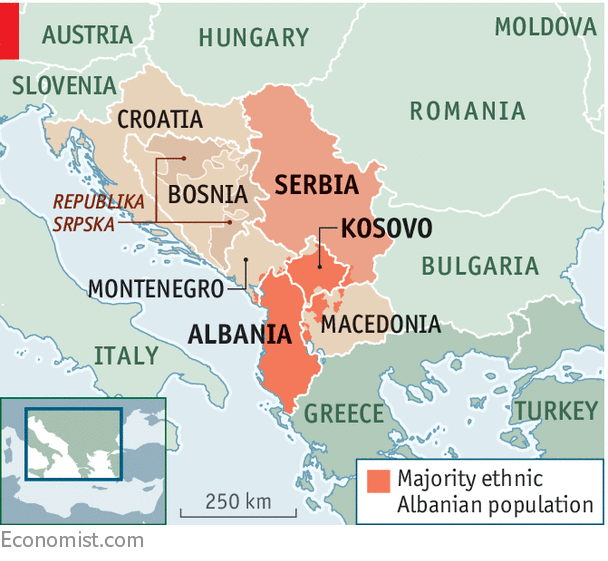
TEN years ago Kosovo declared independence from Serbia. Its Albanians, who make up the majority of the population, have been celebrating. But its Serbs, most of whom live in enclaves, have not. Serbia does not recognise Kosovo, which used to be its southern province, and Kosovo Serbs still consider themselves citizens of Serbia. The situation is typical of the Balkans, where borders are, frankly, a mess. So there are Serbs living in Kosovo and in Bosnia-Hercegovina, where they have their own republic (the Republika Srpska), Albanians and Bosniaks (Muslims) living in Serbia, and Greeks living in Albania. Recently the Serbian authorities proposed a discussion about an exchange of territory with their Kosovo Albanian counterparts. Is this a sensible idea?

In 1923 Greece and Turkey agreed to exchange some 2m people. Mostly Greek-speaking Christian Orthodox citizens of Turkey were sent to Greece, and Muslims from Greece were sent to Turkey. It was a brutal relocation, but, note its defenders, Greece and Turkey have not fought a war since. The only place where Greeks and Turks have fought is Cyprus, where their populations remained mixed. This has inspired nationalists in the western Balkans. Between 1918 and the late 1950s, many Muslims were encouraged to leave Yugoslavia for Turkey. But at the time of Yugoslavia's collapse in the 1990s it still contained a thorough mix of peoples. Leaders in those Yugoslav wars saw ethnic cleansing as the best way to create new nation-states unpeopled by troublesome minorities. By 1995 historically Serb-populated regions of Croatia were empty and hundreds of thousands of Serbs, Croats and Bosniaks had similarly been turfed out of their homes in Bosnia. But the countries that emerged from the implosion did not neatly encircle Serbs, Albanians, Croats and so on. Myriad Serbs may have fled Kosovo after its war, but some 120,000 remain. 

Latest stories


The Serbian authorities want to discuss taking Kosovo's northern part, with Albanian-inhabited regions of Serbia moving to Kosovo in exchange. Proponents of such "map-tidying" say that multi-ethnic states have failed in the Balkans. But they ignore the fact that, once governments start down this path, the process has no obvious end and pays no heed to the human rights of everyone involved. If Kosovo and Serbia begin serious talks about a redrawing of their borders, the impact on Balkan communities apart from those in the affected parts of Kosovo and Serbia could be profound. Bosnian Serb leaders would hold a referendum on the future of the Republika Srpska; Bosnian Croats would follow suit; and Bosniaks would then fight to prevent the dismemberment of their shared country. Over the border Serbia would clamp down on Bosniak nationalists in Sandzak who dream of incorporating that region into a Greater Bosnia. Meanwhile Albanians in western Macedonia and Montenegro would demand to join a Greater Albania. Proponents of that idea would also like to incorporate parts of northern Greece, whereas Greek nationalists would demand part of southern Albania.

One irony behind the mooted exchange is that most Kosovo Serbs actually live in enclaves in the south of Kosovo. So the agreement would not leave them living in Serbia, and they would probably have to leave their homes or else be driven out. But Serbian officials may be less concerned about their countrymen than about taking steps towards recognising Kosovo—and thus making their own hoped-for accession to the European Union (EU) easier. It may not concern them that an exchange of territories in the western Balkans could have huge ramifications. Hungarian nationalists, after all, remain unreconciled to the loss of Transylvania to Romania, and Romanian nationalists would like to redraw their borders to take in Moldova. There is a reason that "Balkanisation" has a bad name. As in the EU at large, lessening the relevance of national borders would seem wiser than redrawing them and, in the words of one senior EU official, "opening the gates to hell".


https://www.economist.com/blogs/economist-explains/2018/02/economist-explains-11

February 08, 2018

Exclusive: Kosovo Intelligence Agency and Police know who killed Oliver Ivanovic

gazetaexpress.com

Exclusive: Kosovo Intelligence Agency and Police know who killed Oliver Ivanovic

GazetaExpress

2 minutes


Killing of the Kosovo Serb leader, Oliver Ivanovic, who was gunned down in front of his SDP Party headquarters in Mitrovica North, is likely to be solved soon. "The KIA and Kosovo Police, possess information on who pulled the trigger and the motives behind this this killing," a reliable source told Gazeta Express. "Maybe they don't have all the information, to order the arrest of the alleged perpetrators, but there is a lead," a source told Express noting however that the KIA and Police are careful not to damage the investigation. "It is very likely that the security institutions have already informed political leaders, in both Kosovo and Serbia related to their findings," the source said.  

Oliver Ivanovic was killed on 16 January in front of his party's headquarters. Only days before he was gunned down with six bullets by unknown perpetrators, Ivanovic told media in Belgrade the he was not feeling safe. Strained relations of Ivanovic with the Government in Belgrade, and Serbian president Aleksandar Vucic, were tense. The Government during general and local elections in Kosovo held in 2017 have openly supported the Srpska List, hampering other political parties gathering Serbs in Kosovo. Media in Serbia have reported that only days before Ivanovic's killing he sent an SMS to President Vucic, but he received no answer on his concerns. Media continue speculations on alleged perpetrators of Ivanovic's killing.