November 19, 2018

Michael Bloomberg: Why I'm Giving $1.8 Billion for College Financial Aid

nytimes.com

Opinion | Michael Bloomberg: Why I’m Giving $1.8 Billion for College Financial Aid

6-7 minutes


Let’s eliminate money problems from the admissions equation for qualified students.

By Michael R. Bloomberg

Mr. Bloomberg is the founder of Bloomberg LP and served as mayor of New York, 2002-2013.

  • Nov. 18, 2018
  •  

Looking across Wyman Quad to Shriver Hall on the campus of Johns Hopkins University in Baltimore.CreditAndrew Mangum for The New York Times

Image

Looking across Wyman Quad to Shriver Hall on the campus of Johns Hopkins University in Baltimore.CreditCreditAndrew Mangum for The New York Times

Here’s a simple idea I bet most Americans agree with: No qualified high school student should ever be barred entrance to a college based on his or her family’s bank account. Yet it happens all the time.

When colleges review applications, all but a few consider a student’s ability to pay. As a result, high-achieving applicants from low- and middle-income families are routinely denied seats that are saved for students whose families have deeper pockets. This hurts the son of a farmer in Nebraska as much as the daughter of a working mother in Detroit.

America is at its best when we reward people based on the quality of their work, not the size of their pocketbook. Denying students entry to a college based on their ability to pay undermines equal opportunity. It perpetuates intergenerational poverty. And it strikes at the heart of the American dream: the idea that every person, from every community, has the chance to rise based on merit.

I was lucky: My father was a bookkeeper who never made more than $6,000 a year. But I was able to afford Johns Hopkins University through a National Defense student loan, and by holding down a job on campus. My Hopkins diploma opened up doors that otherwise would have been closed, and allowed me to live the American dream.

I have always been grateful for that opportunity. I gave my first donation to Hopkins the year after I graduated: $5. It was all I could afford. Since then, I’ve given the school $1.5 billion to support research, teaching and financial aid.

Hopkins has made great progress toward becoming “need-blind” — admitting students based solely on merit. I want to be sure that the school that gave me a chance will be able to permanently open that same door of opportunity for others. And so, I am donating an additional $1.8 billion to Hopkins that will be used for financial aid for qualified low- and middle-income students.

This will make admissions at Hopkins forever need-blind; finances will never again factor into decisions. The school will be able to offer more generous levels of financial aid, replacing loans for many students with scholarship grants. It will ease the burden of debt for many graduates. And it will make the campus more socioeconomically diverse.

But Hopkins is one school. A recent analysis by The Times found that at dozens of America’s elite colleges, more students came from the top 1 percent of the income scale than from the entire bottom 60 percent of that scale — even though many of those lower-income students have the qualifications to get in.

And until recently, by some estimates, half of all high-achieving low- and middle-income students have not even been applying to top colleges — largely because they believe they can’t afford it, doubt they’ll be accepted, or aren’t even aware of their options.

As a result, they often lose out — and so do colleges that would benefit from their talents and diverse perspectives. Our country loses out, too.

College is a great leveler. Multiple studies have shown that students who attend selective colleges — no matter what their family’s background — have similar earnings after graduation. But too many qualified kids from low- and middle-income families are being shut out.

As a country, we can tackle this challenge and open doors of opportunity to more students by taking three basic steps:

First, we need to improve college advising so that more students from more diverse backgrounds apply to select colleges. Through a program called CollegePoint, my foundation has counseled nearly 50,000 low- and middle-income students about their options, and helped them navigate the financial aid process.

Second, we need to persuade more colleges to increase their financial aid and accept more low- and middle-income students. Through the American Talent Initiative (which my foundation created several years ago), more than 100 state and private schools have together begun admitting and graduating more of these students.

Third, we need more graduates to direct their alumni giving to financial aid. I’m increasing my personal commitment — the largest donation to a collegiate institution, I’m told. But it’s my hope that others will, too, whether the check is for $5, $50, $50,000 or more.

But these steps alone are not sufficient. Federal grants have not kept pace with rising costs, and states have slashed student aid. Private donations cannot and should not make up for the lack of government support.

Together, the federal and state governments should make a new commitment to improving access to college and reducing the often prohibitive burdens debt places on so many students and families.

There may be no better investment that we can make in the future of the American dream — and the promise of equal opportunity for all.

Michael R. Bloomberg is the founder of Bloomberg LP and served as mayor of New York, 2002-2013.

Follow The New York Times Opinion section on Facebook, Twitter (@NYTopinion) and Instagram.

A version of this article appears in print on Nov. 19, 2018, on Page A19 of the New York edition with the headline: More Aid For College Students. Order Reprints | Today’s Paper | Subscribe


November 18, 2018

Children's show is propaganda for Putin

thetimes.co.uk

Children’s show is propaganda for Putin, say critics

Mark Bridge, Technology Correspondent

2 minutes


November 17 2018, 12:01am, The Times

Masha and the Bear is produced by a studio in Moscow

A programme about a mischievous girl and a bear watched by millions of British children is accused of being a “soft propaganda” tool for the Kremlin (Mark Bridge writes). The English-language Masha and the Bear has more than 4.18 million subscribers on YouTube and, in various languages, the animated series has gained 40 billion views across 13 channels.

Children enjoy watching the feisty little girl and her gentle giant protector. However, critics in Russia’s neighbouring states have claimed the series, from a Moscow studio, is part of the country’s propaganda machine. Professor Anthony Glees, of the University of Buckingham, an intelligence expert, said: “Masha is feisty, even rather nasty, but also plucky. She punches above her slight weight. It’s not far-fetched to see her as…


November 15, 2018

What are the benefits of a Kosovo-Serbia land-swap?

blogs.lse.ac.uk

A high risk, high reward gamble: What are the benefits of a Kosovo-Serbia land-swap?

12-15 minutes


The prospect of Kosovo and Serbia exchanging territories received significant attention earlier this year. Beáta Huszka argues that while much of the reaction to the proposal was negative, a well-managed exchange based on domestic consensus and the mitigation of regional risks could have a stabilising effect for both countries. However, securing these conditions would be highly difficult in practice, and the success of the land-swap would be far from guaranteed.

On 14 March, Serbian President Aleksandar Vucic, while talking to Wess Mitchell, the U.S. Assistant Secretary of State for European affairs, said that his country was ready for a compromise with Kosovo but not for "a humiliation of our own people". Ever since, there has been speculation about the possibility of a land swap between Kosovo and Serbia as a way to end the dispute over Kosovo's statehood.

At the European Forum Alpbach in Austria at the end of August this year, Vucic, together with his Kosovo counterpart, Hashim Thaci, made clear during a panel discussion that they were considering the possibility of territorial changes. If the two sides manage to agree on some form of final settlement, this would allow Kosovo to gain full international recognition while also removing the greatest obstacle to Serbia's EU accession.

However, it is worth remembering that the idea of an exchange has never been officially endorsed or negotiated by the two sides. So far, both presidents have been talking about the territories they might want to recover without admitting that it might require also handing over some territories of their own. Since no leader in their right mind would give over some part of their country's territory without gaining anything in return, it has been tempting for observers to read between the lines and assume that Vucic and Thaci have in fact been floating the idea of trading territories. But before jumping to any conclusions, it is worth emphasising, as Robert Cooper from the ECFR recently pointed out, that "so far, no one has proposed anything concrete. We hear of ideas, but they are rather vague".

Who is for a land swap and who is against?

The possibility of a land swap has triggered strong reactions inside the two countries and beyond. With a few notable exceptions, hardly anyone seems to be in favour of the idea. Kosovo's Prime Minister, Ramush Haradinaj, came out strongly against it, as did key opposition parties in Kosovo. Similarly, the Serbian Orthodox Church and many Serbs living south of the Ibar river have expressed dismay at the prospect. Only Albanian politicians from the two Albanian majority municipalities in southern Serbia of Presevo and Bujanovac appear enthusiastic about the potential of being integrated into Kosovo.

An indication that Belgrade is serious about pursuing a land swap came on 4 September when Serbian representatives of Srpska Lista, a Serbian minority party in Kosovo which has close ties with Vucic's Serbian Progressive Party, decided not to attend Kosovo's parliament during a vote initiated by the opposition. The vote, which aimed to withdraw the negotiating mandate from President Thaci, could have put future talks on territorial exchanges in jeopardy.


Credit:  CC0 1.0

The response from the international community has been relatively lukewarm. Most of those presented as backing the deal have simply indicated they would not oppose it if the two sides come to an agreement. This includes President Trump's national security advisor, John Bolton, as well as Federica Mogherini, the EU's High Representative for Foreign Affairs and Security Policy, and Johannes Hahn, the EU's Neighbourhood and Enlargement commissioner. A few EU member states, such as Belgium, Romania, Hungary and more recently Austria have taken a similar position. International opponents have been more explicit and vocal in their opposition, among them the leaders of Germany, the UK, France, Finland and Luxembourg. Serbia's Balkan neighbours have also communicated their concerns, notably Croatia, Bosnia and Herzegovina (with the exception of Republica Srpska), Macedonia and Montenegro.

The risks

The arguments against adjusting the borders abound and could be heard many times even before the current situation. Probably the most important one concerns fears about destabilising spillover effects: what would happen if some nationalists applied the same logic of adjusting borders according to ethnic lines in Bosnia and Herzegovina or Macedonia? That could result in Albanians in Macedonia and Serbs in Republica Srpska (RS) mobilising for secession, potentially leading even to the outbreak of violence.

While such fears should not be dismissed out of hand as nationalists in both countries have at times been stepping up their demands, there is a big difference between the current situation in Kosovo/Serbia and the situation in these other countries. Namely, if territorial exchange happened between Serbia and Kosovo, it would happen by consensus. A similar consensus in Bosnia and Macedonia under the current circumstances with the present actors is pretty much unthinkable. It is worth remembering that before Montenegro separated from its union with Serbia, the same warnings about potential spillover effects to other parts of the Balkans were echoed, which is why Montenegro had to wait until 2006 to proclaim independence. In the end, Montenegro achieved independence via a process managed according to an agreement with Serbia and the EU, without any negative repercussions.

One could argue that it was a very different situation because internal borders were not modified, with separation happening along the established borders between the two republics – who by the way had held the right to pursue secession under the old Yugoslav constitution. This is not the case in Kosovo, where the border would have to be changed. Modifying borders has been off the table since the Yugoslav dissolution. Accordingly, even though many countries separated from Yugoslavia, and from its successors, no internal border has been modified during any of these processes.

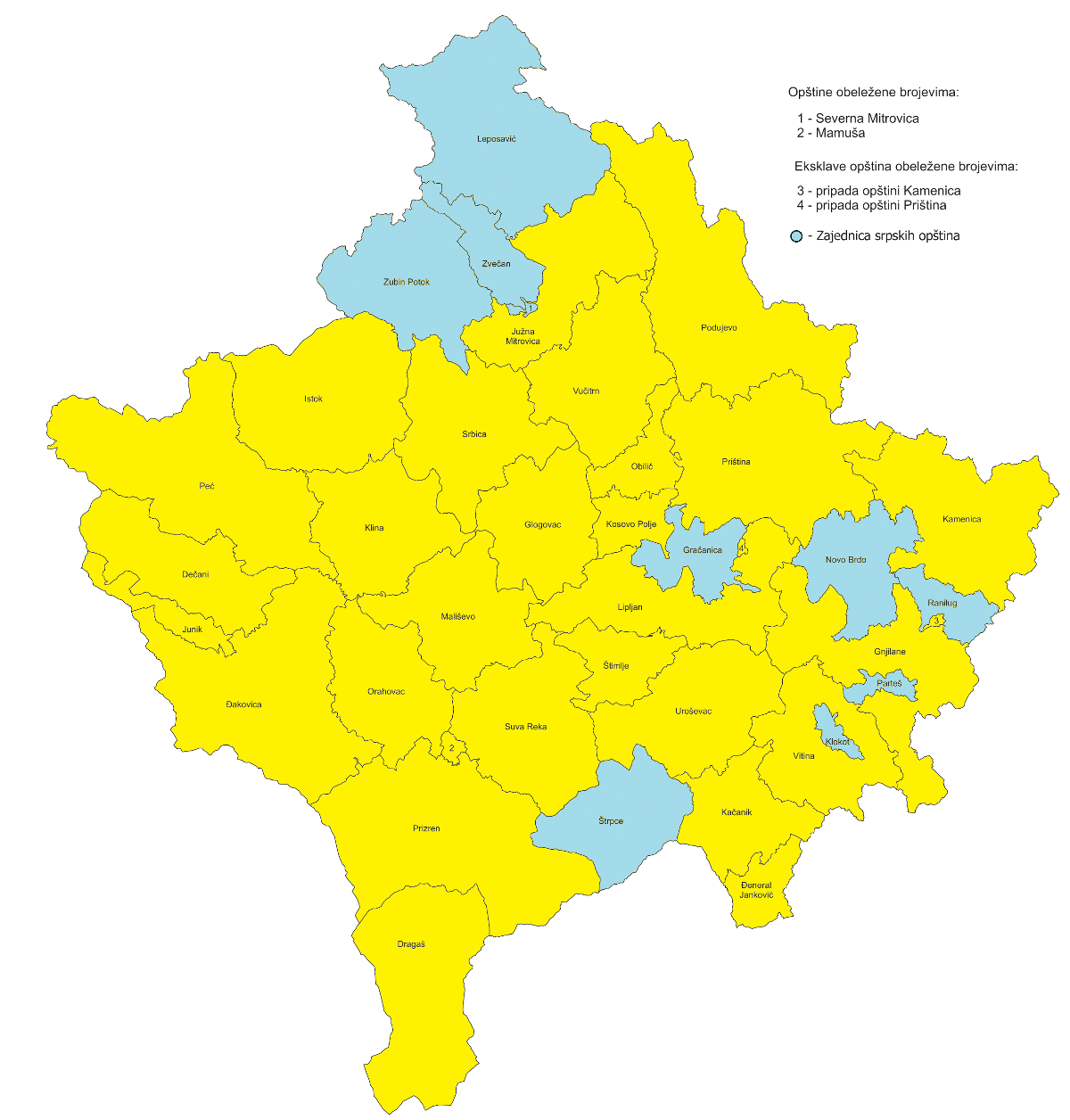
Yet, changing internal borders is not as unthinkable as it looks at first glance. It is less well known that Kosovo's northern border – which is under dispute in the current debate – was modified during Tito's time in 1959 when the municipality of Leposavic was added to Kosovo, which was an autonomous province of Serbia in Yugoslavia. It was an important change considering that this municipality constitutes the greatest part of the territory of North Kosovo (i.e. Kosovo north of the Ibar river, as shown in the map below).

Map of Kosovo with Serbian majority areas highlighted in blue


Credit: Wikimedia commons (CC BY 3.0)

The other important counter-argument is that "such a territorial swap is legitimising a dangerous propaganda of ethnic ownership over the territory – a principle that has pushed the region on several occasions into bloody conflicts". However, a territorial swap of this nature is not going to fulfil the abominable goal of establishing ethnic ownership over territories, as the aspiration of increasing ethnic homogeneity would be only partially realised.

North Kosovo joining Serbia would be the least controversial change as there are very few Albanians and other minorities living there. According to OSCE estimates from 2015, the four municipalities north of the Ibar river – Leposavić, Zvečan, Zubin Potok and North Mitrovica – have 79,910 inhabitants. Around 70,300 (88%) of these are Serbs, 6,970 (9%) are Albanians, and 1,500 (2%) are Bosniaks. Yet, the majority of Kosovo Serbs live in the south, and their position would undoubtedly be weakened by losing their ethnic kin in the north. By contrast, southern Serbia is home to many non-Albanians, among them around 18,000 Serbs, (and even more, around 25,000, if we add Medvedja to its territory). Thus, at least 25% of the population is composed of ethnic Serbs, (or more if we include Medvedja).

It is difficult to imagine that these people would be ready to live in Kosovo. It could be argued that Kosovo could accept giving up the north without getting Presevo Valley as international recognition would be the greatest price for Pristina. North Kosovo anyhow has not been an integral part of Kosovo since 1999, so it would not be such a huge loss for Kosovo if its northern part formally separated. However, it is unlikely that it could be sold politically in Kosovo in the face of strong resistance from opposition parties and public opinion.

The benefits

The arguments in favour of the land swap are that it would allow for normalising relations between the two countries, enabling Kosovo to gain full international recognition and Serbia to move ahead with EU accession. Serbia will not recognise Kosovo without some serious concessions. Without such a radical agreement it is difficult to imagine how the two countries could move forward from the current deadlock, which is unsustainable. As Ivor Roberts, former ambassador of the UK to Yugoslavia, has rightly pointed out, "the reality is that no course is without risks, and the present impasse is not risk-free, either". Without international recognition, life in Kosovo is going to remain a challenge, which has obvious security risks, not to mention Serbia getting into a deadlock with its EU accession.

Key conditions: Domestic consensus and the regional environment

Getting into a serious discussion about a possible land swap is therefore a high risk-high reward gamble. The truth is that no one can predict what would happen afterwards. Such a deal could well bring the impasse between Kosovo and Serbia to an end. Yet, things could also go wrong easily. While Vucic seems capable of asserting control over the various actors in Serbia and the Serbian politicians in Kosovo for a deal to be implemented, Thaci seems less able to forge the internal support such an agreement would require. Without a certain degree of domestic backing, the agreement could not be carried out, or could be messy and possibly even violent, in light of Vetevendosje's more recent violent actions in parliament. Therefore, a considerable degree of internal support is a necessary requirement for any settlement to succeed. Yet, this will not prevent the mentioned negative repercussions from occurring in other parts of the Balkans.

By looking at the experience of other negotiated settlements in the region, I have argued elsewhere (alongside my co-author Erin K. Jenne) that stability in the regional environment is key for territorial settlements to work. Conflict spillover from neighbouring countries, deadlock in NATO or the EU integration process, and interventionist kin state activism can fuel discrimination against minorities or separatism by minority organisations, which can result in conflict.

Examples include Macedonia following the signing of the Ohrid Agreement in 2001. Ethnic relations began to deteriorate after 2008 when Macedonia's NATO and EU accession was put on hold because of the name dispute with Greece. Thus, it can be assumed that if Macedonia manages to solve the name issue with Greece, its EU accession might receive new momentum, taking the wind out of the sails of nationalist troublemakers. In Bosnia, the situation is more complicated, yet without outside support, such as from Serbia or Russia, Bosnian Serbs are unlikely to take the risk of outright secession and a possible conflict in the face of internal and international resistance.

Since the summer, Kosovo-Serbia relations have been on a downward spiral, most recently owing to Kosovo's unilateral imposition of customs tariffs on Serbian and Bosnian products. The current political atmosphere is definitely not conducive for reaching a compromise between the parties. However, the idea could be put back on the agenda if talks gain better momentum. A well-managed land swap which is based on domestic consensus and the mitigation of regional risks could have a stabilising effect for both countries. Yet, securing these conditions is no small feat, and its success cannot be guaranteed – and herein lies the risk.

Please read our comments policy before commenting.

Note: This article gives the views of the author, not the position of EUROPP – European Politics and Policy or the London School of Economics.

_________________________________

About the author

Beáta Huszka – ELTE University
Beáta Huszka is an Assistant Professor at the Department of European Studies in ELTE University, Budapest. She completed her PhD in International Relations at the Central European University in 2010.


November 10, 2018

Commission Finds NATO Bombs Continue to Kill Serbs 19 Years After 1999 Strikes

sputniknews.com

Commission Finds NATO Bombs Continue to Kill Serbs 19 Years After 1999 Strikes

Sputnik

4-5 minutes


Europe

21:31 09.11.2018(updated 21:50 09.11.2018) Get short URL

NATO carried out a 78-day campaign of airstrikes against Yugoslavia in 1999 after accusing Belgrade of committing war crimes in Kosovo. The strikes left up to 5,700 civilians dead, and contaminated part of southern Serbia with radiation from the depleted uranium rounds used by the alliance.

The Serbian government-designated Commission Investigating the Effects of NATO's 1999 Bombing of the Federal Republic of Yugoslavia has provided Sputnik with important information about some of its preliminary findings. 

Speaking to Sputnik Serbian, commission head Dr. Darko Laketic explained that in the course of visits to cities, towns and municipalities affected by the NATO bombings, the commission has been able to establish what appears to be evidence of a link between the depleted uranium rounds dropped in these areas and a rise in cancer incidence.

According to the physician, in the city of Vranje, southern Serbia, out of 40 people who came into direct contact with soil contaminated by depleted uranium, ten have died, with "the majority of the deaths caused by malignant neoplasms."

© AFP 2018 / ANDREJ ISAKOVIC

"Many people who have been to the affected areas suffer from the symptoms of erythema and ulcerous eruptions of an unknown etiology on their skin," Dr. Laketic added.

Commission members have already visited Vranje, Pancevo and Novi Sad, and plan to visit Kragujevac, with all of these areas facing heavy NATO bombing in 1999. "These are our priority regions. We are collecting medical and statistical data from medical institutions in these areas and interviewing people who have come into contact with contaminated soil," Laketic explained.

The doctor noted that in the village of Borovac, another area struck by NATO bombs, three residents, or one percent of the village's total population, are suffering from malignant brain damage.

Dr. Laketic noted that an increase in oncological diseases has also been observed in Pcinjski District, and said that this was particularly significant, since the area's population is younger than the Serbian average.

The commission is now working on the creation of a large, systematized database.

"We are investigating the effects of toxic substances. Our task is to establish the causal links between [NATO's] actions and illnesses. Having established them, we will receive weighty arguments for organized efforts in the detection, prevention and treatment of cancer at its early stages in those regions where it is necessary," the doctor said.


© AP Photo / Manuel Balce Ceneta

According to Dr. Laketic, in addition to depleted uranium, other toxic substances released during NATO's bombardment, such as chlorine, benzene, and polychlorinated biphenyls are also proven to cause illness, including malignant neoplasms which can lay dormant for five, ten or even twenty years after a person first comes in contact with them.

Established in June, the commission hopes to complete its first preliminary report by 2020. Dr. Laketic will report on the status of his team's investigation in the Serbian National Assembly in December.

According to openly available data, in the late 1990s, the average Serbian death rate from oncological illnesses hovered between 9,000 and 12,000 people per year. By 2014, however, the figure doubled to 22,000, with the number of newly diagnosed cancer patients reaching 40,000. 

Some medical doctors and scientists have attributed the jump in cancer rates to NATO's use of depleted uranium rounds during its bombing, and have pointed to the rise in leukemia and lymphoma, cancer types affecting tissue most sensitive to ionizing radiation.  Other experts have maintained that there yet to be conclusive proof of a relationship between cancer rates and the depleted uranium rounds, since cancers have been growing across Serbia, while depleted uranium rounds were dropped primarily in southern Serbia. According to World Cancer Research Fund statistics, Serbia is 18th in the world in total incidence of cancers, with 307.9 cases per 100,000 residents reported in 2018.


November 09, 2018

"Protect Kosovo crimes witnesses, or they will be killed"

b92.net

"Protect Kosovo crimes witnesses, or they will be killed" - English - on B92.net

5-7 minutes


Former Swiss Senator and Council of Europe (CoE) Rapporteur on human organs trade in Kosovo Dick Marty says he has faith in the (Kosovo) Specialist Chambers.

Source: Tanjug Friday, November 9, 2018 | 13:29

(screen capture)

The chambers are colloquially referred to as "the special court for KLA ('Kosovo Liberation Army') crimes."

Marty is also optimistic when it comes to arresting "the big fish" in Pristina.

"I'm an optimist that the tribunal will soon test itself by the first arrests of those people who are known in Kosovo and to the international community as 'the big fish'," Marty has been quoted as telling Presheva Jone - an Albanian language news agency located in Presevo, a town in the southern part of central Serbia.

Tanjug is citing this, and also reporting this Friday that the Swiss "expressed his concern that the witnesses might be murdered if the Kosovo police or EULEX fail to protect them."

Marty has also been quoted as saying that "Kosovo cannot have political and economic perspective if the country is led by suspected, corrupted persons, and mafiosi criminals."

Presheva Jone further recalled that Marty in the past referred to Kosovo President Hashim Thaci, Kosovo Assembly Deputy President Xhavit Haliti, and Assembly President Kadri Veseli as "the big fish."

According to Marty, "by establishing a tribunal for crimes committed in Kosovo, Kosovo will undoubtedly open uo new prospects for integration."

"I do not think the (court) will be against Kosovo or the KLA, but the abusers from their ranks during and after the war in the region. I believe that a good portion of Kosovo politicians know this, especially those whose hands are not clean," the former Council of Europe official has been quoted as saying.

Presheva Jone also writes that Marty "asked why Hashim Thaci is not suing him for slander."

In July 2014, in an interview with the Swiss Radio SRF, Marty spoke about the chief prosecutor for the investigation into the trafficking of human organs in Kosovo and Metohija in 1999, Clint Williamson - who had been appointed at the time and has since been replaced - as "a pleasant surprise" - adding that, although Williams never mentioned any names, but only former high-ranking KLA members, it was "quite clear to Marty who they were."


November 08, 2018

Belgrade NATO week kicks off with a focus on Serbia-NATO relations and dialogue with Pristina

europeanwesternbalkans.com

Belgrade NATO week kicks off with a focus on Serbia-Alliance relations and dialogue with Pristina - European Western Balkans

EWB

6-8 minutes


Scott, Dačić, Milić, Pszczel; Photo: Tanjug/Filip Krainčević

BELGRADE – Sixth Belgrade NATO week, organised by the Center for Euro-Atlantic Studies (CEAS) and supported by NATO's Public Diplomacy Division and US Embassy in Serbia, started today in the Palace of Serbia.

Introductory speeches were delivered by Jelena Milić, Director of CEAS, Serbia's Minister of Foreign Affairs Ivica Dačić, US Ambassador to Serbia Kyle Scott and Senior Officer for Russia and Western Balkans in NATO's Public Diplomacy Division Robert Pszczel.

Milić emphasised that this year's NATO week takes place in the time of interesting geopolitical circumstances. "The conditions for solving decade-long conflicts in the region have been fulfilled. Some leaders in the region are ready for a compromise", she said, adding that misinformation coming from both inside and outside the country have to be confronted.

It is time for Belgrade and Pristina to reach a multidimensional binding agreement that would contribute to peace and stability in the region, Milić underlined. Some Western countries have shown a more flexible approach towards the subject since the summer, she reminded.

On the other hand, there is a certain skepticism of some other actors, who believe that particular aspects of the agreement would spark conflicts in the region. "Some of this arguments better apply to the 1990s and early 2000s, the situation is significantly different nowadays", Milić said.

She stressed that CEAS supports border correction between Serbia and Kosovo, which implies that the four municipalities in the northern Kosovo would become a part of Serbia, as the least bad solution. It is not an issue of creating ethnically pure countries, which can be seen from demographic statistics, nor it is a division of Kosovo, because it is a relatively small territory, she explained.

"Multiculturalism is, of course, a noble idea, but it cannot be an ultimate goal without a democratic context", Milić concluded.

"We are aware that Serbia-NATO relations are delicate and carry the burden of the past – we have differing views on it, and that is a reality. But, we also have an obligation and responsibility to ensure stability", said Minister Dačić.

He reminded that Serbia's chosen path is further development of relations with the Alliance, but within the context of military neutrality. After a successful conclusion to the first cycle of the Individual Partnership Action Plan, preparations for a second one are underway.

"We respect the choice of our neighbours to join NATO, and expect understanding for our cooperation with non-NATO members. Those relations are not undermining our relationship with NATO", said Dačić.

He added that Serbia expects of the Alliance to understand its priorities, at that is first and foremost Kosovo, the main security challenge for Serbia. The only possible solution in that area is a compromise, Dačić emphasised.

Serbia is against the formation of Kosovo Army, because it would violate UN SC Resolution 1244, he said, adding that it is important to receive guarantees that Kosovo Security Forces will not enter north without the permission of KFOR and the Serbs who are living there.

US Ambassador Kyle Scott confirmed that the Serbia-NATO partnership does not imply entering the Alliance through the back door and that United States respects Serbia's military neutrality.

"Why are we here, if Serbia does not want to become a NATO member? There are two reasons – common goals and partnership", stated Scott.

As common goals he listed a peaceful, stable and united Europe. He also stressed NATO's support to Serbia's EU membership.

"Serbia has just hosted a NATO exercise – who says that the Western Balkans cannot change and that we cannot be optimistic about reaching an agreement between Belgrade and Pristina", said Scott.

He also listed the benefits of NATO partnership: resources, training, research… "US wants to play an even better and more positive role", Scott stated.

As a representative of Public Diplomacy Division, Robert Pszczel said that the Alliance has been supporting this event for years, because of the importance of debating the planned topics and subjects. There is no other agenda, he emphasised.

"What is said in Serbia, also travels out to the region", he further stressed the importance of the event.

Reflecting on the activities of political actors in the region, Pszczel said that he, as a football fan, knows that half of the victory depends on the approach, and that this is applicable in other fields as well.

Those who are tackling regional issues should adopt this position and do away with some old myths, Pszczel concluded.

Immediately after introductory speeches, the first panel, titled "Opportunities and future plans for Serbia-NATO cooperation" took place. Apart from Mr Pszczel, acting Assistant of the Minister in the Sector for Security Policy of the Ministry of Foreign Affairs Branimir Filipović and Director of the Office of the National Security Council and protection of classified data Goran Matić also participated.

Asked how well Serbia used the first cycle of IPAP, Filipović answered that the mutual estimate is that more than 60% of the goals were fulfilled, 30% of them are long-term ones and thus continue within the second cycle and only two to three percent of the goals were not fulfilled.

He used the opportunity to further emphasise the benefits of Serbia's cooperation with NATO, such as Science for Peace and Security Programme, which enabled researchers from academia and civic sector to take part in these fields, military projects aimed at establishing integrity and crisis management exercises.

Answering the question on the awareness of these benefits, Matić said that there are problems in that sense, the main ones being historical relations, first of all 1999 bombing, as well as lack of enough media representation.

Reflecting on this subject, Pszcel stressed that, for example, during the visits of Secretary General Jens Stoltenberg, many positive things can be heard. However, in other situations, the leading media represent the partnership as "mixed" at best.

"We are open for a debate, but it has to be grounded in facts", Pszczel said.


November 05, 2018

CIA "hid reports about massacres committed against Serbs"

b92.net

CIA "hid reports about massacres committed against Serbs" - English - on B92.net

5-6 minutes


A US expert on radical Islam and terrorism says Saudi Arabia had influenced the US to make a document about a massacre against Serbs near Srebrenica disappear.

Source: Tanjug Monday, November 5, 2018 | 12:03


(Getty Images, file, illustration)

Analyst Robert Spencer told Vecernje Novosti daily in an interview - commenting on the newspaper's recent discovery of the role of US intelligence officials in hiding reports about crimes perpetrated against Serbs in Podrinje (along the Drina River), said the Saudi authorities had a huge impact on the state apparatus in Washington.

That's how, he claims, it came to the CIA hiding the real ruth about the events in Bosnia-Herzegovina (BiH) in the 1990s.

Spencer expressed his view that it is possible for the US to change its policy towards BiH, but "only in case of a turning point in relations between America and Saudi Arabia."

He assessed that former US President Bill Clinton "made a catastrophic decision to work with the Muslims during the civil war in the Balkans."

"This decision made it possible to establish a jihadi stronghold, all under the guise of democracy and the right to self-determination. It is not difficult to conclude that President Clinton was influenced by Saudi Arabia in making this decision," Spencer was quoted as saying by the Belgrade-based daily.

Asked whether BiH "can survive as a democratic and multinational state, despite the growing influence of some Middle Eastern countries," the US expert replied, "No."

"Sharia is incompatible with democracy, and in the end, Bosnia will have to decide one way or the other," Spencer said.


November 04, 2018

From Balkan nationalism to Zionism: was the Jewish State born in Serbia?

jpost.com

From Balkan nationalism to Zionism: was the Jewish State born in Serbia?

11-14 minutes


President Reuven Rivlin visited Serbia this past July to participate in a ceremony with Serbian President Aleksandar Vucic renaming a street after the Zionist visionary Theodor Herzl in the Belgrade neighborhood of Zemun. This unusual event, which marked the first ever visit by an Israeli president to Serbia, received less coverage than would be expected from most Israeli news outlets.

It begs the question: What was Herzl’s connection to Zemun, and why would the Serbian government name a street after him?
The answer may surprise most Jews and even many ardent Zionists. The intellectual roots of political Zionism and the Jewish state did not start with the refined emancipated Jews of fin-de-siècle Vienna or Paris, and they certainly don’t begin in Poland. Zionism’s journey traces back to a pious Sephardi rabbi in what was then the Serbian border town of Zemun at the edge of the Austrian Empire. It was this rabbi who taught Herzl’s grandfather and father and likely planted the seeds of the Jewish state, some 70 years before the First Zionist Congress in Basel and 90 years before the Balfour Declaration.


Moving from Balkan nationalism to Zionism
Historians in the past focused on difficulties secular emancipated Jews like Theodor Herzl had integrating into the rapidly developing European societies of Western and Central Europe at the end of the 19th century. However, Herzl’s exposure to the idea of reconstituting the Jewish nation predates his coverage of the Dreyfus Affair as a journalist or even his encounters with elite antisemitism as a law student in Vienna. Instead, it can be traced back to his father’s family’s roots in Zemun (also known by its old German name Semlin) and the influence of the community’s Sephardi rabbi, Judah Ben Shlomo Hai Alkalai.

Alkalai is today acknowledged as a precursor of the modern Zionist movement, but his ideas are usually mentioned in passing if at all. Likewise, there is very limited scholarship regarding how this Sephardi rabbi on the edge of an empire came to his revolutionary ideas for the return of the Jewish people to the Land of Israel. Historians and literary experts have pointed to the influence of the radical interpretations of the Bible from the Kabbala as a source of inspiration (as was the case with Rav Abraham Isaac Kook). While it is certainly possible that the rabbi’s knowledge of Kabbala played a role, what has been ignored is the influence of the early national revolts in the Balkans against Ottoman rule, in particular by the Serbs, and its possible influence on the ideas of a young Rabbi Alkalai.

Alkalai was born in 1798 in Sarajevo in what was then the Ottoman Empire and which today is Bosnia and Herzegovina. He came from a prominent family of rabbis whose roots trace back to Spain before the Jewish expulsion, and his father moved the family to Sarajevo from the large and well-established Sephardi community in Thessalonica. After spending years acquiring a traditional education, including rabbinical ordination and studying with kabbalists in the Holy Land, at the age of 27 Alkalai become the communal rabbi of the town of Zemun in what was then on the military frontier of the Austrian Empire. He served as rabbi for both the Sephardi and Ashkenazi members of the town’s small Jewish community, according to information found in the Jewish Historical Museum’s archives in Belgrade.

In his first work, Shema Yisrael (“Hear O Israel”), published in Belgrade in 1834, Alkalai provides a radical re-interpretation of the well-known Jewish prayer. In Alkalai’s reading, the quote from the Bible, “Hear O Israel” is actually a commandment to gather all of the children of Israel together as one. This singular body, Alkalai says, should be some sort of national congress that will supervise the general return of the Jewish people to the land of their forefathers. He also says that the return of the Jewish people to the Land of Israel would require the recreation of the Sanhedrin in Jerusalem or the election of a political leader, known from the rabbinical literature as the Messiah son of Joseph.


Taking from Kabbala and Serbian nationalism
After the Damascus Blood Libel in 1840, Alkalai’s work acquired a more urgent nature and his writings included a stronger kabbalistic dimension. He declared in his work Minhat Yehuda (“The Offering of Judah”), that a 100-year process of redemption of the Jewish people through voluntary means had begun. However, the book also stated that if the Jewish people did not unite and achieve an ingathering of the exiles during these 100 years, the next 100 years (from 1940 to 2040) would witness a terrible involuntary ingathering of the exiles accompanied by the outpouring of God’s wrath.

What is interesting is that in Alkalai’s earlier writings he places greater emphasis on the need for unity among the Jewish people for the return to the Land of Israel to be achieved. “It is easy to reconcile two states, but [hard to bring together] two Jews!” Alkalai wrote according to a chronicle of the Jewish community in Zemun written by Danilo Fogel.

Alkalai’s focus on the importance of unity, as with other aspects of his writing, may have been influenced by his study of Kabbala. However, it is hard to overlook the influence of the Serbian uprisings against the Ottoman Empire that engulfed the region surrounding Zemun in the first two decades of the 19th century. The uprisings led to the founding in 1817 of the semi-independent Principality of Serbia and eventually to de jure independence for the Kingdom of Serbia with its capital, Belgrade, just across the river from Zemun. It was Serbian intellectuals of this era who coined and adopted the rallying cry for Serb nationalists ever since, “Only unity saves the Serbs.”

The Serbian uprisings were the first successful national uprising against the Ottoman Empire, which controlled the Land of Israel and predated the emancipation of the Jews by the Habsburgs by 50 years. Perhaps Alkalai sought to emulate the national success of his Serbian neighbors? In fact, his advocacy for the reunification and return of the Jewish people to the Land of Israel had a very practical bent as well.

“Although based on the values of Judaism and Kabbala, Alkalai’s plans for the future of his people in the Holy Land were very practical,” says local Serbian Jewish historian Oliver Klajn. “He envisioned buying land and creating settlements comprised mostly of Jews from the Ottoman Empire, since they would face fewer legal impediments than Jews from elsewhere.” According to Klajn, Alkalai even founded in Zemun a society dedicated to the return of the Jewish people to the Land of Israel, which was active among several Jewish communities in Serbia’s largest cities.

Starting in the 1850s, Alkalai moved to a position that success in re-establishing the Jewish people in the Land of Israel would require the support of prominent Jews in Western Europe and the assistance of the European powers. Alkalai established in 1852 the short-lived Society for the Settlement of Eretz Israel in London. More importantly, he started touring across Europe to raise support for Jewish resettlement in the Land of Israel in the larger Jewish communities outside the Balkans.

Planting ‘Der Judenstaat’s’ seeds
The Herzl family originated in either the Sudetenland (modern-day Czech Republic) or Hungary but moved to Austrian-ruled Serbia in the period immediately following the Treaty of Passarowitz in 1718. While the Herzl family were Hungarian Ashkenazi Jews, they married Jews from local Sephardi families that moved to the region around Belgrade earlier under the rule of the Ottoman Turks. Documents maintained in the Jewish community archives (much of which were destroyed during World War II) note that Simon Leib Herzl, Theodor Herzl’s paternal grandfather, was a pious and active member in the Jewish community of Zemun and a well-respected merchant. Theodor’s father, Jacob Herzl, was also born and raised in Zemun before relocating to Budapest around the time of his marriage to Herzl’s mother, Jeanette Diamant. However, Theodor Herzl saw his grandfather at regular intervals until the latter’s death when Herzl was 19 years old and had moved with his family to Vienna.

Simon Herzl was a shofar blower of the community served by Alkalai, and he and his son Jacob appear to have studied the rabbi’s ideas. According to a monograph on Alkalai found in the historical archives, the elder Herzl studied in particular Alkalai’s book Kol Kore (“A Voice Calling”), which called for Jewish nationalism in 1848, the year of nationalist revolutions took place in Central Europe and in the Austrian Empire in particular.

However, some later literary scholars, such as McGill professor David Aberbach, suggest that Theodor Herzl and his book Der Judenstaat (“The Jewish State”) may have been more influenced by Alkalai’s Goral L’Adonai (“A Lot for the Lord”). The latter book, published in 1857, almost 40 years before Der Judenstaat, laid out a political program for uniting the Jewish community and gaining external support from major world powers to re-establishment a Jewish state in the Land of Israel. Like Alkalai before him, Herzl traveled across Europe to enlist the support of prominent Jews and non-Jews alike for the creation of a Jewish state. The major difference is that Herzl succeeded in generating real interest among the non-Jewish political elite in Europe and created a lasting Zionist political infrastructure within the Jewish community.

Interestingly, several descendants of relatives of Theodor Herzl and Rabbi Alkalai who stayed in Zemun would become prominent members of the Zionist movement in Yugoslavia in the 20th century. One, David Alkalai, would represent Serbian Jewry at the First Zionist Congress in Basel in 1897 and from 1924 would serve as president of the Zionist Alliance of Yugoslavia.

Balkan Zionism’s forgotten halcyon days
The Zionist movement would find fertile ground in pre-World War II Yugoslavia, and of the roughly 10% of Jews who survived the Holocaust many were former members of the Zionist youth groups. However, while Serbia’s government has demonstrated pride in the illustrious past of its Jewish community, this history is almost entirely unknown, even among educated Serbs today.
“The Zionist movement in Yugoslavia was big and very important, but unfortunately we do not know much about it,” says Barbara Panic, the curator at the Belgrade’s Jewish Historical Museum.

It’s not just an issue of the much-reduced size and importance of Serbia’s once-thriving Jewish community, but also an unintended casualty of an educational agenda that sought to de-emphasize ethnic histories and particularism in Communist-era Yugoslavia.

“When I was school-age, we learned about the history of America and of Europe,” adds Panic. “Serbs do not know much about Theodor Herzl or about Judah Alkalai. In Serbian primary and secondary school, we do not learn much about our own history.”

Join Jerusalem Post Premium Plus now for just $5 and upgrade your experience with an ads-free website and exclusive content. Click here>>


October 22, 2018

Constantinople's actions in Ukraine to trigger long-term rift, warns Serb patriarch

tass.com

TASS:  Constantinople’s actions in Ukraine to trigger long-term rift, warns Serb patriarch

4-5 minutes


Serbian Orthodox Church Patriarch Irinej

© AP Photo/Darko Vojinovic

MOSCOW, October 22. /TASS/. The interference of the Ecumenical Patriarchate of Constantinople in Ukraine’s church dispute has resulted in a crisis in relations between local Orthodox Churches and can mark the beginning of a long-standing rift, Primate of the Serbian Orthodox Church Patriarch Irinej told Serbia’s Novosti publication, the Synodal Department for Church’s Relations with Society and Mass Media reported on Monday.

"The crisis Orthodox Christianity is currently mired in is very deep and can, unfortunately, spiral into a tragedy of a profound and long-term schism," he cautioned.

According to the patriarch, the Serbian Church views the decisions by the Holy and Sacred Synod of the Ecumenical Patriarchate of Constantinople "as a step, which will not only result in a deepening rift on the canonical territory of the autonomous Ukrainian Orthodox Church, but will also pave the way for new schisms in other local Churches."

According to Patriarch Irenej, the Serbian Church has asked the Patriarch of Constantinople twice "to refrain from hasty moves, and instead to proceed along the path of dialogue and pan-Orthodox consensus." "Later on, I personally outlined our stance while meeting with Patriarch Bartholomew in Thessaloniki. Of course, I spoke to the Patriarch of Moscow prior to that, and we conveyed our church’s position to all local autocephalous churches," he specified.

"This stance boils down to the fact that it is essential to fully and immutably observe the centuries-old ecclesiastical order and the Sacred and Divine Canons, something which, according to the overwhelming majority of bishops and theologians in the Serbian Orthodox Church, our Mother Church in Constantinople does not do now, unfortunately. We are not waffling over whether to choose ‘for’ or ‘against’. We are for the Church’s unity, responsibility, and loyalty to the canonical order. However, at the same time, we oppose everything that divides us and makes the danger of a schism possible," the patriarch concluded.

On October 20, Patriarch John X of Antioch and All the East and Patriarch Irinej of Serbia made a joint statement after the Patriarch of Antioch’s visit to Serbia calling on Ecumenical Patriarch Bartholomew of Constantinople to restore the fraternal dialogue with Moscow in order to resolve the crisis.

Ukraine’s church crisis

On October 11, the Holy and Sacred Synod of the Ecumenical Patriarchate of Constantinople decided to proceed with granting autocephaly to the Ukrainian Church. It revoked the 1686 decision on transferring the Kiev Metropolitanate under the jurisdiction of the Moscow Patriarchate and reinstated the heads of two non-canonical churches in Ukraine, Filaret of the Kiev Patriarchate and Makariy of the Ukrainian Autocephalous Church, to their hierarchical and priestly ranks. In addition, it announced plans to bring back the Kiev Metropolitanate under the jurisdiction of the Ecumenical Patriarchate.

On October 15, the Holy Synod of the Russian Orthodox Church said in response to that move that full communion with the Ecumenical Patriarchate of Constantinople was no longer possible.

In other media


October 14, 2018

Elections in Bosnia: More of the same, but there is a silver lining

blogs.lse.ac.uk

More of the same, but there is a silver lining

6-8 minutes


Elections were held in Bosnia and Herzegovina on 7 October. Dimitar Bechev explains that Bosnian politics continues to be dominated by two ethnically defined poles, each with external support. The country will probably hold together as a state, but it will be highly dysfunctional and resistant to EU and US initiatives to promote pro-western reforms.

Nothing much changes in Bosnia. A journalist colleague of mine used to quip that since 2006, the year when a major constitutional reform failed, he could write the same piece over and over again. The names, the issues, the concerns would be pretty much identical. The West continues to be outmaneuvered by cunning politicians beating the drum of nationalism to cling to power.

Elections seem to make only a marginal difference. That’s the takeaway from October 7 when elections were held both at the state level of Bosnia and Herzegovina (BiH) and within BiH’s two “entities,” the predominantly Bosniak- and Croat-populated Federation, and the Serb-populated Republika Srpska (RS). Voters turned out to elect the three members of the collective presidency and the lower house of the BiH legislature. They also chose the heads of the two entities and their respective legislatures.

The main development is that Milorad Dodik, the current RS president who is under US sanctions, has been elected as the Serb member of the BiH presidency, defeating the incumbent Mladen Ivanic. Dodik’s party, the Union of Independent Social Democrats, also preserved control over the RS legislature. In other words, the vote has empowered a nationalist leader who has openly aligned with Russia and threatened, on multiple occasions, to take RS out of Bosnia and Herzegovina through a referendum. But his decision to assume a seat in a BiH-level institution, rather than remain in his position in RS, may mean he might not be pushing for secession with the same vigor as he has before.

That doesn’t mean that Dodik will be less obstructionist after moving from Banja Luka, RS’ capital, to Sarajevo. He will likely continue to stoke nationalism as a means to divert attention away from corruption and abuse of power within the Serbian half of Bosnia.

The election of Sefik Dzaferovic as the Bosniak member of the presidency underscores continuity. Dzaferovic is taking over from Bakir Izetbegovic, the leader of the Democratic Action Party (SDA) established by his father, the late president Alija Izetbegovic. According to preliminary data, SDA is in the lead in the vote for the lower house of the BiH-level parliament. It is also doing very well in the legislative races in the Federation entity.

The race for the Croat seat in the presidency brought a surprise. Zeljko Komsic prevailed over Dragan Covic, the head of the main Croat party HDZ. Komsic’s victory is likely to provoke a backlash as HDZ activists will likely blame Covic’s defeat on ethnic Bosniaks casting a tactical vote for Komsic, an ethnic Croat, and, in effect, stealing the position. That is what happened in 2006 when Komsic won the race for the presidency to serve over two terms.

What is different this time is that Covic has deepened contacts with Russia. He might seek help from Moscow in demanding greater rights for ethnic Croats, a strategy to offset the loss of his position. Together with Serbian leader Dodik, Russia can count on two allies within Bosnia’s political scene.

To cut a long story short, Bosnia’s politics continue to be dominated by two ethnically defined poles—one led by Serbian Dodik and another around Muslim Bosniaks and the SDA. Each of those two rely on external support, Russia in the case of the Serbs and Turkey for the SDA. Bosnia will probably hold together as a state, contrary to the fear that a new war is on the horizon. But it will be highly dysfunctional and resistant to EU and US initiatives to promote pro-Western reforms.

Additionally, there are mounting suspicions of foul play. The Central Electoral Commission has already cancelled more than 452,000 ballots cast in polls at all levels (BiH, entity, and Federation cantons). That corresponds to between 6-8% of votes in any of those elections which involve a body of just 1.5 million voters. There will be even more disputes ahead, in addition to the inevitable squabble over Bosniaks propelling a “fake Croat” into the presidency.

But it is not all doom and gloom, to be sure. Ethnopolitics is not the only game in town now. Data shows that both the SDA and the HDZ have lost voters since their heyday in the mid-1990s, immediately after the war. The SDA’s base has shrunk by a whopping two-thirds since that time. There is a shortage of politicians who can appeal across the ethnic divide (people like Komsic are an exception), but voters’ preferences are far from fixed.

In RS, too, Dodik’s grip on power is not as foolproof as it seems. Just before the elections, 40,000 people marched in Banja Luka demanding an investigation into the death of David Dragicevic, a twenty-one-year-old student believed to have been kidnapped and murdered by the police. “Justice for David” (Pravda za Davida) has become a rallying cry for all opponents of Dodik’s increasingly authoritarian rule. Remarkably, protests have taken place in predominantly Bosniak Sarajevo as well. In other words, the fight for accountability and clean government is a cause that can unite all Bosnia’s citizens. All is not lost.

Please read our comments policy before commenting.

Note: This article originally appeared at the Atlantic Council. It gives the views of the author, and not the position of EUROPP – European Politics and Policy, nor of the London School of Economics. Featured image credit: Jennifer Boyer (CC BY 2.0)

_________________________________

About the author

Dimitar Bechev – Atlantic Council / University of North Carolina – Chapel Hill
Dimitar Bechev is a Nonresident Senior Fellow at the Atlantic Council’s Eurasia Center and a research fellow at the Center for Slavic, Eurasian, and East European Studies, University of North Carolina—Chapel Hill. He was formerly a Visiting Fellow at LSEE Research on South Eastern Europe (LSE European Institute) and Director of the Sofia Office at the European Council on Foreign Relations (ECFR), where he covered Turkey and the Western Balkans.


October 10, 2018

Why Borders Are Not the Problem for Serbia and Kosovo

foreignaffairs.com

Why Borders Are Not the Problem for Serbia and Kosovo

By Eric Gordy

10-13 minutes


In August, political leaders in Kosovo and Serbia proposed to resolve long-standing tensions by exchanging territory: Serb-populated municipalities in the north of Kosovo would come under Belgrade’s administration, while Albanian-populated towns in the south of Serbia would be yoked to Pristina. Politicians and specialists weighed in on what remained a vague notion over the month that followed. Nobody seemed to regard the idea as brilliant, and in general responses ranged from grudging acceptance to shocked scorn. But neither side of the debate gave much consideration to what should have been its central question: How would the proposed changes affect the lives of those who reside in the areas under discussion?  

The omission of such a consideration reflects the dangerous underlying presumption of those making and debating this proposal: that the basic desire of both Serbs and Albanians is little more than to be united with ethnic co-nationals. This assumption buys into the fundamental schemes of all Balkan (and other) nationalisms. If such a narrative is going to be bought at all, let the buyers beware.

Stay informed.

Get the latest news delivered weekly right to your inbox.

There are almost certainly other solutions to the dispute between Belgrade and Pristina, involving elements that have not entered the discussion very much to date: securing the well-being of citizens, enhancing security and freedom, and building relations of trust between and within communities. These alternative approaches may not have quite as much appeal as a cartographic quick fix, but they promise to be more stable and durable.

BORDERS FOR WHOM?

One reason the land swap solution has become so focal is that it appears to serve the personal interests and political goals of three regional players: Serbian President Aleksandar Vucic, Kosovo President Hashim Thaci, and EU foreign policy chief Federica Mogherini. When he took power, Vucic was expected to produce the settlement with Kosovo that had eluded his predecessors, precisely because he was a figure from the far right whose constituency would have no place else to go. Six years in, efforts to normalize relations have unimpressively fizzled, and Vucic has to finally deliver. As for Thaci, an agreement that results in mutual recognition would resolve Kosovo’s main international problem, which is its disputed status. He appears willing to incur considerable costs: Thaci cannot count on the support of the cabinet or most of the parliament for a deal that trades industrially developed territory in Kosovo for sparsely developed villages in Serbia and appears to give Serbia veto power over what constitutes the territory of Kosovo. Finally, Mogherini is said to be looking for a legacy achievement with which to leave her position in the EU next year and return to Italian domestic politics. A comprehensive settlement of the Serbia-Kosovo dispute would fit the bill.

So here we are with an (outline of a) plan designed to give Vucic a float, Thaci a string to hang on to, and Mogherini a future advantage. The only difficulty is that the proposed resolution would have effects beyond just two states and three people. Are there other states with territories where ethnifying entrepreneurs stake their appeal on a demand for autonomy? Look no further than Bosnia and Herzegovina. Are there other states where chauvinist political leaders would love nothing more than to see a precedent for claiming territory where they have significant irredenta? Hungarian Prime Minister Viktor Orban would be chuffed. Are there people living in the territories where a trade is suggested who would very likely be forced out of their homes, jobs, and livelihoods to accommodate the border pencillers’ dreams? Such is always the case with this sort of self-interested fiddling.

Commentators in the United States and Europe have greeted the border swap proposal with mixed enthusiasm. In a recent op-ed in The New York Times, the author Charles Kupchan describes the plan as a bitter pill to be swallowed. He admits that the consequence of an exchange of territories would be “ethnic cleansing” but notes that the ethnic cleansing would be “peaceful.” The suggestion is that while human costs might be high, political benefits are large, and the scheme is acceptable if it is reached by mutual consent. On the other side, critics of the deal warn about upsetting settlements reached elsewhere, about the danger of escalating demands, about precedents that could spiral, and ultimately about the risk of a new round of violence in the region. Michael Roth, Germany’s minister of state for Europe, warned of a “Pandora’s box,” while the cleric Sava Janjic invoked the perennial “powder keg.” The argument is that achieving even a fragile peace in the region has been an expensive, drawn-out challenge and that any disruption of the basic principles involved is like pulling the bottom Lego from the tower.   

Both views share the assumption that the people in the disputed region are members of easily identified national groups and that what national groups want are national states. Where they differ is in their expectations about what would be produced by offering something to the nationalists. The advocates hope that one biscuit will be enough to soothe the beast, while the opponents fear that one biscuit will stoke insatiable appetites and rouse the rest of the menagerie.  

DIVERSITY, NOT EXCLUSIVITY, DEFINES THE BALKANS

The assumption that Albanians, Serbs, or others in the Balkans fundamentally want most of all to live on a national territory is false.

But the assumption that Albanians, Serbs, or others in the Balkans fundamentally want most of all to live on a national territory is false. The very high rate of migration out of the region into multicultural states where people are offered a better chance at obtaining employment, education, and access to social welfare offers contemporary evidence that material desires are at least as strong as symbolic ones. If we look more deeply into the history of the region, we will find that migration, mixing, diversity, reciprocal influence, and exchange constitute not only basic factors of social life over many centuries, but the core of those features that make the Balkans culturally and socially unique. Syncretism and diversity are the signature characteristics of the Balkans. This is apparent in every field of social life, from language and architecture to religion and cuisine.

In fits and starts over the past 150 years, nationalism has sought to unmake that rich historical and cultural legacy. Disappointment and resentment, directed toward both imposed ethnic dominance and unsuccessful multicultural regimes, have helped nationalists to make their point. Where national states and parastates have been established, discrimination has encouraged diverse people to shift their identities and orientations toward the dominant group or to position themselves against the dominant group as cross-border enclaves.

At bottom, though, the nationalist project of creating homogeneous territorial units repeatedly comes into collision with the lived experience of people in the region. The only real means to make the project seem inevitable is by changing the population, and the only effective way to change populations is by violence. Outside observers are compelled to talk about Bosnia and Herzegovina now in terms of “ethnic territories” and “ethnic groups” because sustained violence changed the character of both territories and groups. Imposition and transposition of borders do the same thing, usually less dramatically and more slowly. The effect in both cases is the same: to legitimate the consequences of violence by making them appear as though they were the causes.

The implication here is that drawing new borders to create nationally homogeneous territories can succeed, but not without considerable use of force and not without a sustained campaign that encourages people to develop ideas about who they are, where they belong, and what they want. This campaign has been continuous and has partly succeeded, but it has also partly failed.

So much for conflict, then. But what about peace? As the recent failure of the Macedonia name referendum indicates, reaching agreements without first securing the assent of the people who would be affected is risky and insecure. Resolutions that are insincerely reached quickly come apart. Lasting peace requires that negotiators demonstrate sensitivity to, and awareness of, the way that people in the territories that politicians love to argue about actually live and what they actually need.

AN ALTERNATIVE

Projects for the redrawing of borders are strategies to satisfy the short-term desires of politicians. They will project negative consequences outward, and consequently they will fail. An alternative approach would try to address the long-term needs of citizens and build relationships where they are absent or broken.

Such an approach would begin by recognizing the reality on the ground. Years have been wasted on disputes over whether Kosovo is a state or not. It is. It may have been an autonomous (sometimes more, sometimes less) province of Serbia at one point, but the last period of occupation demolished the legitimacy of this arrangement. It now has a population of 1.8 million people who would not accept rule from Serbia, and Serbia has neither the capacity nor the intent to assert rule over Kosovo. Mutual recognition and establishment of diplomatic relations would acknowledge this reality and provide an avenue for people in both states to realize their social and legal rights.

The region’s political leaders would then need to prioritize meeting human and social needs. From 1991 onward in the region, there has been a good deal of discussion over whether this or that group of people ought to have a state. This discussion has not been accompanied by debate about what a state is for. The legitimacy of a state derives not from its ability to articulate a set of inventive cognitive associations but from its ability to provide for people’s needs in the areas of employment, housing, education, health care, social protection, and basic security. Consolidating not just the existence but also the function of states is always necessary but might be thought of as essential in those areas (such as the northern municipalities of Kosovo) where governance has been surrendered into the hands of operators functioning in the shadow economy. The problems of environmental degradation are experienced in exactly the same way in the lungs of people regardless of whether the census defines them as Albanians or Serbs. A responsible government, or pair of governments, can establish its legitimacy by addressing citizens’ immediate and tangible concerns.


September 30, 2018

Former CIA chief says U.S. would accept Balkan border changes

Former CIA chief says U.S. would accept Balkan border changes

Belgrade, 30 September 2018 (MIA) – Steven Meyer, former CIA deputy chief of the Balkan Task Force, told Belgrade newspaper Novosti that he believed U.S. policy towards Kosovo and the region had significantly changed and that, in his opinion, Washington was unlikely to oppose border changes in the Balkans.

"If the local leadership wants to change borders," Meyer said, "I don't believe that Washington would oppose it."

According to him, Germany was in favor of the changes but was afraid this would threaten stability; Britain was "fifty-fifty," whereas the EU would accept such a solution if it were reached.

Mayer noted he has been saying this for twenty years and that border changes should be made.

"I told my Serbian friends they need to understand they cannot take back a large part of Kosovo," Mayer said, "because it would mean war. But, the region north of the Ibar is a different story."

Regarding southern Kosovo, Mayer said that the Serbian population could either stay there or move out.

He also noted that Republika Srpska should hold a referendum with three choices: to stay within Bosnia and Herzegovina, to be independent, or to join Serbia. In Meyer's opinion, this would make the countries more homogenous.mr/15:02


September 28, 2018

Breaking old habits in the Balkans

ecfr.eu

Breaking old habits in the Balkans

5-6 minutes


Opinions cost nothing, but it is not our opinions that matter - let's not take sides before we know what has been proposed

"An intellectual hatred is the worst", says W B Yeats, "So let her think opinions are accursed." That's what I used to think when I was involved in diplomacy myself, in a small way. It's easier to have an opinion than to make a decision, or to take responsibility for proposing something new. Opinions cost nothing, but if you are a political leader who is making a proposal, then you are in some way betting your future on it.

The commentariat – and, I guess, I have to confess to being a commentator now (also in a small way) – seems to have taken to the Serbia-Kosovo question in a very polarising fashion: everyone is taking sides. In Pristina last week on a study trip led by ECFR, I found that everyone identifies with one side or the other. Pluralism is the essence of democracy – but so is unity when it comes to big national issues.

We ought not to allow old habits to shape our approach to Balkans issues

Twenty years after the end of the last war in the Balkans, the conflict between Serbia and Kosovo has found its way back into international headlines. The leaders of Serbia's and Kosovo's governments began in August discussions to find a compromise on the long-disputed border between their countries.

This is a question that has lots to recommend it if you want to take sides: it's about war and peace – some say changing borders will bring war, and others say it's a way of making peace; it's about our history in the Balkans too, the mistakes we made, the successes we had, the lessons we learned. It's true also that geopolitical deals don't solve the big problems of the Balkans. These are, as they always have been, bad politics and bad government. But it's difficult to govern well if you are not sure where your borders are, and if you have non-relations with your neighbours.

My plea is that we ought not to allow old habits to shape our approach to Balkans issues. We ought not to take sides too quickly and too definitively.

The European solution has been to keep borders as they are, and make them irrelevant. That has worked brilliantly for us. But we should also admit that we did quite a lot of moving borders around before we got there. Then there is the Helsinki Final Act: it is clear on territorial integrity and the inviolability of frontiers; but it also includes an exception for peaceful change in accordance with international law.

Politics ought to be about bringing people together, not dividing them. So, let's not dig in prematurely. Why not wait and see if someone has a proposal to make, listen to it carefully, examine it seriously: not just what is proposed, but also how it might be done, and what measures might accompany it, where the balance between the parties' is, how it would affect the region.

Decisions should be primarily taken for those who will be most affected by them. That is, first of all, those directly affected, and their neighbours.

So far, no one has proposed anything concrete. We hear of ideas, but they are rather vague. Before ideas can become a plan, they need to be given a precise shape. Usually, the more you go into detail, the more difficult it becomes – but there's no avoiding detail; policy is not about principles or generalisations. ("I like principles", said Napoleon to Talleyrand in Erfurt, "They don't commit me to anything".) Detail takes time; if several parties are involved, that means there will be compromises; so, the parties will have to ask if the package is balanced, if both sides gain.

Decisions should be primarily taken for those who will be most affected by them

So, let's break old habits in the Balkans for once, and not take sides before we know what has been proposed. Give those concerned time to work their ideas into proposals, give them time to explain them, maybe even to adapt them. Let's hear opinions from all sides, especially those on the ground, and only then make our minds up – but bearing in mind that, in the end, it's not our opinions that matter.

And then, according to what those concerned want – let's get back to the serious business of making Kosovo work. There are lots of clever, creative, determined people in Kosovo; they do brilliantly in other people's countries. Given the right sort of chance, there must be a way they can do brilliantly in their own too.

Robert Cooper is an ECFR council member and a European diplomat who facilitated the dialogue between Serbia and Kosovo.

Read more on: ECFR Council,Wider Europe,Western Balkans