March 25, 2019

A tale of two countries: Kosovo and Ukraine

prishtinainsight.com

A tale of two countries: Kosovo and Ukraine

8-10 minutes


A stark comparison between the social, political and economic development of Ukraine and Kosovo brings to light the EU's asymmetric policies on visa liberalization.

"It is time to vote for the ratification of the agreement. That would release the visa liberalization for the Kosovo people," said the EU's High Representative for Foreign Affairs and Security Policy, Federica Mogherini in March 2018. Three weeks later, the Kosovo Assembly ratified the agreement Mogherini urged for, but to this day, Kosovars continue to be deprived from moving visa-free in the EU Schengen zone.

The visa liberalization process has been a long one. The process began in early 2012 when the European Commission handed over the visa roadmap to Kosovo officials. Since then, there has been four-yearly reports on Kosovo's progress until the roadmap was completed in 2016 when the European Parliament Committee, Civil Liberties, Justice and Home Affairs, LIBE, recommended visa liberalization for Kosovo.

However, the LIBE committee voted against the initiation of negotiations until Kosovo completed two remaining criteria: ratification of the border demarcation agreement with Montenegro and strengthening track record in the fight against organized crime and corruption.

March 21 will mark one year since Kosovo ratified its border demarcation deal with Montenegro, which was achieved despite political controversy and the lack of public support for the agreement. However, the visa restriction remains intact.

In 2016, the EU recommended visa liberalization for both Ukraine and Georgia, countries that do not have full control of their borders and suffer from a fragile rule of law. Despite this, Ukrainians and Georgians are now enjoying the benefits of free movement in the Schengen zone.

After Kosovo ratified the border agreement with Montenegro, the European Commission gave the green light for a second vote on July 18, 2018. In August, the LIBE committee voted in favor of visa liberalization for Kosovo and in September the European Parliament agreed to open talks on the abolition of the visa regime.

However, the seven-year marathonic process has yet to be concluded. The Council of European Union, made up of EU member states' interior ministers, must adopt the change by a qualified majority, a common voting system in the Council.

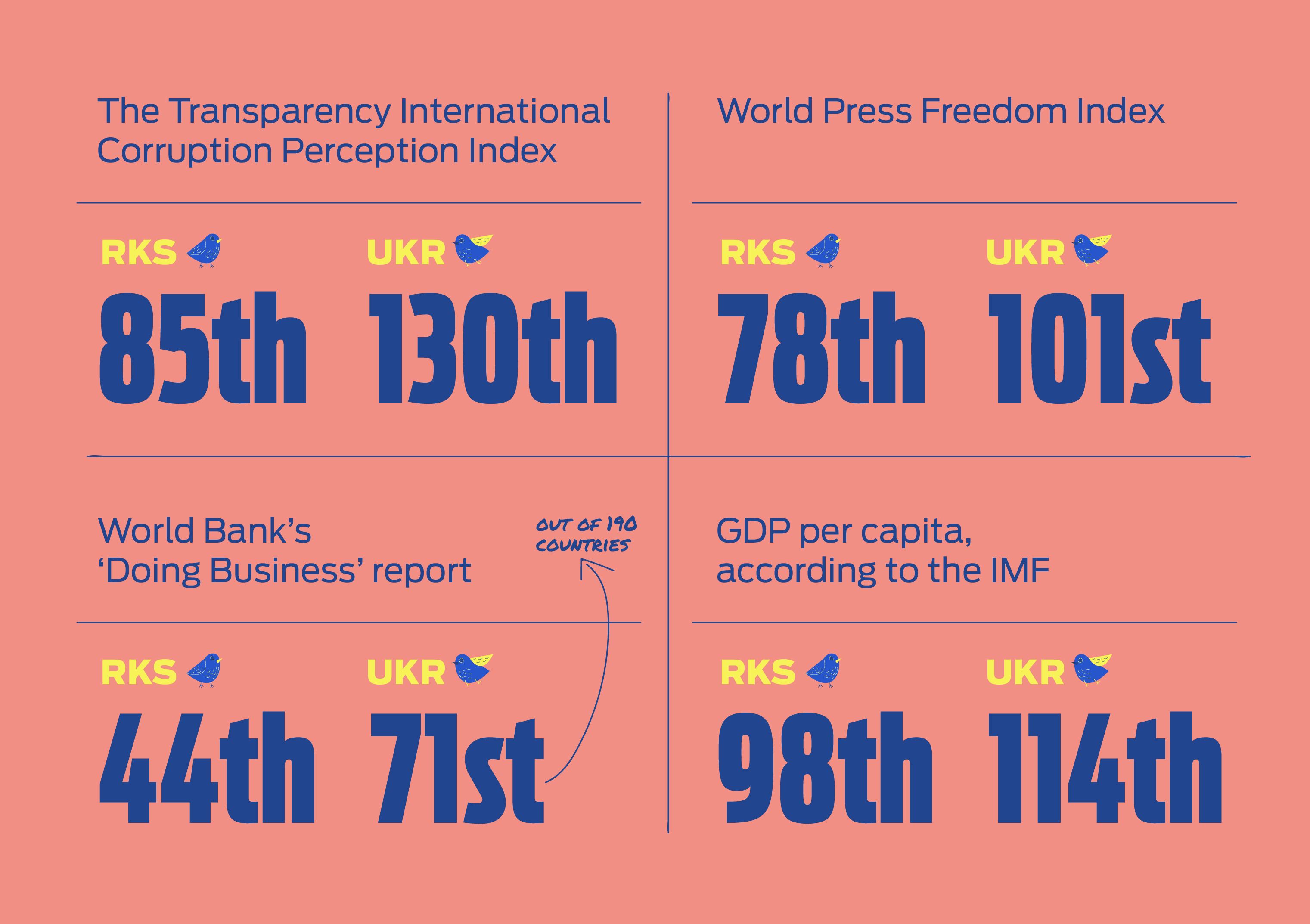
If we compare the case of Kosovo with that of Ukraine, there is clear evidence that the visa liberalization process is an example of how the EU employs asymmetric policies. To reflect this claim, Ukraine ranks lower than Kosovo in most, if not all international 'indexes,' ranking systems that use expert opinions, reports and surveys to draw conclusions on states' progress in the areas of social, political and economic development.

Illustration for Prishtina Insight: Jeta Dobranja/Trembelat.

The Transparency International Corruption Perception Index ranks Kosovo as 85th and Ukraine as 130th in their 180-country ranking of perceived public sector corruption. Furthermore, the World Press Freedom Index ranks Kosovo 78th, with Ukraine coming in at 101st in their assessment of the countries' media freedom.

Also, the World Bank's Doing Business' report ranks Kosovo significantly higher than Ukraine. Kosovo ranks 44th whereas Ukraine is 71st out of 190 countries in their estimation of countries' progress in access to the labor market.

In terms of GDP per capita, according to the International Monetary Fund, IMF, Kosovo ranks 98th, with 4.5 thousand dollars per capita, and Ukraine 114th, with 3.13, a useful benchmark to compare Ukraine's population of 45 million people and Kosovo's less than two million.

What distinguishes the case of Kosovo from that of Ukraine and Georgia is the presence of the EU Rule of Law Mission in Kosovo, EULEX, which operated with executive powers from 2008 to 2018. These powers gave EULEX the right to investigate, prosecute and judge cases independently from the Kosovo authorities, and its employees and decision makers were not accountable to the Kosovo government or its people.

EULEX deployed a combination of civilian and police personnel with the purpose of introducing a rule of law culture, improving negotiations with Serbia and strengthening local institutions. This made Kosovo the largest per capita recipient of EU financial aid in the world, and home to the largest bloc of civilian crisis management personnel.

In 2012, the European Court of Auditors reported that EULEX has not been sufficiently effective in its mission. According to the report, EU member states seconded an insufficient and unqualified staff to EULEX. The Mission was shaken twice: its first scandal broke out in 2014 when the EULEX prosecutor Mariah Bamieh accused one of the judges of taking bribes. Three years later, Malcolm Simmons, the chief judge of EULEX, resigned and unleashed a string of accusations against the organization. In response, EULEX then revealed that Simmons himself was the subject of several investigations into alleged serious wrongdoing.

Long story short, the most expensive mission of the EU has failed to deliver. Ironically, the mission in charge of fighting corruption experienced its own internal corruption scandals. Huge investments, minor progress and corruption damaged the EU's reputation in Kosovo.  

Today, corruption and organized crime remains high in Kosovo. In fact, according to the yearly European Commission report on the EU's enlargement policy, since 2008, there has been an increase in corruption in Kosovo.

The Kosovo judiciary continues to suffer from inefficiency, lack of transparency and political interference, and EULEX's biggest failure is its negligence and incompetence concerning Kosovo's most serious crimes. EULEX is not the one to be blamed for corruption in Kosovo, however, it failed to achieve the primary objectives of its mission, fighting corruption and strengthening the rule of law.

Kosovo has fulfilled all required conditions, including the two outstanding requirements; ratification of the border demarcation agreement with Montenegro and strengthening track record in the fight against organized crime and corruption. It stands better than Ukraine on its perceived corruption levels, press freedom, GDP per capita, and doing business.

Despite this, many countries, even those that are so-called friends of Kosovo, are skeptical of supporting visa liberalization. Some hold the belief that it would produce a wave of Kosovo migrants into the EU.

The fear that Kosovars might 'invade' Europe illegally and produce instability doesn't stand, at least considering the above-mentioned statistics. Even in the worst-case scenario, if all Kosovars migrate to the EU, that is still only four percent of the total population of Ukraine.

Kosovo has many socio-political problems, corrupt politicians, a fragile rule of law and an unstable economy. However, it stands better than Ukraine on almost all fronts according to international data. Kosovars have made many compromises through the years, such as the approval of the Kosovo Specialist Chambers in the Hague and the adoption of the border demarcation agreement with Montenegro, things that were extremely hard to pass at the Assembly due to their unpopularity among the Kosovo people.

Visa liberalization is not European integration, although Kosovo politicians try to sell it as such. Visa liberalization is simply free movement and the advantages that come with it. The people of Kosovo are being punished and treated differently than other countries and this must change.

The EU is directly responsible for the lack of progress on the fight against corruption and organized crime in Kosovo because they have invested large sums of money into the areas highlighted as criteria for a visa-free regime, but without the results. Saying that Kosovo needs to fight corruption more in order to enjoy the freedom of movement in the EU is hypocritical, and only works to highlight their own shortcomings.

The opinions expressed in the opinion section are those of the authors only and do not necessarily reflect the views of BIRN.

Visar Xhambazi is a research fellow at Prishtina Institute for Political Studies (PIPS). He holds a Master's degree in International Studies from Old Dominion University in Virginia, specializing in US foreign policy and international relations.

Feature illustration for Prishtina Insight: Jete Dobranja/Trembelat.


March 24, 2019

78 Days of Bombing Yugoslavia - (DOCUMENTARY)


https://youtu.be/_ddjyv80kgQ

Hellbent: 78 Days of Bombing Yugoslavia - (DOCUMENTARY)


Two decades ago, NATO started its 78-day bombing campaign against Yugoslavia. RT America's Alex Mihailovich revisits the Balkans to recall how the intervention happened and see the harm the people in the Balkans still suffer from.


The 1999 NATO operation was the culmination of Yugoslavia's decade of bloody dissolution, which split the entire region along ethnic and religious lines. Mihailovich was there when the cruise missiles started hitting Novi Sad and other major cities. Touted as a surgical humanitarian intervention to stop the violence in Kosovo, in reality, Operation Allied Force killed more civilians than troops and devastated civilian infrastructure of the nation.

It had plenty of unintended consequences too, from hitting a civilian train, a marketplace and the Chinese Embassy, to polluting the land with depleted uranium. The toxic substance is used for armor-piercing munitions and is believed to be the cause of a spike of cancer cases today.


The political legacy is arguably as toxic as the medical. Kosovo, the area split with the help of NATO battering, remains unrecognized by plenty of nations and turned out to be a bountiful recruiting ground for jihadist groups like Islamic State. And ethnic divisions in the Balkans don't seem any less severe.

Watch RT documentary 'Hellbent: 78 Days of Bombing Yugoslavia' to learn more.


Reflections on the 20th Anniversary of the NATO Bombing of Yugoslavia

balkanist.net

Memories of a Bombardment: Reflections on the 20th Anniversary of the NATO Bombing of Yugoslavia - Balkanist


CONTINUED:  http://balkanist.net/memories-of-a-bombardment-20th-annivesary-of-the-nato-bombardment/

March 22, 2019

The tragedy of Kosovo

spiked-online.com

The tragedy of Kosovo

Philip Hammond

12-15 minutes


Twenty years ago this week, NATO launched its first major military campaign. The US, Britain and other NATO powers pounded Serbia for 78 days. This was not a purely military operation: NATO also destroyed what it called 'dual-use' targets, such as factories, city bridges, and even the main television building in downtown Belgrade, in an attempt to terrorise the country into surrender.

The Kosovo War was the final chapter in the break-up of what was then Yugoslavia. The province's ethnic-Albanian majority faced rising repression throughout the 1990s, while most of Yugoslavia's constituent republics broke away — through protracted bloody conflicts in the cases of Croatia and Bosnia. Although the official policy of Kosovo-Albanian leaders was non-violence, the growing influence of the armed separatists of the Kosovo Liberation Army (KLA) led to increasing attacks on the central state authorities and on Kosovo's Serbian minority.

As they had done in Croatia and Bosnia, Western governments threw fuel on the flames by supporting the separatists, while portraying themselves as peacemakers. NATO leaders were fully aware that, as the UK's then defence secretary George Robertson admitted on the day the bombing began, until early 1999 'the KLA were responsible for more deaths in Kosovo than the Yugoslav authorities had been'. As NATO also knew, the KLA strategy was to escalate conflict, precisely in order to precipitate Western action. One Kosovo-Albanian leader told the BBC afterwards: 'The more civilians were killed, the chances of international intervention became bigger, and the KLA of course realised that.'

So it was that the world's most powerful military alliance could present its assault on a small European country as a 'humanitarian' operation. Initially, the idea was that bombing would prevent a refugee crisis. As then prime minister Tony Blair put it at the time: 'Fail to act now, and [we]… would have to deal with the consequences of spiralling conflict and hundreds of thousands of refugees.' Predictably, the effect was the opposite: the bombing itself led to exactly these consequences as conflict within Kosovo intensified.

NATO's response was to ratchet up the propaganda, denouncing the Serbs as 'Nazis' committing 'genocide' in Kosovo. NATO leaders were helped by sycophantic media coverage, since most journalists were already fully on-board with the idea that the West was a force for 'good' against 'evil' in the post-Cold War world. It is a story we have heard many times since: NATO's Kosovo campaign was held up as a supposedly successful model by those arguing for military action against Iraq in 2003, Libya in 2011, and Syria in 2018.

But this idea is well past its sell-by date. The argument for 'humanitarian military intervention' is always that the ends justify the means: that the risk of death and destruction in the short term will be vindicated by the ultimate goal. At the end of the Kosovo conflict, Blair pledged that the international community would 'build a Kosovo which, in the end, will be a symbol of how the Balkans should be'. Twenty years on, they have had ample time to make good on that promise.

How the Balkans should be?

The distance between rhetoric and reality gapes widest in relation to the claim that, as Kosovo's EU-approved constitution proclaims repeatedly, it is 'a multi-ethnic society'. This, after all, is supposedly what the war was all about: Blair claimed at the time that 'it was fought for [the] fundamental principle… that every human being, regardless of race, religion or birth, has the inalienable right to live free from persecution'.

As he spoke, tens of thousands of Kosovo Serbs were fleeing the pogroms that immediately followed the war. Many thousands more have left in the years since, because NATO intervention did not resolve the underlying conflict. Serbia still claims jurisdiction over the province, but constant low-level violence, intimidation and harassment continue to make normal life impossible for Kosovo's Serbs and other minorities. Eruptions of serious violence occurred in 2004, 2008, 2009 and 2011.

Post-war Kosovo is not a peaceful place, and – despite being the only place in the world where you can meet someone named Tonibler walking down Bill Clinton Boulevard – in recent years it has exported more militant jihadis per capita than anywhere else in Europe. According to a 2017 report by the UN Development Programme, over 300 young men from Kosovo went to join Islamic State in Syria, some climbing 'to the top of the ISIS hierarchy', while others have 'carried out attacks on Western Europe and in the USA'.

Some commentators have blamed the influence of the Saudi-funded Islamic charities who set up in Kosovo after the war, possibly unaware that the KLA used to be an importer of jihadis. As the British author Mark Curtis has pointed out, Western intelligence agencies knew about the KLA's active collaboration with al-Qaeda before the war. The response of NATO governments at the time was to supply arms and training.

Many analysts point to stalled economic development as a key 'push factor' driving a rise in extremism, and indeed Kosovo has the lowest per-capita GDP in the region. Unemployment is at over 30 per cent (around four times the European average and worse than Greece at the height of its recent economic crisis), rising to over 55 per cent for youth unemployment. Yet many more people have left Kosovo in search of jobs than have travelled abroad in pursuit of martyrdom. Rather than straightforward economic immiseration, probably the more significant factor is a wider sense of disenchantment with the reality of 'independent' Kosovo.

The 'failed state' built by the West

Kosovo today is the product of years of intensive international intervention. It was ruled directly by the United Nations Interim Administration Mission in Kosovo (UNMIK) from the end of the war in June 1999. In 2008, Kosovo declared itself an independent state – but this was 'supervised independence' under the auspices of the European Union Rule of Law Mission in Kosovo (EULEX). Even since formal supervision officially ended in 2012, extensive international oversight has continued: a recent study noted that the US and EU are 'vigorously and persistently intervening in [Kosovo's] internal affairs'. There are still around 4,000 NATO troops and over 500 EULEX staff in Kosovo, plus the office of the European Union, the 500-strong Organisation for Security and Cooperation in Europe mission, and the United Nations Kosovo Team comprising 19 agencies and hundreds of staff.

Kosovo, in other words, is a showcase for Western state-building efforts – it has received more aid per capita than anywhere else – just as the 1999 NATO intervention was itself a showcase for what Blair called the 'doctrine of international community'. Yet the outcome, according to international relations academic Aidan Hehir, was that 'the West built a failed state in Kosovo'. Or as another scholar, Arolda Elbasani, puts it: 'Even when endowed with massive resources and unlimited powers, the international community has not been able to deliver on its own set of goals: a multi-ethnic, functional and democratic state.'

Instead, it has delivered a virtually mono-ethnic, dysfunctional state where minorities have either fled or live in precarious enclaves, and where voters have become disillusioned by the corruption and criminality at the highest levels of the ruling institutions.

A 2005 UN report highlighted 'organised crime and corruption' as the 'biggest threats to the stability of Kosovo', noting that 'the government has not taken the necessary… action to fight organised crime and to prevent corruption'. Yet this was during the period of direct UNMIK rule, so if anyone was going to take action it would presumably have been the UN itself. Matters did not improve under the supervision of the EU. A 2010 Council of Europe report on 'Inhuman treatment of people and illicit trafficking in human organs in Kosovo' documented 'shady, and in some cases open, connections between organised crime and politics, including representatives of the authorities'. Its findings were confirmed by another investigation in 2014.

'State capture' and Western evasion

Many of these problems are personified by former KLA leader Hashim Thaçi. Immediately after the war, the KLA became the 'Kosovo Protection Corps': Thaçi commanded it, as well as heading the provisional government. He led Kosovo to self-declared independence as prime minister in 2008, and since 2016 he has been Kosovo's president. Once fêted in the West as 'the George Washington of Kosovo', Thaçi was identified in the 2010 Council of Europe investigation as the boss of the 'Drenica Group' – former KLA leaders turned 'criminal entrepreneurs' who have engaged in murder, kidnap and unlawful imprisonment, who exert 'violent control over the trade in heroin', and who have 'designs on a form of "state capture"'.

Even sympathetic analysts have acknowledged the problem of 'state capture' in Kosovo, whereby 'state resources and institutions are used for private ends', involving 'pervasive' networks of corruption and patronage that hold back development. Understandably, many are frustrated with the lack of progress. Yet ultimate blame for Kosovo's problems lies with the West.

The mayor of Priština, Shpend Ahmeti, is surely right when he argues that the local problem of 'state capture' is the outcome of the EU's preference for 'stability over democracy'. As Hehir also suggests, it is precisely because Kosovo has been a showcase for international state-building that the Western supervisors of Kosovo have been reluctant to confront its problems. Certainly in the period of direct rule, the priority was to maintain a façade of stability rather than risking the conflict that would result from tackling the sordid reality of Kosovo's mafia-style politics. Given the lack of improvement, it seems likely that the EU's belated 'discovery' of the KLA's extremely well-known criminal connections, and their increasing preoccupation with 'state capture' by the very people they groomed to take charge, are just further attempts to dodge responsibility.

Ironically, one consequence of this evasive approach is that the EULEX mission – set up with the express purpose of fighting corruption and upholding the rule of law – has itself become mired in corruption scandals. In 2014, EULEX prosecutor Maria Bamieh demanded a corruption inquiry against her own colleagues, but EULEX responded by sacking her. Bamieh says she had been told by the UK Foreign Office to ignore evidence of corruption. In 2017, chief EULEX judge Malcolm Simmons resigned, alleging corruption and political interference, but then became the subject of counter-accusations of criminal conduct, and revelations that he had never been qualified to act as an international judge in the first place.

Whatever the truth of these various allegations, it seems clear that, as one former EULEX employee reportedly said of the mission, 'there's little demand for accountability, because there is ultimately more concern for job protection'. Others have also identified the relationship between international organisations with 'expansive powers' but no 'line of authority or accountability', and the wider 'sense of general malaise and malfunctioning' in Kosovo society. In Elbasani's damning description: 'International staff travelled around Kosovo in luxury cars, frequented upmarket cafés that catered specifically to them and lived exclusive lifestyles [which] set them a world apart from the impoverished and dysfunctional polity they helped to create.'

The people attacked by NATO in 1999 certainly won't be celebrating this month, but it seems equally unlikely that the anniversary will generate much enthusiasm among those whom the intervention was supposedly designed to help.

Philip Hammond is professor of media and communications at London South Bank University and is co-editor, with Edward Herman, of Degraded Capability: The Media and the Kosovo Crisis.

Picture by: Getty.


February 27, 2019

Janusz Bugajski: Moscow’s Balkan Partition Strategy

cepa.org

Moscow's Balkan Partition Strategy

6-7 minutes


MOSCOW'S BALKAN 
PARTITION STRATEGY

What Are the Kremlin's Ulterior Motives for Backing Balkan Land Swaps?

For Washington, a potential territorial exchange between Serbia and Kosova could normalize relations between the two states and help stabilize the wider region. For Moscow, the prospect of land swaps can add a new dimension to its divide and conquer plans in the Western Balkans and establish usable precedents elsewhere.

In recent

months, the prospect of border adjustments between Kosova and Serbia has been at the center of political debate throughout the region. Although any such plans are tentative and high-level discussions have not been transparent, even raising the legitimacy of territorial changes has sparked both hope and fear in several states. When Washington reportedly gave the green light to such negotiations between Belgrade and Prishtina, Moscow pounced on a new opportunity to foster conflict and promote its influences.

During the disintegration of Yugoslavia in the 1990s, Russian officials backed Slobodan Milošević's plans for a larger Serbian state that would encompass Montenegro, Kosova, half of Bosnia-Herzegovina, and parts of Croatia. They were not averse to changing the borders of former Yugoslav federal units in order to strengthen their main ally in the region. The Kremlin also calculated that Balkan border adjustments could bolster its own plans to carve up former Soviet republics and enlarge the Russian Federation.

Russia's new partition strategy in the Western Balkans has emerged in the past few months with several overlapping goals. The first objective is to create fissures among Albanian politicians and divide Albanian societies in Kosova, Albania, and Macedonia. Albanian populations are not only renowned for being staunchly pro-American, they are also deeply resistant to Russian political and economic penetration. Moscow may now exploit any emerging divisions over border changes to implant itself.

In Kosova there is a growing disconnect between those who support and oppose a transaction involving sections of Kosova's four northern municipalities in exchange for parts of three Serbian municipalities in the Preševo Valley. Moreover, any closed-door discussions inevitably beget rumors that can be exploited by provocateurs to inflame political disputes.

Kosova's President Hashim Thaçi and Prime Minister Ramush Haradinaj have expressed diametrically opposed positions on border shifts. Thaçi met with Putin during the Paris Peace Forum in November 2018 and reportedly discussed the territorial question. It is worth remembering that the Russian leader regularly whispers disinformation to foreign leaders to test their reactions and plant ideas that suit Kremlin interests.

After his recent visit to Washington, Thaçi declared that he had received guarantees that Russia would recognize Kosova once an agreement with Belgrade was implemented that could entail border adjustments. However, any pledges by the Kremlin must be treated with enormous caution, as Putin is notorious for breaking agreements that suit his larger ambitions, whether these are arms treaties with the United States or border agreements with neighboring countries.

A second Kremlin goal is to exacerbate divisions between Serbs and Albanians so that neither Serbia nor Kosova can enter NATO or the EU. The most effective way to close doors to membership is by creating diversions that foster inter-state conflicts so the disputants are viewed as unfit for accession. Moscow is well aware that both Serbian and Albanian nationalists will pounce on the prospect of territorial acquisitions and can be encouraged to pursue more ambitious irredentist claims, such as dividing Bosnia-Herzegovina, Montenegro, or Macedonia.

It is unclear whether the Serbian government is fully aware of Moscow's ploys or whether it is being duped. President Aleksandar Vučić needs to be mindful that Serbia could be drawn into more protracted conflicts with neighbors by working too closely with Russia. Belgrade's stated goal in forging an agreement with Kosova is for Serbia to gain faster entry into the EU. But why should the Kremlin assist Vučić in an EU accession endeavor that it has tried to quash in Ukraine, Moldova, Georgia, and elsewhere?

As Russian officials drive wedges between the region's capitals, they can simultaneously offer regional settlements and inject themselves as mediators to reduce the role of NATO and the EU. By purportedly assisting in resolving regional conflicts, Moscow also calculates that it can gain additional advantages, whether in lessened Western opposition to its gas projects in Europe or a special status with diplomatic immunity for its intelligence base in southern Serbia.

A third motive for Russia's support for Balkan land exchanges is to establish usable precedents, particularly for its own partition of Ukraine, Georgia, and Moldova. Moscow's coerced border adjustments can be propagandized as legitimate moves that mirror Western support for ethnic homogenization in the Balkans. This would help reduce calls for sanctions and other punishment against Russia for carving up its neighbors' territories.

In an ideal world, a bilateral border exchange between Serbia and Kosova could be arranged without provoking political conflicts, ethnic resentments, or irredentist claims. But conditions in the Balkans and other regions where the Kremlin has injected its influences are far from ideal. With "normalization" between Serbia and Kosova as the tempting prize, Western actors may be stepping into a partition trap whose unintended consequences may prove more far-reaching than was bargained for.

Europe's Edge is an online journal covering crucial topics in the transatlantic policy debate. All opinions are those of the author and do not necessarily represent the position or views of the institutions they represent or the Center for European Policy Analysis. 

Photo: "Vladimir Putin in Serbia March 2011-1" by premier.gov.ru under CC BY 4.0.

Janusz Bugajski
25 February 2019


January 29, 2019

What the Evolution of NATO's Missions Means for the Future

nationalinterest.org

What the Evolution of NATO's Missions Means for the Future

by Ted Galen Carpenter

8-10 minutes


Throughout the Cold War, American and European leaders consistently portrayed NATO as a defensive alliance. They emphasized the peaceful nature of their cooperation in contrast to the Kremlin’s record of belligerence and aggression. Moscow’s brutal suppression of even modest political deviations within its East European satellite empire helped confirm the proclaimed difference. Soviet tanks rolled into East Germany in 1953, Hungary in 1956, and Czechoslovakia in 1968 to crush reform movements. Western insistence that the Soviet Union was a dangerous aggressor while NATO was a purely defensive association was quite credible.

Unfortunately, post-Cold War NATO’s image as a collection of democracies pursuing defensive objectives corresponds less and less to reality. Robert W. Merry, former editor of Congressional Quarterly, the National Interest , and the American Conservative , aptly observes that instead of appreciating how the end of the Cold War and the demise of the Soviet Union was a boon to the security of the West, U.S. and NATO leaders “turned NATO into a territorial aggressor of its own.” He concludes that NATO today is “a danger, not a guarantor of peace.”

Avoidance of offensive actions and objectives disappeared early in the post–Cold War era. The interventions in Bosnia and Kosovo emphatically transformed NATO from a defensive alliance designed to deter or repel an attack on its members into an organization with an offensive orientation. In Bosnia, the Alliance used force simply to prevent a secessionist movement from succeeding; no aggression against a NATO member had taken place. Four years later, NATO attacked a sovereign state, Serbia, recognized by the international community, to detach one of its provinces, Kosovo. Once again, the target of NATO’s military wrath had not committed the slightest act of aggression—or even threatened to do so—against any Alliance member.

The rationale for NATO military action had expanded dramatically. Citing a security justification for the interventions in the internecine Balkan conflicts flowing from the breakup of Yugoslavia required a major stretch of logic. Even most NATO partisans knew better than to emphasize such a far-fetched rationale. Instead they focused on the alleged need to prevent a humanitarian tragedy . Even that justification failed to hold up to any serious scrutiny.

A few NATO traditionalists were decidedly unhappy about the Alliance’s new missions or expanded geographic focus. Writing at the time of the Kosovo war, Washington Post columnist Charles Krauthammer was caustic about the increasing focus of the “new NATO” on out-of-area missions. “What was wrong with the old NATO?” he asked rhetorically. “For the clever young thinkers of the [Clinton] administration,” Krauthammer added sarcastically, the Alliance’s traditional deterrence mission apparently was “too boring.” He accused them of suffering from “Acheson envy,” by wanting to create a memorable new international order. Worse, he saw them as wanting to refashion NATO as “a robust, restless alliance ready to throw its weight around outside its own borders to impose order and goodness.”

Krauthammer’s observations were extremely perceptive, but even with his prominence in the American foreign-policy community, his concerns about NATO’s new focus and the dangers it posed, went largely unheeded. NATO continued to become an increasingly offensive alliance with an ever-expanding out-of-area orientation.

Indeed, as transformative as the Bosnia and Kosovo interventions were, they at least occurred in Europe, albeit outside the formal boundaries of the Alliance. Even during the Cold War, NATO (and especially the United States) maintained informal, but important, security ties to Yugoslavia. Washington also made it clear to Moscow that any military aggression against Yugoslavia would be considered a serious threat to the transatlantic community, even though the country was not a NATO member.

But other NATO military missions now take place far outside the European theater. That point became evident following the September 11, 2001, terrorist attacks on the United States when NATO members invoked Article 5 of the North Atlantic Treaty, which proclaims that an attack on one member will be considered an attack on all. Thereafter, Germany and other Alliance members sent forces to assist the U.S. military campaign in Afghanistan.

The new missions reflected a dramatic expansion of NATO’s geographic coverage. It had become a misnomer even to regard the Alliance as a “transatlantic” organization to protect the security of Europe and North America. Indeed, as the Afghanistan operation confirmed, the focus increasingly was on problems outside those two regions. That point was reinforced when a majority of NATO members joined the U.S.-led assault on Iraq to oust Saddam Hussein. It became evident again in 2011, when the United States backed its European allies, especially Britain and France, to launch military attacks against Libya. The ostensible purpose of the aircraft and cruise missile strikes was to thwart a bloodbath that Muammar el-Qaddafi’s regime might unleash on innocent civilians. The reality was that the intervention was another regime-change war.

The proliferation of such far-ranging missions has not been healthy either for NATO’s European members or the United States. Sending troops to Afghanistan entangled European forces in a messy, intractable war in a country that posed little threat to any of the European countries. In essence, NATO governments signed on to an amorphous, armed nation-building venture that Washington was pursuing. Conversely, a divided Obama administration signed on to a regime-change war in Libya that France and other European allies were pushing. In both cases, the resulting policies were ill-considered ventures that did not benefit the best interests of either the United States or its European partners.

Indeed, a major reason why Islamic radicals have attacked targets in Europe is because of the involvement of those countries in U.S.-led wars in the Muslim world, especially Iraq and Syria. The perpetrators of the December 2015 terrorist attack on the Bataclan concert hall in Paris shouted out: “This is for Syria!” France had joined with its NATO allies to back the U.S.-dual campaign to oust Syrian leader Bashar al-Assad and eradicate ISIS. French aircraft had been bombing ISIS-controlled areas for more than a year. The Paris attacks were bloody payback—as have been subsequent incidents in multiple NATO countries.

If increasing their exposure to America’s wars in the Middle East and Central Asia is now a crucial requirement of alliance burden-sharing, the Europeans would be wise to opt-out. That step might or might not cause the Trump administration to reconsider the U.S. commitment to NATO, but as Washington pushes the Alliance to adopt an increasingly offensive focus, and one outside of Europe at that, the allies could be making a major, self-destructive blunder to follow Washington’s lead.

At the same time, responding favorably to European calls for humanitarian or regime-change missions in the Balkans and North Africa, or for a needlessly confrontational policy toward Russia, is not in the best interests of the American people. The growing uneasiness on both sides of the Atlantic is evidence both of a fraying consensus about NATO’s proper role and the reality of a divergence in European and American security interests. The “old NATO” of the Cold War era is obsolete, and the “new NATO” of military interventions with vague justifications and a nearly boundless geographic coverage is a meddlesome aggressor.

Ted Galen Carpenter, a senior fellow in security studies at the Cato Institute and a contributing editor at the National Interest , is the author of twelve books and more than 750 articles on international affairs. His latest book is Gullible Superpower: U.S. Support for Bogus Foreign Democratic Movements (2019).


January 25, 2019

Assessing the revival of EU enlargement in the Western Balkans

blogs.lse.ac.uk

Assessing the revival of EU enlargement in the Western Balkans

8-10 minutes


Several efforts aimed at giving greater impetus to the EU enlargement process in the Western Balkans took place in 2018, but without securing substantive results. Anna Nadibaidze outlines some of the major challenges that remain for the process as the EU seeks to balance its aspirations for influence in the region against concerns over what future enlargement might mean for the EU's own stability.

Last year was supposed to demonstrate a significant revival of EU interest in the Western Balkans, with several key events designed to give new life to the region's European accession process. Under the Bulgarian presidency of the Council of the European Union, the European Commission revealed its new Enlargement Strategy paper, President Jean-Claude Juncker completed a tour of the region's capitals, and a top-level EU-Western Balkans Summit took place in Sofia in May.

As Austria took over the presidency, Greece and the Former Yugoslav Republic of Macedonia (FYROM) agreed on a deal to change the latter's name to Republic of North Macedonia – an issue which acted as an obstacle to Macedonia's EU and NATO accession path. Both Serbia and Montenegro opened new chapters in their negotiation processes, and the EU hosted several ministerial meetings for Serbian and Kosovo officials as part of their normalisation dialogue.

Despite these developments, there were also major setbacks in the region last year, many of which remain unresolved. Albania and Macedonia's accession processes have been delayed by a decision of the 2018 June European Council due to their lack of progress in reforms.

Tensions between Serbia and Kosovo sparked over a controversial border swap deal, the details of which remain unclear, despite EU Foreign Affairs High Representative Federica Moghereni's efforts at providing a platform for dialogue. The conversation stalled as Pristina imposed 100 per cent tariffs on Serbian goods, despite the EU condemning the move. In December, a decision of the Kosovo parliament to launch a military structure sparked further problems with Belgrade, and attracted warnings from the EU.


Federica Mogherini and Serbia's Aleksandar Vučić at the 2015 Western Balkans Summit, Credit: EEAS (CC BY-NC 2.0)

Romania, which took over the EU presidency in January, is seeking to maintain the region on its agenda. It is understandable why consecutive EU presidencies keep enlargement on their priority list. Enlargement is strategically important for the Union as a whole, because the Western Balkans continue to be crucial for the security of the EU's borders.

Brussels cannot ignore the fact that challenges such as migration, concerns over radicalisation, organised crime and the arms trade have an important impact on Euro-Atlantic security. European Parliament President Tajani said during his visit to Serbia last year, "Your security is our security," while Juncker warned, "Not too long ago, the region saw a fierce war. If we take away the Western Balkans' accession perspective, that could soon repeat itself."

Moreover, the slow progress of EU engagement with the region over recent years has encouraged other players, notably Russia, Turkey, and China, to get more involved. Serbia and Montenegro have a historically close relationship with Moscow, as demonstrated by President Vladimir Putin's visit to Belgrade on 17 January.

Feeling threatened by the EU's enlargement towards its traditional spheres of influence in Eastern Europe, Russia has been showing interest in building stronger connections with the Balkans. Although Moscow's actual political and economic attractiveness remains limited compared to the EU, Brussels will have more leverage in the region if it is prepared to engage with and respond to these external challenges.

The obstacles on the road to accession

The rationale for the Enlargement Strategy and other EU efforts is clear, but whether they have produced the desired results, or whether they will be effective in the near future, is debatable.

There is a whole laundry list of challenges in the region, the two main ones being the need for reforms and good neighbourly relations. For Serbia, the major obstacle is normalisation of relations with Kosovo, with the EU expecting to see a legally-binding agreement before Belgrade can finalise its accession. Border disputes remain unresolved, and the EU has been clear that it does not intend to import these conflicts. It already has to deal with tensions between two EU members, Slovenia and Croatia, who are unable to resolve their border issue.

Dealing with these problems will likely take many years, which leads to another challenge: accession fatigue. With the process having already taken a prolonged period of time, citizens of many Western Balkan countries are growing increasingly tired of politicians pushing for reforms, while not meeting expectations. In 2018, according to the Balkan Opinion Barometer, 26 per cent of the region's population believed that accession will never happen, 14 per cent expected accession to be in 2030, 24 per cent said it would happen in 2025, and only 12 per cent said 2020. While these dynamics vary from country to country, rising Euroscepticism should be counted as a challenge.

The EU's enlargement dilemma

On the European side, member states remain divided on the issue of enlargement, partly because of a concern about the consolidation of EU norms in countries that joined in 2004 and 2007. Recent flashpoints, such as Poland and Romania's judicial reforms, Bulgaria's corruption problems, as well as Hungary's turn towards 'illiberal democracy', cast doubt on these countries' willingness to implement EU laws. This inevitably leads to the fear of further clashes if some Western Balkan countries join the Union too quickly.

Public opinion also appears to be divided. A recent Eurobarometer poll shows 43 per cent of the EU public support "further enlargement of the EU to include other countries in future years," while 45 per cent are against. The support is mostly concentrated in 'new' member states from Central and Eastern Europe. Moreover, many EU leaders want to first reform the EU before moving on to enlargement. For instance, French President Emmanuel Macron mentioned that he was not in favour of widening the Union before deep reforms were carried out.

Brussels faces the dilemma of accommodating different positions in its enlargement plans. Some form of credible commitment to the Western Balkans is necessary to strengthen the attractiveness of the European model, deal with external influences, and importantly, show the EU's vitality after Brexit. The UK's departure will have an impact on the EU's redefinition of its global role, and engagement with the Western Balkans is one of the ways to demonstrate Brussels' willingness to remain a relevant actor.

At the same time, as it cannot push the process too quickly given many member states' reservations, the Commission's approach seems to be to keep the Western Balkans in a state of limbo, where the EU confirms the European perspective of the region, but where accession developments are based on merit and any time frames remain indicative.

Enlargement policy remains a powerful mechanism in the EU's foreign policy toolbox. It allows the bloc to have considerable leverage over its neighbourhood if the prospect of joining is credible. As seen with the recent efforts, the EU is aware of the Western Balkans' importance and tries to make use of its tools to address regional concerns, mostly over security.

But progress is being held back by problems in the region, and by internal EU disputes and fears of admitting more unstable countries into the club. Given these obstacles, the Commission will have to limit itself to statements and summits without making any firm promises, and continue engaging with the region, but without securing substantive results.

Please read our comments policy before commenting.

Note: This article gives the views of the author, not the position of EUROPP – European Politics and Policy or the London School of Economics.

_________________________________

About the author

Anna Nadibaidze – Open Europe
Anna Nadibaidze is a research and communications associate at the think tank Open Europe. She holds an MSc in International Relations from the London School of Economics.


January 22, 2019

Serbia as Vanguard of Russia’s Policy in the Balkans

valdaiclub.com

Serbia as Vanguard of Russia's Policy in the Balkans

7-8 minutes


On January 17, 2019, Russian president Vladimir Putin was warmly welcomed in Serbia. It was Putin's fourth visit to Belgrade – he came to Serbia twice as president and once as prime minister. According to Alexander Pivovarenko, Ph.D. in History, Senior Research Associate, RAS Institute of Slavonic Studies, today Russia's positions are highly dependent on the overall situation and a broad set of ties and interconnections in Southeast Europe.

The Balkans are not mentioned in Russia's 2016 Foreign Policy Concept (as distinct from the 2013 concept). Today Russia's positions are highly dependent on the overall situation and a broad set of ties and interconnections in Southeast Europe. As distinct from other countries, Russia's presence in the region is primarily limited to Serbia. In this way, Russia differs from Turkey, which can gather at the same table Aleksandar Vučić and the leader of the Bosnian Muslims Bakir Izetbegović, and carry out economic projects in Serbia's southern areas with considerable Muslim presence (Sanjak Region, and the Preševo, Bujanovac and Medvedja). Under the circumstances, it is only possible to talk about tactical goals, such as the launch of the TurkStream or one or two investment or infrastructure projects.

Consequences of Putin's visit for Serbia's prospects of joining the EU

Out of all the six Balkan countries (along with Bosnia and Herzegovina, Macedonia, Montenegro, Albania and the Republic of Kosovo), Serbia is the most likely candidate for the admission to the EU. Today, 2025 is mentioned as the year of Serbia's potential accession to the EU. Meanwhile, even if Serbia fulfils all of Brussels' requirements on Kosovo (full diplomatic recognition on the basis of the principle of inviolability of borders) its entry will not be guaranteed if the EU deems it inappropriate to expand again.

During the latest Russia-Serbia summit, the sides signed over 20 intergovernmental agreements, including those on nuclear power and IT. This is good progress because relations are becoming more diversified and less dependent on the oil and gas agenda. Recommendations of the experts who insisted on the diversification of bilateral relations were taken into account. However, their implementation may be complicated because one of the EU requirements is that Belgrade does not use the advantages from its decision not to join the anti-Russian sanctions.

Be that as it may, a broad package of agreements meets Belgrade's interests by giving it extra room for manoeuver in relations with Brussels and Washington. Belgrade can use this as a trump card by increasing or winding down the intensity of its cooperation with Moscow depending on how its relations with Brussels evolve.

Putin's visit may facilitate Belgrade's concessions to Kosovo

Paradoxically, this visit may facilitate Belgrade's concessions to Kosovo Albanians because official Belgrade is interested in resolving the Kosovo issue as soon as possible, even if this requires further concessions. In the past year and a half, Belgrade was subjected to diplomatic pressure from Brussels and Washington, while Aleksandar Vučić announced the start of a "sincere dialogue" that should eventually lead to the recognition of "the existing reality" and the elaboration of a "pragmatic peace treaty" with the Albanians.

Holding early parliamentary elections in spring, which was announced in late December, may be a possible scenario of developments in Serbia. The aim of the ruling party is to establish an overwhelming parliamentary majority that will result in automatic decisions, including on Kosovo. If this happens, it is possible to expect changes to be made to the Constitution of Serbia, namely in the provision on Kosovo and Metohija being an inalienable part of its territory. Today Vučić is facing considerable opposition that objects both to his style of running the country and his version of the agreement on Kosovo. Rallies take place in the center of Belgrade every day. Furthermore, Vučić does not enjoy the support of a number of high-ranking hierarchs in the Serbian Orthodox Church.

It is possible to say that the election campaign in Serbia has already started. Russia's support for the Serbian leaders during the January 17 visit, gives them a certain all-clear to make decisions that they deem expedient.

Serbia's role in TurkStream

The South Stream experience shows that it is too early to talk about a role before the project is launched. However, Serbia's position has not changed. It is from its territory that gas will be transported to the rest of the EU. Serbia's location also allows for the construction of branches to neighboring countries from its territory. A decision to expand the Banatski Dvor underground gas storage shows that Serbia can become a major hub for the Russian energy.

Meanwhile, like in the situation with the previous project, Serbia's position is dependent and this time not only on Bulgaria but also on Turkey, whose role has increased considerably since the launch of the TANAP gas pipeline. Its role will become even bigger after the Trans Adriatic Pipeline (TAP) is put into operation. Its readiness is estimated at 82 percent. TAP will pass through the territory of Greece and Albania. Considering the EU's positive attitude to the Turkish project, branches are likely to be built to the north towards Croatia, thereby creating competition with the Russia-Serbia route. All this will make Belgrade more receptive towards the position of Ankara, Washington and Brussels.

It is important to remember the US plans to build an LNG terminal in Croatia and the development of the shelf on Cyprus, over which Turkey and the EU have now clashed. The future of all these projects should become clear in 2019.


Serbia After Putin's Visit

The most important political event at the beginning of this year in Serbia was the official visit by President of Russia Vladimir Putin and the Serbian authorities' muscle flexing, designed to show the EU, Kosovo and the opposition that Moscow loves Serbia. The Serbian authorities plan to use this situation to win the upcoming elections this spring and also to strengthen their position in relations with the EU and the United States.

Follow the link

© Sputnik/Mikhail Klimentyev


January 11, 2019

The Balkan Blues

ips-journal.eu

The Balkan Blues

7-9 minutes


Read this article in German.

It has been more than twenty years since the Yugoslav Wars and the European Union has maintained a strong presence in the Balkans ever since. It has taken on direct military and political responsibility in Bosnia-Herzegovina (EUFOR terrestrial force) and Kosovo (EULEX rule of law mission) respectively. Then there are the accession assurances to all six West Balkan states and active negotiations with two of them – Serbia and Montenegro. Last but not least, the accession of Romania and Bulgaria in 2007 anchored the EU in the region. Yet the results of the last two decades are hardly encouraging: the Balkan remains the powder keg it has always been, and not even the two member states Romania and Bulgaria have been able to apply European standards and drive economic development forward.

By and large, this unsatisfactory state of affairs can be attributed to two factors. Firstly, the region is still riven by a range of ethnic and national divides. Secondly, other external powers such as Russia and Turkey, but also China and some Arab states, are increasing their presence in the Balkans, clashing with NATO expansion and the US role in the region which seeks to uphold stability at almost any cost.

Taken in the context of the stagnating or, in some cases, retrograde development of democratic structures and socio-economic conditions in the region, these factors represent a latent threat to the security of a Europe already facing enough crises on its eastern and southern flanks. A policy focussing on preventing and avoiding conflict in south-eastern Europe must therefore be a strategic priority for the EU.

The EU-US-Russia triangle

So how can conflicts in the region be diffused? To start with, Brussels would have to give some contours to its strategic interests in the area. The Strategy for the Western Balkans of February 2018 focusses, as usual, on EU enlargement. However, the block needs to move away from its emphasis on integration in favour of transformation, as outlined in a study by the FES South-Eastern Europe Office in April 2018. Considering that the EU's prevailing wisdom of 'a credible accession perspective being key to transformation' is eminently dubitable, it's more important to create a sustainable framework for genuine political stability – rather than the superficial kind which currently passes muster.

The primary interest of the EU in the Balkans, however, is stability.

Moreover, there should be more clarity about the divergence in US and EU strategic interests vis-à-vis the Balkans. With the caveat that no-one can really know what interests Donald Trump is pursuing in the region, it's already obvious that strategic thought in the US State Department and the Pentagon is still very much dominated by the Cold War doctrine of containing Russia. As such, their goal is to keep up the pace of NATO expansion into south-eastern Europe with the aim of pushing Russia out. The integration of Bulgaria, Romania, Albania, and Montenegro into the North Atlantic alliance has already gone some way towards achieving this objective. Macedonia is next up.

It's also evident that Moscow will not simply sit back and watch this happen. Only recently, the Russian Minister of Foreign Affairs Sergei Lavrov warned countries in the region of 'succumbing to the false dilemma' of feeling forced to opt for either Moscow on the one hand of Washington and Brussels on the other.

The Balkans are a geopolitical chessboard

These geopolitical considerations are nothing new in the Balkans. In 1904, British geographer Halford Mackinder, one of the fathers of political geography as a discipline, defined eastern Europe as a core region from which the Eurasian landmass could be dominated – and, by extension, the world.

In his book The Grand Chessboard, American political scientist and security advisor to President Jimmy Carter, Zbigniew Brzezinski, followed Mackinder's line of thought and argued that NATO's eastwards expansion was essential to American dominance in Eurasia. Yet this strategy only worked for as long as Russia under Boris Yeltsin was bereft of power. Under Vladimir Putin, the state of play has changed markedly. Now, Moscow too is scrabbling to erect its own spheres of influence, having first and foremost beefed up its military capabilities quite substantially.

The primary interest of the EU in the Balkans, however, is stability. And indeed, it has already managed to at least achieve an appearance of it – at the price of subordinating its noble aims of establishing democracy, human rights, and pluralistic societies to the reality of the mostly corrupt and authoritarian elites of the region.

The most striking example of this process is Montenegro, where Milo Đukanović – who, in a variety of functions, has ruled the country for a quarter of a century now – has managed to morph from a pro-Russian satrap to the Darling of the West without losing his grip on power.

The EU could, and therefore should, act as the go-between here, aiming to erect a regional security architecture which includes Turkey and Russia – and doesn't side-line Moscow.

Then there are the EU's quasi-protectorates Bosnia and Kosovo, where problems are simply piling up: without the protection of the US, for instance, the Kosovan leadership would be up before the International Court of Justice in Den Haag. According to Europol, the country has become the continent's hub for Afghan heroin as the international (primarily European) administration looks on.

Meanwhile, by virtue of its extensive cannabis plantations, neighbouring Albania (now a NATO country) has come to be considered 'Europe's Colombia.' In Bosnia-Herzegovina, the international administration has not yet been able to resolve the institutional logjam and the proportional ethnic representation at the heart of the Dayton agreement. Only Macedonia, with its democratic handover of power, offers a glimmer of hope in the region.

The EU needs to act as a mediator

Genuine stability in the region would mean taking a preventative approach towards solving its problems. This would mean resolving the open border issue between Albania and Serbia through a peace accord which brings together both local entities and external protagonists on the regional scene (i.e. Turkey on the Albanian and Russia on the Serbian side).

The EU could, and therefore should, act as the go-between here, aiming to erect a regional security architecture which includes Turkey and Russia – and doesn't side-line Moscow. Doing so would put pressure on the region's autocrats, but would be predicated on a moratorium on further NATO expansion and a more closely integrated European foreign and defence policy of the kind envisioned by Emmanuel Macron.

All of this would, all things told, be the only way to stop EU aid from trickling away into obscure channels, as it currently does, and ensure that it actually reaches the populations it's intended to help. This kind of security architecture would provide resolution to the Serbian/Albanian conflict and also allow the EU to surmount the current enlargement dilemma between stabilisation and democratisation.

After all, it cannot be in the interests of the citizens of the six west Balkan states to become official EU members on the back of administrative reforms without being really equipped to benefit from accession: the example of the current Romanian Presidency of the European Council, marred by the country's endemic corruption and the anaemic rule of law, should serve as a salutary lesson here.


January 07, 2019

What Is Orthodox Christmas?

ibtimes.com

What Is Orthodox Christmas? Facts, Photos Of Celebrations

By Vaishnavi Vaidyanathan 01/07/19 AT 6:56 AM

3-4 minutes


Orthodox Christians in some parts of Europe and other countries including Russia, Ukraine, Georgia and Serbia celebrate Christmas on Jan. 7, two weeks after those from Western churches.

The 13-day gap is because Orthodox Christians follow the Julian calendar while majority of Christians, from other denominations, follow the modern day Gregorian calendar. Though the Julian calendar was revised and re-introduced in 1923 in order match it with the Gregorian calendar, only some countries like Cyprus and Romania have adopted it.

“December 25 for Orthodox Christians on the Julian calendar actually falls on January 7 on the Gregorian calendar. So strictly speaking, Christmas is still kept on December 25, which just happens to fall 13 days later on the Julian calendar day,” Archimandrite Christopher Calin, dean of the Russian Orthodox Cathedral of the Holy Virgin Protection said, the Christian Post reported.

The festival is also celebrated differently by Orthodox Christians. Though some aspects like the Christmas tree and giving gifts are common, Orthodox Christians focus primarily on the spiritual side of the season. This includes fasting and charity.

“We focus more on the aspect of the incarnation of Christ and the cosmic salvation it has for all mankind. While many of the external trappings are the same, like Christmas trees, wreaths, ribbons and gifts, there is an increased emphasis on the spiritual reality of this truly miraculous mystery of God becoming man, so that man may be united to God and each other,” Calin said.

They observe a 40-day fast before Christmas and avoid eating meat during the season. On the Christmas Eve, they have a meal consisting of 12 meat-free dishes — one for each of the 12 apostles. Some of the dishes includes sauerkraut (cabbage) and red perogies (boiled or deep fried dumplings) and potatoes.

“Many people observe all 40 days leading to Christmas as a way to renew their faith and relationship to God,” said Archimandrite Nathanael Symeonides of Annunciation Greek Orthodox Church of New York.

Apart from that, the Christmas Eve dinner is usually covered with white or embroidered tablecloth which symbolized the cloth that baby Jesus was wrapped in. Some people also use straws to decorate the table which symbolizes the stable where Jesus was born. Candles are also lit in order to represent the end of fasting. Extra places are also set at the table in some houses for spirits of dead family members.

Post dinner, small treats such as chocolate and cookies are distributed to neighbors and in countries such as Belarus, they go home and sing carols and dance for the neighbors. In other countries, special religious ceremonies are held near seas, rivers and lakes in order to celebrate the festival, CBC reported.

Jan.7 is a public holiday in countries like Belarus, Egypt, Macedonia, Moldova, Ethiopia, Georgia, Kazakhstan, Montenegro, Russia, Serbia and Ukraine.

In this photo, a woman lights a candle at a church in Bishkek, Kyrgyzstan, Jan. 7, 2019. Photo: VYACHESLAV OSELEDKO/AFP/Getty Images


December 27, 2018

Arms Sales to Saudis Leave American Fingerprints on Yemen's Carnage

nytimes.com

Arms Sales to Saudis Leave American Fingerprints on Yemen’s Carnage

15-19 minutes


Image

Newly graduated officers of the Royal Saudi Air Force in Riyadh. The F-15 fighter jets behind them are American-made and maintained.CreditCreditFayez Nureldine/Agence France-Presse — Getty Images

CAIRO — When a Saudi F-15 warplane takes off from King Khalid air base in southern Saudi Arabia for a bombing run over Yemen, it is not just the plane and the bombs that are American.

American mechanics service the jet and carry out repairs on the ground. American technicians upgrade the targeting software and other classified technology, which Saudis are not allowed to touch. The pilot has likely been trained by the United States Air Force.

And at a flight operations room in the capital, Riyadh, Saudi commanders sit near American military officials who provide intelligence and tactical advice, mainly aimed at stopping the Saudis from killing Yemeni civilians.

American fingerprints are all over the air war in Yemen, where errant strikes by the Saudi-led coalition have killed more than 4,600 civilians, according to a monitoring group. In Washington, that toll has stoked impassioned debate about the pitfalls of America’s alliance with Saudi Arabia under Crown Prince Mohammed bin Salman, who relies on American support to keep his warplanes in the air.

Saudi Arabia entered the war in 2015, allying with the United Arab Emirates and a smattering of Yemeni factions with the goal of ousting the Iran-allied Houthi rebels from northern Yemen. Three years on, they have made little progress. At least 60,000 Yemenis have died in the war, and the country stands on the brink of a calamitous famine.

For American officials, the stalled war has become a strategic and moral quagmire. It has upended the assumptions behind the decades-old policy of selling powerful weapons to a wealthy ally that, until recently, rarely used them. It has raised questions about complicity in possible war crimes. And the civilian toll has posed a troubling dilemma: how to support Saudi allies while keeping the war’s excesses at arm’s length.

In interviews, 10 current and former United States officials portrayed a troubled and fractious American response to regular reports of civilians killed in coalition airstrikes.

The Pentagon and State Department have denied knowing whether American bombs were used in the war’s most notorious airstrikes, which have struck weddings, mosques and funerals. However, a former senior State Department official said that the United States had access to records of every airstrike over Yemen since the early days of the war, including the warplane and munitions used.

At the same time, American efforts to advise the Saudis on how to protect civilians often came to naught. The Saudis whitewashed an American-sponsored initiative to investigate errant airstrikes and often ignored a voluminous no-strike list.

“In the end, we concluded that they were just not willing to listen,” said Tom Malinowski, a former assistant secretary of state and an incoming member of Congress from New Jersey. “They were given specific coordinates of targets that should not be struck and they continued to strike them. That struck me as a willful disregard of advice they were getting.”

Yet American military support for the airstrikes continued.

While American officials often protested civilian deaths in public, two presidents ultimately stood by the Saudis. President Obama gave the war his qualified approval to assuage Saudi anger over his Iran nuclear deal. President Trump embraced Prince Mohammed and bragged of multibillion-dollar arms deals with the Saudis.

As bombs fell on Yemen, the United States continued to train the Royal Saudi Air Force. In 2017, the United States military announced a $750 million program focused on how to carry out airstrikes, including avoiding civilian casualties. The same year, Congress authorized the sale of more than $510 million in precision-guided munitions to Saudi Arabia, which had been suspended by the Obama administration in protest of civilian casualties.

Nearly 100 American military personnel are advising or assisting the coalition war effort, although fewer than 35 are based in Saudi Arabia.

American support for the war met stiff headwinds this fall, when congressional fury over the murder of the Saudi dissident Jamal Khashoggi combined with worries over civilian deaths in Yemen.

In response, the Trump administration ended American air-to-air refueling of coalition warplanes over Yemen in November but has otherwise continued to support the war. This month, the Senate voted to end American military assistance to the war altogether, a sharp rebuke to the Trump administration, but the bill died when the House refused to consider it.

The civilian toll is still rising. According to the Armed Conflict Location and Event Data Project, November was the most violent month in Yemen since the group began tracking casualties in January 2016. There were 3,058 war-related fatalities in November, it said, including 80 civilians killed in airstrikes.

Image

A factory damaged during airstrikes and fighting in Yemen, where a Saudi-led coalition has killed thousands of civilians in a campaign against Houthi fighters.CreditAgence France-Presse — Getty Images

For decades, the United States sold tens of billions of dollars in arms to Saudi Arabia on an unspoken premise: that they would rarely be used.

The Saudis amassed the world’s third-largest fleet of F-15 jets, after the United States and Israel, but their pilots almost never saw action. They shot down two Iranian jets over the Persian Gulf in 1984, two Iraqi warplanes during the 1991 gulf war and they conducted a handful of bombing raids along the border with Yemen in 2009.

The United States had similar expectations for its arms sales to other Persian Gulf countries.

“There was a belief that these countries wouldn’t end up using this equipment, and we were just selling them expensive paperweights,” said Andrew Miller, a former State Department official now with the Project on Middle East Democracy.

Then came Prince Mohammed bin Salman.

When the prince, then the Saudi defense minister, sent fighter jets to Yemen in March 2015, Pentagon officials were flustered to receive just 48 hours notice of the first strikes against Houthi rebels, two former senior American officials said. American officials were persuaded by Saudi assurances the campaign would be over in weeks.

But as the weeks turned to years, and the prospect of victory receded, the Americans found themselves backing a military campaign that was exacting a steep civilian toll, largely as a result of Saudi and Emirati airstrikes.

American military officials posted to the coalition war room in Riyadh noticed that inexperienced Saudi pilots flew at high altitudes to avoid enemy fire, military officials said. The tactic reduced the risk to the pilots but transferred it to civilians, who were exposed to less accurate bombings.

Coalition planners misidentified targets and their pilots struck them at the wrong time — destroying a vehicle as it passed through a crowded bazaar, for instance, instead of waiting until it reached an open road. The coalition routinely ignored a no-strike list — drawn up by the United States Central Command and the United Nations — of hospitals, schools and other places where civilians gathered.

At times, coalition officers subverted their own chain of command. In one instance, a devastating strike that killed 155 people in a funeral hall was ordered by a junior officer who countermanded an order from a more senior officer, a State Department official said.

The Americans offered help. The State Department financed an investigative body to review errant airstrikes and propose corrective action. Pentagon lawyers trained Saudi officers in the laws of war. Military officers suggested putting gun cameras on Saudi and Emiratis warplanes to see how strikes were being conducted. The coalition balked.

In June 2017, American officials extracted new promises of safeguards, including stricter rules of engagement and an expansion of the no-strike list to about 33,000 targets — provisions that allowed the secretary of state, then Rex W. Tillerson, to win support in Congress for the sale of more than $510 million in precision-guided munitions to the kingdom.

But those measures seemed to make little difference. Just over a year later, in August 2018, a coalition airstrike killed at least 40 boys on a packed school bus in northern Yemen.

Still, American leaders insisted they need to keep helping the Saudi coalition.

America’s role in the war was “absolutely essential” to safeguard civilians, the general in charge of Central Command, Gen. Joseph L. Votel, told a charged Senate hearing in March.

“I think this does give us the best opportunity to address these concerns,” he said.

Image

President Trump, meeting with Crown Prince Mohammed bin Salman of Saudi Arabia in March, bragged of American arms sales to the kingdom.CreditDoug Mills/The New York Times

In March, Prince Mohammed paid a visit to Washington, where he was feted by President Trump. As the two leaders sat in the White House, Mr. Trump held aloft a chart with price-tagged photos of warplanes and other weapons.

“$3 billion,” Mr. Trump said, pointing to the chart. “$533 million. $525 million. That’s peanuts for you.”

The prince chuckled.

But in Congress, the mood was souring. In the March hearing, senators accused the Pentagon of being complicit in the coalition’s errant bombing, and pressed its leaders on how directly the United States was linked to atrocities.

General Votel said the military knew little about that. The United States did not track whether the coalition jets that it refueled carried out the airstrikes that killed civilians, he said, and did not know when they used American-made bombs. At a briefing in Cairo in August, a senior United States official echoed that assessment.

“I would assume the Saudis have an inventory system that traces that information,” said the official, who spoke anonymously to discuss diplomatically sensitive relations. “But that’s not information that is available to the U.S.”

But Larry Lewis, a State Department adviser on civilian harm who worked with the Saudi-led coalition from 2015 to 2017, said that information was readily available from an early stage.

At the coalition headquarters in Riyadh, he said, American liaison officers had access to a database that detailed every airstrike: warplane, target, munitions used and a brief description of the attack. American officials frequently emailed him copies of a spreadsheet for his own work, he said.

The data could easily be used to pinpoint the role of American warplanes and bombs in any single strike, he said. “If the question was “Hey, was that a U.S. munition they used?” You would know that it was,” he said.

Capt. Bill Urban, a spokesman for Central Command, did not deny the existence of the database, but said that American officers only used coalition data to carry out their core mission: advising on civilian casualties, sharing intelligence on Houthi threats and coordinating the midair refueling that ended in November.

“I will not speculate on how the United States could have used or compiled the information the Saudi-led coalition shared for some other function,” he said in a statement. “That is not the mission these advisers were invited to Riyadh to perform. That is not the way partnerships work.”

Other officials have said that collating information about use of American munitions in Yemen would be onerous and, ultimately, pointless. “What difference would it make?” the senior United States official in Cairo said.

But legal experts say such information could be significant. Inside the State Department, there have been longstanding worries about potential legal liability for the American role in the war. In August, the United Nations’ human rights body determined that some coalition airstrikes were likely war crimes.

Under American law, customers of American weapons must follow the laws of armed conflict or future sales may be blocked, said Ryan Goodman, a former Defense Department attorney who teaches law at New York University.

Mr. Lewis, who left the State Department in 2017, said that in his experience, individual Saudi officers were often concerned or distressed by airstrikes that killed civilians but there was little institutional effort to reform the system.

The Joint Incidents Assessment Team, the body set up to investigate errant strikes, worked diligently at first, he said. But when its findings were made public, the Saudi Ministry of Foreign Affairs had removed any references that were critical of coalition actions.

Asked if that was the case, the Saudi ambassador to Yemen, Mohamed Al Jaber, said, “The JIAT is an independent team,” and he referred any questions to them.

Image

Mourners carried the coffin of the mayor of Sana, the Yemeni capital, who was killed in 2016 by an airstrike that hit a different funeral.CreditKhaled Abdullah/Reuters

Obfuscation and impunity continue to characterize the coalition’s airstrike campaign. The coalition rarely identifies which country carries out an airstrike, although the vast majority are Saudi and Emirati, officials say. In July, King Salman of Saudi Arabia issued an order lifting “all military and disciplinary penalties” for Saudi troops fighting in Yemen, an apparent amnesty for possible war crimes.

Over the summer, as Emirati warplanes pounded the Red Sea port of Hudaydah, General Votel and the defense secretary at the time, Jim Mattis, held at least 10 phone calls or video conferences with Saudi and Emirati leaders, urging them to show restraint, a senior American military official and a senior Western official said.

At least one of the conferences involved Mohammed bin Zayed, the crown prince of Abu Dhabi and the effective leader of the United Arab Emirates.

“The Saudis are decent partners,” Gen. C.Q. Brown Jr., a former top commander of American air forces in the Middle East, said in an interview. “And sometimes our partners don’t always do things we would expect.”

Short of halting all weapons sales, critics say the United States could pressure the Saudis by curtailing its assistance to the air war. Hundreds of American aviation mechanics and other specialists, working under Defense Department contracts, keep the Saudi F-15 fleet in the air. In 2017, Boeing signed a $480 million contract for service repairs to the fleet.

But after the departure of Mr. Mattis, who resigned last week, the Defense Department will be helmed by Patrick M. Shanahan, an arms industry insider. Mr. Shanahan, the acting defense secretary as of Jan 1., spent more than three decades at Boeing, the F-15 manufacturer which has earned further billions from lucrative service contracts in Saudi Arabia.

Pentagon officials said that in his current job as deputy defense secretary, Mr. Shanahan had recused himself from decisions involving Boeing.

Daniel L. Byman, a professor at Georgetown University’s School of Foreign Service, said that a more robust policy toward Saudi airstrikes would not just be good for Yemeni civilians — it would also help the Saudis.

“This war has been a strategic disaster for the Saudis,” he said. The airstrikes have shown no sign of defeating the Houthis, and the Houthis’ foreign ally, Iran, has gained from Saudi Arabia’s clumsy prosecution of the war.

“The United States needs to use its power to promote peace and stability in Yemen,” Mr. Byman said. “And it needs to protect its allies from themselves.”

Declan Walsh reported from Cairo, and Eric Schmitt from Washington.

Follow Declan Walsh and Eric Schmitt on Twitter: @declanwalsh and @EricSchmittNYT.

A version of this article appears in print on , on Page A1 of the New York edition with the headline: U.S. Arms Sales To Saudis Leave A Stain in Yemen. Order Reprints | Today’s Paper | Subscribe