March 10, 2020

Serbia Built New Rockets To Show NATO That It Is Still Mad About The 1999 Bombings

Serbia Built New Rockets To Show NATO That It Is Still Mad About The 1999 Bombings

Serbia is also quadrupling its modern jet fighter force.

by Michael Peck

Key point: The Serbian missiles are also a warning that if NATO attacks Serbia again

Still angry after NATO's 1999 bombing campaign, Serbia has unveiled a new guided rocket that sends a message to its neighbors: if you help NATO bomb us, we'll bomb your cities.

Serbia's new Sumadija is a truck-mounted weapon that can hit targets 175 miles away. IHS Jane's describes it as a four-hundred-millimeter rocket with a 440-pound warhead and an inertial-navigation guidance system.

A defense expert in Serbia, which fought Bosnia and Croatia in the 1990s and was bombed by NATO in 1999 over the Kosovo conflict, told Russian media that those missiles will fly if Serbia's neighbors help NATO again.

"This is exactly what Serbia needed to prevent its regional neighbor's possible participation in the 1999 aggression against us," Miroslav Lazanski, a military analyst for Serbian newspaper Politika, told Russia's Sputnik News. "The Sumadija can also hit big cities in neighboring countries."

"Hopefully no such conflict will ever happen," Lazanski said. "But if it does and someone is crazy enough to make his airspace available to any third country willing to attack Serbia [like Bulgaria did in 1999], we now have a missile to reach all the strategic cities in the region."

Serbia is also quadrupling its modern jet fighter force, courtesy of Russia and Belarus. Russia is selling Serbia six MiG-29s as well as Buk medium-range antiaircraft missiles in a $640 million sale. At the same time, Belarus, a Russian ally, is donating eight more MiG-29s and two Buk antiaircraft missile systems.

10

seconds

Do You Know What Happened Today In History?

"The MiGs will be equipped with the most modern arms, radars, optical and communication systems," said Serbian defense minister Zoran Djordjevic. This will significantly boost Serbian combat air strength, which now comprises just four MiG-29s, three MiG-21s slated for retirement soon, and another fifteen Yugoslavian-made light attack jets.

Meanwhile, Serbia's archrival Croatia is shopping for a new fighter to replace the nation's aging MiG-21s. "The two leading contenders for the planned contract reportedly include Lockheed Martin's F-16 and Saab's JAS-39 Gripen," according to Defense News. "Considered alternatives comprise the French Mirage, Israel's Kfir, as well as a variant of South Korea's T-50."

However, Croatia's attempted purchase of Ukrainian MiG-21s resulted in a government corruption investigation last year.

Even with the additional MiG-29s, Serbian air strength will only be a fraction of the of the former Yugoslavia's air force before the country splintered during the early 1990s. During NATO's 1999 bombing campaign, Serbia lost five MiG-29s shot down in 1999, four by American F-15s and F-16s, and a fifth downed by a Dutch F-16.

With Serbia and Croatia rearming, is war coming to the Balkans? Some Balkan analysts say the arms purchases don't necessarily presage an arms race in the region. With Croatia a client of the West, and Serbia enjoying closer ties to Russia, it is natural for both nations to seek arms from their patrons.

But the Serbian missiles are also a warning that if NATO attacks Serbia again, the Serbs will retaliate against any neighboring state that assists the alliance.

Michael Peck is a contributing writer for the National Interest. He can be found on Twitter and Facebook. This first appeared several years ago.

Image: Wikipedia.

https://nationalinterest.org/blog/buzz/serbia-built-new-rockets-show-nato-it-still-mad-about-1999-bombings-131182

February 29, 2020

Serbia’s Crown Prince Couple hold gala dinner in London

royalcentral.co.uk

Serbia's Crown Prince Couple hold gala dinner in London

By Oskar Aanmoen

3-4 minutes


Oskar Aanmoen/Royal Central

On Thursday, Crown Prince Alexander and Crown Princess Katherine of Serbia held a gala dinner in London at the Nobel Berkeley Hotel. Last year's 25th-anniversary celebration of Crown Princess Katherine's charity organisation, Lifeline, was held at Claridge's hotel. The famous hotel is the birthplace of Crown Prince Alexander. Because the ballroom is under renovation, this year's dinner was held at the Berkeley hotel.

This year's dinner was also a memorable evening for a good cause. It all started with a reception where the 200 guests were served with a drink and the opportunity to talk to the royals and other prominent guests. A three-course dinner followed. The appetizer was Scottish salmon, followed by steak and finished with a lovely cheesecake. Andrew Eborn, a renowned inspirational speaker, guided the guests through the evening.

Photo: Oskar Aanmoen

There was also a live performance by RJ Gibb, son of the late Robin Gibb from the Bee Gees. Additionally, a charity auction was held where jewellery, paintings and experiences were auctioned off. All the money raised went directly to the Crown Princess's foundation to help Serbian children.

The successful auction raised a significant amount of money for the good causes that the Crown Princess's charity helps with Serbian hospitals. There was little doubt as to what was most popular. There was a regular bidding war among many who wanted to secure a private dinner with the Crown Prince and Crown Princess at their palace in Serbia.

Crown Prince Alexander. Photo: Oskar Aanmoen/Royal Central

In 1993, Crown Princess Katherine founded the Lifeline Humanitarian Organisation which currently has offices in Chicago, New York, Toronto, London and Athens. This organisation, together with the HRH Crown Princess Katherine Foundation, works to collect money for medical equipment that has been delivered to numerous hospitals in Serbia. If you want to read more about the HRH Crown Princess Katherine Foundation and the Lifeline Humanitarian Organisation, you can do so here.

When Crown Princess Katherine's charity organisation, Lifeline, celebrated its 20th anniversary, it also held a charity gala at Claridge's in London. That event raised money for the Cerebral Palsy Society in Greece and the Children's Home Foundation in Greece. In addition to the Serbian royals, the event in 2014 was also attended by Princess Beatrice of York.

Photo: Oskar Aanmoen/Royal Central

Among the guests this year was Oskar Aanmoen, Royal Central's Senior Europe correspondent. His exclusive comments from Crown Princess Katherine at the event will be k Royal Central next week, stay tuned.


February 24, 2020

WHY IS CANADA DEFENDING NAZI SS ATROCITIES?

espritdecorps.ca

WHY IS CANADA DEFENDING NAZI SS ATROCITIES? Governments Can Re-visit History, Not Revise It — espritdecorps

Social Media Manager

9-11 minutes


(Volume 25 Issue 6)

By David Pugliese

In late April more than 50 members of the U.S. Congress condemned the government of Ukraine's ongoing efforts to glorify "Nazi collaborators."

The letter, signed by both Republicans and Democrats, outlined concerns about ongoing ceremonies to glorify leaders of the Ukrainian Insurgent Army as well as 14th SS Galizien Division (aka 1stGalician/Galizien or the 1st Ukrainian Division). "It's particularly troubling that much of the Nazi glorification in Ukraine is government-supported," noted the letter to U.S. Deputy Secretary of State John Sullivan. The letter was initiated by Democratic Reps. Ro Khanna of California and David Cicilline of Rhode Island.

Contrast that to how the Canadian government handled a related issue last year when the Russian Embassy in Ottawa tweeted out that, "There are monuments (sic) to Nazi collaborators in Canada and nobody is doing anything about it."

A monument in Oakville commemorates those who served with the 14th SS Galizien Division. Another monument in Edmonton honors Roman Shukhevych, the leader of the Ukrainian Insurgent Army.

As my Postmedia colleague Marie-Danielle Smith discovered, the Russian tweet sent bureaucrats at Global Affairs Canada into overdrive as they tried to defend the SS unit and Ukrainian Nazi collaborators. Documents she received through the Access to Information law show government officials were under a lot of pressure from the "Centre" (the Privy Council Office and the Prime Minister's Office) to counter the news about the monuments to Nazi collaborators. The bureaucrats came up with a strategy. The would label the tweet as "disinformation" and they came up with a plan to spread the word to the news media as part of their efforts to defend Ukraine's Nazi collaborators.

Now as I have written before, the Russians are more than happy to try to embarrass the Canadian government, which has steadfastly stood behind the Ukrainian government in the ongoing conflict in the region. Suggesting that Canada allows monuments to Nazi collaborators seems to fit that bill.

But in this case the Russian tweets aren't "fake news" or "disinformation." They are accurate.

As those members of the U.S. Congress have pointed out, the Ukrainians who served in the SS Galizien Division were indeed Nazi collaborators.

So too was Roman Shukhevych.

Before going to the Ukrainian Insurgent Army, Shukhevych was commander of the Ukrainian battalion called Nachtigall. The men of Nachtigall rounded up Jews in Lviv in June 1941, massacring men, women and children. The Simon Wiesenthal Center estimates that the Nachtigall Battalion, along with their German military counterparts, managed to murder around 4,000 Jews in Lviv. Other historians put the estimate at around 6,000.

Shukhevych was later assigned to a new unit whose role in Germany's war, according to one Holocaust expert, was "fighting partisans and killing Jews." Shukhevych later turned against the Nazis.

Then there is the SS Galizien Division. They were eager Nazi collaborators. Some 80,000 Ukrainians volunteered to join the SS but only those who could meet the strict requirements were selected.

The SS used some of its most seasoned killers to oversee the development of its new division. SS Gen. Jürgen Stroop, who would later be executed as a war criminal for his brutal destruction of the Jews in the Warsaw Ghetto, was brought on as an advisor.

Other commanders of the division were all versed in the murder of Jews throughout occupied territories in eastern Europe. "Many of the Ukrainian officers, like SS-Hauptsturmführer Michael Brygidryr, had previously served in SS Schuma battalions, routinely used to kill partisans, burn down villages and, when the opportunity arose, murder Jews," wrote award-winning author Christopher Hale in his 2011 ground-breaking book, Hitler's Foreign Executioners.

SS Galizien Division was used by the Nazis in a variety of operations, one of the most controversial being the 1944 destruction of the village of Huta Pieniacka. Huta Pieniacka was considered a "Polish" village that just months before had been the shelter for several hundred Jews, Hale noted. The SS units surrounded the village. Men, women and children, who had taken refuge in the village church, were taken outside in groups and murdered. Kids were executed in front of their parents, their heads smashed against tree trunks, one witness testified. Others were burned alive in houses. Around 850 people were murdered.

Some Ukrainians dispute that the SS Galizien Division took part in the killings or they argue that only small elements from the unit – and under Nazi command – were involved.

A Ukrainian military board heard testimony in 1944 that members of the Galizien Division did take part in the attack. But that action was justified, the board was told since the inhabitants of Huta Pieniacka had been killing Ukrainian peasants. "By the way, the Jews were hiding in the village," a Ukrainian officer added in his testimony describing the destruction of the village inhabitants.

Some Ukrainians see Shukhevych and SS Galizien Division members as heroes. They argue that those individuals served the Nazis because they saw them as liberators from the Russians. Their ultimate goal was an independent Ukraine.

But to claim that these individuals were not Nazi collaborators is something else. They served Hitler.

In May 1944, SS leader Heinrich Himmler addressed the Ukrainian SS recruits in a speech.  "Your homeland has become more beautiful since you have lost – on our initiative, I must say – the residents who were so often a dirty blemish on Galicia's good name – namely the Jews," said Himmler. "I know that if I ordered you to liquidate the Poles, I would be giving you permission to do what you are eager to do anyway."

Himmler speech was greeted with cheers from the Ukrainian recruits.

Equally disturbing are the details contained in the book, The Holocaust Chronicle, published in 2003 and written by 7 top scholars in the field of Holocaust studies. They noted that Ukrainian SS were also sent to help kill Jews during the Warsaw Ghetto uprising. The Chronicle published a photo of two of Ukrainian SS members standing over the bodies of Jews murdered during that uprising. See the photo below:

But this issue of Ukrainian collaboration with the Nazis is not new. Since 1986 the Nazi-hunters with The Simon Wiesenthal Center have warned about efforts from those in Ukraine and in the Ukrainian community in Canada who want to deny involvement of the SS Galizien Division with the Nazis.

The Latvian government is also trying to use the "fake news" label to whitewash the reality of Latvian collaboration with the Nazis.

My colleague Scott Taylor has recently written several articles about the Latvian Legion (15th Waffen Grenadier Division of the SS (1st Latvian) et al) and Latvian killers like war criminal Herberts Cukurs as well as the members of the Arajs Kommando, who murdered an estimated 26,000 Jews.

According to Karlis Eihenbaums, Latvia's Ambassador to Canada, Taylor is spreading "fake news" and "disinformation." Eihenbaums has also tried to smear Taylor by suggesting that he is under the "influence" of the Russian government.

Taylor's research into the Latvian SS Legion and the Latvian murderers of Jewish men, women and children is solid.  It is a well-documented historical fact that many of the killers from the Arajs Kommando went to the Latvian Legion. These Latvians served Hitler. No number of claims of "fake news" can change that fact.

The controversy over the Latvian Legion and the annual parade held in Riga to celebrate these Nazi collaborators is well known and has been going on for two decades, long before the term "fake news" was even coined. In 1998 the parade caused a storm of protests around the world, particularly in Israel, where Holocaust survivors couldn't understand Latvia's desire to celebrate such ruthless killers. German Chancellor Helmut Kohl and French President Jacques Chirac were among those that year to protest the Latvian parade. The Times of Israel reported on this year's Latvian SS parade in Riga, which took place mid-March.

So much for "fake news." Did Helmut Kohl and Jacques Chirac spread "disinformation" when they denounced the SS parade in Latvia? Of course not.

This whole issue isn't about "fake news" or Russian "disinformation." It is about nations trying to whitewash their Nazi collaboration and rewrite history, while attacking journalists who don't want to let that happen.

It is a positive development that members of the U.S. Congress could see through these efforts to glorify members of the SS. They are speaking out.

But in Canada, the federal government is more than happy to play along with defending Himmler's SS divisions and Nazi collaborators.

What would our soldiers who fought during the Second World War to help rid the world of this scourge think about that?

Reprinted by permission of author and Postmedia/Ottawa Citizen. Originally published May 17, 2018. 


February 21, 2020

[Opinion] Why Miroslav Lajčák is the wrong choice for EU envoy

euobserver.com

[Opinion] Why Miroslav Lajčák is the wrong choice for EU envoy

Toby Vogel and Bodo Weber

7-9 minutes


The European Union could commit a major strategic blunder in its immediate neighbourhood with the appointment, expected in March, of Slovak foreign minister Miroslav Lajčák to lead the negotiations between Serbia and Kosovo on a final normalisation agreement.

His precise capacity – whether as a special envoy in charge of the negotiations only or for the whole Western Balkans, or as a kind of all-Western Balkans EU special representative – remains unclear.

What is clear is that this is a terrible choice.

The staffing and organisational decision is part of a reset of talks that collapsed under the EU's previous foreign policy chief, Frederica Mogherini; her team had championed a dangerous land-swap that would have threatened regional and European stability.

Those ill-designed negotiations were less aspirational than grounded in an anti-policy of "any deal is a good deal" 'transactionalism', defying core European values and the one lesson learned from the Balkan wars – that any talks focused on maps, ethno-territorial demarcations, and leadership interests are everything but a solution.

Mogherini's successor, Josep Borrell, seems to have understood that in order to resume the negotiations under credible EU leadership, he needs to delegate the lead negotiator role to an envoy – as this tough and demanding task is a full-time job.

On the surface, Lajčák may seem to have the requisite qualifications for that job.

He speaks Serbian and served twice in the Balkans: first, as EU envoy to supervise Montenegro's referendum on independence from the state union with Serbia, in 2006, and then as the EU's special representative in Bosnia and Herzegovina, in 2007-09, simultaneously serving as the international community's high representative.

Moreover, he knows how to navigate the Brussels bureaucracy, having served as managing director for Europe and central Asia in the European External Action Service in 2010-12, just as the EEAS was being built up as an institution.

In addition, he is likely to be available for the job: polls in Slovakia predict that the social democrats with which he's affiliated will be booted from power in elections at the end of this month.

Despite these apparent qualifications, however, Lajčák is the wrong man for a number of reasons.

First, Slovakia is one of just five EU member states that do not recognise Kosovo's independence from Serbia, for entirely domestic reasons.

Spain, whose former foreign minister, Josep Borrell, became EU foreign policy chief in December, is another.

Non-recognition duo

Should Lajčák indeed be appointed, the two senior EU diplomats dealing with Kosovo would both come from the small minority of member states that do not recognise Kosovo – and oversee talks whose declared end point should be Serbia's recognition of Kosovo's independence.

This would send a strong signal that the EU is taking sides. It would also prop up Serbia's increasingly authoritarian president, Aleksandar Vučić, ahead of early elections in April.

Second, Lajčák carries serious political baggage: a history of political failure in the Balkans.

As the EU's special representative (and the international community's high representative) in BiH, he got embroiled in a serious political confrontation with Bosnian Serb strongman Milorad Dodik.

Demonstrating serious miscalculations and limited political skills, the conflict ended in Lajčák's humiliating retreat.

The episode earned him a reputation as being weak on Dodik and having a pro-Serb bias. Lajčák's tenure deepened the EU's de facto policy of letting illiberal actors in BiH determine the EU's own agenda.

Third, Lajčák has a track record of putting personal and professional ambitions above the mission.

He abruptly abandoned his post in Sarajevo after a year and a half in the job – explaining that he could not decline an offer made by Robert Fico, then Slovakia's prime minister, to head his country's diplomacy – only to undercut his successor in Sarajevo in subsequent years.

According to multiple sources, Lajčák himself requested a much broader portfolio than just the Kosovo-Serbia negotiations, despite knowing very well that this in itself is a full-time job.

This self-seeking approach to the job is exactly what drove Mogherini and her team.

Finally, the illiberalism of the governments which Lajčák served in Bratislava should be anything but a selling point. He remained in post as prime minister Fico had to resign in the fallout from the murder of investigative journalist Jan Kuciak.

In a region struggling with attacks on the media by powerful officials, not least in Serbia, Lajčák's appointment would send exactly the wrong message, providing another illustration of what Balkan citizens see as a pattern of EU officials 'failing up.'

His being on the job market at all is a result of a presumed electoral manifestation of the civic backlash against corruption under the government he served – twice.

Western Balkan citizens deserve better than discredited leftovers, no matter how much elites have become accustomed to this pattern.

Appointing Lajčák to lead the Kosovo-Serbia talks – in any capacity – would signal the EU's deepening lack of seriousness to leaders and citizens in Serbia, Kosovo and the wider region and alienate Pristina, thus dooming the reset of negotiations to failure. It would also seriously hamper the Union's recently announced revitalisation of its enlargement policy.

EU member states thus need to prevent this appointment.

Other candidates

Rather than choosing Lajčák to give the appearance of commitment to the issue, the EU should instead first define the parameters of a future envoy's mission and profile, and define the political terms of the reset of negotiations.

Only then should it even consider a list of potential candidates. A number of conditions should apply.

First, a future envoy, unlike Borrell, must come from a member state which recognises Kosovo.

Second, they must be tasked only with the Serbia-Kosovo negotiations. Any portfolio that included the wider Western Balkans, and especially Bosnia and Herzegovina, would not only be an overstretch. It would imply linkage between a Kosovo-Serbia agreement and Bosnia, which is precisely was secessionist Bosnian Serb leader Milorad Dodik has been promoting.

This is a particularly dangerous signal as Dodik again is openly mooting a secession referendum, which carries with it the spectre of renewed violence.

The EU's weak posture in Bosnia since before Lajčák's tenure (but further reduced by him) has empowered Dodik to behave without restraint.

Third, she or he must be a political heavyweight and experienced negotiator. The selected individual would not necessarily need to have Balkan experience – indeed, given the fact that most European politicians with deep Balkan experience come with baggage, be it an ethnic bias or a history of political failure, not having a Balkan background might even be an asset.

But the future envoy must have demonstrated sound judgment and fortitude, a clear mandate, and be supported by a broad team that includes experts both on the Balkans and on relevant topics that will be part of a future comprehensive agreement (international and constitutional law, minority rights, local self-governance, economic and property issues).


February 16, 2020

North Macedonia Is Being Used by NATO To Target Serbia & Russia

zerohedge.com

North Macedonia Is Being Used by NATO To Target Serbia & Russia

Voima Gold's blog

5-7 minutes


Authored by Paul Antonopoulos via AntiWar.com,

The North Macedonian House of Representatives this week unanimously approved for their country to accept the NATO Accession Protocol, taking the former Yugoslav Republic a step closer towards accession into NATO which is expected to be completed and finalized in the spring.

North Macedonia's rapid accession into NATO is only possible because of the Prespa Agreement signed between Athens and Skopje in June 2018, bringing an end to the name dispute between the two countries that emerged in 1991 with the breakup of Yugoslavia.

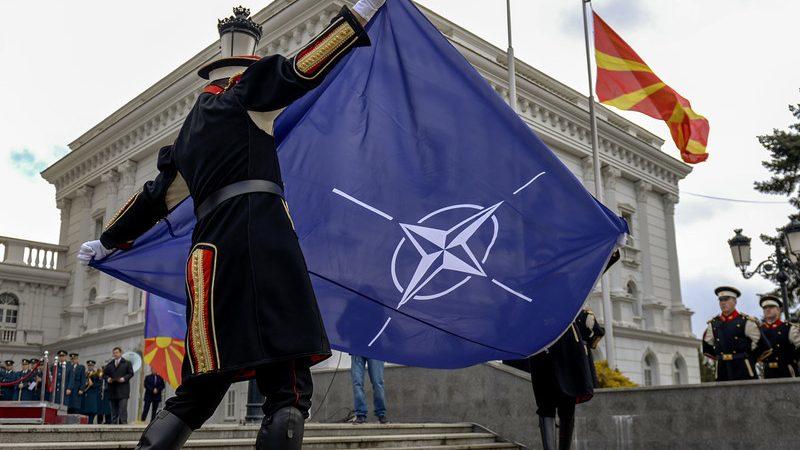
NATO flag being hoisted alongside the Macedonian flag in front of the government building in Skopje, The Former Yugoslav Republic of Macedonia. Image source: EPA-EFE

The Prespa Agreement, named after a lake that traverses the borders of Greece, North Macedonia and Albania, defined exactly what was meant by "Macedonia" and "Macedonian." For Greece, according to the agreement, these terms denote an area and people of Greece's northern region, who continue the legacy of the Ancient Macedonian Hellenic civilization, history and culture, as well as the legacy of Alexander the Great.

In reference to North Macedonia, these terms denote the modern territory of North Macedonia, the Slavic language and Slavic people with their own history and culture unrelated to the Ancient Macedonians. The agreement also stipulates the removal of North Macedonian irredentist efforts against Greek territory and to align them with UNESCO and Council of Europe's standards.

With Greece no longer blocking North Macedonia's attempts to join NATO and the European Union, no time has been wasted to elevate the Balkan country into the Atlanticist organization. There is no doubt that the Prespa Agreement, which caused political turmoil in Athens and Skopje, was signed only for North Macedonia's rapid entry into NATO.

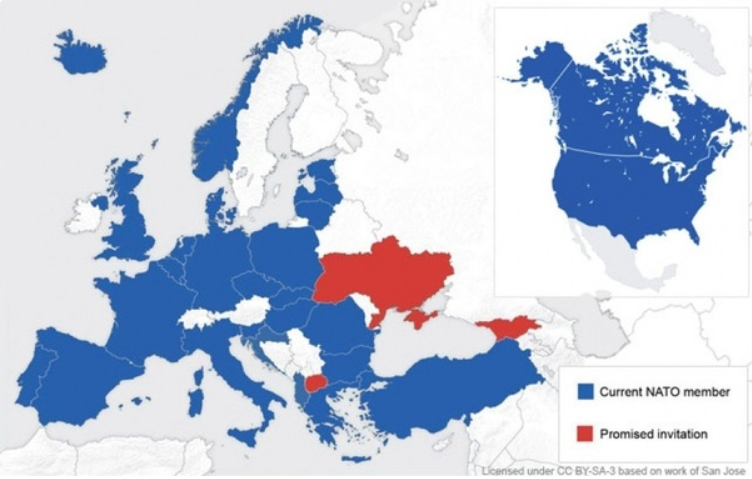
The acceleration of North Macedonia into NATO is not only a key priority for the organization to reduce Russian influence in the Balkans, but to continue pressurizing Serbia that was bombed by NATO in 1999 in response to the Serbian military operation against the "Kosovo Liberation Army" terrorist organization. North Macedonia, Serbia and Bosnia are the only non-NATO members remaining in the Balkans, however it is important to remember that Bosnia is effectively a U.S. protectorate, while North Macedonia has been trying to join NATO since 1995 when Yugoslavia was completely destroyed in all but name.

Serbia has no such ambition to join NATO and is considered a problematic country as it is the only remaining bastion of Russian influence left in the Balkans and is preventing full Atlanticist hegemony over the region.

Syriza, the ruling Party of Greece at the time of the signing of the Prespa Agreement, knew full well that the Prespa Agreement was largely despised by the Greeks, but none-the-less pushed for it and signed it. It is very obvious that the Prespa Agreement was to accelerate North Macedonia primarily into NATO, especially as not only Syriza, but also the current ruling party of New Democracy is loyal to NATO, with North Macedonia's entry into the EU being only a consolation prize for Western powers.

Less than a month after signing the Prespa Agreement, North Macedonia received an invitation to join NATO on 11 July 2018 with the accession protocol made in February 2019. North Macedonia's accession into the EU on the other hand has made no progress since the Prespa Agreement was made.

For the Atlanticists, a rapid accession into NATO to contain and weaken Russian influence in North Macedonia and to also further constrain and pressurize Serbia was a higher priority than formalizing the Balkan country into the European neoliberal order as an official member. Although North Macedonia will undoubtedly join the EU eventually, it is not a matter of urgency as making the country into a NATO member.

The Prespa Agreement is highly unpopular in both countries as they both feel they have lost out and did not achieve their objectives of promoting their interests with the name issue. NATO was unwilling to risk the Prespa Agreement failing and the name issue re-emerging which would once again put on hold North Macedonia's accession into the organization.

North Macedonia cannot contribute to NATO in any meaningful way as it is a poor country of just over two million people and not close to the Russian border like the tiny Baltic states. Its accession into NATO is only for the purpose of weakening or preventing any Russian influence in the country and to further isolate Serbia.

Despite North Macedonia being an overwhelmingly Orthodox and Slavic country that had the potential to become another pro-Russia state in the Balkans alongside neighboring Serbia, since its separation from Yugoslavia in 1991, Skopje pursued a pro-Western policy and joined the NATO program Partnership for Peace as early as 1995 and became a European Union candidate a decade later.

Why North Macedonia has pursued such a Western-centric policy since its separation with Yugoslavia is not clearly understood, but it is certainly understood why NATO has accelerated North Macedonia's membership into its organization.

Paul Antonopoulos is a research fellow at the Center for Syncretic Studies.


January 30, 2020

Montenegro's Corrupt Party of Socialists Is Killing the Country

nationalinterest.org

Montenegro's Corrupt Party of Socialists Is Killing the Country

by Gordon N. Bardos

9-12 minutes


Largely unnoticed in the wake of events in the Middle-East and the impeachment drama, another crisis is brewing in the Balkans. In Montenegro, thousands of people have been protesting a new law passed by the Montenegrin parliament and signed into effect by the country's longtime strongman, Milo Djukanovic, which gives the government authority over properties that religious organizations in the country have been using for at least a century. Evidence of the problems the controversial new law creates can be seen in the widespread condemnation it has received from individuals such as Pope Francis, Ecumenical Patriarch Bartholomew, and Russian Orthodox Patriarch Kiril.

Djukanovic's motives are fairly transparent. Economically, the new law allows Djukanovic's kleptocracy to take control of hundreds of properties used by the Serbian Orthodox Church while simultaneously politically weakening the only organized institution left in Montenegro capable of posing a serious threat to his rule. (Public opinion polls show that the Serbian Orthodox Church in Montenegro by far enjoys more trust than the country's president, government, parliament or judiciary.)

Ultimately, Djukanovic's plan is to turn over church properties with no economic value to an uncanonical organization under his control, led by a defrocked charlatan fond of hitting old women.

The current protests in Montenegro, however, are only a symptom of a conflict that has been long in the making. Remarkably, NATO's newest member is the only former communist European country that has never had a democratic transition. Even in Belarus and Russia communists have been out of power for at least one electoral cycle. But Djukanovic's ruling Democratic Party of Socialists (DPS), which is just the renamed Montenegrin League of Communists, has been in power continuously since 1945.

To put this longevity in some perspective, Djukanovic's DPS has been in power longer than the Bolsheviks ruled the Soviet Union, and Djukanovic himself has been in power longer than Stalin.

Djukanovic has managed to stay in power so long by constantly reinventing himself and changing with the times. In 1991, as a protégé of Slobodan Milosevic, Djukanovic ordered the bombardment of Dubrovnik. Yet today, there are people in Washington who hail Djukanovic as an "elder statesman," and he is feted in Washington's foreign policy salons. In 2014, Joe Biden welcomed him to the White House. 

While enjoying so much popularity in Washington, however, Djukanovic has turned Montenegro into his feudal fiefdom. As a recent New York Times article put it:

[Djukanovic]. . . is now the longest-serving leader in Europe, in power longer than both Vladimir V. Putin in Russia and Recep Tayyip Erdogan in Turkey . . . The president's sister is the nation's top lawyer, helping foreign investors join in the building boom sweeping across the coast. His brother owns First Bank, the country's largest financial institution. His son runs the country's biggest power plant. His nephew is involved in the country's largest tourism projects.

Thanks to such machinations, as Moisés Naim has argued, Djukanovic has turned Montenegro into a "mafia state." Thus, according to Naim, leading government officials are actually "integral players in, if not the leaders of, criminal enterprises, and the defense and promotion of those enterprises become official priorities . . . the national interest and the interests of organized crime are now inextricably intertwined." Indeed, one prominent democratic opposition figure in Montenegro has aptly called Djukanovic's system-of-rule "Montenegrin Putinism."

In 2015, Djukanovic's success in turning Montenegro into a mafia state led to his being named "Man of the Year in Organized Crime" by an international anti-corruption watchdog group. As the award announcement noted, "this as a lifetime achievement award." Nobody outside of Putin has run a state that relies so heavily on corruption, organized crime and dirty politics. It is truly and thoroughly rotten to the core.

An audit of the Djukanovic family bank by Price Waterhouse Coopers has revealed one of the many mechanisms by which corruption in Montenegro operated. First, public funds were deposited with First Bank, which then provided loans to Djukanovic associates and well-known organized crime figures, such as Darko Saric, a prominent Balkan drug dealer. Another tactic has been for Djukanovic cronies to acquire state-owned enterprises, fleece them of their value, and then declare them legally insolvent. According to one report, by November 2015, 89 percent of the state-owned enterprises that had been privatized by Djukanovic had reportedly gone bankrupt.

Apart from financial corruption, Djukanovic has used various means of illegal electoral engineering to stay in power. These tactics have run the gamut from voter fraud to blackmail, demobilizing potential opposition voters, fear-mongering, threatening police violence, and outright vote-buying. Anti-corruption watchdogs believe up to 15 percent of the votes in the October 2016 elections were fraudulent.

Lastly, attacks on independent media and critical voices have also been a hallmark of Djukanovic's system of rule. Djukanovic once said that investigative journalists should be "exterminated like mice," and someone in Montenegro clearly got the message. In 2004, the editor of the opposition newsmagazine Dan was assassinated. In August 2013, investigative journalist Tufik Softic was the target of a bombing attack. In December 2013, an explosive device was detonated outside the offices of Vijesti, an independent daily in Podgorica. In October 2015, Jovo Martinovic, a journalist covering Montenegro's organized crime scene, was jailed for fifteen months on trumped-up drug-smuggling charges. In April 2018, a car bomb exploded outside the home of investigative journalist Saed Sadikovic. In May 2018, Olivera Lakic, a journalist reporting on corruption, was shot outside her apartment in Podgorica.

Yet despite this organized terror campaign the country's independent media, Reporters Sans Frontieres would note in December 2018 that  "All of the attacks on journalists in the past two years have gone unpunished."

Apart from outright physical attacks, Djukanovic and his surrogates also resort to various smear campaigns against their opponents. For people who think that Donald Trump's comments about women are beyond the pale, Djukanovic takes things even lower. In 2015, Djukanovic launched an attack against one of Montenegro's leading anti-corruption activists, Vanja Calovic, literally accusing her of having sex with dogs. To its credit, the U.S. Embassy in Podgorica named her "The Most Courageous Woman in Montenegro" in 2016.

As evident from the above, the nature of Djukanovic's rule has ranged from the depraved to the corrupt. At times, however, it has also been farcical. The primary example of this was seen in the events surrounding the so-called "Russian-backed coup plot" in Montenegro in October 2016.  

Indeed, the story of the so-called Russian-backed coup attempt becomes more absurd the more one analyzes it. It is worth noting, for instance, that the alleged coup attempt was at least the third such "attack on the state" that has happened on the eve of elections in Montenegro in recent years. And the absurdities just compound from there.

The alleged organizer of the coup, Sasa Sindjelic, was a high-school drop-out wanted for murder in Croatia who hadn't been to Montenegro in fifteen years. Yet the GRU supposedly tasked such a marginal figure to organize a coup (on three week's notice) against a regime that had been in power for some three decades. Not surprisingly, in March 2019, Sindjelic renounced his testimony altogether, revealing that the story had been coerced out of him after twenty-three days in solitary confinement and numerous beatings.

The other central actor in the alleged plot, Mirko Velimirovic also renounced his story in April 2017, after which he had a serious "car accident" and decided it would be better for his health to testify again. Yet under cross-examination his testimony quickly fell apart; Velimirovic, for instance, could not identify the weapons he had allegedly bought (and which have never been produced), nor could he identify the mysterious Albanian black marketeer he supposedly bought the weapons from.

The other alleged participants in this third-rate Balkan cabaret were similarly farcical; as one report put it, most of those arrested were "elderly and in ill-health." The comedic highpoint of the proceedings came with the testimony of an alleged coup-plotter (in real life a self-confessed drug addict), who was tasked with breaking windows and throwing Molotov cocktails at a political party headquarters—but he got the address wrong. During his confused testimony, the alleged coup-plotter claimed, "Actually, I don't even know what I was supposed to do. The only people I know here work for the government."

Surprisingly, considering the supposedly grave danger facing the country, neither the interior minister, nor the defense minister, nor Montenegro's Council for National Security were informed about such an unprecedented threat. Nor did Montenegrin officials inform NATO that they had discovered a Russian-backed plot against their country. Even Djukanović said that he only found out about the alleged affair from media reports. As Montenegro's interior minister himself noted somewhat incredulously in the days after the discovery of the alleged coup attempt was made public "There has not been a meeting of the government or of the Council for National Security, the state president has said that he does not want to comment, the prime minister said that he does not know anything about it or that he does not have enough information . . . I have to admit that this is a very specific 'coup d'etat'."


January 23, 2020

The Illusion of Russian Influence in the Western Balkans

theglobepost.com

The Illusion of Russian Influence in the Western Balkans

Visar Xhambazi

6-7 minutes


In the absence of a clear E.U. integration perspective, Albania, Serbia, and North Macedonia have decided to take matters into their own hands and initiate their version of regional cooperation known as "mini Schengen." Two other Balkan countries, Montenegro and Bosnia and Herzegovina, have stated their reservations, while Kosovo has rejected the idea altogether.

Kosovo based its refusal to participate primarily on its relationship with Serbia and Belgrade's lack of recognition of Kosovo as an independent state. In addition, Kosovo's Prime Minister, Ramush Haradinaj, said that the "mini Schengen" initiative would pave the way for more Russian influence in the region.

However, amid political statements, the evidence says otherwise. Russia does not have the capability nor the propensity to meddle in the Balkans. While there is an opportunity, the reality is that Moscow has little to offer.

Furthermore, the Western Balkans is surrounded by E.U. and NATO members and is over a thousand miles away from Russia, leaving Moscow without direct access to the region. Finally, Russia's economy is largely based on the energy sector, and in this respect, the country has little to offer to the developing nations of the Balkans.

Unfavorable Geography

Russia relinquished its security mechanisms to NATO when the last peacekeepers left Kosovo and Bosnia and Herzegovina in 2003. Since then, Moscow's regional interests have been focused mainly on preventing the remaining Balkan countries from joining NATO.

To this end, Russia attempted to stage a coup in Montenegro in 2018 and tried to prevent the name agreement between Greece and North Macedonia to jeopardize their chances of joining NATO. Yet so far, Russia's disruption strategy has proved unsuccessful. Montenegro is NATO's newest member, while North Macedonia is expected to join this year.

Consequently, Russia's influence is limited to "near abroad" countries, referring to the independent republics that emerged after the 1991 Soviet Union dissolution. Moscow's annexation of Ukraine's Crimea and Georgia's Abkhazia and South Ossetia – countries that traditionally had close ties to Russia – is a strong indicator that Russian foreign policy priorities focus predominantly on neighbors rather than the Balkans.

Limited Soft Power

Russia's inability to project influence in the Balkans further stems from the fact that its persuasion methods are focused on historical symbolism such as Christian Orthodoxy and Pan-Slavism, factors that are losing significance in the Balkan region.

While Russian disinformation remains potent, leaders in the Balkans are cautious and do not seem to trust Moscow's intentions. The country's effectiveness is limited to disinformation and attempting to disrupt E.U. reforms by halting the region's democratic advancement and aspirations to join the E.U. and NATO.

Security Facade

Serbia remains Russia's sole friend in the region and the only country that regularly participates in Russian military drills. Serbia shows enormous support for "big brother" Russia, and it is the only Balkan country that refuses to join sanctions against Moscow for the annexation of Crimea.

However, Serbia's close ties to Russia have not stopped the country from pursuing E.U. membership and quietly cozying up to NATO. While Belgrade constantly professes its determination to never join the alliance, cooperation between Serbia and NATO is on the rise. In 2019, Serbia conducted 17 military exercises with other countries, 13 of which were with NATO members and only four with Russia.

And while Russia handed over five MiG-29 fighter jets to Serbia in 2017, these were second-hand aircraft and to fully operationalize them, Serbia has to spend around 200 million euros.

Lack of Economic Incentives

 Russia's main economic interest lies within the energy sector, but it has started to lose that battle too. In 2007, Russia initiated its most ambitious plan in the region, the South Stream gas pipeline, which was to stretch from the Black Sea into the Balkans. The initiative failed because it was not economically viable.

In terms of trade, Russian exports to each Western Balkan country do not exceed 2 percent, except for Serbia which is around 5 percent.

More recently, China has emerged as a serious actor in the region. It is now among the top five markets for imports in most of the region's countries, while Russia enjoys that status only in Serbia.

Chinese Influence 

In the last few years, the Western Balkans have been witnessing a massive increase in Chinese investments (millions in infrastructure and telecommunications projects), something that Russia cannot offer.

China has been spending money to gain influence rapidly, taking advantage of the poor investment climate by providing loans and consequently ensuring long-term dependency. In this respect, China faces little resistance from the small and developing Balkan states.

Chinese President Xi Jinping. Photo: AFP

Russian influence in the Balkans is exaggerated. Its method of persuasion through religious and ethnic symbolism is outdated and Moscow cannot compete with other actors to provide effective economic and technological advancement in the region.

As Russian influence slowly starts to fade away, Europe and the West should be more concerned with the growing Chinese influence in the Balkans and how this will affect its relationship with the region.

Disclaimer: The views and opinions expressed here are those of the author and do not necessarily reflect the editorial position of The Globe Post.


January 22, 2020

27 years since Croatian massacre Maslenica that killed 348 Serbs, destroying their homes

telegraf.rs

27 years since Croatian massacre Maslenica that killed 348 Serbs, destroying their homes

5-6 minutes


22/01/20 |  11:50    11:54

Operation Maslenica was planned and executed by Janko Bobetko, Ante Gotovina, Ante Roso, Mirko Norac and Mladen Markac, with the knowledge and approval of Franjo Tudjman, then president of the republic and commander-in-chief of the Croatian Army

Foto: Profimedia/AFP

On January 22, 1993, the Croatian Army carried out an aggression, codenamed "Maslenica", against the southern parts of the Republic of Serb Krajina (RSK).

The aggression was carried out during the implementation of the Vance Plan, which a year earlier put the RSK under the protection of the UN peacekeeping force (UNPROFOR). It was Croatia's third aggression against an area protected by the UN, an organization that it had joined 2 years earlier.

Over the next few days, the Croatian armed forces managed to occupy several tens of square kilometers in Ravni Kotari, including the Zemunik Airport, several heights on Mt. Velebit, and take control of the Peruca dam and hydroelectric power plant.

Three Serb villages were the most affected by this aggression: Islam Grcki, Kasic and Smokovic, as well as ethnically mixed villages: Murvica, Crno, Zemunik Gornji, Poljica and Islam Latinski. Serbs from the villages mentioned were killed, driven out or taken to prisons and camps, Banija.rs reports.


Photo: Guliver/Peter Turnley/Corbis/VCG via Getty Images

Their rich faming households were looted, devastated and destroyed, cultural monuments, cemeteries and churches devastated, desecrated or demolished, among them Dvori Jankovic Stojana in Islam Grcki with a small church dedicated to St. George (Georgije) (consecrated in 1675), in which the famous writer Vladan Desnica was buried, and the church of St. George (consecrated in 1567) in Smokovic and St. Ilija (consecrated 1872) in Kasic.

According to the organization Veritas and its records, 348 Serbs, 55 civilians, with an average age of 60, were killed or went missing in this aggression. The victims include 34 women, with an average age of 57 and three children under 12. Among the victims are 65 volunteers from Serbia and Bosnia and Herzegovina who came to Ravni Kotari to help local Serbs defend their centuries-old homes. Out of the total number of victims so far, the fate of 337 persons has been clarified, while 11 more are kept on the register as missing persons, of which 6 are civilians, including 3 women.

In the next few months, 165 persons more died, mostly the elderly. More than ten thousand Serbs were driven out from the aforementioned villages, to be displaced all over the world.


Photo: Guliver/Peter Turnley/Corbis/VCG via Getty Images

One of the gravest crimes, already on the first day of the aggression, happened at the Mali Alan pass on Mt. Velebit, near an UNPROFOR observation post, when members of Croatia's Special Police "Alfa" ambushed, killed and massacred 22 members of the Serb Krajina Army (SVK) from the area of ​​Gracac. This massacre was committed by members of the 5th Alfa squad, commanded by Milijan Brkic aka Vaso, currently deputy leader of the HDZ party and vice-president of the Croatian parliament.

Operation Maslenica was planned and executed by Janko Bobetko, Ante Gotovina, Ante Roso, Mirko Norac and Mladen Markac, with the knowledge and approval of Franjo Tudjman, then president of the republic and commander-in-chief of the Croatian Army who were already or subsequently promoted to the rank of general.


Photo: Profimedia/AFP

During this aggression, the Velebit sector artillery chief was a Kosovo Albanian, who until 1991 served in the Yugoslav People's Army (JNA): Agim Ceku. (Ssince 1999 he served as KLA commander and then of Kosovo Security Force, and was also prime minister and minister of security forces). Ceku's mortars, due to indiscriminate shelling of Benkovac and Obrovac municipalities, killed the most civilians.

Although the aggression was carried out against a UN protected zone and before the eyes of many UNPROFOR members, nobody has been prosecuted for crimes against Serbs committed in this operation either in international or in domestic courts, writes Banija.rs.

Video: How Operation Storm changed Knin?

(Telegraf.rs/Banija.rs)


November 03, 2019

Are the Balkans splitting the EU apart?

jpost.com

Are the Balkans splitting the EU apart?

7-9 minutes


European Union flags flutter as people take part in the demonstration "One Europe for all", a rally against nationalism across the European Union, in Vienna, Austria, May 19, 2019.. (photo credit: LISI NIESNER)

The European Union is going through a serious internal crisis over the prospects of its further expansion, with the main line of confrontation running between Paris and Berlin.

On October 15, France, backed by Denmark and the Netherlands, blocked the EU's decision to start negotiations concerning the admission of Albania and Northern Macedonia. Germany and other EU members opposed the move as unfounded, citing previous decisions by the European Commission.

This split at the very top of the 28-member bloc could seriously undermine its status in the eyes of the Balkan states, and force them to shift their foreign policy priorities and possibly turn toward Russia and its integration mechanisms.

The news of the decision by France, the Netherlands and Denmark to block the previous EU decision to start admission talks with the two Balkan states, citing the slow pace of their reforms, followed the EU foreign ministers' meeting in Luxembourg. The three countries opposed the start of negotiations with Albania, and France's position concerning similar talks with Northern Macedonia was equally negative.

Paris also insisted on a fundamental reform of the EU's accession process. Germany and other EU members disagreed, arguing that in late May, the European Commission had found Albania and Northern Macedonia fully in line with EU conditions and ready to engage in EU accession talks with Brussels. Moreover, Brussels's promise to start such negotiations is clearly mentioned in the list of official decisions made by the European Union.

At the same time, Brussels uses a differentiated approach to Balkan countries' applications for membership, with EU Commissioner for European Neighborhood Policy and Enlargement Johannes Hahn speaking against inviting Serbia and Montenegro to start negotiations, arguing that they should make "more efforts to protect the rule of law."

Naturally enough, the Balkan counties were disappointed by this decision. Just a few days before the Luxembourg meeting, the leaders of Albania, Northern Macedonia and Serbia gathered in the Serbian city of Novi Pazar, accusing Brussels of ignoring their interests. The most influential institute of the Balkans, IFIMES, published its report before the critical decision in Brussels took place, calling it "grave mistake."

Briefing reporters after the meeting, Albanian Prime Minister Edi Rama called on his colleagues from Northern Macedonia and Albania to work out a foreign policy agenda without waiting for tips from Brussels.

"There has been no change in the agenda of our international partners, but the format of relations that we are building has changed, as we are not waiting for the EU to find time to pay attention. Let's be honest, we are not a priority for the EU, because they prioritize their own reforms. We cannot expect to become a priority for the EU, but we are still able to promote more active and organized cooperation," Rama said.

Northern Macedonia's Prime Minister Zoran Zaev and Serbian President Aleksandar Vucic see the creation of a visa-free zone in the Balkans – "a small Schengen" – as one example of such cooperation. This is sending a clear message to Brussels to consider a situation where even such EU members as Bulgaria, Romania and Croatia still remain outside the pan-European visa-free space.

POLAND, WHICH is the Balkan candidate states' most active ally in the EU, has fairly tense relations with the big shots in Brussels. During a recent meeting of the leaders of the Visegrad Group (Hungary, Poland, Slovakia and the Czech Republic) held in the Czech city of Lany and attended by the Slovenian and Serbian leaders, Polish President Andrzej Duda described the start of EU accession talks with Northern Macedonia and Albania as "a litmus test that will show how open the EU really is." He said that both these Baltic nations had already met all the necessary criteria for admission to the European Union, and emphasized that Warsaw, for its part, favored Europe with "open doors," which is the only way to ensure the EU's peaceful and peaceful development.

This position is fully shared by Germany, with Minister of State for Europe at the Federal Foreign Office Michael Roth telling the newspaper Die Welt, "Albania and Northern Macedonia have done their homework. In recent years, they have been outstandingly successful all across the board fulfilling all the prerequisites for starting negotiations. They need to be rewarded for this, and this is exactly what the Bundestag did in an unambiguous vote. I am sure that the terms proposed by the Bundestag will convince others in the EU to green-light the start of the EU accession talks."

He added, "The EU's decision is being watched very closely, not only by those in Albania and Northern Macedonia, but in the whole region as well. The EU must show that reform efforts are encouraged. Any further postponement would seriously undermine confidence in the EU, with negative consequences for peace and stability in the region." He also voiced fears that a political vacuum would result in Russia, China, Turkey, the countries of the Near East and Middle East coming to the region.

In his seminal work on five historic Europes, Prof. Anis H. Bajrektarevic notes, "The inner unionistic equilibrium will be maintained only if the Atlantic-Central Europe skilfully calibrates and balances its own equidistance from both assertive Russia and the omnipresent US. Any alternative to the EU at present is a grand accommodation of either France or of Germany with Russia. This means a return to Europe of the 18th, 19th and early 20th centuries – namely, direct confrontations over the Continent's core sectors, perpetual animosities wars and destructions. Both Russia and the US have demonstrated ability for a skillful and persistent conduct of international affairs, passions and visions to fight for their agendas. It is time for Brussels to live up to its idea, and to show the same. Biology and geopolitics share one basic rule: Comply or die."

Therefore, the latest events in Brussels are yet another indication of serious undermining of the European Union's role in the Balkans. That surely opens wide the space for other key players, above all Russia, China and the United States. Therefore, Moscow needs to develop a more clear-cut concept of its own interests and goals in the region and ways of its implementation, always mindful of the local geopolitical situation and the time-tested traditions of Russian-Balkan cooperation.

The writer is a senior researcher attached to the Russian Academy of Science, Institute of Slavic Studies (modern political history analysis).


Join Jerusalem Post Premium Plus now for just $5 and upgrade your experience with an ads-free website and exclusive content. Click here>>


November 02, 2019

The Diary of Diana Budisavljević: An untold story of World War II - Emerging Europe

emerging-europe.com

The Diary of Diana Budisavljević: An untold story of World War II - Emerging Europe | News, Intelligence, Community

Dominik Istrate

3-4 minutes


A film chronicling the unique and heartbreaking story of Diana Budisavljević, who saved thousands of children in Croatia during World War II, has been causing a stir around the world ever since its release earlier this year. On November 7, it comes to Belgrade.

The Diary of Diana Budisavljević tells the story of a Croatian woman, who as a true humanitarian, rescued more than 15,000 children from the hands of the Ustasha, Croatia's brutal, ultra-nationalist wartime government.

Directed by Dana Budisavljević, a descendant of the protagonist, the movie depicts the cruel reality of wartime Zagreb, Croatian concentration camps, how children try to survive in the unbelievable reality of war and how much mothers are able to fight for their sons and daughters.

An ethnic Serb, Diana Budisavljević – together with the assistance of a German officer and the Croatian Jewish community – saved more than 15,500 children, although 3,200 died after being rescued due to the ill treatment they had received in the Ustasha camps.

Despite her gargantuan efforts however, Diana Budisavljević's name has almost been forgotten, primarily because the Yugoslav communists ignored what she had accomplished.

Fortunately, Mrs Budisavljević kept a careful record of what she did. Her diary, however, was rather a "work report" – as she preferred to call it – rather than an actual summary of her experience: it contained no emotions, feelings and storytelling, only names, photos and personal data which she hoped to use to reunite the children with their parents. At the end of the war, the diary was confiscated and was lost for decades.

The task of interpreting Mrs Budisavljević's story on screen fell to Croatian actress Alma Prica.

"We owe the greatest gratitude to her granddaughter, Sylvia, who preserved the diary and translated it from German," she told the Croatian press, adding that "Diana's endeavours, saving thousands of children, not of any particular nationality or religion, but thousands of human lives, are an act of kindness that restores hope in our world."

The film's director Dana Budisavljević has already won several awards, notably at the Pula Film Festival for the astonishing historical drama General, a movie about former Croatian general Ante Gotovina.

"When I see the reactions to the movie, I feel very small and humble. I hope that this movie will help us to understand our history realistically, without lies," she says.

The Diary of Diana Budisavljević will be screened at the Free Zone (Slobodna Zona) Film Festival in Belgrade between November 7 and November 12. Learn more about the festival here. Photo: Pula Film Festival


October 25, 2019

Vucic: EU’s decision on Albania and N.Macedonia justifies Serbia’s close relations to Russia and China

top-channel.tv

Vucic: EU's decision on Albania and N.Macedonia justifies Serbia's close relations to Russia and China

1 minute


While Europe is concerned about the constantly increasing influence of Russia and China in Western Balkan, the Serbian President, Alexandar Vucic, said that the refusal to open the EU accession negotiations with Albania and Northern Macedonia justifies his policies to stay open with the other powers, Russia and China.

In an interview for the Financial Times, Vucic says that the decision of the EU, regardless of the reforms made by the countries, justifies his policy to stay close to Russia and China.

"We cannot be depending on the next decision of the European Council, or by what the Dutch or Danish government will do", Vucic declared.

Top Channel


October 24, 2019

Palmer: EUCO sends wrong message to Balkans - whatever you do, may not be enough

rs.n1info.com

Palmer: EUCO sends wrong message to Balkans - whatever you do, may not be enough

Author: VOA

3 minutes


Matthew Palmer, Deputy Assistant Secretary at US Department of State - Bureau of European and Eurasian Affairs and Washington's special envoy to Western Balkans, said on Thursday that one of the reasons why the European Council (EUCO) decision not to open the accession talks with Albania and North Macedonia was discouraging, was because it sent a wrong message to both Belgrade and Pristina – you can settle difficult issues, you can reach a compromise, but nevertheless you can be denied access to Europe, the Voice of America (VOA) reported.

Palmer said he expected a new government in Pristina to lift the 100 percent import tariffs on goods from Serbia and Bosnia, while  Belgrade should stop its campaign against Kosovo's membership to the international organisations.

He added that he and Richard Grenell, the White House representative for the Belgrade – Pristina dialogue, would work together to normalise Kosovo – Serbia relations.

Addressing the Senate's Sub-Committee for Europe and Regional Security Cooperation, Palmer said a new Kosovo cabinet would be the first without any former members of the Kosovo Liberation Army (KLA), adding he hoped that would be a good incentive.

Palmer also said he was in constant communication with Grenell who was interested in economic empowerment and believed that could bring the two sides closer in the dialogue.

"I think that ambassador Grenell will pressure both sides to act quickly. They now have the White House's attention, a full focus not only from the administration but also from the White House and the President (Donald Trump)," Palmer said.

"That," he added, "is a beneficial instrument which won't be available forever. And to use it, the sides must show they're ready to act quickly to reach agreements, to implement them and to show they're committed to the reconciliation and normalisation as we are."

Palmer said the European Union remained the chief mediator and the US did not have any formal role in the dialogue itself.

"We are here; we support the process and encourage the parties to reach that agreement. However, we want them to be aware of what is offered, why is it essential to find a solution on normalisation."

He added that support to the Balkans was not enough and said America should increase its presence and investments in the region.        


October 16, 2019

"They expected me to agree, I didn't: FRY bombing and recognizing Kosovo - a mistake"

b92.net

"They expected me to agree, I didn't: FRY bombing and recognizing Kosovo - a mistake"

5-6 minutes


Retired Canadian General, former UNPROFOR Commander in Sarajevo, Lewis MacKenzie, reiterates that FRY bombing and recognition of Kosovo were "insane"

Source: Tanjug Wednesday, October 16, 2019 | 08:39

Ilustracija: Depositphotos/ Yarr65

Retired Canadian General, former UNPROFOR Commander in Sarajevo, Lewis MacKenzie, comes to Belgrade on the forthcoming Belgrade Book Fair, in order to promote Serbian edition of his book entitled: "Peacekeeper: The Road to Sarajevo", written 26 years ago, that was a bestseller in Canada.

In an interview for "Politika" daily, he reiterates his views, for which he was often criticized in his country and, above all, in Bosnia-Herzegovina, that genocide was not committed in Srebrenica, but a war crime, that the release of the Hague commander of Bosniak forces in Srebrenica, Naser Oric, is shameful, and that 1999 air raids on Serbia and the recognition of Kosovo are a big mistake, "insanity".

MacKenzie was UNPROFOR Commander for Sarajevo Sector from 1992 until June 1993 when the Sarajevo authorities requested his replacement.

"They expected me to agree with them on all issues... As my mandate meant being impartial and objective, they were very upset by my comments on particular issues", MacKenzie says.

The Canadian General, who after retiring and returning from Sarajevo in 1997, served briefly as Canada's Deputy Prime Minister, opposed NATO bombing of Serbia and criticized his government for recognizing Kosovo's unilaterally declared independence.

"The truth will always upset those who have a different opinion. With the development that took place after the air raids, it is clear that the insane decision to bomb a sovereign country and recognize Kosovo's independence has created a problem, rather than solved it", MacKenzie concluded.


October 14, 2019

Enlargement yes, but why…

neweurope.eu

Enlargement yes, but why…

3-4 minutes


Western Balkan countries are anxious to get a date to start entry negotiations and this is good because most of the countries of the former Yugoslavia suffered a lot in the last three decades. The ex-Yugoslav republics endured through several catastrophic wars, mainly in Serbia and Bosnia, which decimated infrastructure, killed civilians and put societies back centuries. Some 15 years ago, I was in Bosnia's capital Sarajevo for a few days and I was impressed by three things – There were very few people who were middle aged as most were killed by shelling and sharpshooters; many young people in their late twenties were walking around missing limbs; but most importantly, all were full of hope for the future.

I found no Eurosceptics in Sarajevo. They were all looking at the European Union as the promise land and all had forgotten that, in the case of the Serbs, the bombers which killed their parents were departing from a NATO airbase in Aviano, Italy. When I asked a hairdresser, who was working with one hand, she said, "If we want to look at the future, we have to forget the past".

They were survivors, strong and determined.

The people of the Western Balkans now expect the EU to give them a date to start the process of joining the union. The Bosnians and Serbs that suffered from the war deserve it; not of Albania and Montenegro. Those two countries were flourishing in the 1990s as drugs and counterfeit goods flooded into and out of both nations. In the case of North Macedonia, it opted for self-imposed isolation under the pretext of the name dispute with Greece. This was done to remain outside the reach of external interference and would institutionalise North Macedonian corruption and dubious Austrian investments in casinos near the Greek border.

The purpose of the enlargement is only geopolitical only, as was the previous big enlargement in 2004. It aims at containing Russia from taking advantage of the "strategic vacuum" in the troubled region by gaining a strong foothold in the Balkans, the soft underbelly of Europe.

Albania, Montenegro, and North Macedonia are, however, already NATO members. As a a consequence, the Russians, who had a certain presence and influence in the last two, disappeared from the area overnight.

What remains to be addressed to completely eliminate the Russian presence form Southeast Europe – the real purpose of the present enlargement – is to get Serbia and Bosnia in the bloc, as it is not easy to get them into NATO. In this context, we should mention the French interest in the resolution of the Kosovo conflict and the state visit to Belgrade by French President Emmanuel Macron in July this year.


October 11, 2019

Serbia’s President PR: Tough meeting with Grenell, Vucic takes minutes himself

rs.n1info.com

Serbia's President PR: Tough meeting with Grenell, Vucic takes minutes himself

Author: Beta

2 minutes


Suzana Vasiljevic, Serbia's President Aleksandar Vucic media advisor, said on Friday the meeting with Richard Grenell, the US head of state Donald Trump's envoy to Kosovo, was challenging, but could not go into the details of the talks, the Beta news agency reported.

Speaking to the Prva TV, Vasiljevic said the two spoke alone in the first ten minutes, after which the head of Serbia's Government Office for Kosovo Marko Djuric joined the meeting.

"What is unusual is that the President was taking notes himself for the first time. The talks were apparently extremely tough and he (Vucic) was not in a mood to talk about it even with us," Vasiljevic said.

She added it happened before that meetings, especially with the Kosovo issue on the agenda, were difficult, but never so tough that the President didn't want to talk about it with his associates, and decided to take some time to think about that and about the way how to say what would be a solution he had heard from Grenell.

After meeting with Grenell, a statement from his office said Vucic told the envoy that a compromise, which would be in the interest of stability and the future of the whole region, could be achieved with the respect of Serbia's legitimate interests.

The statement quoted Grenell as saying the two sides would have to "cooperate closely and quickly, looking at the future."    


October 07, 2019

Belgrade to take the lead : Interview with Dejan Ralevic

neweurope.eu

Belgrade to take the lead : Interview with Dejan Ralevic

7-8 minutes


Interview with Dejan Ralevic, Serbia's Deputy Assistant Minister for EU Affairs

After having gained the backing of four European Union members from Eastern Europe for accelerated accession talks, Serbia's point man for EU affairs sat down to talk with New Europe about the enlargement process and what he thinks will be the next stage in Serbia's integration process with the European Union and why Belgrade must continue to be a leader in the Western Balkans, as well as why he believes Serbia will be the next nation in the region to become a full member of the bloc.

New Europe (NE): What is the current status regarding EU accession negotiations with Serbia? Is the pace of the negotiations moving quickly or slowly and what are the obstacles that have been encountered?

Dejan Ralevic (DR): No doubt, the first country to be the next European Union member will be Serbia. Whether it will join alone or together with some other country is less important. Our commitment to EU membership is unquestionable. It is the same as the EU's readiness to admit Serbia with full membership. Above all, EU membership is Serbia's strategic interest in view of the fact that the European Union is by far our largest trading and business partner. Moreover, many of our citizens live in EU countries, do business or receive education there, or travel to those countries. It is also because Serbia is geographically and culturally a part of Europe.

Serbia's negotiations with Brussels about full membership are well underway. So far, we've opened 17 out of 35 negotiating chapters and have provisionally closed two. I do have to note, however, that we are not pleased with the current pace of the negotiations. Come January, it will be six years since we started the accession negotiations and we expected a faster progress. We are probably partly to blame for not going faster, but I am convinced that the European Union is even more responsible for failing to conduct the negotiations more decisively and more dynamically and thus truly reaffirm its often restated readiness to admit Serbia as a fully-fledged member.

Serbia's accession has been somewhat slowed due to internal reasons within the EU. This could be on account of Brexit or disagreements in connection with the overall operation of the European institutions, as well as the elections for the European Parliament and the formation of the Commission, which is still ongoing. We are not the only ones saying that Europe should have been faster in working together with Serbia and other Balkan countries. Many European officials, including Federica Mogherini, have confirmed that. Almost two years ago, she admitted that the Brussels neglected the Balkans and that it needed to be more invested in its integration.

Dejan Ralevic with the Executive Director of the International Visegrad Fund, Andor David.Twitter

NE: When will Serbia join the EU?

DR: Even though we can safely say that the first country to be the next EU member will be Serbia, since it has indisputably gone the farthest down that road, it is impossible to say precisely when this will actually happen. We are prepared to progress much faster and we contend that we could have opened many more negotiating chapters so far, but the people in Brussels obviously felt differently. It is unhelpful to speculate when exactly, whether it will be 2024 or 2025, or even a bit later, it is difficult to say. We are not going to make any wild guesses. Our priority is to undertake steady and in-depth reform of our legislation, institutions, and economy so that they are in line with the criteria set by the EU. We are taking into consideration that this is primarily in our own interest and in the interest of our citizens.

Full EU membership will happen, but it is not a goal in itself. We are committed to achieving daily goals and we seek to turn Serbia into a modern European state. We are not biding our time.

NE: What activities have you undertaken towards regional integration in the meantime?

Having recognised the EU's hesitance regarding the integration of Serbia and other Balkan countries, we have launched a number of regional connectivity initiatives to avoid wasting time and energy. In the most recent few years, Serbia has been doing a job that the European Union should be doing. Serbia wants to compensate for the obvious stagnation in the European integration process by strengthening the integration among the Balkan countries themselves as well as in our immediate neighbourhood.

As the largest and most influential country of the Balkans, Serbia is in favour of integration and connectivity. We are open to this and encourage others to be responsive in this regard, as well. After all, one of Europe's most important expectations for the region is to strengthen intra-regional cooperation. With this aim in mind, Serbia, and most notably President Aleksandar Vučić, have initiated a number of steps over the past few years to make the ties among the Balkan countries much more solid than they are today. Some of these steps were not favourably received, such as the initiative for the establishment of a customs union, but we are not giving up.

At the initiative of President Vučić, discussions will commence in the coming days between Serbia, Albania, and North Macedonia on the removal of customs barriers between our states. Our economic cooperation has been excellent, but there are still too many hurdles related to customs and customs administration. As a result, we have all suffered major financial losses.

To solve this, we put forward the following proposal – let's facilitate cross-border traffic of goods. We need not wait for Europe to do this for us given that we foster good-neighbourly relations, which means an agreement can be easily reached. I am confident that this will be a success and that Serbia, Albania, and North Macedonia will, in this way, open up a perspective for similar models throughout the Balkans. We have also been putting in significant efforts with our friends in Bulgaria, Romania, and Greece in the framework of the Craiova Group towards the strengthening of our economic and cultural ties in this context.

Overall, Serbia has been at the forefront of both the integration processes and initiatives in the Balkans. We oppose and fight against blockades and walls that are regrettably still being erected. I am referring to the brutal 100% tariffs that the Pristina authorities imposed a year ago on goods originating from Serbia and Bosnia and Herzegovina. The whole world has condemned this adventurous move and called for putting an end to the tariffs, but sadly, to no avail as this wall remains untouched. This is something we cannot accept.

Serbia will continue to extend its hand to all in the region as this is our interest, but also a kind of an obligation and expectation of the largest and most stable country in the Balkans.    


October 04, 2019

Trump appoints US ambassador to Germany as special envoy for Serbia-Kosovo talks

rs.n1info.com

Trump appoints US ambassador to Germany as special envoy for Serbia-Kosovo talks

Author: Beta

2 minutes


President Donald Trump has appointed US Ambassador to Germany Richard Grenell as his special envoy for the Belgrade-Pristina dialogue, the Beta news agency reported on Friday, quoting a White House press release.

Grenell will remain Washington's envoy in Berlin while leading American efforts to help Serbia and Kosovo reach a formal agreement which the media in Washington said could result in Belgrade's recognition of Kosovo.  

The Washington Times recalled that Grenell was the longest-serving US spokesman at the United Nations, working under four ambassadors from 2001 to 2008.

Kosovo President Hashim Thaci welcomed the appointment in a post on his Twitter account. "I look forward to working with him to secure peace in the Balkans and bring Kosovo into NATO and the European Union family," Thaci tweeted.  

Serbia's Minister for European Integration Jadranka Joksimovic told the Serbian state TV (RTS) that Grenell's appointment as special envoy shows that the Trump administration is interested in finding a solution to the Kosovo issue. She added that the format of the talks will not change. "This is a serious man. We will see how things will develop," she said.