|

Strasse der Republik 17
Wiesbaden Hessen 65203
GERMANY
|
Strasse der Republik 17
Wiesbaden Hessen 65203
GERMANY
KoSSev -
18-22 minutes
Foto: RTK
Ambassador Kosnett, welcome.
Thank you. It is a great honor and privilege to return to Kosovo as the Ambassador of the United States.
First of all, let me express our condolences to you upon the passing of President George H. W. Bush.
Thank you for that Xhevdet. I had the privilege of meeting President Bush only once, many years ago, and I feel the same way that everyone in my country does. He was a great leader, a man of honor who has earned his place in history, and I know that he was also a great friend of Kosovo.
A great supporter to Kosovo too. Thank you. Ambassador, Kosovo has changed since you have worked here in 2003. At this point where Kosovo stands, it had huge support from the US. Do you think that Kosovo could still count on U.S. policy?
Absolutely. The United States has considered Kosovo to be a great success story. We have said that it's a success story for the United States, but most importantly it's a success story for the people of Kosovo. I can tell you that in the months I spent in Washington preparing for this assignment, I met with many people in the government, in Congress, as well as outside the government, and I think America's commitment to Kosovo's future is unshakeable. In fact, I would say, that it is an area where there is complete consensus between Republicans and Democrats—between the government, the administration and the Congress. Everybody feels that Kosovo is a very close friend of the United States and we are deeply committed to supporting Kosovo.
Ambassador, in what fields will your commitment be focused with your mandate in Kosovo?
There are a lot of issues where the Embassy will continue to work very closely with our Kosovo friends. Economic security is critical in foreign investment and job creation. We are also focused on rule of law and countering corruption, which remains a very high priority for us. Then there is the issue of security. Security has many meanings and many aspects. Certainly, at the top of the agenda is supporting the efforts of leaders in Kosovo and in Serbia to find a way forward on the Dialogue, to achieve a mutually beneficial solution that will help both governments' prosperity and security in the future. Also in terms of security, we continue to work very closely with Kosovo on counter-terrorism, countering violent extremism—a range of security related issues.
How up, Ambassador, is Kosovo ranked in U.S. foreign affairs today?
It is a very high priority. In fact, I would say that the current administration in Washington is more interested in supporting, not just Kosovo but also progress in the Balkan region, than I have seen in many years. This is an administration that looks at longstanding problems and says: we need to shake things up—we need to find a way forward.
Ambassador, Kosovo is facing new challenges now, as we said, mostly with relations with Serbia. There have been discussions between two states in Brussels. Not much progress, sometimes with the tensions as we are talking now. These days they are probably facing the lowest point of their relations, since after the start of dialogue. The Government of Kosovo decided to come to a decision that Serbian goods must pay 100% of taxes in order to enter Kosovo. What is your opinion when it comes to this decision?
This would be a good time for me to remind your viewers that I have been back in Kosovo for less than a week, so at this point I want to listen to lots of people and get their input before I start making a lot of big declarations. Having said that, I do believe, and my government believes, that this is a critical moment in the Dialogue process. That it is important for Kosovo and Serbia to approach this process in a spirit of cooperation. I understand the challenges of that—I know the country's history, but in a spirit of cooperation and creativity to find a way forward. When we speak of the Dialogue in Washington, we're talking about a comprehensive discussion of all the issues that have separated the two countries for many years. What we need to see is a process that ends with agreement that benefits both countries.
We all negotiate in our daily lives. We negotiate with our families, with our neighbors, business people negotiate: it is not only governments and diplomats that negotiate. But one thing that I think that is critical to a successful negotiation is that it has to be beneficial to both parties so that both parties have an incentive to fulfill their obligations, to maintain the agreement, to move forward. Any agreement between Kosovo and Serbia needs to be durable, it needs to be sustainable, and it needs to, again, to benefit both countries. I think sometimes people enter into negotiations in the spirit that, I am going to win this negotiation—I'm going to defeat the other side. When you do that, it is really, very hard to have the sort of trust that is necessary to see that a negotiation is successfully implemented. Last point there, when we speak about the implementation of agreements, the United States is deeply focused on the future of Kosovo, but also on stability in the entire Balkan region. We have every reason to want to stay by your side to make sure that if governments make commitments, they abide by them. We are not just going to applaud while a piece of paper is signed and then move on to the next crisis.
The government of Kosovo took this measure Mr. Ambassador, as I said, after the failure of entering Interpol, but they also say it is a reflection of Serbia's ongoing obstructions towards Pristina, and because of Belgrade not respecting the earlier signed agreements.
I think that both governments have taken steps to show that they have levers—that they have tools they can use against the other side. Both governments have shown that we can be tough—we can stand up for ourselves. Frankly, what I'd rather see, not a competition to see who can be toughest, but a competition to see who can be most creative and most forward-looking in trying to find a way forward. I think it is very common in negotiations to hit obstacles, to reach a difficult stage, and then the two parties will retreat to their corners and think about what to do next. I know that some people are concerned that the Dialogue process is at a tough stage—this is pretty normal in negotiations. You go forward, you take a step back, you go forward again. I do think it is important that the negotiating strategy and negotiating position of Kosovo reflect a wide range of political opinion and a wide range of popular opinion. In that regard, and I am sure we'll come back to this, the United States thinks it's important that every voice in Kosovo is heard. That members of all communities, all political parties, women as well as men, have a stake in the future of the country and feel that their voice is heard and respected.
Lately in Kosovo there have been words, Ambassador, about the possible final agreement between Pristina and Belgrade. In one side we have President's commitment to reach the final agreement with Serbia with possible, as he says, border correction. In the other hand political opposition that strongly disagree about anything that has to do with the border. The Dialogue with Serbia seems like it is stopped for now, as we said, or there is tension. How do you think they could find a political will to continue discussions? Do you think that a future agreement between these two countries might also touch the border issue?
I think some people have the misunderstanding that the United States has been pressing for a shift to the border or an exchange of territory. As my superiors in Washington have tried to make clear: what we are interested in is an agreement that is negotiated in good faith by the two sides. The United State does not have any preconceptions about what a comprehensive Dialogue agreement might entail. It might be that the two sides decide – honestly in good faith – to make an adjustment to the border. They may very well decide not to, and believe me, I understand the depth of concern, the historical reasons why adjusting the border is very complicated. And again, I want to emphasize, my government is not pushing for that. We do not necessarily see that as a key to the dialogue. I think that a great deal of discussion of the Dialogue has focused on that. I think discussion of the border is only one aspect of the wide range of discussion that has to take place between the two countries. It has also has to touch on economic cooperation, security, culture, education, justice, very much justice – the wide range of issues that the two governments need to speak about, and it is important not to fixate on only one aspect of the problem.
Just to clarify this, Ambassador. There had also been voices, as we said, about a territorial exchange between two parts. Will this be acceptable for the United State, if the two countries decide to do that?
So, we have tried to make clear that we do not have any preconceptions. We are not saying that certain issues should not be discussed and we are not saying that certain outcomes are required. Serbia and Kosovo are the negotiating partners. These are two sovereign, independent nations. We are always going to support Kosovo. By support Kosovo, I do not mean that we are going to blindly agree to any idea that comes out of the government in Pristina. But, we are going to support Kosovo in the effort to establish peace, prosperity, justice in the country and in the region. We do not see those goals as contradictory to a broader goal – wanting the same things for other countries in the region. I think it is important to emphasize that we are standing by to support the parties to come to a sustainable, mutually beneficial conclusion, but we are not writing the script.
Right. Ambassador, people are getting tired of this situation. Prolonged discussions seem to never end. How long do you think that this situation should continue for?
I would be reluctant to suggest any sort of timeline or deadline for the discussion, but I do think that time is of the essence, that it is important to move forward as quickly as possible, and frankly, that's because – as I said earlier – my government is really focused on making progress in the region now. You have our full attention, our full support. It is a great opportunity and I don't think that anybody, either side, or the people of either country has anything to gain by delaying a process of negotiation. I think that the time to do anything is usually right now.
Kosovo's government and population seem also to be frustrated from the EU stand towards Pristina. They have been promised visa liberalization and now, suddenly, the EU, as we saw, is not prepared for such a decision. Do you think that this has increased tensions in Kosovo? Young population that cannot move freely like others in Europe.
I do think that the frustration over the current status of visa liberalization is an indication that people of Kosovo want to strengthen their ties to the West. That is where they see their future. We certainly support that, we agree with that. We think that closer ties between Kosovo and the European Union is something that is very much in the interest of the United States, as well as the people of Kosovo. I have been struck in the short time I have been back by the amazing young people that I'm meeting. People with education, with skills, with a very broad European and global perspective who have an enormous amount to contribute to their own country and to the world. They want to be able to do that here, but also in other countries. I suspect that the more that young people in Kosovo are able to travel, to study, to work in other countries, and then in many cases to come back to Kosovo to contribute here – that will be wonderful for the country. I am not going to get into what is the right timing for visa liberalization and so on, but I am encouraged that people in this country look to the West and look to the European Union.
What is your opinion about Kosovo Serbs? Let's talk about them a little, as we talked about Kosovo and Serbia relations. We also have Serbian population, in Kosovo. They seem to be a part, every time, of Kosovo's government, but they are always influenced by Belgrade. Do you think this help Kosovo's Serb to build their future here, in Kosovo?
I think it is important for everyone in the country – every community in the country to feel that it is their country and that they have a future here and that their voices are heard and they're role is respected. You know, America like Kosovo is a very diverse country. We have people from all religions, different ethnic groups, different races and a very complicated history, as people know. We do not have all the answers for how people should live in a multi-ethnic society. I think we have gotten better at asking the questions – at honestly talking about our history and understanding its necessary to examine a country's history, in order to move forward into the future. And, in that regard I'd like to say that I think that it is important that all of the members of all of the minority groups feel that they have a voice and that they are equal participants in the country. That is an area where I look forward to making friends and hearing perspectives from all communities.
Do you thing that they should look more towards Pristina rather than Belgrade so that this way they might feel that this is their country?
I think this is kind of circular. The more comfortable people feel, the more they feel like their voice matters, like this truly is their country, the less they might take their cues from outside.
Kosovo's institutions are preparing to give to KSF – a hot topic, these days –a functional army mandate. Does Washington support this step?
Washington has consistently supported the development of the KSF and the development of the KSF into Armed Forces. The United States has invested a lot of money; we have spent time on training; we've done exchanges between KSF and U.S. military. We think that the KSF's evolution into Kosovo Armed Forces is a positive step and that it is only natural for Kosovo as a sovereign, independent country to have a self-defense capability. Also, Kosovo's leaders have talked about how the Kosovo Armed Forces could participate in peace-keeping operations overseas. That Kosovo has reached the point where instead of only being a consumer of international security that it can contribute to it. This is all welcome. Now, it is long process. I know that people – some people in neighboring countries have fixated on a certain date that is coming up very soon and have expressed concerns that the evolution of the KSF into the Armed Forces could have negative implications for security. What I will say about that is: this is a process that will take many years. That Kosovo has every reason, every right to have a self–defense capability. The most important point I want to leave you with is if there are people who genuinely believe that Kosovo's Police, Security Forces, Armed Forces—with any label—pose a threat to regional security, I think that's another indicator of the importance of Dialogue. I think that it is important for people in both countries to understand the perspective of the other side. Because when you are not communicating, all sorts of fears will rise to the surface and people always fear what they do not understand.
Do you agree that Kosovo government can pass the law on 14th – let's say they mentioned the date of December – about the transforming the KSF into Army? It takes time as they say, it's going to take 10 years for the proper Army to be formed.
That's exactly the point, Xhevdet. Whether they pass this law or change the patches on their shoulders of the personnel on a certain date, is not the most important thing. What's important is that it'll be a long, sustainable process and, moreover, that as the Armed Forces are established – which again, is a long process—that it be multiethnic. It is important for members of the Serb community and other communities to participate in a big way in the Armed Forces as they have in the KSF and in the Police. Because, this is an experience that we've had in my country, that it's important for the people in the community to see that the people in uniform represent them and not just some outside force.
How can economic relations between Kosovo and U.S. improve? Do you think that Kosovo can be a suitable place for U.S. investments, for companies to invest in? Did you ever think if you could contribute in this field?
I think that encouraging American investment is a very high priority for the U.S. Embassy and for the U.S. Government. We have seen some small-scale investment already. It is been very important. You see these American food franchises around the country now and you say: ok, that is great, people enjoy that, I enjoy it. It is fairly small-scale, but American businesses watch to see what the food franchises are doing because, the food franchises are famous for doing very careful research on a country before they enter a market. When companies see – oh, Domino's, famous Famiglia, Kentucky are in Kosovo, that moves Kosovo closer to the top in their planning. That is important. We support the Counter Global proposal for a new power plant, which, we think, will have enormous benefits, not just for the environment, but also for economic stability and development.
Let me put it this way: when we speak of the different areas where our countries cooperate; when we speak of regional stability; when we speak of rule of law and anti-corruption; when we speak of economic development, these different areas are all closely intertwined. American companies want to see legal system where everybody is treated equally. American companies want to know that if they get into dispute with a local partner, for example, that they would be treated fairly. American companies spend a lot of attention on looking at what we call risk analysis. They look at the regional stability and they are sometimes reluctant to invest in a country where they see ethnic tensions, or tensions between the country and its neighbors. I am completely confident that as Kosovo and Serbia improve relations; move towards normalization; recognition; towards respectful, neighborly relations; as Kosovo continues not just to pass laws on anti-corruption which is important and which I applaud, but is able to implement them fairly and consistently—then American companies and other companies will see Kosovo as an increasingly attractive location to invest.
Ambassador Kosnett, thank you very much for being with us.
It's my great pleasure. It's good to be back.
comments
Preuzimanje i objavljivanje tekstova sa portala KoSSev nije dozvoljeno bez navođenja izvora. Hvala na poštovanju etike novinarske profesije.
GazetaExpress
2 minutes
Addressing media following the meeting of the North Atlantic Council, Stoltenberg confirmed that one of the topics discussed was also Kosovo’s intention to move ahead with the transformation of the Kosovo Security Force (KSF) into an army. “Such a move is ill-timed. It goes against the advice of many NATO Allies. And may have serious repercussions for Kosovo’s future Euro-Atlantic integration,” he said. Stoltenberg assessed that the new tariffs introduced by Pristina create new divisions. “Such steps are making the EU-mediated dialogue between Belgrade and Pristina even more difficult. But this remains the only way to bring durable peace to the region. We encourage both Belgrade and Pristina to show restraint. To refrain from provocative steps and statements. And to make the necessary compromises so that they can move forward towards a better future,” he said. Kosovo Parliament is set to vote on 14 December a package of laws on transition of the lightly armed KSF into Army of Kosovo. /GazetaExpress/
http://www.defenddemocracy.press/albanians-usa-are-threatening-serbia-with-war/
Serbian and Kosovo media are trading accusations over Kosovo's decision to hugely increase import tariffs on goods from Serbia and Bosnia.
22 Nov 18
Serbian media on Thursday accused Kosovo of resorting to "war" and economic "cleansing" following its decision to hike import taxes to 100 per cent – while Kosovo media supported the measure, adopted in retaliation for Belgrade's role in Kosovo's failed Interpol membership bid.
The pro-government Serbian tabloid Informer, (pictured above with the Pristina-based daily Zeri), told readers that "Shiptars Want War", using a highly derogatory term for Albanians.
The front page of Zeri, on the other hand, featured a headline "From 'So-called' Kosovo With Love" and a stop sign – referring to the practice of Serbian officials and media of calling Kosovo a "so-called state".
"Due to irresponsible actions done to the detriment of the Kosovo state, Serbia and Bosnia and Herzegovina risk losing a 500-million-euro market," Zeri wrote on its front page.
|
Almost all Serbian tabloids close to the ruling Progressive Party warned of possible armed conflict, with the daily Kurir calling Pristina's decision an "Introduction to War".
Alo newspaper claimed that "[Kosovo Prime Minister Ramush] Haradinaj Declared War On Us!"
The dailies Politika and Vecernje Novosti were not close behind. Politika's headline from Thursday accused Kosovo of "Economic Ethnic Cleansing", while Vecernje Novosti said Kosovo leaders "Want to Cleanse Kosovo of Serbs".
Meanwhile, Kosovo Albanian newspapers hailed the government's decision, some calling it a deserved act of retaliation for Serbian lobbying against Kosovo's membership of Interpol.
Kosovo's bid to join the global police organisation failed on Tuesday when it did not secure enough votesat Interpol's general assembly in Dubai.
|
Under the headline "Kosovo increases sanctions against Serbia, EU and Belgrade react angrily", the daily Koha Ditore on its front page reported that Kosovo had imposed economic sanctions against Serbia "as a response to its latest campaign to block Kosovo's membership of Interpol and dim its international subjectivity".
The daily Epoka e Re ran an interview with a former head of the Kosovo delegation to the EU-led dialogue with Serbia, Edita Tahiri, who said that Kosovo should "temporarily stop the dialogue with Serbia".
"Kosovo Brings Serbia to its Knees" ran the headline of another Prishtina-based newspaper, Bota Sot.
Kosovo on Wednesday increased taxes on Serbian and Bosnian imports from 10 per cent, as imposed on November 6, to 100 per cent.
Serbia's Chamber of Commerce told BIRN that Serbian companies sold 349.6 million euros worth of goods to Kosovo from January to September 2018; Serbia's trade surplus was 329.9 million.
Bosnia also has a large trade surplus with Kosovo, exporting products to Kosovo worth about 80 million euros against imports of only 8 million euros in 2017.
Kosovo's measure has been condemned by the European Union whose foreign policy chief, Federica Mogherini, said Kosovo must "immediately revoke these decisions", as they violate its membership of the regional free trade area, CEFTA.
Published at http://www.balkaninsight.com/en/article/serbian-kosovo-media-wage-war-over-tax-hike-11-22-2018
6-7 minutes
Let’s eliminate money problems from the admissions equation for qualified students.
Mr. Bloomberg is the founder of Bloomberg LP and served as mayor of New York, 2002-2013.
Looking across Wyman Quad to Shriver Hall on the campus of Johns Hopkins University in Baltimore.CreditAndrew Mangum for The New York Times
Looking across Wyman Quad to Shriver Hall on the campus of Johns Hopkins University in Baltimore.CreditCreditAndrew Mangum for The New York Times
Here’s a simple idea I bet most Americans agree with: No qualified high school student should ever be barred entrance to a college based on his or her family’s bank account. Yet it happens all the time.
When colleges review applications, all but a few consider a student’s ability to pay. As a result, high-achieving applicants from low- and middle-income families are routinely denied seats that are saved for students whose families have deeper pockets. This hurts the son of a farmer in Nebraska as much as the daughter of a working mother in Detroit.
America is at its best when we reward people based on the quality of their work, not the size of their pocketbook. Denying students entry to a college based on their ability to pay undermines equal opportunity. It perpetuates intergenerational poverty. And it strikes at the heart of the American dream: the idea that every person, from every community, has the chance to rise based on merit.
I was lucky: My father was a bookkeeper who never made more than $6,000 a year. But I was able to afford Johns Hopkins University through a National Defense student loan, and by holding down a job on campus. My Hopkins diploma opened up doors that otherwise would have been closed, and allowed me to live the American dream.
I have always been grateful for that opportunity. I gave my first donation to Hopkins the year after I graduated: $5. It was all I could afford. Since then, I’ve given the school $1.5 billion to support research, teaching and financial aid.
Hopkins has made great progress toward becoming “need-blind” — admitting students based solely on merit. I want to be sure that the school that gave me a chance will be able to permanently open that same door of opportunity for others. And so, I am donating an additional $1.8 billion to Hopkins that will be used for financial aid for qualified low- and middle-income students.
This will make admissions at Hopkins forever need-blind; finances will never again factor into decisions. The school will be able to offer more generous levels of financial aid, replacing loans for many students with scholarship grants. It will ease the burden of debt for many graduates. And it will make the campus more socioeconomically diverse.
But Hopkins is one school. A recent analysis by The Times found that at dozens of America’s elite colleges, more students came from the top 1 percent of the income scale than from the entire bottom 60 percent of that scale — even though many of those lower-income students have the qualifications to get in.
And until recently, by some estimates, half of all high-achieving low- and middle-income students have not even been applying to top colleges — largely because they believe they can’t afford it, doubt they’ll be accepted, or aren’t even aware of their options.
As a result, they often lose out — and so do colleges that would benefit from their talents and diverse perspectives. Our country loses out, too.
College is a great leveler. Multiple studies have shown that students who attend selective colleges — no matter what their family’s background — have similar earnings after graduation. But too many qualified kids from low- and middle-income families are being shut out.
As a country, we can tackle this challenge and open doors of opportunity to more students by taking three basic steps:
First, we need to improve college advising so that more students from more diverse backgrounds apply to select colleges. Through a program called CollegePoint, my foundation has counseled nearly 50,000 low- and middle-income students about their options, and helped them navigate the financial aid process.
Second, we need to persuade more colleges to increase their financial aid and accept more low- and middle-income students. Through the American Talent Initiative (which my foundation created several years ago), more than 100 state and private schools have together begun admitting and graduating more of these students.
Third, we need more graduates to direct their alumni giving to financial aid. I’m increasing my personal commitment — the largest donation to a collegiate institution, I’m told. But it’s my hope that others will, too, whether the check is for $5, $50, $50,000 or more.
But these steps alone are not sufficient. Federal grants have not kept pace with rising costs, and states have slashed student aid. Private donations cannot and should not make up for the lack of government support.
Together, the federal and state governments should make a new commitment to improving access to college and reducing the often prohibitive burdens debt places on so many students and families.
There may be no better investment that we can make in the future of the American dream — and the promise of equal opportunity for all.
Michael R. Bloomberg is the founder of Bloomberg LP and served as mayor of New York, 2002-2013.
Follow The New York Times Opinion section on Facebook, Twitter (@NYTopinion) and Instagram.
A version of this article appears in print on Nov. 19, 2018, on Page A19 of the New York edition with the headline: More Aid For College Students. Order Reprints | Today’s Paper | Subscribe
Mark Bridge, Technology Correspondent
2 minutes
November 17 2018, 12:01am, The Times

Masha and the Bear is produced by a studio in Moscow
A programme about a mischievous girl and a bear watched by millions of British children is accused of being a “soft propaganda” tool for the Kremlin (Mark Bridge writes). The English-language Masha and the Bear has more than 4.18 million subscribers on YouTube and, in various languages, the animated series has gained 40 billion views across 13 channels.
Children enjoy watching the feisty little girl and her gentle giant protector. However, critics in Russia’s neighbouring states have claimed the series, from a Moscow studio, is part of the country’s propaganda machine. Professor Anthony Glees, of the University of Buckingham, an intelligence expert, said: “Masha is feisty, even rather nasty, but also plucky. She punches above her slight weight. It’s not far-fetched to see her as…
12-15 minutes
 The prospect of Kosovo and Serbia exchanging territories received significant attention earlier this year. Beáta Huszka argues that while much of the reaction to the proposal was negative, a well-managed exchange based on domestic consensus and the mitigation of regional risks could have a stabilising effect for both countries. However, securing these conditions would be highly difficult in practice, and the success of the land-swap would be far from guaranteed.
On 14 March, Serbian President Aleksandar Vucic, while talking to Wess Mitchell, the U.S. Assistant Secretary of State for European affairs, said that his country was ready for a compromise with Kosovo but not for "a humiliation of our own people". Ever since, there has been speculation about the possibility of a land swap between Kosovo and Serbia as a way to end the dispute over Kosovo's statehood.
At the European Forum Alpbach in Austria at the end of August this year, Vucic, together with his Kosovo counterpart, Hashim Thaci, made clear during a panel discussion that they were considering the possibility of territorial changes. If the two sides manage to agree on some form of final settlement, this would allow Kosovo to gain full international recognition while also removing the greatest obstacle to Serbia's EU accession.
However, it is worth remembering that the idea of an exchange has never been officially endorsed or negotiated by the two sides. So far, both presidents have been talking about the territories they might want to recover without admitting that it might require also handing over some territories of their own. Since no leader in their right mind would give over some part of their country's territory without gaining anything in return, it has been tempting for observers to read between the lines and assume that Vucic and Thaci have in fact been floating the idea of trading territories. But before jumping to any conclusions, it is worth emphasising, as Robert Cooper from the ECFR recently pointed out, that "so far, no one has proposed anything concrete. We hear of ideas, but they are rather vague".
Who is for a land swap and who is against?
The possibility of a land swap has triggered strong reactions inside the two countries and beyond. With a few notable exceptions, hardly anyone seems to be in favour of the idea. Kosovo's Prime Minister, Ramush Haradinaj, came out strongly against it, as did key opposition parties in Kosovo. Similarly, the Serbian Orthodox Church and many Serbs living south of the Ibar river have expressed dismay at the prospect. Only Albanian politicians from the two Albanian majority municipalities in southern Serbia of Presevo and Bujanovac appear enthusiastic about the potential of being integrated into Kosovo.
An indication that Belgrade is serious about pursuing a land swap came on 4 September when Serbian representatives of Srpska Lista, a Serbian minority party in Kosovo which has close ties with Vucic's Serbian Progressive Party, decided not to attend Kosovo's parliament during a vote initiated by the opposition. The vote, which aimed to withdraw the negotiating mandate from President Thaci, could have put future talks on territorial exchanges in jeopardy.
The response from the international community has been relatively lukewarm. Most of those presented as backing the deal have simply indicated they would not oppose it if the two sides come to an agreement. This includes President Trump's national security advisor, John Bolton, as well as Federica Mogherini, the EU's High Representative for Foreign Affairs and Security Policy, and Johannes Hahn, the EU's Neighbourhood and Enlargement commissioner. A few EU member states, such as Belgium, Romania, Hungary and more recently Austria have taken a similar position. International opponents have been more explicit and vocal in their opposition, among them the leaders of Germany, the UK, France, Finland and Luxembourg. Serbia's Balkan neighbours have also communicated their concerns, notably Croatia, Bosnia and Herzegovina (with the exception of Republica Srpska), Macedonia and Montenegro.
The risks
The arguments against adjusting the borders abound and could be heard many times even before the current situation. Probably the most important one concerns fears about destabilising spillover effects: what would happen if some nationalists applied the same logic of adjusting borders according to ethnic lines in Bosnia and Herzegovina or Macedonia? That could result in Albanians in Macedonia and Serbs in Republica Srpska (RS) mobilising for secession, potentially leading even to the outbreak of violence.
While such fears should not be dismissed out of hand as nationalists in both countries have at times been stepping up their demands, there is a big difference between the current situation in Kosovo/Serbia and the situation in these other countries. Namely, if territorial exchange happened between Serbia and Kosovo, it would happen by consensus. A similar consensus in Bosnia and Macedonia under the current circumstances with the present actors is pretty much unthinkable. It is worth remembering that before Montenegro separated from its union with Serbia, the same warnings about potential spillover effects to other parts of the Balkans were echoed, which is why Montenegro had to wait until 2006 to proclaim independence. In the end, Montenegro achieved independence via a process managed according to an agreement with Serbia and the EU, without any negative repercussions.
One could argue that it was a very different situation because internal borders were not modified, with separation happening along the established borders between the two republics – who by the way had held the right to pursue secession under the old Yugoslav constitution. This is not the case in Kosovo, where the border would have to be changed. Modifying borders has been off the table since the Yugoslav dissolution. Accordingly, even though many countries separated from Yugoslavia, and from its successors, no internal border has been modified during any of these processes.
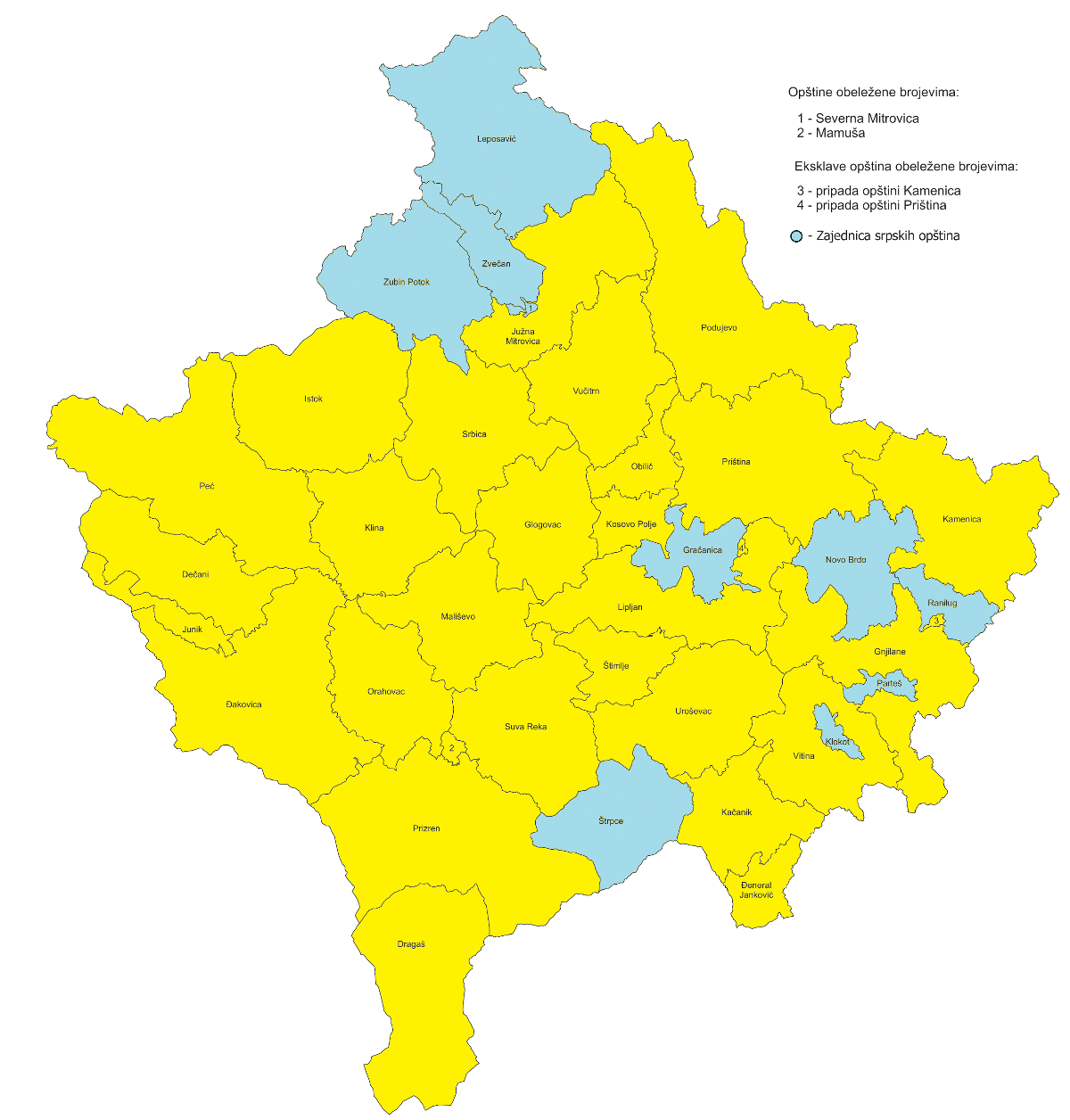
Yet, changing internal borders is not as unthinkable as it looks at first glance. It is less well known that Kosovo's northern border – which is under dispute in the current debate – was modified during Tito's time in 1959 when the municipality of Leposavic was added to Kosovo, which was an autonomous province of Serbia in Yugoslavia. It was an important change considering that this municipality constitutes the greatest part of the territory of North Kosovo (i.e. Kosovo north of the Ibar river, as shown in the map below).
Map of Kosovo with Serbian majority areas highlighted in blue
The other important counter-argument is that "such a territorial swap is legitimising a dangerous propaganda of ethnic ownership over the territory – a principle that has pushed the region on several occasions into bloody conflicts". However, a territorial swap of this nature is not going to fulfil the abominable goal of establishing ethnic ownership over territories, as the aspiration of increasing ethnic homogeneity would be only partially realised.
North Kosovo joining Serbia would be the least controversial change as there are very few Albanians and other minorities living there. According to OSCE estimates from 2015, the four municipalities north of the Ibar river – Leposavić, Zvečan, Zubin Potok and North Mitrovica – have 79,910 inhabitants. Around 70,300 (88%) of these are Serbs, 6,970 (9%) are Albanians, and 1,500 (2%) are Bosniaks. Yet, the majority of Kosovo Serbs live in the south, and their position would undoubtedly be weakened by losing their ethnic kin in the north. By contrast, southern Serbia is home to many non-Albanians, among them around 18,000 Serbs, (and even more, around 25,000, if we add Medvedja to its territory). Thus, at least 25% of the population is composed of ethnic Serbs, (or more if we include Medvedja).
It is difficult to imagine that these people would be ready to live in Kosovo. It could be argued that Kosovo could accept giving up the north without getting Presevo Valley as international recognition would be the greatest price for Pristina. North Kosovo anyhow has not been an integral part of Kosovo since 1999, so it would not be such a huge loss for Kosovo if its northern part formally separated. However, it is unlikely that it could be sold politically in Kosovo in the face of strong resistance from opposition parties and public opinion.
The benefits
The arguments in favour of the land swap are that it would allow for normalising relations between the two countries, enabling Kosovo to gain full international recognition and Serbia to move ahead with EU accession. Serbia will not recognise Kosovo without some serious concessions. Without such a radical agreement it is difficult to imagine how the two countries could move forward from the current deadlock, which is unsustainable. As Ivor Roberts, former ambassador of the UK to Yugoslavia, has rightly pointed out, "the reality is that no course is without risks, and the present impasse is not risk-free, either". Without international recognition, life in Kosovo is going to remain a challenge, which has obvious security risks, not to mention Serbia getting into a deadlock with its EU accession.
Key conditions: Domestic consensus and the regional environment
Getting into a serious discussion about a possible land swap is therefore a high risk-high reward gamble. The truth is that no one can predict what would happen afterwards. Such a deal could well bring the impasse between Kosovo and Serbia to an end. Yet, things could also go wrong easily. While Vucic seems capable of asserting control over the various actors in Serbia and the Serbian politicians in Kosovo for a deal to be implemented, Thaci seems less able to forge the internal support such an agreement would require. Without a certain degree of domestic backing, the agreement could not be carried out, or could be messy and possibly even violent, in light of Vetevendosje's more recent violent actions in parliament. Therefore, a considerable degree of internal support is a necessary requirement for any settlement to succeed. Yet, this will not prevent the mentioned negative repercussions from occurring in other parts of the Balkans.
By looking at the experience of other negotiated settlements in the region, I have argued elsewhere (alongside my co-author Erin K. Jenne) that stability in the regional environment is key for territorial settlements to work. Conflict spillover from neighbouring countries, deadlock in NATO or the EU integration process, and interventionist kin state activism can fuel discrimination against minorities or separatism by minority organisations, which can result in conflict.
Examples include Macedonia following the signing of the Ohrid Agreement in 2001. Ethnic relations began to deteriorate after 2008 when Macedonia's NATO and EU accession was put on hold because of the name dispute with Greece. Thus, it can be assumed that if Macedonia manages to solve the name issue with Greece, its EU accession might receive new momentum, taking the wind out of the sails of nationalist troublemakers. In Bosnia, the situation is more complicated, yet without outside support, such as from Serbia or Russia, Bosnian Serbs are unlikely to take the risk of outright secession and a possible conflict in the face of internal and international resistance.
Since the summer, Kosovo-Serbia relations have been on a downward spiral, most recently owing to Kosovo's unilateral imposition of customs tariffs on Serbian and Bosnian products. The current political atmosphere is definitely not conducive for reaching a compromise between the parties. However, the idea could be put back on the agenda if talks gain better momentum. A well-managed land swap which is based on domestic consensus and the mitigation of regional risks could have a stabilising effect for both countries. Yet, securing these conditions is no small feat, and its success cannot be guaranteed – and herein lies the risk.
Please read our comments policy before commenting.
Note: This article gives the views of the author, not the position of EUROPP – European Politics and Policy or the London School of Economics.
_________________________________
 Beáta Huszka – ELTE University
Beáta Huszka is an Assistant Professor at the Department of European Studies in ELTE University, Budapest. She completed her PhD in International Relations at the Central European University in 2010.

Sputnik
4-5 minutes
21:31 09.11.2018(updated 21:50 09.11.2018) Get short URL
NATO carried out a 78-day campaign of airstrikes against Yugoslavia in 1999 after accusing Belgrade of committing war crimes in Kosovo. The strikes left up to 5,700 civilians dead, and contaminated part of southern Serbia with radiation from the depleted uranium rounds used by the alliance.
The Serbian government-designated Commission Investigating the Effects of NATO's 1999 Bombing of the Federal Republic of Yugoslavia has provided Sputnik with important information about some of its preliminary findings.
Speaking to Sputnik Serbian, commission head Dr. Darko Laketic explained that in the course of visits to cities, towns and municipalities affected by the NATO bombings, the commission has been able to establish what appears to be evidence of a link between the depleted uranium rounds dropped in these areas and a rise in cancer incidence.
According to the physician, in the city of Vranje, southern Serbia, out of 40 people who came into direct contact with soil contaminated by depleted uranium, ten have died, with "the majority of the deaths caused by malignant neoplasms."

© AFP 2018 / ANDREJ ISAKOVIC
"Many people who have been to the affected areas suffer from the symptoms of erythema and ulcerous eruptions of an unknown etiology on their skin," Dr. Laketic added.
Commission members have already visited Vranje, Pancevo and Novi Sad, and plan to visit Kragujevac, with all of these areas facing heavy NATO bombing in 1999. "These are our priority regions. We are collecting medical and statistical data from medical institutions in these areas and interviewing people who have come into contact with contaminated soil," Laketic explained.
The doctor noted that in the village of Borovac, another area struck by NATO bombs, three residents, or one percent of the village's total population, are suffering from malignant brain damage.
Dr. Laketic noted that an increase in oncological diseases has also been observed in Pcinjski District, and said that this was particularly significant, since the area's population is younger than the Serbian average.
The commission is now working on the creation of a large, systematized database.
"We are investigating the effects of toxic substances. Our task is to establish the causal links between [NATO's] actions and illnesses. Having established them, we will receive weighty arguments for organized efforts in the detection, prevention and treatment of cancer at its early stages in those regions where it is necessary," the doctor said.
© AP Photo / Manuel Balce Ceneta
According to Dr. Laketic, in addition to depleted uranium, other toxic substances released during NATO's bombardment, such as chlorine, benzene, and polychlorinated biphenyls are also proven to cause illness, including malignant neoplasms which can lay dormant for five, ten or even twenty years after a person first comes in contact with them.
Established in June, the commission hopes to complete its first preliminary report by 2020. Dr. Laketic will report on the status of his team's investigation in the Serbian National Assembly in December.
According to openly available data, in the late 1990s, the average Serbian death rate from oncological illnesses hovered between 9,000 and 12,000 people per year. By 2014, however, the figure doubled to 22,000, with the number of newly diagnosed cancer patients reaching 40,000.
Some medical doctors and scientists have attributed the jump in cancer rates to NATO's use of depleted uranium rounds during its bombing, and have pointed to the rise in leukemia and lymphoma, cancer types affecting tissue most sensitive to ionizing radiation. Other experts have maintained that there yet to be conclusive proof of a relationship between cancer rates and the depleted uranium rounds, since cancers have been growing across Serbia, while depleted uranium rounds were dropped primarily in southern Serbia. According to World Cancer Research Fund statistics, Serbia is 18th in the world in total incidence of cancers, with 307.9 cases per 100,000 residents reported in 2018.


 Headlines of Serbian newspapers from November 22. Photo: BIRN
 Kosovo newspapers' headlines on the tax hike. Photo: BIRN