February 27, 2018

“Western Balkans could take up to 200 years to catch up with EU”

inserbia.info

"Western Balkans could take up to 200 years to catch up with EU"

InSerbia with agencies

3 minutes


Western Balkans countries need to tackle their low productivity and speed up reforms, the EBRD said on Monday, warning it could otherwise take them up to 200 years to catch up with the living standards of the EU states they hope to join.

Albania, Bosnia and Herzegovina, Macedonia, Kosovo, Montenegro and Serbia are held back by weak institutions, corruption and government dominance in some industries, the European Bank for Reconstruction and Development (EBRD) said.

The current average gross domestic product (GDP) per capita for the six countries, still scarred by ethnic wars fought in the 1990s, is only half the average in 11 EU member states of Eastern Europe, such as Poland or Hungary, and just a quarter of their more advanced western European peers.

"The fundamental problem holding back the region's economic development is low productivity," the EBRD said in its report, released at the bank's Western Balkans Investment Summit in London. "This reflects years of under-investment, weak institutions and a difficult business environment."

While the private sector was the main contributor to economic output in all of the six countries, governments often dominated key industries, with significant privatisation programmes ahead.

Private sector productivity across the Western Balkans stood at just 60% cent of EU levels overall, the report said.

In the EBRD's baseline scenario, which used average annual growth rates for 2001-2016 of 3.2% for the Western Balkans and 1.4% in the EU, the report suggested the six countries could achieve the EU's average GDP per capita in about 60 years.

However, the EBRD noted that the speed of convergence had slowed down markedly over the past seven years. The region achieved average annual growth of just 1.2% in the post-crisis 2009-2016 years compared with 5.3% in the pre-crisis period of 2001-2008.

So under a more pessimistic scenario using post-crisis growth rates it could take the Western Balkans over 200 years to converge, the bank said, with parity achieved only in 2220.

An optimistic scenario using pre-crisis growth rates would allow the Western Balkans to catch up in under 40 years, by 2053.

"The speed of catch up would depend on the pace of addressing the challenges that hamper the region from developing its full potential," the report said.

"Full EU convergence will require states to implement a determined and comprehensive reform agenda towards boosting productivity and investment," the EBRD added.

All six countries are seeking membership of the European Union, which recently launched a new integration campaign.


February 24, 2018

Russia’s Election Meddling: Worse Than a Crime a Blunder


http://www.theamericanconservative.com/articles/russias-election-meddling-worse-than-a-crime-a-blunder/


Russia's Election Meddling: Worse Than a Crime; a Blunder


U.S.-Russian hostility is now inevitable, and the results could be tragic.

Robert Merry, Journalist and Editor of The American Conservative

February 19, 2018

When Napoleon Bonaparte executed the Duc d'Enghien in 1804 for what seemed like trumped-up treason charges, the implications extended far beyond questions of French justice and even beyond the borders of France. European leaders were shocked, and the episode helped crystallize anti-Bonaparte sentiment throughout the Continent and in Britain. The famous French diplomat Charles de Talleyrand captured the moment when he said: "It was worse than a crime; it was a blunder."

That might well be said now about the Russian effort to manipulate the 2016 presidential election by using social media to undermine Democratic candidate Hillary Clinton, promote the candidacy of Donald Trump, and generally sow discord throughout the American body politic. Three Russian companies and 13 Russian citizens were indicted by U.S. authorities Friday on charges of engaging in a three-year, multimillion-dollar effort to interfere in the election. Americans naturally are shocked at this brazen effort to unravel the political fabric of their country.

But it isn't really all that shocking. To understand why it was more of a blunder than a crime—and a blunder with likely tragic consequences—it is important to absorb five fundamental realities surrounding this important development in U.S.-Russian relations.

First, countries have been doing this sort of thing for centuries. It is a fundamental part of tradecraft—the use of covert actions to undermine the internal workings of rival nations. No country likes being on the receiving end, but few refrain from such activity when they think it will thwart national security threats.

Second, no nation has been more aggressive than the United States in pursuing efforts, covert and even overt, to destabilize other regimes. In part that's because, as the leading global power since World War II, the Unites States has had more at stake in events of significance throughout the world. In part also, it's because America has had the greatest capacity for bringing the latest technology and the greatest covert capabilities to meet the challenge.

In any event, the U.S. record in this area is beyond dispute. A New York Times piece by Scott Shane over the weekend quoted a University of Georgia professor named Loch Johnson as saying, "We've been doing this kind of thing since the CIA was created in '47. We've used posters, pamphlets, mailers, banners—you name it." Among other things, he adds, the United States has planted false information in foreign newspapers and distributed "suitcases of cash" to influence foreign elections. Steven L. Hall, a 30-year CIA veteran (now retired) with extensive experience leading the Russia desk, told Shane that the United States "absolutely" engaged in such activities, "and I hope we keep doing it."

Shane cites a study by Dov H. Levin of Carnegie Mellon that sought to quantify "election influence operations" by the United States and the Soviet Union/Russia between 1946 and 2000. He counts 81 by the United States and 36 by the Soviet Union or Russia (though he figures there were more ops initiated from Russian soil than we know about).

Beyond that, there is what has become known as the "democracy industry"—legions of U.S. NGOs, many funded with federal money, that fan out through the world to remake regimes they consider insufficiently imbued with Western values. Writer and thinker David Rieff, writing in The National Interest a few years ago, attacked these democracy promotion adherents as people who "will not or cannot acknowledge either the ideological or the revolutionary character of their enterprise." He likened the democracy promoters in propaganda terms to Soviet leader Nikita Khrushchev's 1956 boast to America that "we will bury you."

Third, the greatest interference in the internal affairs of foreign nations, aside from invasion, is regime change, and here the United States is by far the leader in the post-World War II era. We know of major efforts—covert or overt, successful or not—by America to upend regimes in Iran, Guatemala, South Vietnam, Chile, Nicaragua, Grenada, Serbia, Iraq, Libya, Syria, and Ukraine.

Leaving aside the case-by-case merits, this is a powerful record, and it has implications far beyond U.S. domestic politics. Like Bonaparte's execution of the Duc d'Enghien, it generates concerns and fears among foreign leaders. In the case of America's regime change zest, it sends chills down the spines of leaders fearful that they may be next on the list of U.S. regime change targets. Certainly the resolve of North Korea's Kim Jong-un to develop nuclear weapons with a delivery capacity to the United States is partly a product of such fears.

Fourth, America and its allies bear by far the greater share of the blame for the current tensions between the West and Russia. It was all predictable back in 1998 when NATO fashioned its policy of aggressive eastward expansion toward the Russian border. George F. Kennan, the highly respected U.S. diplomat and Russia expert, predicted the outcome in particularly stark terms. He called it "the beginning of a new cold war…a tragic mistake." He foresaw that of course the Russians would react badly, as any nation would, and then the NATO expansionists would say, see, we always said the Russians were aggressive and couldn't be trusted. "This is just wrong," Kennan warned.

But if NATO expansion was a provocative policy destined to elicit a strong Russian response, the provocation was heightened hugely when America helped perpetrate a regime change initiative in Ukraine, which is not only next door to Russia but has been a crucial part of Russia's sphere of influence going back to the mid-17th century. Further, Russia lies vulnerable to invasion. The unremitting grassy steppes of the nation, extending from Europe all the way to the Far East, with hardly a mountain range or seashore or major forest to hinder encroachment by army or horde, has fostered a national obsession over the need to control territory as a hedge against incursion. Such incursions from the West occurred three times in the 19th and 20th centuries.

Ukraine is crucial in this Russian sense of territorial imperative. It's a tragically split country, with part tilting toward the West and part facing eastward toward Russia. That makes for a delicate political and geopolitical situation, but for centuries that delicate political and geopolitical situation has been overseen by Russia. Now the West wants to end that. Upending a duly elected (though corrupt) Ukrainian president was part of the plan. Getting Ukraine into NATO is the endgame.

Note that the Ukrainian revolution occurred in 2014, which just happened to be the year, according to the U.S. indictments, that Russia initiated its grand program to influence America's 2016 elections. Kennan was right: Russia inevitably would react badly to the NATO encirclement policy, and then America's anti-Russian cadres would cite that as evidence that the encirclement was necessary all along. That's precisely what's happening now.

Which brings us to the fifth and final fundamental reality surrounding the revelation of Russia's grand effort to influence the U.S. election. It was an incredible blunder. Given all that's happened in U.S.-Russian relations this century, there probably wasn't much prospect that those relations could ever be normalized, much less made cordial. But that is now utterly impossible.

Donald Trump campaigned on a platform of seeking better relations with Russia. After getting elected he repeatedly asserted in his first news conference that it would be "positive," "good," or "great" if "we could get along with Russia." Unlike most of America's elites, he vowed to seek Moscow's cooperation on global issues, accepted some U.S. share of blame for the two countries' sour relations, and acknowledged "the right of all nations to put their interests first."

This suggested a possible dramatic turn in U.S.-Russian relations—an end to the encirclement push, curtailment of the hostile rhetoric, a pullback on economic sanctions, and serious efforts to work with Russia on such nettlesome matters as Syria and Ukraine. That was largely put on hold with the narrative of Russian meddling in the U.S. election and vague allegations of campaign "collusion" with Russia on behalf of Trump's presidential ambitions.

It doesn't appear likely that investigators will turn up any evidence of collusion that rises to any kind of criminality. But it doesn't matter now, in terms of U.S.-Russian relations, because these indictments will cement the anti-Russian sentiment of Americans for the foreseeable future. No overtures of the kind envisioned by Trump will be possible for any president for a long time. It won't matter that every nation does it or that America in particular has done it or that the West's aggressive encirclement contributed to the Russian actions. The U.S.-Russian hostility is set. Where it leads is impossible to predict, but it won't be good. It could be tragic.

Robert W. Merry, longtime Washington, D.C., journalist and publishing executive, is editor of The American Conservative. His latest book, President McKinley: Architect of the American Century, was released in September.


Russia, Serbia are objects of overt pressure

tass.com

TASS: Russian Politics & Diplomacy - Russia, Serbia are objects of overt pressure

5-6 minutes


© Alexander Shcherbak/TASS

MOSCOW, February 24. /TASS/. Moscow and Belgrade are the objects of the West's overt pressure, Russia's Foreign Minister Sergei Lavrov said in an interview with the Rossiya 1 television channel on Saturday.

"This country, like Serbia, becomes an object of overt pressure," the foreign minister said referring to what his Serbian counterpart Ivica Dacic had said about the West's attempts to make use of Belgrade's interest in the European integration to "make Serbia follow an anti-Russian position."

"By the way, not many in Europe are able to use the simple language to express attitudes to what is going on," Lavrov said.

The minister spoke about how warmly the Serbians welcomed him during the recent visit. "Crowds of people, who came to the Russian embassy in Belgrade, those who in the snow and rain participated in the ceremony of laying wreaths to the memorial, devoted to Belgrade's liberators - nobody made them come, that was their own choice," he said. "These are the relations we have, as we love our countries, and the Serbians love Russia, and Russians love Serbia."

Russia's foreign minister was in Serbia on a two-day working visit on February 21-22. Serbian President Aleksandar Vucic received him on Wednesday. Lavrov held a meeting with Serbia's Prime Minister Ana Brnabic on Thursday.

In other media


February 19, 2018

The difficulties of exchanging territory in the Balkans

The Economist explains


The difficulties of exchanging territory in the Balkans

If Kosovo and Serbia swap parcels of land, the process won't end there


The Economist explains

Feb 19th 2018

by T.J.

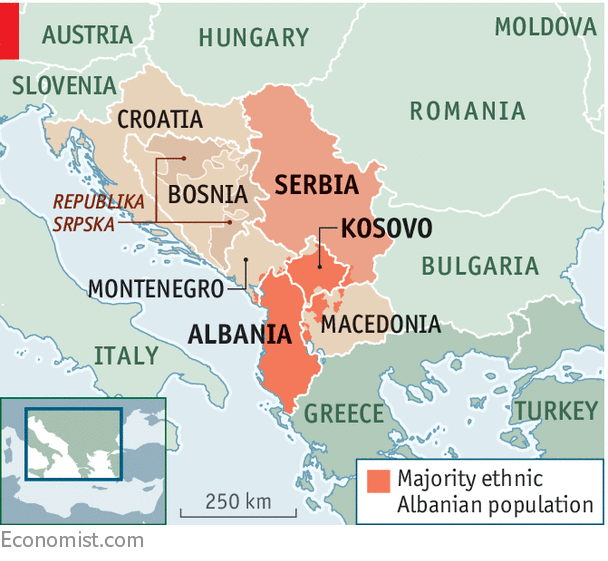
TEN years ago Kosovo declared independence from Serbia. Its Albanians, who make up the majority of the population, have been celebrating. But its Serbs, most of whom live in enclaves, have not. Serbia does not recognise Kosovo, which used to be its southern province, and Kosovo Serbs still consider themselves citizens of Serbia. The situation is typical of the Balkans, where borders are, frankly, a mess. So there are Serbs living in Kosovo and in Bosnia-Hercegovina, where they have their own republic (the Republika Srpska), Albanians and Bosniaks (Muslims) living in Serbia, and Greeks living in Albania. Recently the Serbian authorities proposed a discussion about an exchange of territory with their Kosovo Albanian counterparts. Is this a sensible idea?

In 1923 Greece and Turkey agreed to exchange some 2m people. Mostly Greek-speaking Christian Orthodox citizens of Turkey were sent to Greece, and Muslims from Greece were sent to Turkey. It was a brutal relocation, but, note its defenders, Greece and Turkey have not fought a war since. The only place where Greeks and Turks have fought is Cyprus, where their populations remained mixed. This has inspired nationalists in the western Balkans. Between 1918 and the late 1950s, many Muslims were encouraged to leave Yugoslavia for Turkey. But at the time of Yugoslavia's collapse in the 1990s it still contained a thorough mix of peoples. Leaders in those Yugoslav wars saw ethnic cleansing as the best way to create new nation-states unpeopled by troublesome minorities. By 1995 historically Serb-populated regions of Croatia were empty and hundreds of thousands of Serbs, Croats and Bosniaks had similarly been turfed out of their homes in Bosnia. But the countries that emerged from the implosion did not neatly encircle Serbs, Albanians, Croats and so on. Myriad Serbs may have fled Kosovo after its war, but some 120,000 remain. 

Latest stories


The Serbian authorities want to discuss taking Kosovo's northern part, with Albanian-inhabited regions of Serbia moving to Kosovo in exchange. Proponents of such "map-tidying" say that multi-ethnic states have failed in the Balkans. But they ignore the fact that, once governments start down this path, the process has no obvious end and pays no heed to the human rights of everyone involved. If Kosovo and Serbia begin serious talks about a redrawing of their borders, the impact on Balkan communities apart from those in the affected parts of Kosovo and Serbia could be profound. Bosnian Serb leaders would hold a referendum on the future of the Republika Srpska; Bosnian Croats would follow suit; and Bosniaks would then fight to prevent the dismemberment of their shared country. Over the border Serbia would clamp down on Bosniak nationalists in Sandzak who dream of incorporating that region into a Greater Bosnia. Meanwhile Albanians in western Macedonia and Montenegro would demand to join a Greater Albania. Proponents of that idea would also like to incorporate parts of northern Greece, whereas Greek nationalists would demand part of southern Albania.

One irony behind the mooted exchange is that most Kosovo Serbs actually live in enclaves in the south of Kosovo. So the agreement would not leave them living in Serbia, and they would probably have to leave their homes or else be driven out. But Serbian officials may be less concerned about their countrymen than about taking steps towards recognising Kosovo—and thus making their own hoped-for accession to the European Union (EU) easier. It may not concern them that an exchange of territories in the western Balkans could have huge ramifications. Hungarian nationalists, after all, remain unreconciled to the loss of Transylvania to Romania, and Romanian nationalists would like to redraw their borders to take in Moldova. There is a reason that "Balkanisation" has a bad name. As in the EU at large, lessening the relevance of national borders would seem wiser than redrawing them and, in the words of one senior EU official, "opening the gates to hell".


https://www.economist.com/blogs/economist-explains/2018/02/economist-explains-11

February 08, 2018

Exclusive: Kosovo Intelligence Agency and Police know who killed Oliver Ivanovic

gazetaexpress.com

Exclusive: Kosovo Intelligence Agency and Police know who killed Oliver Ivanovic

GazetaExpress

2 minutes


Killing of the Kosovo Serb leader, Oliver Ivanovic, who was gunned down in front of his SDP Party headquarters in Mitrovica North, is likely to be solved soon. "The KIA and Kosovo Police, possess information on who pulled the trigger and the motives behind this this killing," a reliable source told Gazeta Express. "Maybe they don't have all the information, to order the arrest of the alleged perpetrators, but there is a lead," a source told Express noting however that the KIA and Police are careful not to damage the investigation. "It is very likely that the security institutions have already informed political leaders, in both Kosovo and Serbia related to their findings," the source said.  

Oliver Ivanovic was killed on 16 January in front of his party's headquarters. Only days before he was gunned down with six bullets by unknown perpetrators, Ivanovic told media in Belgrade the he was not feeling safe. Strained relations of Ivanovic with the Government in Belgrade, and Serbian president Aleksandar Vucic, were tense. The Government during general and local elections in Kosovo held in 2017 have openly supported the Srpska List, hampering other political parties gathering Serbs in Kosovo. Media in Serbia have reported that only days before Ivanovic's killing he sent an SMS to President Vucic, but he received no answer on his concerns. Media continue speculations on alleged perpetrators of Ivanovic's killing.  


February 03, 2018

Weinbaum: Jasenovac exhibition worst I’ve ever seen

inserbia.info

Weinbaum: Jasenovac exhibition worst I've ever seen

InSerbia with agencies

3-4 minutes


"The setting in Jasenovac is one of the worst exhibitions I've ever seen. This is a true example of blurring the history of the Holocaust and Croatia is not the only country to do it," said Dr. Laurence Weinbaum, President of the World Jewish Congress, after visiting the memorial site of the infamous Ustasha Jasenovac camp. He was shocked that the way of showing the people the Ustasha tortured and killed in one of the most horrible concentration camps in Europe during the Second World War was shown in this way.

According to him, the setting was also technically badly set up and wrongly conceived, and he added that he had to kneel to see some parts of the collection.

Dr. Weinbaum is a long-time diplomat, he dealt with the suffering of the Jews, taught about the history of the Holocaust, and is one of the best connoisseurs of the events in the camps opened by the Nazis and their sympathizers, such as the quisling regime of the infamous Ante Pavelic. Weinbaum is also the chief director of the Israeli Foreign Relations Council, and after a review of the exhibition he made a series of criticism. During his visit, otherwise, there were no Croatian officials accompanying him.

"Society in Croatia today is not healthy, and unconvincingly sound claims that today's Croatia is not a follower of NDH. The celebration of the criminals is entering into Croatian society," stated Weinbaum, claiming that Jasenovac exhibition does not speak about what was happening there. The Croatian authorities should support the establishment of a mixed committee, including scientists from the world and Croatia, in order to provide answers to Holocaust issues in Croatia. According to him, the problem is in historians, because it comes "from the top". It is not about ignorance, but about negation and blurring, and a mature society is needed that will not shift responsibility on others and accuse them, but will take responsibility.

Dr. Weinbaum is also very sharp when it comes to the number of victims of Jasenovac, especially regarding the official list with which Croatian politicians most often go public. He claims that in Croatia during the Ustasha regime 30,000 Jews were killed and that this was a real reality:

"Many crazy people say that it was not like that. The health of many societies, including Croatian, depends on the relationship with the Holocaust. I hope that Croatia will have the strength to face the crimes of the NDH and will oppose those who glorify it."

Academician Vasilije Krestic says that Dr. Weinbaum's reaction is not surprising, since Croats have been trying for years to cover and diminish the crimes against the Serbs and Jews.

"Officials want things to look the way the Ustashas presented them, that they were labor camps, not death camps," comments Krestic.

"They are very persistent in denying their own crimes and this is only a proof that they do not want to face the truth. Their policies correspond to Josip Broz's policy, when everything was buried and silenced, and the number of those killed reduced and covered."

He adds that the exhibition about Jasenovac in the United Nations building has the real truth come to the fore and the whole world can see it these days.


January 30, 2018

Kosovo for “Europe”: Washington’s “Balkans Policy” and the Future of Serbia

globalresearch.ca

Kosovo for "Europe": Washington's "Balkans Policy" and the Future of Serbia | Global Research

By Dr. Vladislav B. Sotirović

19-24 minutes


The assassination of Kosovo's Serb leader Oliver Ivanović on January 16th, 2018 in the northern (the Serb) part of the divided city of Kosovska Mitrovica once again put on the agenda both the issue of contested land of Kosovo and Serbia's policy toward the West, in particular, the EU.

The Western (the USA/EU) client Serbia's government is quite long time under the direct pressure from Brussels to recognize an independence of the narco-mafia Kosovo's quasi-state in exchange for joining  the EU but not before 2025.

It is only a question of time that a Western colony of Serbia has to finally declare its position towards Kosovo's independence. All pro-Western bots and trolls in Serbia, already publicly announced their official position in regard to this question: Serbia's Government has to finally inform the Serbian nation that Kosovo is no longer an integral part of Serbia and therefore the recognition of Kosovo's independence by Belgrade is only way towards a "prosperous" Euro future of the country that is within the EU (and the NATO's pact as well). The fundamental Western quisling in Belgrade – president of Serbia Aleksandar Vučić (of the Bosnian origin from a Nazi-Croat district of Bugojno) recently clearly informed the nation not to be surprised if Serbia has to recognize the independence of Kosovo in order to join "Europe" (why Switzerland, Andorra, Lichtenstein, Monaco, Norway or Iceland are not in "Europe" he did not explain).

In the following paragraphs, the most important features of the "Kosovo Question" are going to be presented for the better understanding of the present political situation in which the Serb nation is questioned by the Western "democracies" upon both its own national identity and national pride.

Prelude

The southeastern province of the Republic of Serbia – under the administrative title of Kosovo-Metochia (in the English only Kosovo), was at the very end of the 20th century in the center of international relations and global politics due to the NATO's 78 days of "humanitarian" military intervention against the Federal Republic of Yugoslavia (the FRY composed by Serbia and Montenegro) in 1999 (March 24th–June 10th). As it was not approved and verified by the General Assembly or the Security Council of the United Nations, the US-led operation "Merciful Angel" opened among the academicians a fundamental question of the purpose and nature of the "humanitarian" interventions in the world like it was previously in Bosnia-Herzegovina in 1995, Rwanda in 1994 or Somalia in 1991−1995. More precisely, it provoked dilemmas of the misusing ethical, legal and political aspects of armed "humanitarian" interventions as the "responsibility to protect" (R2P) for the very reason that it became finally obvious in 2008 that the NATO's "humanitarian" military intervention in 1999 was primarily aimed to lay the foundation for Kosovo's independence and its separation from Serbia with transformation of the province into the US−EU's political-economic colony, what Kosovo, in fact, today is [see more in Hannes Hofbauer, Eksperiment Kosovo: Povratak kolonijalizma, Beograd: Albatros Plus, 2009].

Kosovo as contested land between the Serbs and the Albanians

The province of Kosovo-Metochia (Kosova in the Albanian) is a landlocked territory in Central Balkans having borders with Albania, the Former Yugoslav Republic of Macedonia (the FYROM), Central Serbia and Montenegro. It is almost of the same size as Montenegro but having more than four times Montenegro's population [Sabrina P. Ramet (ed.), Central and Southeast European Politics since 1989, New York: Cambridge University Press, 2010, 359]. The province, as historically contested land between the Serbs and the Albanians, did not, does not and will not have an equal significance for these two nations. For the Albanians, Kosovo was all the time just a provincial land populated by them without any cultural or historical importance except for the single historical event that the first Albanian nationalistic political league was proclaimed in the town of Prizren in Metochia (West Kosovo) in 1878 and existed only till 1881. However, both Kosovo as a province and the town of Prizren were chosen to host the First (pan-Albanian) Prizren League only for the very propaganda reason – to emphasize allegedly predominantly the "Albanian" character of both Kosovo and Prizren regardless to the very fact that at that time the Serbs were a majority of population either in Kosovo or in Prizren. Kosovo was never part of Albania and the Albanians from Albania had no important cultural, political or economic links with Kosovo's Albanians regardless the fact that the overwhelming majority of Kosovo's Albanians originally came from North Albania after the First Great Serbian Migration from Kosovo in 1690.

However, quite contrary to the Albanian case, Kosovo-Metochia is the focal point of the Serbian nationhood, statehood, traditions, customs, history, culture, church and above all of the ethnonational identity. It was exactly Kosovo-Metochia to be the central administrative-cultural part of medieval Serbia with the capital in Prizren. The administrative centre of the Serbian Orthodox Church in the medieval and later on the Ottoman-time was also in Kosovo-Metochia in the town of Peć (Ipek in the Turkish; Pejë in the Albanian). Before Muslim Kosovo's Albanians started to demolish the Serbian Christian Orthodox churches and monasteries from June 1999 onward, there were around 1.500 Serbian Christian shrines in this province. Kosovo-Metochia is even today called by the Serbs as the "Serbian Holy Land" while the town of Prizren is known for the Serbs as the "Serbian Jerusalem" and the "Imperial Town" (Tsarigrad) in which there was an imperial court of the Emperor Stefan Dušan of Serbia (1346−1355) [see more in Миладин Стевановић, Душаново царство, Београд: Књига-комерц, 2001]. The Serbs, differently to the Albanians, have a plenty of national folk songs and legends about Kosovo-Metochia, especially in regard to the Kosovo Battle of 1389 in which they lost state independence to the Ottoman Turks. For the Serbs, Kosovo-Metochia is the "cradle of the Serbs" and real "Serbia proper" while for the Albanians, Kosovo is just a peripheral province of their nationhood and culture.


Prizren – A Serbian Orthodox Church (built in 1306) of Holy Virgin of Ljevish. However, the Albanian propaganda is presenting this church as all other (Serbian) Christian Orthodox churches in Kosovo-Metochia either as the Byzantine or even as the Albanian. In March 2004 the church was set on fire and seriously damaged by local (Muslim) Albanians. The church is proclaimed as the UNESCO World Heritage Site in 2006 (Source: author)

Nevertheless, there is nothing similar in the Albanian case in regards to Kosovo. For instance, there is no single Albanian church or monastery in this province from the medieval time or any important monument as the witness of the Albanian ethnic presence in the province before the time of the administration by the Ottoman Sultanate. Even the Muslim mosques from the Ottoman time (1455−1912) claimed by the Albanians to belong to the Albanian national heritage, were, in fact, built by the Ottoman authorities but not by ethnic Albanians. The Albanian national folk songs are not mentioning the medieval Kosovo that is one of the crucial evidence that they simply have nothing in common with the pre-Ottoman Kosovo. All Kosovo's place-names (toponyms) are of the Slavic (the Serb) origin but not of the Albanian. The Albanians during the last 50 years are just renaming or adapting the original place-names according to their vocabulary what is making a wrong impression that the province is authentically the Albanian. We have not right to forget the very fact that the word Kosovo is of the Slavic (the Serb) origin meaning a kind of eagle (kos) while the same word means simply nothing in the Albanian language. Finally, in the Serbian tradition, Kosovo-Metochia was always a part of the "Old Serbia" while in the Albanian tradition Kosovo was never called as any kind of Albania.

The province became contested land between the Serbs and the Albanians when the later started to migrate from North Albania to Kosovo-Metochia after 1690 with getting a privileged status as the Muslims by the Ottoman authorities. A Muslim Albanian terror against the Christian Serbs at the Ottoman time resulted in the Albanisation of the province to such extent that the ethnic structure of Kosovo-Metochia became drastically changed in the 20th century. A very high Muslim Albanian birthrate played an important role in the process of Kosovo's Albanisation too. Therefore, after the WWII the ethnic breakdown of the Albanians in the province was around 67 percent. The new and primarily anti-Serb communist authorities of socialist Yugoslavia legally forbade to some 100.000 WWII Serb refugees from Kosovo-Metochia to return to their homes back after the collapse of the Greater Albania in 1945 of which Kosovo was an integral part. A Croat-Slovenian communist dictator of Yugoslavia, Josip Broz Tito (1892−1980), granted to the province of Kosovo-Metochia a considerable political autonomous status in 1974 with a separate government, Provincial Assembly, president, Academy of Sciences, security forces, independent University of Prishtina and even military defense system for the fundamental political reason to prepare Kosovo's independence after the death of his Titoslavia. Therefore, Kosovo-Metochia in socialist Yugoslavia was just formally part of Serbia as the province was from a political-administrative point of view an independent as all Yugoslav republics.

A fully Albanian-governed Kosovo from 1974 to 1989 resulted in both destruction of the Christian (the Serb) cultural monuments and continuation of mass expulsion of the ethnic Serbs and Montenegrins from the province to such extent that according to some estimations there were around 200.000 Serbs and Montenegrins expelled from the province after the WWII up to the abolition of political autonomy of the province (in fact, independence) by Serbia's authority in 1989 with the legal and legitimate verification by the provincial assembly of Kosovo-Metochia and the reintegration of Kosovo-Metochia into Serbia. At the same time, there were around 300.000 Albanians who illegally came to live in Kosovo-Metochia from Albania after 1945. Consequently, according to the official census, in 1991 there was only 10 percent of the Serbs and Montenegrins in Kosovo-Metochia, 87 percent of the Albanians and 3 percent of others. In one word, during one century of time, the Serbian population of Kosovo-Metochia from 65−70 percent fell down to 10 percent (according to the first Ottoman census in 1455, there was only 2 percent of the Albanians in Kosovo-Metochia) [see more in Р. Самарџић et al, Косово и Метохија у српској историји, Београд: Друштво за чување споменика и неговање традиција ослободилачких ратова Србије до 1918. године у Београду−Српска књижевна задруга, 1989; Д. Т. Батаковић, Косово и Метохија: Историја и идеологија, Београд: Чигоја штампа, 2007].

Fighting Kosovo's Albanian political terrorism and territorial secession

The revocation of Kosovo's political autonomy in 1989 by Serbia's central government in Belgrade was aimed primarily to stop further ethnic Albanian terror against the Serbs and Montenegrins and to prevent secession of the province from Serbia with the final aim to restore the WWII Greater Albania and legalize the Albanian ethnic cleansing of all non-Albanian population what practically happened in Kosovo after mid-June 1999 when the NATO's troops occupied the province and brought to the power a classical terrorist political-military organization – Kosovo's Liberation Army (the KLA). Nevertheless, the Western mainstream media, as well as academia, presented Serbia's fighting Kosovo's Albanian political terrorism and territorial secession after 1989 as Belgrade policy of discrimination against the Albanian population which became deprived of political and economic rights and opportunities [typical examples of such approach are, for instance, propaganda and shameful books based on the falsification of historical facts and a partisan interpretation of political events Noel Malcolm, Kosovo: A Short History, New York: HarperPerennial, 1999; and Sabrina P. Ramet (ed.), Central and Southeast European Politics since 1989, New York: Cambridge University Press, 2010]. The fact was that such "discrimination" was primarily a result of the Albanian policy of boycotting Serbia's state institutions and even job opportunities offered to them in order to present their living conditions in Kosovo as the governmental-sponsored minority rights oppression.


The Serbian Orthodox Church Samodrezha (second half of the 14th century) demolished by the (Muslim) Albanian mob in March 2004 (Source: author)

In the Western mainstream mass media and even in academic writings, Dr Ibrahim Rugova, a political leader of Kosovo's Albanians in the 1990s, was described as a person who led a non-violent resistance movement against alleged Milošević's policy of ethnic discrimination of Kosovo's Albanians. I. Rugova was even called as a "Balkans Gandhi". In the 1990s there were established in Kosovo-Metochia the Albanian parallel and illegal social, educational and political structures and institutions as a state within the state. The Albanians under the leadership of Rugova even three times proclaimed the independence of Kosovo. However, these proclamations of independence were at that time totally ignored by the West and the rest of the world. Therefore, Rugova-led Kosovo's Albanian national-political movement failed to promote and advance Kosovo's Albanian struggle for secession from Serbia and independence of the province with the final political task to incorporate it into a Greater Albania. I. Rugova himself, coming from the Muslim Albanian Kosovo's clan that originally migrated to Kosovo from Albania, was active in political writings on the "Kosovo Question" as a way to present the Albanian viewpoint on the problem to the Western audience and, therefore, as a former French student, he published his crucial political writing in the French language in 1994.

One of the crucial questions in regard to the Kosovo problem in the 1990s is why the Western "democracies" did not recognize self-proclaimed Kosovo's independence? The fact was that the "Kosovo Question" was absolutely ignored by the US-designed Dayton Accords of 1995 which were dealing only with the independence of Bosnia-Herzegovina. A part of the answer is probably laying in the fact that Rugova-led Albanian secession movement was, in essence, illegal and even terrorist. It is known that Rugova himself was a sponsor of a terrorist party's militia which was responsible for violent actions against Serbia's authorities and non-Albanian ethnic groups in Kosovo. For instance, in July 1988, from the graves of the village of Grace's graveyard (between Priština and Vučitrn) were excavated and taken to pieces the bodies of two Serbian babies of the Petrović's family. Nevertheless, as a response to Rugova's unsuccessful independence policy, it was established the notorious KLA which by 1997 openly advocated a full-scale of terror against everything that was the Serbian in Kosovo.

The KLA had two main open political aims:

  • To get an independence for Kosovo from Serbia with a possibility to include the province into a Greater Albania.
  • To ethnically clean the province from all non-Albanians especially from the Serbs and Montenegrins.

However, the hidden task of the KLA was to wage an Islamic Holy War (the Jihad) against the Christianity in Kosovo by committing the Islamic terror similarly to the case of the present-day Islamic State (the ISIS/ISIL) in the Middle East. Surely, the KLA was and is a part of the policy of radicalization of the Islam at the Balkans after 1991 following the pattern of the governmental (Islamic) Party of Democratic Action (Stranka demokratske akcije – the SDA) in Bosnia-Herzegovina presided by Alija Izetbegović who was a member of Islamic SS Handžar Division in the WWII and the author of a radical Islamic Declaration in 1970.

That the KLA was established as a terrorist organization is even confirmed by the Western scholars and the US administration too. About the focal point of Kosovo's War in 1998−1999 we can read in the following sentence:

"Aware that it lacked popular support, and was weak compared to the Serbian authorities, the KLA deliberately provoked Serbian police and Interior Ministry attacks on Albanian civilians, with the aim of garnering international support, specifically military intervention" [T. B. Seybolt, Humanitarian Military Intervention: The Conditions for Success and Failure, Oxford−New York: Oxford University Press, 2007, 79].

Epilogue

It was true that the KLA realized very well that the more Albanian civilians were killed as a matter of the KLA's "hit-and-run" guerrilla warfare strategy, the Western (the NATO's) military intervention against the FRY was becoming a reality. In other words, the KLA with his commander-in-chief Hashim Thaci (today president of Kosovo and still on the Interpol list of the wanted criminals) were quite aware that any armed action against Serbia's authorities and the Serbian civilians would bring retaliation against the Kosovo Albanian civilians as the KLA was using them in fact as a "human shield". That was, in fact, the price which the ethnic Albanians in Kosovo had to pay for their "independence" under the KLA's governance after the war. That was the same strategy used by Croatia's government and Bosnian-Herzegovinian Muslim authorities in the process of divorce from Yugoslavia in the 1990s [see more in Jelena Guskova, Istorija jugoslovenske krize 1990−2000, 1−2, Beograd: ИГАМ, 2003].

However, as the violence in Kosovo escalated in 1998 the EU's authorities and the US's government began to support diplomatically the Albanian course – a policy which brought Serbia's government and the leadership of the KLA to the ceasefire and withdrawal of certain Serbian police detachments and the Yugoslav military troops from Kosovo followed by the deployment of the "international" (the Western) monitors (the Kosovo Verification Mission, the KVM) under the formal authority of the OSCE. However, it was, in fact, informal deployment of the NATO's troops in Kosovo. The KVM was authorized by the UN's Security Council Resolution 1199 on September 23rd, 1998. That was the beginning of a real territorial-administrative secession of Kosovo-Metochia from Serbia sponsored by the West for the only and very reason that Serbia did not want to join the NATO and to sell her economic infrastructure to the Western companies according to the "transition" pattern of the Central and South-East European countries after the Cold War. The punishment came in the face of the Western-sponsored KLA.

Today, the Western gangsters of NATO, the EU and the USA need from Serbia only a formal verification of the results of their dirty policy in Kosovo-Metochia – an official recognition of the "independence" of the Republic of Kosovo. Nevertheless, behind Kosovo's secession from Serbia are both economic and geopolitical goals of primarily American Balkans policy. Firstly, the Americans build up in Kosovo one of their biggest military camps all over the world – Bondsteel. Secondly, the greatest part of Kosovo's natural resources and economic infrastructure are under direct control and exploitation by the US companies including and a private company of General Wesley Clark – the NATO's chief commander who bombed Serbia and Montenegro in 1999. Finally, why the West occupied Kosovo-Metochia in June 1999 and put it under direct their control one can understood from the very fact that this province has 45 percent of the lignite reserves in Europe [Sabrina P. Ramet (ed.), Central and Southeast European Politics since 1989, New York: Cambridge University Press, 2010, 359].

*

Dr. Vladislav B. Satirovic is Founder & Director of the Private Research Centre "The Global Politics" (www.global-politics.eu), Ovsishte, Serbia. Personal web platform: www.global-politics.eu/sotirovic. Contact: sotirovic@global-politics.eu.


January 25, 2018

Serbia Ruling Party Opens Office at Concentration Camp

balkaninsight.com

Serbia Ruling Party Opens Office at Concentration Camp :: Balkan Insight

Filip Rudic

4 minutes


The ruling Serbian Progressive Party has opened an office at the site of a World War II concentration camp in Belgrade, drawing criticism from rights campaigners.

The Progressive Party office at the Staro Sajmiste (Old Trade Fair) site. Photo: BIRN.

Serbian President Aleksandar Vucic's Progressive Party, which also holds power in the capital Belgrade, has attracted criticism for opening an office at the site of a former Nazi-run camp which is meant to be turned into a memorial complex.

Izabela Kisic, the executive director of the Helsinki Committee for Human Rights, claimed that there is "obviously no real intention to create a memorial centre" at the Staro Sajmiste (Old Trade Fair) site.

"[The grounds] are supposed to be cleared [of occupants], but instead we see the reverse process taking place," Kisic told BIRN.

Located in the part of Belgrade that was handed over to the Nazi-puppet Independent State of Croatia during wartime, the Staro Sajmiste was used as a concentration and extermination camp for Belgrade's Jews, Serbs and Roma.

The Progressive Party's decision to hang a large party banner across one of the buildings that made up the concentration camp complex also attracted some criticism on social media.

"They don't belong there, a Holocaust museum is supposed to be built," one Twitter user wrote. "I could cry," commented another.

The banner was hung on the wall of the Spasic Pavilion, where the camp's hospital used to be, and has since been taken down. The Progressives' office is located in an adjacent building.

The party did not respond by the time of publication to BIRN's questions about its decision to open an office at the site.

The Belgrade city authorities also did not answer BIRN's inquiry about their plans for the memorial.

Belgrade city manager Goran Vesic said in January that Staro Sajmiste will become a "regional centre for Holocaust research", which will be established with the help of Israel's Yad Vashem remembrance centre.

"There will be three museums, one dedicated to the suffering of the Jews, another for the Serbs and a third for the Roma," Vesic said on January 11.

Some 10,000 Serbs, 7,000 Jews and at least 60 Roma died at Staro Sajmiste in 1941 and 1942. The camp was run by the Waffen SS but the Serbian police carried out the arrests of the Jews.

After the war, nothing was done to preserve the site of the former concentration camp. A monument to the victims was erected nearby in 1995.

The buildings have been used for a variety of purposes, housing artists, a restaurant, and a gym.

However city manager Vesic insisted that a memorial centre will be built.

"We have moved people out of the [central] tower, we're finishing the draft law which will enable the project to move further, and we are simultaneously working on the memorial centre project," he said.

Kisic noted however that the first draft of the law had to be withdrawn last year after a public outcry.

"[It] completely denied the involvement of Serbia and [wartime Serbian premier] Milan Nedic's government [in the camp]," she said.

Kisic also said that it was a "disgrace" that Serbia does not have a memorial centre dedicated to the persecution of Jews in World War II.

Serbia's Federation of Jewish Communities declined to comment on the opening of the Progressive Party's office at Staro Sajmiste.


January 16, 2018

Serbian Political Leader In Northern Kosovo Shot Dead

rferl.org

Serbian Political Leader In Northern Kosovo Shot Dead

RFE/RL's Balkan Service

6-7 minutes


MITROVICA, Kosovo -- Oliver Ivanovic, an ethnic Serb political leader in northern Kosovo, has been shot dead in front of his office in the Serb-dominated northern part of the divided city of Mitrovica.

Ivanovic's lawyer, Nebojsa Vlajic, told RFE/RL that Ivanovic was shot at 8:15 a.m. on January 16, and that doctors at a hospital in Mitrovica confirmed his death at 9:30 a.m.

Kosovo's government denounced the killing as an attack on the rule of law. Serbian delegates walked out of EU-facilitated talks with Kosovar authorities in Brussels, calling it an attempt to sow "chaos" in Serbia.

Media reports in Serbia described the killing as a drive-by shooting carried out by more than one assailant while Ivanovic was entering his office on Sutjeska Street in northern Mitrovica.

Ivanovic sustained at least five gunshot wounds to his upper torso, Vlajic quoted doctors as saying.

Ksenija Bozovic, the deputy president of Ivanovic's SDP (Freedom, Democracy, Justice) Civic Initiative party, told RFE/RL that police found three bullet casings on the ground outside of Ivanovic's office.

Kosovo police said they believe a burned out Opel Astra car found later on another Mitrovica street was used by the perpetrators.

In Pristina, Kosovar President Hashim Thaci strongly denounced Ivanovic's killing.

A statement issued on Thaci's Facebook page called on law enforcement authorities to "throw light as soon as possible on the circumstances of the death so that the perpetrators are brought to justice."

Thaci also urged Kosovar citizens in the north to cooperate with police as their investigation continues.

The government in Pristina said it considered the killing an attack on "the rule of law and efforts to establish the rule of law in the whole of Kosovo territory."

In Brussels, Serbian delegates walked out of talks with Kosovar authorities that had just gotten under way -- the latest attempt to improve severely strained relations between Serbia and Kosovo.

The leader of Belgrade's delegation, Marko Djuric, said he and other Serbian delegates were returning to Belgrade because of "Ivanovic's murder."

Djuric, who heads of the Serbian government's Office for Kosovo and Metohija, said the killing was "an attempt to push the Serbian people into chaos, to push Serbia into chaos."

He said that "whoever is behind this attack…whether they are Serb, Albanian, or any other criminals, they must be punished."

EU foreign-policy chief Federica Mogherini spoke to the presidents of both Serbia and Kosovo by telephone after the killing of Ivanovic.

A statement from Mogherini's office said she urged all sides "to show clam and restraint" and to allow the rule of law to take its course.

Mogherini also said the EU's Rule of Law mission in Kosovo (EULEX) would support the investigation by Kosovar authorities "in accordance with its mandate."

The EU-facilitated talks in Brussels -- which had last taken place in March 2017 -- were scheduled to continue through January 18 and were aimed pushing forward with the normalization of relations between Pristina and Belgrade.

Issues on the agenda of the Brussels talks included contentious issues surrounding a proposal for the creation of an Association of Serb Majority Municipalities in Kosovo.

Although Kosovo declared independence in 2008, Belgrade still claims the former Serbian province as part of its territory.

The normalization of ties between Pristina and Belgrade is also a key issue tied to the EU-membership ambitions of both Serbia and Kosovo.

In Belgrade, Serbian President Aleksandar Vucic scheduled an emergency meeting of the National Security Council on January 16 to discuss the implications of the killing.

Kosovar Prime Minister Ramush Haradinaj said in a Facebook statement that "exploiting this tragic act for daily political goals, even to block processes aiming at normalizing ties between two countries, is against the logic and spirit of cooperation."

"Kosovo remains committed to create a safe environment for all its citizens and is powerfully set in its Euro-Atlantic path," Haradinaj said.

He also said Pristina would "in no situation accept the logic of calculating criminal acts for political purposes by anyone."

Ivanovic, considered a moderate opposition politician, was a controversial political figure in both Serbia and Kosovo.

Judges from the EULEX mission in Kosovo in January 2016 found Ivanovic guilty of committing war crimes against ethnic Albanians during Kosovo's 1998-99 war and sentenced him to nine years in prison.

But that verdict was annulled by the Appeals Court in Pristina in February 2017, and a retrial was under way at the time of Ivanovic's death.

Ivanovic's political career began in June 1999 during the final days of the Kosovo war when he was named as the head of the Serbian National Council of Kosovo and Metohija, a body set up in 1999 to represent ethnic Serbs in Kosovo.

More recently, he was the president of the SDP Civic Initiative that ran candidates in local elections in Kosovo in 2017.

Ivanovic served as a member of Serbia's government from 2008 to 2012, despite Kosovo's 2008 declaration of independence, as Belgrade's state secretary of the Ministry for Kosovo and Metohija.

He was also a leader in Kosovo of Serbia's Social Democratic Party until 2009 when he became president of the SDP Civic Initiative.

Before the 1998-99 war, Ivanovic was a manager at the Trepca mine complex in Mitrovica.

Belgrade continues to claims ownership of the Trepca mines, which once employed 23,000 people and accounted for 70 percent of Kosovo's gross domestic product.

But the de facto partition of Mitrovica between Serbs and ethnic Albanians has kept most of Trepca's facilities closed since 1999.

With reporting by B92, Reuters, Tanjug, and AP


January 14, 2018

The ‘Macedonia issue,’ beyond diplomacy

ekathimerini.com

The 'Macedonia issue,' beyond diplomacy | Comment

NIKOS KONSTANDARAS

3-4 minutes


It is becoming ever more evident that the effort to solve the "Macedonia issue" will demand skillful handling domestically as well as on the diplomatic front. With the red lines, the emotions and the harsh language that define our political debate, the signs are not good.

The position taken by the Church of Greece, and the Foreign Ministry's response, in which an unnamed source asked whether "the Church's leadership has decided to align itself with the neo-Nazi entity of Golden Dawn," suggest that a difficult situation is likely to get dangerous.

If our institutions and citizens all knew each institution's responsibilities and its limits, the Holy Synod's intervention on Wednesday would have been no more and no less than the expression of the Church's position on an issue of national interest.

The "Macedonia issue" concerns every Greek and the Church is no exception. Responsibility for solving the problem, however, lies solely with the government.

The problem is that the Church, the government and citizens all believe that – whether they agree with its positions or not – the Church exerts disproportionately great influence.

Hence the Foreign Ministry blunder: Instead of commenting, "We note the Church's position but we continue with our efforts," it resorted to rage and insult. 

(Prime Minister Alexis Tsipras sought to repair the damage with a letter to Archbishop Ieronymos along these lines, but the ministry source's initial comment cast a long shadow.)

The ministry's mistake is not so much the angry words as the effort to present everyone who disagrees with the government's efforts as camp followers of Golden Dawn.

This shows reckless indifference to the danger of bestowing on the group a significance and size that it does not merit.

In the past, SYRIZA had no problem with Golden Dawn's presence, so long as this strengthened the "anti-bailout" front in demonstrations, in Parliament, in the 2015 referendum. Now, the government wants to tar its opponents with Golden Dawn's brush.

After years of expecting national triumph on the issue, and after having grown used to the impasse, it is difficult to persuade everyone that an honorable compromise is better than the risk of a post-dated defeat.

After so many real defeats in recent years, many citizens and groups see the "Macedonia issue" as a battle of the greatest national import – symbolically and literally.

The danger of disappointment is great. But it is the duty of responsible politicians and others in positions of power to handle reality and not illusions; to seek consensus and not provoke extremism and foster division; to inspire confidence in citizens, not despair.

Because it is not only names that define us, but our actions, too. Our politicians, our clergy, and every citizen should remember this.


Geopolitical poker in the Western Balkans

ekathimerini.com

Geopolitical poker in the Western Balkans | Comment

ALEXIS PAPACHELAS

4-5 minutes


Geopolitical poker in the Western Balkans

COMMENT 17:18

Buildings are seen as fog blankets the city of Skopje, capital of the Former Yugoslav Republic of Macedonia (FYROM). Many people wonder why the name issue reappeared all of a sudden. The answer lies in the geopolitical game that is being played out in the Western Balkans.

Many people wonder why the issue of the Former Yugoslav Republic of Macedonia's name reappeared all of a sudden. The answer lies in the geopolitical game that is being played out in the Western Balkans. The European leadership – Berlin, Brussels and the other important players – believes that 2018 will be a crucial year for the bloc's interests in this neighborhood. Russia, meanwhile, is playing a lone hand and sees the Western Balkans as the European Union's soft underbelly and a possible foothold. This is more than apparent in the case of Serbia, which is vacillating between Russia and the West. China is attending to its interests in a quieter manner, with major infrastructure investments in the context of the Silk Road initiative. And even Turkey and some of the theocratic Gulf states are looking to control the Muslim population in the region.

The European Union and the United States understand the challenges and are determined that all or most of the Western Balkan countries join the EU and NATO. For Brussels, a major prerequisite is that the many historical differences dividing these countries are settled. This is a long list and includes Kosovo's status vis-a-vis Serbia as well as territorial disputes. In FYROM's case, it is all about the name and European leaders do not want to leave the country out in the cold. They believe that Nikola Gruevski's defeat has presented a rare opportunity for a solution but also predict that his more moderate successor, Zoran Zaev, will face a lot of opposition inside the country.

The peculiarities of the Trump administration mean that America both is and isn't involved in this game. The fact is that it took the intervention of a mid-level diplomat to unblock the political crisis in Skopje. The US has influence in and knowledge of the region, but it is not yet clear how much significance it wants to give it. So far, it seems that the Balkan "account" is being handled by Vice President Mike Pence.

What does all this mean? That Greece has to play what is by and large a European game – something that both the prime minister and the head of the opposition are well aware of. Europe and the US want FYROM in NATO and in talks (along with Albania) for EU accession within the year. This is no easy feat as the domestic pressures will be significant in both Greece and FYROM. Athens has a strong hand because of developments but is weakened by the economic crisis. And the international players will play hardball in this game of geopolitical poker that has only just begun.

Online


January 10, 2018

NATO’s 1999 Attack on Serbia’s State TV Headquarters “Wiped from the Record”

globalresearch.ca

Forgotten War Crimes: NATO's 1999 Attack on Serbia's State TV Headquarters "Wiped from the Record" | Global Research

By Shane Quinn

6-7 minutes


On 23 April 1999, a NATO missile attack on Radio Television of Serbia (RTS) headquarters killed 16 employees of the state broadcaster. The forgotten war crime occurred during the Kosovo War (March 1998-June 1999), and was part of NATO's aerial campaign alongside the US-backed Kosovo Liberation army, in opposition to the Federal Republic of Yugoslavia.

In the aftermath of the attack there were no great public campaigns launched for the 16 murdered journalists and employees, no outpouring of emotion for those killed, no calls for solidarity and togetherness in the face of aggression. On the contrary the West justified this grievous blow against freedom of expression, praised it even.

Tony Blair, Britain's then Prime Minister, welcomed the killings when speaking at NATO's 50th anniversary summit in Washington. Blair said the missile attack was "entirely justified… in damaging and attacking all these targets", and that those murdered were part of the "apparatus of dictatorship and power of [Slobodan] Milosevic".

Blair felt that, "the responsibility for every single part of this action lies with the man [Milosevic] who has engaged in this policy of ethnic cleansing and must be stopped". Apparently Milosevic "must be stopped" by wiping out state journalists or what Blair describes as an "apparatus of dictatorship".

According to one of the main leaders of the Western world, Milosevic must bear full responsibility for a NATO fighter plane firing a US-made missile on a state broadcasting service's headquarters. Perhaps we shouldn't be too surprised by Blair's visions of justice, particularly when examining his key role in the deaths of hundreds of thousands of Iraqis in the following decade.

Blair was not alone in praising this violation of international law. His Secretary of State for International development, Clare Short, said afterwards that,

"the propaganda machine is prolonging the war and it's a legitimate target".

Short is a Labour Party member and her official title today is The Right Honourable Clare Short. Defending these killings was neither right nor honourable one can assume.

NATO themselves commended the deliberate attack afterwards. NATO's military spokesperson Air Commodore David Wilby declared RTS,

"a legitimate target which filled the airways with hate and with lies over the years".

This followed on from a number of other NATO attacks on radio and television outlets in the country.

In the build up to the 2003 Iraq invasion, Cardiff University revealed that the BBC adopted the most pro-war stance of any British network. The official reasons for invading Iraq were based entirely on lies and misinformation. In this case was the BBC "the propaganda machine", had it become "a legitimate target" too?

Pentagon spokesperson Kenneth Bacon also legitimised the war crime saying that,

"Serb TV is as much a part of Milosevic's murder machine as his military is".

Not to be outdone, the respected US diplomat and magazine editor Richard Holbrooke described the bombing of RTS as,

"an enormously important and, I think, positive development".

In the build up to the Iraq invasion American networks like Fox News were styling the illegal intervention as "Operation Iraqi Freedom", with its correspondents and news anchors compelled to repeat that phrase. In addition a permanent American flag was fluttering in the top corner of the screen, and during the invasion itself the banner "war on terrorism" was unfurled.

Did this make Fox News and others like it, "a legitimate target which filled the airways with hate and lies"? Judging by the standards of Western elites, one would have to suggest so.

Meanwhile, a single person was charged for the attack on RTS: Dragoljub Milanovic, the Serbian network's general manager, who received a 10-year jail term for failing to evacuate the building in time. Yet the International Criminal Tribunal for the former Yugoslavia concluded that NATO's bombing of RTS was not a crime, noting that deaths were "unfortunately high, they do not appear to be clearly disproportionate". Clearly disproportionate to the overall number of civilian deaths inflicted by NATO perhaps.

However, in January 2015 the Western reaction was somewhat different when 12 journalists from the Charlie Hebdo satirical newspaper were murdered by Islamic extremists – along with four Jewish men killed at a kosher supermarket shortly afterwards.

The British Prime Minister on this occasion, David Cameron, did not justify the killing of journalists and said,

"We stand absolutely united with the French people against terrorism and against this threat to our values – free speech, the rule of law, democracy". Cameron went on, "we should never give up the values we believe in… a free press, in freedom of expression, in the right of people to write and say what they believe".

About two weeks later Blair, now a Middle East peace envoy, said of the thinking behind the Charlie Hebdo attacks, "this extremism is not natural, it's taught and it's learned and you have to un-teach it in the school systems". Blair seems further unaware of his own role in creating "this extremism" by playing the junior partner role in invading Iraq, a crucial factor in the rise of ISIS.

In the aftermath of the Charlie Hebdo attacks, millions marched to honour the dead with the slogan "I am Charlie" becoming famous. When the Serbian journalists and employees were killed just over 15 years earlier, there was no international motto of "I am RTS".

New York civil rights lawyer Floyd Abrams described the Charlie Hebdo shootings as, "the most threatening assault on journalism in living memory". The perception of "living memory" appears to be a remarkably short one.

*

This article was originally published by The Duran in August 2017.


December 27, 2017

Dacic: US, Britain, and France are not Serbia’s friends

inserbia.info

Dacic: US, Britain, and France are not Serbia's friends

InSerbia with agencies

5-6 minutes


Only a blind person could believe that problems in the Balkans are over, Serbian Foreign Minister Ivica Dacic said late on Tuesday.

The regional conflict will last until the cause of those problems have been found – if you sweep all the problems under the carpet, you will trip over that carpet, Dacic told a talk show broadcast on TV Happy.

"Have the problems that had led to the wars in the Balkans been removed – no. This is merely an interlude between some new conflicts, not because of the Serbs, but because of the unsolved issues in the Balkans. If great powers don't understand that, they're creating a problem, we will be going round in circles," he stressed.

Speaking about the pressure coming from great powers that have recognized Kosovo, the minister directly mentioned the United States, Britain, and France.

"I cannot say that these are our friends – I beg President Vucic's pardon, they are not working in favor of our interests, they are working against them. I can respect them as partners, but they're far from being our friends," he stressed, and added:

"These are big powers, they think that just because somebody comes from the (US) State Department they can dictate conditions here. America will analyze our military cooperation with Russia – if they have something to say to us, let Donald Trump or Rex Tillerson come here and say it, I'm not listening to what (US State Department official) Bryan Hoyt Yee is telling me this, he can go to my assistant, my deputy…"

On the other hand, Dacic added, "the Russians are our friends, our brothers."

"Ten years ago many countries recognized Kosovo under pressure. Ten years have gone by and Kosovo has not rounded off its independence and never will as long as Serbia is what it is, has these authorities, as long as it will not make compromises at the expense of its own state. Russia will not allow Kosovo to join the UN because it has veto powers," Dacic remarked.

He spoke about lobbying to say that when he recently visited Washington, a man called Barjaktari who originally came from Kosovo sat at the table next to Trump's national security adviser, H.R. McMaster.

"The only solution for us is to talk to Trump and the new administration, because the State Department will never move on," Dacic stressed.

The minister urged "all our people, wherever they are in the world, to make use of all their connections, and to contact him" in order to "together try to talk to some states."

He pointed out that Serbia on several occasions scored own goals after October 5, 2000, citing as an example Goran Svilanovic, Vojislav Kostunica and others accepting that "we should appear in the UN as a new member."

"The MFA at the time warned both Svilanovic and Kostunica that this was not good for our interests – how can we, a founder of the UN, appear as a new member?," Dacic said.

He said there had been various negotiations with the Albanian side, "and at the time we could have talked about many variants of how to resolve the Kosovo issue."

"The situation is such that what could have been discussed in 2005 or 2006, can hardly be discussed today. At that time, we had the principle of rejecting everything that is proposed as a compromise – that's not contentious, but it is contentious that we did not consider the consequences, and the consequence of that is the proclamation of unilateral independence in 2008 and that by 2012, when a new government was formed with the SNS, more than 80 countries had recognized Kosovo's independence," Dacic said.

"We already lost that race at the start – Europe in the highest percentage recognized Kosovo, and we left the countries of Africa and Asia to others," Dacic said. "I think that someone in Serbia should sit down and draft a new memorandum or a new nachertaniye."

Speaking about relations in the region, Dacic pointed out that the Serbs in Slovenia do not have the status of a national minority, that in Croatia they were once a constituent people, and that Croats are now a problem for Bosnia-Herzegovina.

He also said that in Montenegro, a third of the population declares themselves as Serbs, but, he added, "I am looking to see one Serb hold an office in Montenegro – what kind of a thing is that?"

"I told Milo Djukanovic that it would be too much to ask for reciprocity , considering how many Montenegrins hold offices in Serbia – they would not have no spots left for Montenegrins," Dacic said.

In Macedonia, he added, the government believes that Serbia is working against that country – "we challenged that many times."

"They warn us from the EU about using the term the Republic of Macedonia, we have problems in the negotiations with the EU… they say it must be FYROM (the Former Yugoslav Republic of Macedonia). We are getting our knuckles rapped for recognizing Macedonia under its constitutional name. The Greeks are angry, the EU is angry, while Macedonia is voting in favor of Kosovo in UNSCO. Do you want us to be friends? We will, but it has to be mutual," said Dacic.


December 21, 2017

As Serbian president goes to Russia, US plots to ‘finish the job’

rt.com

As Serbian president goes to Russia, US plots to 'finish the job' — RT Op-Edge

6-8 minutes


As the president of Serbia negotiates energy and trade deals in Moscow, the US foreign policy establishment plots to "finish the job" in the Balkans, and already dominates the country's media space.

Serbian President Aleksandar Vucic sought to bolster his patriotic bona fides by meeting Russian President Vladimir Putin on Tuesday. They reportedly negotiated Serbia's access to Eurasian Union markets and Russian oil and gas. Vucic hinted at buying Russian transport helicopters but dodged questions about the rumored deal for tanks and armored vehicles, or the S-300 air defense systems.

Officially, Serbia maintains military neutrality and refuses to join the US-EU trade sanctions against Russia. On the other hand, Belgrade signed the Individual Partnership Action Plan (IPAP) with NATO in 2015 and remains committed to entering the EU at some point. These policies had prompted the US envoy to the region, Hoyt B. Yee, to threaten Belgrade in October over "sitting on two chairs."

Hoyt has since become the US ambassador in Macedonia, Serbia's southern neighbor whose government is effectively a client of Washington. Bosnia-Herzegovina to the west is a de facto EU protectorate, with a NATO membership plan, while the renegade province of Kosovo ‒ occupied by NATO in 1999 and declared independent in 2008 ‒ hosts the largest US military base in the region. All the other neighbors are already members of the alliance that waged war on Serbia in 1999.

Vucic rose to power in 2012 as a client of the West. Formerly a senior member of the Serbian Radical Party, which had languished in the political wilderness since the October 2000 color revolution, he rebranded himself as a "progressive" and ousted the Democrats from the US-sponsored ruling coalition. The PR consultancy that made this possible was Bell Pottinger, a UK-based outfit that once made fake terrorist videos for the Pentagon and recently shut down after a South Africa-related scandal.

Temporarily stunned by the election of Donald Trump, whose "America First" platform it had denounced as heretical, the US foreign policy establishment is beginning to stir anew. On November 28, the Atlantic Council presented a report advocating renewed US meddling in the region, arguing that it "offers the best near-term prospect to demonstrate the tangible results of a continued close US-EU relationship."

"Belgrade can and should be a close partner and ally in the region, but it can only become one if it begins to meaningfully distance itself from Russia. This is not a trivial pivot for Serbian leadership, but neither should it be something on which the United States or the EU should compromise," the report's authors wrote.

On December 11, the Council on Foreign Relations listed the Balkans as a potential area of conflict for the first time in years, in the 2018 survey published by the think tank's Center for Preventive Action.

Several news outlets in Serbia have reported that Washington is planning to establish a "media center for battling Russian disinformation" in Serbia, run by NATO and funded through the Atlantic Council, the German Marshall Fund, the National Endowment for Democracy and US European Command (EUCOM).

Yet there is no real need for such an outfit since the US and NATO have exercised dominance over Serbia's media space since 2000, whether through local proxies or outright. The perfect example is N1, a CNN affiliate established in 2014 to cover Serbia and neighboring Croatia and Bosnia-Herzegovina.

N1 is owned by the KKR Global Institute, a branch of a major US investment firm chaired by none other than the former CIA chief and retired US General David Petraeus ‒ most recently seen getting a slap on the wrist for giving classified documents to his biographer and paramour.

In March this year, N1 was placed at the "top of the dial" by the cable operator SBB. Though that may seem innocuous to US cable customers, it was jarring for Europeans used to having their public broadcaster in that spot. To the surprise of precisely no one, SBB ‒ one of the largest cable operators in the lands that were once Yugoslavia ‒ is also owned by KKR Global. Other parts of KKR's media empire include the sports and movie channels Sport Klub and Cinemania, and the music production house Grand.

Earlier this month, N1 drew scrutiny when it "ambushed" an immigrant charity worker who had been providing aid to the besieged Serbs in Kosovo for years. The French-born Arnaud Guillon said the network spent just three minutes talking about his humanitarian work, and the rest of the time attacking him as a nationalist and "identitarian" based on his political views as a student.

"I often had to defend myself in France from questions about the aid we give to the Serbs in Kosovo. I honestly didn't expect that I would have to do so in Belgrade," he said after the interview.

Though the six MiG-29 fighters sent by Russia in October can help replace the losses from the 1999 NATO attack, there is nothing they can do against this sort of media war inside Serbia itself.

While Moscow treats President Vucic as a credible partner, he reportedly said he was "satisfied" with the Atlantic Council's proposals and wished they would become official US policy. Having previously conducted an "internal dialogue" with himself on the topic of surrendering the Serbian claim to Kosovo ‒ in the pages of Western-owned newspapers, no less ‒ he now says he'd be happy to hand the issue over to Russia for mediation.

Embittered Serbians might say that Vucic is setting up Moscow to take the fall on Kosovo so he can finally do what he wants and cave into Washington's demands. Given Serbia's ongoing political and media vassalage to the West, it's difficult to argue they'd be wrong.

Nebojsa Malic for RT

The statements, views and opinions expressed in this column are solely those of the author and do not necessarily represent those of RT.