July 11, 2019

Dutch UN soldiers sue Dutch Government over Srebrenica; "Sent to impossible mission"

b92.net

Dutch UN soldiers sue Dutch Government over Srebrenica; "Sent to impossible mission"

5-6 minutes


Group of veterans from the Dutch UN unit which was part of UN Peacekeeping mission in Srebrenica region in 1995 files lawsuit against the Netherlands Government

Source: Tanjug Thursday, July 11, 2019 | 13:01


Matej Divizna/Stringer/Gettty images/Srebrenica

In a filed lawsuit, the soldiers demand honor restoration, an apology and payment of symbolic damages, Dutch daily AD (The Algemeen Dagblad) reports.

Veterans' attorney Michael Rupert stated that Dutch soldiers were sent to "an impossible mission" and just left there, without appropriate preparation, without sufficient materials and capacity", Rupert concluded.

He had stated earlier that the soldiers suffered major damages during the incidents in Srebrenica, saying that the soldiers had never been compensated for the psychological and financial damages incurred as a result of their deployment, while their social life was ruined.

Three years ago, 230 veterans had gathered with the aim of filing lawsuit against the Netherlands, but gave up on this idea when last year Dutch Minister of Defense Ank Bijleveld announced thorough investigation into the problems Dutch soldiers still face as a result of Srebrenica massacre.

Although the minister still conducts discussions with the work group of the former peacekeeping unit members, certain number of them considers that no progress was made, Rupert explained.

At this point, around twenty soldiers is determined to file lawsuit against the Dutch Government, while their attorney believes that additional hundred soldiers will join them in this effort.


July 08, 2019

Kosovo crisis cannot be ironed out without US and Russia, Serbian president says

tass.com

Kosovo crisis cannot be ironed out without US and Russia, Serbian president says

2 minutes


BELGRADE, July 8. /TASS/. The Kosovo crisis cannot be solved without efforts taken by the United States, Russia and other international powers, Serbian President Aleksandar Vucic told RTS TV channel on Monday.

"I would be glad if we established a lasting peace with the Albanians, this would be important for Serbia’s future and for our citizens. Without the Americans, the Russians and other world powers, it is very hard to reach any solution to the Kosovo issue," Vucic said.

Meanwhile, Vucic noted that the talks cannot bring fruit if some party to the dialogue demands unconditional recognition of its independence within the current borders. "This [Kosovo] is an important part, where our people live, and we should take care of them, their security, their future and fight for their survival," the president said, answering a question of what Kosovo and Metohija mean for him personally.

Serbia’s autonomous territory of Kosovo and Metohija unilaterally proclaimed independence in February 2008. The United Nations International Court recognized its independence in 2010. At present the Republic of Kosovo, according to Serbia, is recognized by 99 countries. Pristina claims that there are 117 such countries. More than sixty countries, including Russia, Greece, Israel, India, Spain and China, are against Kosovo’s recognition.


June 23, 2019

Israelis to teach Serbs how to say 'shalom'

jpost.com

Israelis to teach Serbs how to say ‘shalom’

8-10 minutes


Serbia’s oldest and largest institute of higher learning, Belgrade University, announced earlier this month that students in its Faculty of Philology would be able to study Hebrew language starting October 1.

The decision to accredit the study of Hebrew and Jewish culture in the country was made by the Serbian national educational accreditation body and with the full support of Prof. Ljiljana Markovic, dean of the Faculty of Philology. The first professor to teach Hebrew at Belgrade University will be Prof. Gideon Greif, a historian and Holocaust researcher from Israel, who was named a full professor at the University of Belgrade. Greif will also continue teaching about the World War II-era Ustasha-run death camp Jasenovac, as detailed in his book Jasenovac – the Auschwitz of the Balkans, as part of his course on the Holocaust at the Ono Academic College in Israel.

Study of Hebrew in Balkans after World War II

The decision to teach Hebrew to Serbs may seem confusing at first glance due to the country’s Jewish demographics. For starters, the amount of Jews who remained alive in the entire former Yugoslavia after the World War II numbered just 14,000 and about half of them immigrated to the newly founded State of Israel. Following the break-up of the former Yugoslavia, Serbia maintained a Jewish community of less than 3,000 mostly elderly Jews. Many of the remaining Jewish youth took the war as a sign to move to Israel or somewhere else safer abroad and try their luck elsewhere.

However, the informal teaching of Hebrew in the former Yugoslavia already began in 1974 in under the auspices of Rabbi Cadik Danon – the former chief rabbi of Yugoslavia and a Jasenovac survivor.

Danon organized three groups of Hebrew courses that were held once a week on Mondays, says local Jewish historian Oliver Klajn. More advanced students were encouraged to help those who were just starting or were slow learners. A strong sense of solidarity existed among participants of the Hebrew lessons that were held in the community and willingness to help those left behind.

Five years after the course began, a strong connection was established with the World Hebrew Union (Brit Ivrit Olamit). Guests from that organization came to Belgrade and financially supported the educational endeavor. Soon Hebrew courses started in Novi Sad, Zagreb and elsewhere across the former Yugoslavia.

During the 1990s civil war, the Hebrew courses stopped, according to Klajn, but were soon renewed in the Jewish community of Belgrade. This includes the publication of a Hebrew-Serbian dictionary by Ana Shomlo, written in 1993. Another Hebrew-Serbian dictionary was published in 2001 by Zeljko Stanojevic. Today, an organization in Belgrade called “Center for Hebrew language and literature” teaches the subject. However, the move by the University of Belgrade to teach Hebrew is the first time the study of the language has received such high-level interest in Serbian academia and from state institutions.

Pact of brotherhood signed in blood

At least 80% of the Yugoslav Jewish population during World Word II was murdered along with more than 700,000 Orthodox Serbs killed by German and Ustasha fascists. This fact sealed a pact of brotherhood in blood between the two victim nations.

The “pact of brotherhood” isn’t just some Balkan poetry. It’s what you hear every day on the streets of Belgrade and elsewhere in Serbia. Serbs who are knowledgeable of their own history are quick to point out that the Jasenovac death camp alone, located in present day Croatia, was the size of 250 soccer fields – 2.5 times the size of Auschwitz. It also witnessed the brutality of 57 methods of torture, humiliation and execution for a conservatively estimated 750,000 inmates who never made it out alive. Serbian bystanders mention Jasenovac even to any foreign looking tourists willing to listen for a bit.

However, this expression of brotherhood among victims only expressed itself after the fall of Josip Broz Tito. Before then, his socialist regime sought to paper over ethnic differences from the past and ignore the psychic and physical toll the war had on Yugoslavia’s different ethnic groups. A path that left a festering wound in the heart Yugoslavia, and turned deadly in the 1990s. Much like the situation with the Palestinian territories.

How cultural heritage becomes realpolitik

This strong belief in shared victimhood in history’s wrongs appears to have gone both ways with Israel’s past non-interference and support for the Serbian position in the wars of the 1990s when Yugoslavia broke up. As a close US ally and financial dependent, Prime Minister Ariel Sharon and the Serbian-Jewish Deputy Prime Minister and Justice Minister Tommy Lapid surprised many by breaking the Western consensus. Unlike the global hyperpower at the time, Israel acknowledged Serb grievances that lay at the roots of the conflicts in Bosnia and Herzegovina and Kosovo as well. It also supposedly found backchannel means to assist those Serbs opposed to their disenfranchisement in their own historical homelands.

20th century cultural outlook

One shared misfortune which has brought the Israeli and Serbian outlook closer together has been the experience of repeatedly being subject to partition by larger foreign powers flying the face of justice and historical rights.

“Many Serbs I have spoken with are grateful for Israel’s principled refusal to recognize the independence of Kosovo, which is the heartland of Serbian history and the cradle of the Serbian nation,” says Michael Freund, the founder of the Israel-Serbia Friendship Association. Freund also served as deputy communications director in the Prime Minister’s Office under Benjamin Netanyahu in the 1990s. “They [Serbs] often tell me that, ‘Kosovo is our Jerusalem.’ I believe that the establishment of a Hebrew faculty [at the University of Belgrade] represents a tangible step towards developing greater understanding between the two countries.”

Ensuring continued Hebrew education in Serbia

Continued education in Hebrew and Jewish culture in the Balkans will require the regular exchange of native Israelis (ideally of Balkan heritage) with Serbian Jews and non-Jews to Israel. Otherwise, a critical mass of knowledgeable individuals regarding this shared heritage would be lacking in both countries.

The academic starting point for this exchange in Israel will be at Ono Academic College and will involve four other faculties of the University of Belgrade: the faculty of law, teaching, medicine and physical education. Also included will be the Erasmus Programme – a student exchange mechanism for EU students.

Serb-Jewish connections through history

The doors for scientific, cultural and educational cooperation have in general opened following four years of close working ties between Serbia and Israel due to the efforts of Serbian Ambassador Ljiljana Niksic and Prof. Greif.

The government backers of this cultural endeavor emphasized that in their view the special historic and spiritual connections between the between Serbs and the Jewish people began when Saint Sava came twice on pilgrimage to Jerusalem in 1229 and 1334.

“Sava was an heir to the Serbian throne who gave up his title to become a monk to help serve the establishment of Orthodox monasteries in the Balkans and the Holy Land,” Niksic said. To this day, Saint Sava is viewed as the protector of the Serb people.

“His status among Serbians is legendary but completely unknown to most Jews and Israelis,” added Niksic.

Words have meaning. Perhaps if Saint Sava’s trips to and from Jerusalem are the path to “learning” shalom in two volatile parts of the world.

Join Jerusalem Post Premium Plus now for just $5 and upgrade your experience with an ads-free website and exclusive content. Click here>>


June 15, 2019

Kosovo: Land of the American Dream, Where Clinton and Albright Are Still in Power

sputniknews.com

Kosovo: Land of the American Dream, Where Clinton and Albright Are Still in Power

Sputnik

6-7 minutes


The former US President and Secretary of State, "the heroes of Kosovo" who have monuments and streets named after them in Pristina, have come to congratulate the Kosovo Albanians they saved from the "barbarism of the Serbs" 20 years ago.

According to them, Kosovo is a prosperous civilised country, which is an example of the triumph of democracy and economic well-being; basically a Disneyland. What do Kosovo Serbs who are "lucky enough" to live in this fabulous land think about this?

Sputnik has visited Pristina and Gracanica, a Serbian enclave near Pristina, and looked at how people work and live there.

On 12 June, Pristina celebrated 20 years since NATO peacekeeping forces first entered Kosovo. Ex-US President Bill Clinton, former Secretary of State Madeleine Albright, General Wesley Clark, who commanded NATO forces in Kosovo during the Alliance's aggression against Yugoslavia in 1999, as well as former Croatian President Stipe Mesic, and former leaders of the terrorist Kosovo Liberation Army Hashim Thaçi and Ramush Haradinaj gathered on Skanderbeg Square [George Kastrioti, the national hero of Albania, leader of the anti-Ottoman uprising in the 15th century], former Karageorge Square [Georgiy Petrovic, the Serbian national hero who led the First Serbian uprising against the Ottoman Empire at the beginning of the 19th century].

© Sputnik / Dejan Simic

The flags of America and Kosovo in Pristina

The current Prime Minister of Albania, Edie Rama, and US Assistant Secretary of State Matthew Palmer, who came to congratulate the citizens of the self-proclaimed republic, either as a representative of the current Trump administration or as a deep state representative, also used this "time machine" to travel back to the Clinton era.

The leaders of the partially recognised Kosovo and their distinguished foreign guests have painted a picture of the fantastic prosperity and progress of "Europe's youngest state". The American guests solemnly called Kosovo a champion of democracy, human rights and multi-ethnicity, noting its "incredible progress"; they also called Kosovo one of the "few European countries demonstrating economic growth" and noted that Kosovo has become "a full member of the family of civilised nations".

© Sputnik / Dejan Simic

Poster in Pristina

Madeleine Albright was awarded an order and given a monument in Pristina [according to some observant Serbs, the monument very much looks like the Tito monument]; then she said that the forces that were fighting for democracy and human rights during the 1999 NATO operation had defeated the "barbarians". The monument to Bill Clinton has been in the capital of the self-proclaimed republic for 10 years already, since 2009; one of the city's central boulevards has been named after him. And now he also has the Kosovo Order of Freedom. "You are our hero", Kosovo's President Thaçi told Clinton while awarding him the order.

© Sputnik / Dejan Simic

Albanian flag in Pristina

"You'd better not ask me, anyway, I can't say what I want in front of the camera..." a passerby said when asked what he thought about Clinton, Albright, Clarke and Palmer's words about how lucky he was to live in Kosovo. Frankly, Sputnik faced more than one refusal to comment on the state of things in the province because of the inability to choose words fit for use in the media.

"Today, people gathered in Pristina who contributed to the fact that the terrorist organisation has turned into a legal authority [of course, Serbia, Russia, China and other countries that don't recognise Kosovo don't consider it legal]. Clinton and Albright are the mother and father of Thaçi and Haradinaj", one of the people in Gracanica's streets told Sputnik.

"Albright and Clinton should come to the countryside to see how Albanians live, not to mention us, the Serbs. They have caused us tremendous harm, and haven't done any good to them; but they don't dare to speak about it. I know some old-time Albanians, who I was at school with and played football with; it's them that I'm telling you about. I think they would hardly agree that they live in a prosperous country", another passerby said.

Another Gracanica resident argued that ordinary Kosovo Albanians who have nothing to do with the authorities and criminals, which, according to him, are the same thing in Kosovo, live no better and sometimes even worse than Kosovo Serbs. When asked about the many new houses that can be seen on the road from Kosovska Mitrovica to Pristina, he said that almost all of them were empty:

"Go this way and see. Everywhere the blinds are down; everyone has gone abroad".

Some of Sputnik's interlocutors are wondering what "these murderers who bombed us" want with the Serbian land:

"Let them take care of their country, and not help the Albanians. They are real killers. There's nothing from democracy, not even a letter. This is all a lie. What democracy are we talking about? No one was imprisoned [Not quite so, several minor Kosovo Liberation Army members were imprisoned by the Hague Tribunal for a short period of time and were released early]. Thaçi's and Haradinaj's arms are blood-stained up to their elbows…", one woman said.

Many Gracanica residents wonder how there can be a multi-ethnic society with such pressure on Kosovo Serbs, who are literally being pushed out of their native land by all means.

Even very young people in a café, claiming that they aren't interested in politics and, apparently, born after the 1999 bombing, consider Clinton and Albright's visit a provocation for the Serbs.

"Why have they come? Well, probably, to share the money", a young expert from a Gracanica coffee house suggested.


June 12, 2019

A Clinton war crime, 20 years later

washingtonexaminer.com

A Clinton war crime, 20 years later

by Tiana Lowe  | June 11, 2019 02:26 PM

6-7 minutes


Twenty years ago today, ash settled over Serbia, then a republic of Yugoslavia, in the wake of more than two months of continued bombings by NATO. The campaign had been initiated by President Bill Clinton. NATO acted without the authorization of the United Nations. Its states justified what they called "Operation Noble Anvil" as a humanitarian operation to respond to the Kosovo War.

Of all the atrocities levied by the Clintons, perhaps none is more unjustified, brutal, and lasting as his Serbian legacy.

The Kosovo War featured two sparring, violent sides with legitimate claims on the land in question. Kosovo had been a historical homeland of the Serbs, one from which Ottoman colonists had sought to purge them. Neighboring Albanians, aligned with the Ottomans, soon migrated to Kosovo, where a Serbian population ebbed but persisted nonetheless. Once Serbia had liberated itself from Ottoman conquest and then Habsburg rule, the newly independent principality of Serbia pushed many Albanians out of Kosovo toward the end of the 19th century. Kosovo remained a part of the Kingdom of Serbia, then communist Yugoslavia, all the way up until the Kosovo War.

Both sides committed ample atrocities, as they had through history. The Serbian Academy of Sciences and Arts found that Serbs in Kosovo in the 1980s were subjected to the worst "physical, political, legal and cultural genocide" since the Nazis and Axis powers invaded the region in 1941. Ethnic tensions escalated over the next decade, coming to a head with the emergence of the ethno-nationalist Kosovo Liberation Army. The State Department deemed it a terrorist organization in 1998. That year, the KLA began to attack Serbian forces and the war broke out in full. The Yugoslavian crackdown on Albanians matched and at times exceeded the KLA's brutality. Clinton decided to align with the KLA. One year later, he bombed the Serbs.

Clinton's defense secretary hypothesized on national television that Serbs had "murdered" 100,000 Albanians. In reality, that number was likely between 4,000 and 5,000 over the course of a year-and-a-half-long war, and certainly not more than 11,000 — nowhere near the 100,000 figure used to gin up support for a war in which Clinton authorized bombings that killed hundreds of Serb civilians.

As a purely legal affair, the NATO bombing was an embarrassment. Amnesty International considers it a war crime. The U.N. Security Council did not vote to permit it as required under its charter for invasions of sovereign nations. As a "humanitarian" affair, the Kosovo War was a catastrophe. NATO intentionally bombed the headquarters of Radio Television Serbia — a literal, physical attack on civilian journalists sanctioned by the United States. We bombed Belgrade's Chinese embassy, killing three journalists and Chinese nationals in the process. More than two months after the bombings began, Yugoslavian President Slobodan Milosevic accepted NATO's terms of surrender. By end of the bombings, NATO had killed some 500 Yugoslav civilians.

In the decade following the end of the Kosovo War, NATO and the U.N. kept a presence in Kosovo, transitioning to eventual independence, which it maintains to this day.

All's well that ends well, right? Sure, Clinton's campaign was a grave abuse of imperial power — intervention in a sovereign nation not for any diplomatic or strategic purposes, but simply to show we could do it. But perhaps all of it was worthwhile if it ended ethnic tensions, even if it did so based on a lie that the violence was coming solely from one side.

In the aftermath of the "liberation," Kosovo expelled hundreds of thousands of Serbs and Kosovar minorities and murdered hundreds. In one particularly brutal case, an anti-Serb pogrom in 2004 displaced thousands, burned hundreds of homes and Orthodox churches, and killed dozens.

Just don't call it ethnic cleansing.

Today, Kosovo has Europe's youngest population and its highest unemployment rate. Three out of five Kosovars are unemployed, its people remain ethnically stratified and its minorities terrorized. Kosovo's currently waging a trade war on Serbia, instituting a 100% tariff on all Serbian imports.

For its part, Serbia has recovered somewhat. Yugoslav officials arrested Milosevic for corruption shortly after the war. The government, economy, and culture have all strengthened, but there's one interesting side effect of NATO intervention.

Although Yugoslavia and the Soviet Union were both communist powers, rulers Josip Tito of the former and Josef Stalin of the latter notoriously despised each other. Soviet forces at one point threatened outright war against the Balkan nation. Yet when the world coalesced to destroy Serbia's capital, Serbia found a friend in the newly established Russian Federation. To this day, Russia remains the sole vote on the U.N. Security Council standing against the interests of the Kosovo government.

I visited Belgrade and its many ruins last year and was surprised to find that Vladimir Putin was a bit of folk hero there. He appears on tourist shirts in the bustling Kalemegdan Park and the Serbs who I spoke with were quite vocal in their support for him. When I asked about the Clintons, they made sure to express their ire with just one stipulation: our old president, they emphasize, was a monster. But they may just find themselves falling for President Trump.


June 10, 2019

How to revisit the EU’s framework for international mediation engagements

blogs.lse.ac.uk

Time for an update: How to revisit the EU's framework for international mediation engagements

10-12 minutes


In 2009 the EU adopted the Concept on Strengthening EU Mediation and Dialogue Capacities, its first-ever strategic document focusing specifically on mediation. Ten years later, the EU's concept and practices of mediation need an update, write Julian Bergmann, Toni Haastrup, Arne Niemann and Richard Whitman.

The first two years of implementation of the EU Global Strategy focused on advancing the EU's security and defence capacities as well as its civilian crisis management missions through the adoption of the 2018 Civilian CSDP Compact. While this prioritisation was reasonable, it is now time to focus on the EU's diplomatic tools to prevent and resolve violent conflicts in order to achieve the 'full cycle implementation' of the EU Global Strategy. In this context, the tenth anniversary of the Concept on Strengthening EU Mediation and Dialogue Capacities provides an opportunity to reflect on the EU's role as an international mediator. Drawing on research findings from the EU as International Mediator Research Network, we identify entry points for a revision of the EU's framework for international mediation and more effective deployment of mediation as a tool of conflict prevention and crisis management.

Reflecting on the EU's mediation practices

To increase and streamline its crisis response capacities while sharpening its profile as an international mediator, the EU launched the Concept on Mediation under the Swedish Council Presidency in 2009. The Concept was the first EU policy framework to deal exclusively with the EU's role as a mediator in international conflicts and has become the main reference point for EU mediation activities.

In the ten years since the development of the Concept, the EU has systematically strengthened its institutional capacities for mediation, including through the establishment of a mediation support team within the European External Action Service. The EU has also engaged in mediation activities in various conflicts contexts, including the Kosovo-Serbia conflict, Ukraine, Egypt, the Democratic Republic of Congo, Yemen, and Myanmar. The scope of EU mediation activities and the diverse settings within which they take place are quite broad. The EU has acted as a direct lead or co-mediator in peace negotiations, but it has also played an important role in providing mediation support in terms of funding and operational support to international and regional organisations as well as NGOs and local civil society organisations.

EU facilitated dialogue meeting between Kosovo and Serbia in 2013, Credit: EEAS (CC BY-NC-ND 2.0)

As part of its mediation activities, the EU relies on an impressive diplomatic infrastructure, funding resources, and networks to provide offices, enhance communication and information exchange, and facilitate agreement on joint goals between conflict parties, priorities and strategies that are key resources for mediation engagements. These resources provide the EU with significant leverage that it can employ in its efforts to move conflict parties towards agreements. In its Eastern neighbourhood and the Western Balkans, the EU has been able to use its contractual relations with countries in conflict as incentive to progress in mediation processes.

Yet, the EU's experiences in international mediation are diverse, suggesting that there are also limitations to the EU's effectiveness as a mediator and its impact on the settlement of conflicts. Research findings show that when the EU is considered as a biased mediator, as in the Israeli-Palestinian conflict, the EU has been unable to use its leverage effectively to yield substantive results towards progress. In short, the EU's strength in terms of leverage does not guarantee the EU's success in mediating political settlements between conflicts parties, which is also demonstrated by the current deadlock in Kosovo-Serbia relations.

Version 2.0: towards a renewed strategic framework for EU mediation

Based on the EU's experiences within the last decade, we argue that the EU's approach to mediation needs revisiting after 10 years of developing practices. Specifically, priorities should be set out as follows in a new strategic framework that updates the Concept.

First, an update to the Concept should develop an overarching and systematic political strategy for EU mediation, both for the EU's own engagements and for its support to international and regional organisations in their mediation endeavours. Although the 2009 Concept provided a useful initial framework for showcasing the EU's commitments and highlighting intended areas of strength, it is mainly descriptive. To fully realise the EU's potential as international mediator, we need a substantive debate and strategic directions on where the EU should set its priorities in mediating conflicts and providing mediation support to other actors.

Second, an updated framework for EU mediation should include an Action Plan that sets out clear guidelines for EU mediators, institutions and member states' engagement in crises. Although the 2009 Concept described different mediation roles EU actors can play, it is sparse on offering specific guidance to EU mediators. The Action Plan should also clarify how the EU member states can be better integrated into the EU's mediation efforts. There is already clear evidence that member states have played an important role in supporting mediation efforts undertaken by EU institutions. There, however, needs to be more strategic guidance on how to feed member states' resources and expertise into the EU's mediation efforts, including better coordination and coherence among member states in their approaches to specific conflicts.

Third, the EU must include gender perspectives into its mediation architecture and practices to ensure truly inclusive processes and outcomes. Despite a commitment to gender mainstreaming, this has not always been evident in the EU's mediation efforts. Given renewed commitment to gender issues in the Global Strategy and the adoption of the 2018 EU Strategic Approach on Women, Peace and Security (WPS) there is the opportunity for a greater and more purposeful integration of gender perspectives into the EU's mediation apparatus.

This also links to the need to make a clear link between the EU's mediation activities and its efforts to implement the 2030 Agenda for Sustainable Development. Mediation can be a key instrument for the EU to contribute to the achievement of Sustainable Development Goal (SDG) 16, which focuses on the promotion of peaceful and inclusive societies, providing access to justice for all and build effective, accountable and inclusive institutions at all levels. However, until now no clear link between SDG 16 and the EU's mediation framework exists, which is why an updated mediation concept should firmly establish the link between mediation activities and the EU's contribution towards sustainable development.

Finally, the EU needs to clarify the role and status of mediation within its broader toolbox for external action. Since the adoption of the 2009 Concept, the EU has made considerable steps towards forging integrated approaches to crises. However, only if the integrated approach spells out both the distinctiveness and connection points of mediation in relation to other EU instruments of crisis prevention and conflict management, can mediation take a prominent and permanent place within the EU's foreign policy toolbox.

This list of priorities is certainly not exhaustive. Nevertheless, the EU should take the tenth anniversary of its mediation concept as an opportunity to provide its mediation activities new impetus. It is now time for the EU to consider how to lift mediation to the centre of its foreign policy in order to fully realise the EU's potential as a power for peace in various conflicts around the world.

Please read our comments policy before commenting.

Note: This article gives the views of the authors, not the position of EUROPP – European Politics and Policy or the London School of Economics.

_________________________________

About the authors

Julian Bergmann – Deutsches Institut für Entwicklungspolitik
Julian Bergmann is a Post-Doctoral Researcher at the German Development Institute / Deutsches Institut für Entwicklungspolitik. His research interests revolve around EU foreign, security and development policy, the security-development nexus in EU external action, and the EU's role as international mediator. He has extensively published on EU mediation in leading disciplinary journals.

Toni Haastrup – University of Kent
Toni Haastrup is a Senior Lecturer in International Security at the University of Kent and a Deputy Director of its Global Europe Centre. Her current research interests center on the gender dynamics and processes of institutional transformation within regional security institutions. Her major publications include Charting Transformation through Security: Contemporary EU-Africa Relations (Palgrave Macmillan, 2013); Regionalizing Global Crises. She is an Editor in Chief of JCMS: Journal of Common Market Studies

Arne Niemann – Johannes Gutenberg University Mainz
Arne Niemann is Professor of International Politics and Jean Monnet Professor of European Integration Studies at the Department of Political Science of the Johannes Gutenberg University Mainz, Germany. His research has focused on European integration processes and European Union politics and policies, especially the EU's external relations. He has published widely in this area, including on the EU's mediation roles in international conflicts.

Richard Whitman – University of Kent
Richard Whitman is Professor of Politics and International Relations in the School of Politics and International Relations at the University of Kent, Associate Fellow at Chatham House and an Academic Fellow at the European Policy Centre. His current research interests include the external relations and foreign and security and defence policies of the EU, and the governance and future priorities of the EU. He is also an Editor-in-Chief of JCMS: Journal of Common Market Studies.


June 01, 2019

Canadian parliament to vote on criminalizing Srebrenica genocide denial


Dear friends, 

I am addressing this to all English-speaking Serbs I know, as well as to non-Serbs with an interest in the issue.

I have just been informed by associates in Canada that the Srebrenica genocide denial law is coming up for a parliamentary vote in Ottawa. Given the climate of opinion, unless this bill is strongly and competently opposed, there is little doubt about the outcome. 

Here is basic information about that parliamentary project:

https://petitions.ourcommons.ca/en/Petition/Details?Petition=e-1837

Petition presented to the House of Commons on May 29, 2019 (Petition  
No. 421-03975)

Here is how the measure's sponsor Brian Masse put the matter before his colleagues :

Madam Speaker, on the eve of White Armband Day, it is time to reflect  
on the genocide denial that continues to plague our world. Petition  
e-1837, which has obtained 2,134 signatures, is an opportunity to  
examine the possible actions and initiatives that the government could  
take to combat this horrific behaviour.

The House unanimously declared April as "Genocide Remembrance,  
Condemnation and Awareness Month" and named genocides, which have been recognized by Canada's House of Commons, including the Srebrenica genocide.

It is time for the government to extend resources to commemorate the  
victims and survivors of genocide, educate the public and to take  
specific action to counteract genocide denial, a pernicious form of  
hate which reopens wounds and reinvigorates division. Truth is  
justice; honesty is the path to reconciliation and peace.

https://www.ourcommons.ca/DocumentViewer/en/42-1/house/sitting-422/hansard#Int-10659620  


I was contacted about this by Canadian Serbs roughly two months ago when the Bosnian Muslim petition was inserted in parliamentary procedure. They were quite concerned and indignant at that time and started consultations on what might be done about it. However, since they are Serbs their enthusiasm was short-lived. A few weeks after that they told me that the Bosniak initiative was going nowhere, that nothing would come of it, and that therefore we did not have to undertake anything in particular to stop it. I was left unconvinced by their arguments since I know the Serbian mentality rather well, but there was little I could do without assistance from people in Canada. One of the ideas that were floated in that brief period of potential activism was to hold a conference on Srebrenica in Toronto. A few of them, to their credit, continued working on that in spite of the desertion of the rest of the crew, so something is being done at this moment to at least organize the conference to inform the Canadian public about Srebrenica. 

So the situation we have now is that they are shocked and horrified by something that was perfectly predictable. Bosnian Muslims are not Serbs, or at least they claim that they don't want to be, and in fact many of their cultural traits have become distinctly non-Serbian. One of the admirable traits they have acquired is persistence. Unlike Serbian Serbs, they do not give up. So it comes as no surprise to me that they have been mobilizing parliamentary support in Ottawa and quietly pushing their project so that soon it will be up for a vote. When, precisely, nobody knows, but now we do know for sure that it will be voted upon by the Canadian parliament. 

We need to formulate a coherent strategy to oppose this legislative travesty. To that end, I have suggested the following approaches. First, opposition to this measure should be framed in terms of a freedom of speech and conscience issue, not whether or not genocide occurred in Srebrenica. The Canadian constitution and international conventions to which Canada is a party guarantee freedom of speech and conscience, which includes scholarly research. The Srebrenica genocide denial law would not change anybody's mind about Srebrenica, but by suppressing public discourse it would constitute a serious infringement of Canadian citizens' constitutional rights. That is the issue of principle that all can agree on and that is what should be stressed in talking to Canadian legislators. A legislator is free to think whatever he or she wants about Srebrenica, including that it was genocide. But for Canadian citizens of all backgrounds, who also happen to be legislators, their fellow-citizens' freedom of expression should take absolute priority over the agenda of a foreign lobby. A legislator who thinks that Srebrenica was genocide can still vote against this measure on freedom of speech and conscience grounds. 

Secondly, the law is manifestly discriminatory in relation to the Canadian-Serbian community. I am unaware of a single Canadian Serb who thinks that what occurred in Srebrenica was genocide. This law would have a discriminatory effect on the ability of the Canadian Serbian community as such to enjoy the freedom of expression guaranteed by Canada's constitution. As Canadian Serbs they would be obliged to either maintain public silence about an issue of vital interest to their nation and community, or if they speak up in accordance with the dictates of their conscience they would have to face criminal prosecution. In Canada there is an elaborate system for filing complaints against parties deemed to have committed discrimination on religious, ethnic, or racial grounds. Those mechanisms must be taken advantage of by the Serbian community immediately. I therefore proposed that discrimination complaints be filed against all members of parliament who are sponsoring this bill, with a message thus being sent to the rest as well that should they vote for this measure they will also be targeted for committing a discriminatory act. 

Thirdly, I think that Canadian Serbs should explore forming alliances with other groups who have a natural interest in the defeat of this bill. The Jewish community immediately comes to mind. Canada does not have a Holocaust denial law protecting the dignity of six million victims, yet it is contemplating a massive curtailment of its citizens' civil rights in a matter involving 8,000 unverified deaths. That is a degradation and mockery of the Jewish community. But it gets even worse. In the Tolimir judgment in 2012, the Hague Tribunal ruled that the killing of three individuals in the nearby Muslim enclave of Zepa (which is part of the same conceptual package with Srebrenica) constituted genocide. That was allegedly because those individuals were endowed with such importance within the community of Zepa that as a result of their demise the community was rendered unviable, hence subjected to genocide. Denying this absurd and tortuously reasoned finding of the Hague Tribunal that genocide occurred in Zepa (that I am certain no member of the Canadian parliament had ever even heard of) by operation of the projected denial law would also incur criminal liability on the part of the speaker. That is the absurd level to which this matter has degenerated. I think that there must be sane segments within the Jewish community in Canada that would clearly see this point and join us in opposing this odious measure. 

Fourth, I would go full speed ahead with the projected Srebrenica conference in Toronto in September. As I have informed my Canadian Serb friends, should the law be adopted prior to that, as an American citizen I will have no problem saying at the conference or in a public square in Toronto that Srebrenica was not genocide. I look forward to being detained by the Canadian authorities in order that they would have to start proceedings against me that ultimately would lead to the testing of the constitutionality of this law before the Canadian supreme court. 

These are the ideas that immediately come to mind. Please give this some thought and let me know what you think we should do. 


Stephen Karganovic

President, Srebrenica Historical Project

May 30, 2019

Why can't the Serbs fight for their land in Kosovo?

pravdareport.com

Why can't the Serbs fight for their land in Kosovo? - The Balkan crisis

Lyuba Lulko

5-6 minutes


Why are the Serbs not fighting for their land in Kosovo and Metohija, where Serbian statehood and Serbian Orthodoxy were born? The answer is about their state of mind.

The battle on the Kosovo field near Pristina in 1389 means as much for the Serbs as the battle on the Kulikovo field in 1380 (now the Tula region) means for the Russian. It was a battle for independence between joint forces of the Serbs and the Bosnians led by Prince Lazar, and the army of Turkish Sultan Murad I. The battle ended in victory for the Turks, but they were too exhausted to continue conquering Serbia; the Turkish sultan was killed.

Afterwards, in the heyday of Serbian statehood in the 18th-19th centuries, Kosovo and Metohija's largest cities, such as Pec, Pristina and Prizren, were significant political, economic and religious centers, around which Orthodox monasteries were founded. Today, they have remained in Serb-populated cities of the region. For example, the official residence of the Serbian archbishops and patriarchs is located in the monastery of the Pec Patriarchate.

In a nutshell, those lands that are currently occupied by the Albanians are Serbian sanctuaries, which had been lost as a result of the defeat of Serbian statehood in 1999. It is no coincidence that Russia's support in the non-recognition of Kosovo's independence is extremely important for the Serbs. It is worthy of note that Kosovo has not been recognized either within the UN or the EU (five countries of the European Union did not recognize the independence of Kosovo).

Therefore, if the Kosovars give a reason to return those lands by force, one should use the chance. The chance was given on May 28, when the Kosovo Police (ROSU) conducted an operation in the north of Kosovo and Metohija, which resulted in the arrest of 19 police officers and nine citizens, among them a Russian citizen, a member of the United Nations Interim Administration Mission in Kosovo (UNMIK), Mikhail Krasnoshchekov. One of the affected individuals, Radenko Milovanovic from Zubin Potok, told reporters that the ROSU fired upon them, ambushed houses and chased women and children.

A meeting of the National Security Council was held in Belgrade. Serbian President Alexander Vucic ordered to bring the forces of the Ministry of Internal Affairs and the army to full combat readiness; troops were pulled up to the border. Noteworthy, these territories in the north of Kosovo have their own police on the budget of Belgrade, and the Belgrade budget supports the local authorities too.

Milorad Dodik, chairman of the Presidium of Bosnia and Herzegovina (BiH), told RTRS that the special operation came as a serious blow to the "fragile peace" in Kosovo and Metohija in an attempt to provoke another exodus of the Serbs. According to Dodik, the international community must show a reaction to the crisis.

Political analyst Dragomir Anzelkovic told RTS that a real war in Kosovo was unlikely, but a conflict of "certain intensity" was possible. Military intervention may happen if they start killing the Serbs and establish control in the north, he explained. "In this case, the Serbian army will enter the north of Kosovo," said Anzelkovic. Anzelkovic added that the Serbian authorities maintain contacts with centers of power in the West that block mass actions of the Kosovars against the Serbian side.

Alexander Vucic announced on May 28 that the international community condemned the excessive use of force. According to him, representatives of major powers noted that the police raid had nothing to do with the struggle against crime.

Vucic, of course, is not the president who will fight for his land, but Russia could support him.

Mikhail Alexandrov, Doctor of Political Sciences at the Moscow State University for Foreign Relations, believes that the Serbs have always been oriented towards the West from the psychological point of view. "Back in the times of Tito (Josip Broz Tito - the leader of Yugoslavia in 1945-1980) they were not part of the Warsaw Pact. They would boast of independence and the fact that they could go to the West to earn money, buy a new Mercedes and enjoy freedom that the Warsaw Pact did not have."

"They had eventually fallen a victim to NATO's aggression, and Yugoslavia was dismembered. If Slobodan Milosevic had used ground troops in Kosovo, NATO would not have carried out a large-scale ground operation. At least, Kosovo could have been divided into two, and Russia could have deployed its troops there. The Serbs could have easily deployed their troops in Kosovo," Mikhail Alexandrov said in an interview with Pravda.Ru.

He continued in an interview with the Pravda.Ru correspondent that, like, "Serbia actually surrendered Montenegro without a fight, now Kosovo will be lost, then Vojvodina (inhabited by Albanians).


May 19, 2019

Book Review: International Courts and Mass Atrocity: Narratives of War and Justice in Croatia

blogs.lse.ac.uk

Book Review: International Courts and Mass Atrocity: Narratives of War and Justice in Croatia by Ivor Sokolić

8-10 minutes


In International Courts and Mass Atrocity: Narratives of War and Justice in CroatiaIvor Sokolić focuses on the contradictions that can arise between the 'truths' provided by international courts' judgments and national war narratives, focusing on the understudied case of Croatia. This is an in-depth analysis that will be a must-read for transitional justice scholars and practitioners both in the Balkans and beyond, recommends Ebru Demir

International Courts and Mass Atrocity: Narratives of War and Justice in Croatia. Ivor Sokolić. Palgrave. 2019.

Find this book: 

Can an international court challenge a society's 'narrative of independence'? What happens when 'truths' provided through international courts' judgments are in contradiction with national war narratives? And, under such circumstances, what are the chances of human rights norms taking root in these societiesIvor Sokolić's International Courts and Mass Atrocity: Narratives of War and Justice in Croatia tackles these questions by focusing on Croatia, an understudied case compared with two other countries (Bosnia and Herzegovina and Serbia) involved in the Balkan wars in the 1990s.

The methodology undertaken and the data gathered play a central role in the book and shape the key arguments. Sokolić uses fieldwork research with 'ordinary' individuals and qualitative comparative analysis together in order to collect data, which is a novel approach (8). For the study, data was gathered from two focus groups: members of war veterans' associations and pensioners; and (middle and high school) teachers (15). Sokolić explains the choice of the focus groups by underlining the fact that war veterans' associations and pensioners are an influential and large part of Croatian civil society and they provide a good illustration of the highly politicised war narrative (16-17). In the same way, the teachers were targeted since they are important actors in teaching (and reproducing) national narratives to the next generations (16). Both focus groups therefore enable Sokolić to gain insight into the national war narratives prominent in Croatia today. Considerable use of the interview extracts from these focus groups also makes the book engaging for readers.

The book is centred around three key points. First, Sokolić underlines across the chapters that the decisions of the United Nations International Criminal Tribunal for the former Yugoslavia (ICTY) run counter to the Croatian national meta-narrative. According to this narrative, 'Croatia led an exclusively defensive war (Homeland War/Domovinski Rat) within its own borders' (184). Unlike the 'well-organised' and 'preplanned' Serbian aggression, Croatians fought a purely defensive war, which prevents Croatia from being accused of having committed war crimes. This narrative polarises the positions of Serbia and Croatia in the war: whilst Serbia is considered to have been prepared for conflict far in advance, Croatia is portrayed as a country which was 'caught up in' a brutal war. The alleged unwillingness and unpreparedness of Croatia and the defensive nature of the war are used to excuse and relativise Croatian actions during the conflict (59).

Image Credit: ICTY Building (UN International Criminal Tribunal for the former Yugoslavia CC BY 2.0)

As the book illustrates, ICTY trials and judgments substantially challenge this national narrative. ICTY ascertained that Croatian armed forces carried out joint criminal enterprise with the leadership of Herzeg-Bosnia (184), and Croatian generals were found guilty of crimes against humanity and violations of laws or customs of war during Operation Storm. Yet, these judgments have had no effect on the Croatian official narrative. Operation Storm, which is considered to be a war of independence for Croatia, was 'exculpated' by a 'Declaration on Operation Storm' adopted by the Croatian Parliament in 2000. This Declaration underlined the legitimate and liberating nature of the Croatian defence as opposed to the aggressive and conquering Serbian attacks.

Sokolić underlines how commemoration of the past endorses the 'defensive' nature of the war. To justify and excuse the alleged war crimes of Croatian convicts during Operation Storm, the Croatian narrative employs, for instance, an image of a Serbian baka (grandmother) with a rifle (66). This image is a significant part of the national narrative which supports the argument that every single Serbian (from child to elder) was armed and violent during the war. Such memorialisation justifies (and then excuses) the crimes which 'a few Croatians' might have committed as a result of blurring the distinction between combatants and civilians. Thus, under this narrative, these crimes by no means add up to war crimes; in such a context, the ICTY's decisions largely fail to impact Croatian society.

The second issue with which the book deals is the position of Bosnia and Herzegovina within the Croatian official war narrative. Sokolić uses empirical findings to show how the involvement of Croatia in the Bosnian conflict is simply ignored or denied by the interviewees (189). On the contrary, in the prevailing narrative, Croatia is seen as Bosnia and Herzegovina's saviour. In 2006, another 'Declaration on Operation Storm' by the Parliament described Croatia as the saviour of Bosnia and Herzegovina by preventing another Srebrenica in Bihać by allying with the Bosnian forces (187). Whereas Croatia differentiates itself from Serbia by claiming the aggressive and conquering nature of the Serbian attacks, Bosnia and Herzegovina is also considered different from Croatia by being 'inferior', 'chaotic' and 'savage' (191). By linking this narrative with the concept of Orientalism, Sokolić provides readers with an interesting and gripping discussion on 'orientalism within the Balkans itself'.

Thirdly, the book gives insight into the role of 'emotion' in the transitional justice process of Croatia. Sokolić argues that the Croatian case illustrates 'how pressure from below can hamper the spread of human rights norms, especially when combined with dominant and emotional everyday narratives' (23, emphasis added). There is similar literature exploring where and how exactly justice is 'hijacked' in the domestic sphere (Subotic 2009see also Clark 2014 and Nettelfield 2010). The book makes a contribution to this scholarship by placing a specific emphasis on 'expressivist moments' in the trials. The use of the suicide of Slobodan Praljak at the ICTY as an example to support this point is felicitous. Praljak's suicide supports the Croatian national war narrative by showing (once again) that the ICTY is an incompetent and incapable court (192, 194). The public, media and elites use such a key expressivist moment to weaken the ICTY's credibility and to strengthen Croatia's victimhood narrative before such a court. Emotions impact and shape attitudes towards law (206), and under these circumstances, the trickle-down effects of international human rights norms do not occur in Croatia (208). As a result, the official war narrative once again prevails over the ICTY's judgments.

Overall, International Courts and Mass Atrocity provides an in-depth analysis of the transitional justice process in Croatia. Sokolić not only works through the fault lines of the ICTY regarding the case of Croatia, but also sheds light on an issue that the international criminal justice system as a whole often neglects: namely, the strength of the local in creating and maintaining war narratives. The book is therefore a must-read for transitional justice scholars and practitioners both in the Balkans and beyond.

Please read our comments policy before commenting.

Note: This article is provided by our sister site, LSE Review of Books. It gives the views of the author, not the position of EUROPP – European Politics and Policy or the London School of Economics.

 _________________________________

About the author

Ebru Demir
Ebru Demir is a third-year PhD student and Associate Tutor at University of Sussex, Law School. Her research areas are transitional justice; transformative justice; women, peace and security; and peacebuilding in Bosnia and Herzegovina.


May 14, 2019

It's Time for a New Approach to the Balkans

nationalinterest.org

It's Time for a New Approach to the Balkans

by Frank Wisner Amb. Cameron Munter Marko Prelec

6-8 minutes


Watch the Western Balkans!

As their recent Berlin Summit shows, the leaders of France and Germany realize they must focus on real solutions to the problems of the Western Balkans.

The vision of “Europe whole, free and at peace” has an unfinished corner we now call the Western Balkans, formerly known as Yugoslavia before that country disintegrated into war, ethnic cleansing and genocide. The countries there—Bosnia, Kosovo, Serbia, Northern Macedonia, and Montenegro—are quiet now, but it is a deceptive calm. The region is in trouble, which could easily spread to the rest of Europe and affect the interests and security of the United States.

The hardest problems are the relationship between Serbia and its former province, now an independent republic, of Kosovo; and the conflicts within Bosnia-Herzegovina over that state’s identity and survival. Both have roots that go back to the war, both raise fundamental questions of identity and are deeply emotional.

These problems are like broken bones that have been set hastily and healed wrongly: they affect everything and will keep causing trouble—trouble that has, once again, reached crisis dimensions. On top of these issues, the whole region suffers from endemic corruption, low state capacity, and governance by patronage and clientelism rather than by law.

Also, Russian influence in the Western Balkans has grown in recent years. While its ability to play a decisive role in the region is limited, Russia can be unhelpful and disruptive.

What to do?

Europe and the United States have tried to fix the Western Balkans and it has not worked. A new approach is needed, one that acknowledges the seriousness of the problem and accepts it will take a long time and significant resources to solve it.

Past attempts have erred in one of two ways: ignoring the real problems and trying to do too much too quickly.

For many years Europe and the United States encouraged local leaders to shift their attention from the hardest problems, which brought them into bitter conflict with one another, to the technical and apolitical work of integration with the European Union (EU) and NATO. The hope was that in this way otherwise intractable conflicts would soften and become soluble. It is now clear this approach will not work.

Yet every attempt to create a “Big Bang,” whether in reframing Bosnia’s constitution or bridging the gaps between Belgrade and Pristina, has failed. Any plausible solution will involve painful compromises. It is irresistibly tempting for spoilers to attack these as treasonous sell-outs.

These problems cannot be solved overnight. They will not go away as the Balkan countries inch their way to EU accession. They demand steady, patient attention over many years, by many people, led by local actors with support from Europe and the United States.

The quest for solutions has to continue, but quietly, preferably away from the glare of publicity, and without unrealistic expectations of rapid wins. External actors can help with Track 2 diplomacy, out of the public eye and off the front pages. Understandably, progress may take a long time and incremental gains may be lost in occasional setbacks.

While the search for answers to the Balkans’ big questions and progress toward EU and NATO membership takes place, Europe should help the region knit itself back together and rebuild connections to its wider neighborhood. It is a sad irony that it is harder today to travel from one part of what used to be Yugoslavia to another, than it is to go from Warsaw to Paris. The free movement of people, ideas, money, goods, services, and bytes within the Balkans and between the region and Europe will do much to build trust and create a demand for good government.

Integration into the western political, economic and security architecture is still a worthy, even essential goal, but it is many years off. Yet, integration will not in itself solve the region’s political problems. NATO and the EU can only admit well-ordered states at peace with themselves and their neighbors. The two remaining Balkan conflicts prevent exactly this: they make it impossible for stable, well-run states to form. No one wants a partner for whom the rule of law is a joke and whose neighbors are bitter enemies.

The urgency of the Western Balkans is underscored by a recent breakthrough. There used to be a third challenge: Greece’s refusal to accept its neighbor Macedonia’s name. The two countries just resolved it, with a new compromise name of “Northern Macedonia.” This was the easiest of the big Balkan problems. Yet it took them almost thirty years, at a staggering cost. Northern Macedonia lost about fifteen years of progress toward NATO and EU membership as the quality of its governance slid from best to worst in the region.

Northern Macedonia is now on the hard but hopeful road back. There is no time to spare for Bosnia, Kosovo, and Serbia and the rest of the region. The moment is ripe for Europe’s leadership, in cooperation with the United States, to refocus on the Western Balkans and give the region and its issues the attention it deserves and our interests in a stable and prosperous Europe and Western Alliance call for.

And so, it’s not enough for us to rely on existing mechanisms to address these challenges in the Western Balkans. European leaders are right to engage, and the United States must be ready to support these efforts.

Frank G. Wisner was a career foreign service officer who served eight presidents. He was a four-time ambassador, and also under secretary of defense for policy and under secretary of state for international security affairs. He is now an international affairs advisor at Squire Patton Boggs, an international law firm.

Cameron Munter is CEO and President of the EastWest Institute in New York. A career American diplomat for three decades, he served as U.S. Ambassador to Serbia (2007–2009).  

Marko Prelec is a specialist on southern and eastern Europe and an expert on the states of former Yugoslavia. He is currently Professor of Practice and Director of Applied Policy Projects, School of Public Policy, at the Central European University.

Image: Reuters


May 11, 2019

Standing Up For Realism

            nationalinterest.org

Standing Up For Realism

by Editorial

8-10 minutes


The United States, Henry Kissinger once noted, may be "the only country in which the term 'realist' can be used as a pejorative epithet." Here we go again. The Center for the National Interest, which was founded by Richard M. Nixon in 1994, is being criticized for its embrace of realist principles, including outreach to Russia based on a combination of diplomatic and military strength. The last media frenzy that occurred surrounded the Center's sponsorship of a foreign policy speech by Donald Trump during the 2016 campaign. Now that the Mueller investigation has given the Center a clean bill of health, the critics are working overtime to invent new charges in the hope that something sticks.

Realism, long associated with authoritarian European statesmen such as Otto von Bismarck and Klemens von Metternich, has been consistently portrayed as antithetical to American democratic traditions. During the Cold War, statesmen such as Kissinger or Zbigniew Brzezinski were depicted as amoral or even harboring, in the case of the latter, loyalties to Poland rather than America. But in one form or another, no matter what the detractors may claim, realism is at the very heart of American foreign policy. It is what helped America to emerge as the dominant power after World War II and during the Cold War.

The realist approach served as a bipartisan foundation for Washington's approach to the world, providing a common framework for identifying threats and defending American interests abroad. Everyone from Harry Truman and Dean Acheson to Richard Nixon and Henry Kissinger to George H.W. Bush and James Baker espoused a strategic realism that played a decisive role in ending the Cold War on American terms. Even Ronald Reagan, who talked about battling an evil empire, ended up signing sweeping arms control treaties with the Kremlin and consigning the Cold War to the dustbin of history. These statesmen helped to establish a stable balance of international power that safeguarded Western prosperity and freedom while allowing for the peaceful internal transformation of the Soviet bloc.

With the fall of the Berlin Wall, however, realism fell into disrepute. Headier doctrines that amounted to old wine in new bottles now found favor. The United States found itself alone at the top of the international pyramid and became convinced that its security could be based on transforming non-Western nations in America's image. The two major strands of American foreign policy that dominated during the post-Cold War period—neo-conservatism and liberal internationalism—may have disputed the appropriate mix of force and diplomatic persuasion, but they were united in pursuing a missionary foreign policy. They advocated what George Kennan once referred to as "the smug myopia which views American civilization as the final solution to all world problems; which recommends our institutions for universal adoption and turns away with contempt from the serious study of the institutions of people whose civilizations may seem to us to be materially less advanced."

This approach has failed. It has led to debilitating wars in the Middle East that have sapped America's treasury. It has helped turn competitors into enemies. Regions that once enjoyed the strategic benefits of a balance of power have been thrown into disorder and disarray. The world order that prevailed in 1989 is now in shambles.

Enter the Center for the National Interest. It has consistently warned against the perils of a crusading foreign policy. Nixon's marching orders were that the Center should not be another pedestrian Washington think-tank that regurgitated conventional wisdom, but one that challenged orthodoxies, whenever and wherever it could. Otherwise, its contribution to any foreign policy debates would be null and void right from the very beginning. In that spirit, the Center has consistently challenged liberal international and neocon thinking to advocate a foreign policy based on a prudent combination of diplomacy, economic and military strength to defend American national interests.

Who got it right? The answer seems self-evident. But at the very moment that realist doctrines should be ascendant, a media backlash is taking place that is directly targeting the Center, principally for its pursuit of a dialogue with Russia. The idea seems to be that it is illegitimate, even unpatriotic, to advocate anything that defies foreign policy conventional wisdom.

To be sure, previous foreign policy debates, whether over Vietnam or the second Iraq War, have been marked by fierce vitriol. But those debates took place within a commonly agreed framework of seeking to advance American interests. Today, the debates have curdled into vitriol and character assassination, pure and simple. None of this will deter the Center from pursuing its mission. In fact, they only make it even more imperative.

The Center has always been a leading voice in Track II dialogue with a variety of countries—including, yes, Russia—in the belief that outreach is in the national interest. The Center has sought to attract the best and the brightest for its dialogues, ranging from everyone from Zalmay Khalilzad, who is now the American representative to Afghanistan, to Graham Allison, until recently the head of the Belfer Center at Harvard University. The notion that talking to countries such as Russia is inherently suspect flies in the face of reality. During the Cold War it helped to avoid a nuclear confrontation. Today, a new détente may be a pipedream, but a modicum of mutual understanding remains imperative.

This is why the head of the center, Dimitri K. Simes, is serving as a co-host of the television show aired on Channel 1 in Russia called "The Great Game." In informing the board of the center about the show, chairman Charles Boyd explained that "although a different method than we've used before, this project strikes me as what our Center was established to do. … It well may be one of the most effective channels to present U.S. perspectives in Russia at this point, especially since U.S. media have less reach inside Russia, and there seems to be little diplomatic or unofficial dialogue underway."

The show features contrasting stands. One viewpoint is articulated by Russian Duma committee chairman Vyacheslav Nikonov and with Simes explaining an American viewpoint, and that explanation included saying on a number of occasions that there was serious and real interference in American elections, including in face to face appearance with foreign minister Sergey Lavrov. He also warned Russia to be careful about confronting America in Venezuela and "The Great Game" was the only television outlet in Russia to broadcast an interview with prominent opposition politician Juan Guaido. What's more, Simes called on the Russian government to display new flexibility in dealing with Ukraine and its new president Volodymyr Zelensky.

The bottom line is that the show provides a valuable opportunity for prominent Americans who have served in government or are think tank experts or journalists to address tens of millions of Russians and the country's elite in real-time with no fear of censorship. It also provides an open source channel to learn what makes Russian political elites tick. By the logic of the critics, Nixon should never have traveled to Moscow and engaged in the so-called Kitchen Debate with Nikita Khrushchev in 1959.

According to former Council on Foreign Relations president Leslie Gelb, who is a member of the board of the Center and who served in the Carter administration as Assistant Secretary of State, "Simes plays a key role in the ongoing debate about what our Russia policy should be. His knowledge of what's going on inside the Kremlin is ferocious. He goes there regularly, talks to people, and I've found over the years what he comes back with tends to be borne out by Russian behavior. And that's the best test of whether or not he's a reliable commentator."

Whether they are doing so consciously or not, our critics, more often than not, are doing something worse than Russia could ever accomplish with its interference in American elections. They are sowing doubt about what constitutes legitimate debate and patriotism in America. In purporting to defend democracy, they are undermining it. They might want to recall Abraham Lincoln's admonition that "If we falter and lose our freedoms, it will be because we destroyed ourselves." For our part, we pledge to redouble our efforts to defend them.

Image: Reuters.


April 30, 2019

EU enlargement in the Western Balkans: The missing issue in the 2019 European election campaign

blogs.lse.ac.uk

EU enlargement in the Western Balkans: The missing issue in the 2019 European election campaign

8-10 minutes


The campaign for the European Parliament elections on 23-26 May offers an opportunity for key EU policy areas to be debated. Yet as Anna Nadibaidze writes, the issue of EU enlargement in the Western Balkans has so far remained far from the agenda. She explains that with public opinion focused on other topics and both mainstream and Eurosceptic parties lacking enthusiasm for rapid enlargement, the process is likely to slow in both the shorter and longer term.

The campaign for the European Parliament elections has already begun, and unsurprisingly, the issue of EU enlargement, specifically in the Western Balkans, has barely been mentioned. With the Brexit impasse and a number of other pressing issues to solve, enlargement is not a priority and will remain on the sidelines, at least in the short term until a new European Parliament and Commission are formed.

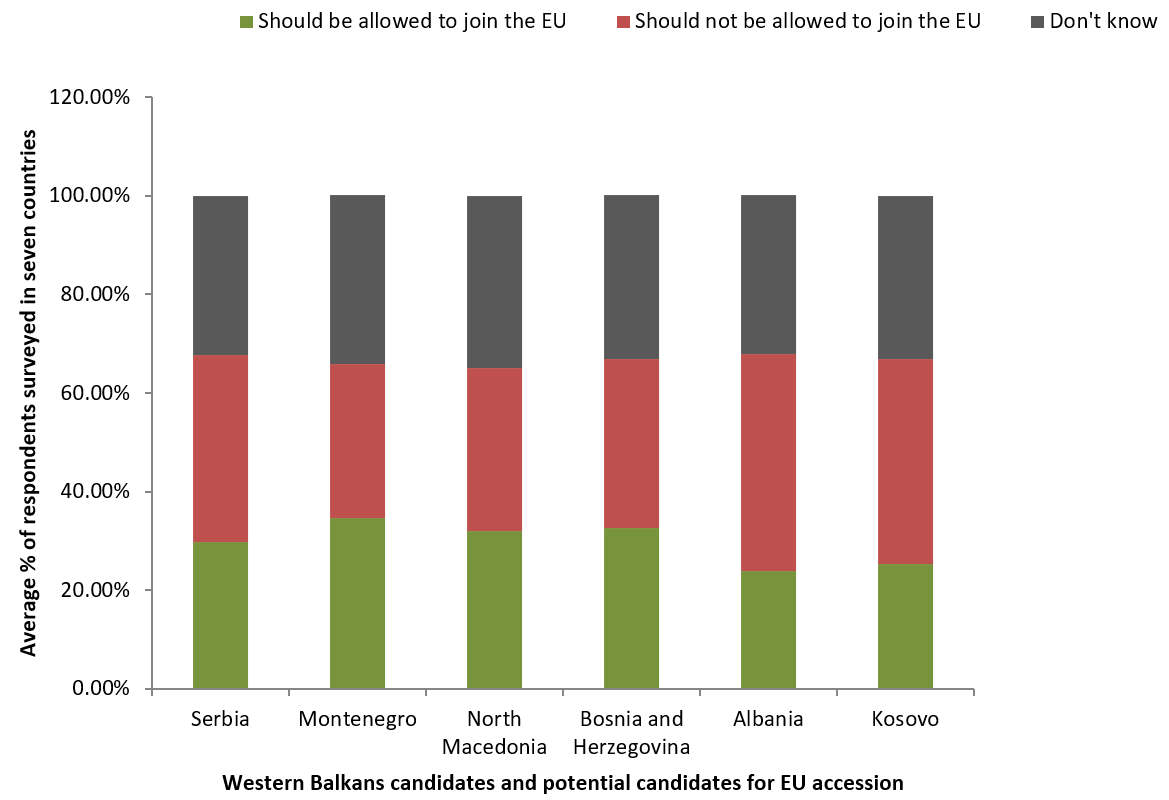
It is not a particularly popular topic among the European public. According to a YouGov poll looking at attitudes towards enlargement in six EU member states (Denmark, Finland, France, Germany, Sweden and the UK) as well as Norway, in most of these countries, there are more people who believe that Romania's EU membership was a mistake than people who do not. The prospects of the six Western Balkans candidates are also viewed with a degree of scepticism by the public in the countries surveyed.

Chart: Attitudes toward Western Balkans enlargement (selected European countries)


Note: Average calculated from results of YouGov/Eurotrack survey conducted in seven European countries (Denmark, Finland, France, Germany, Norway, Sweden and the UK) in December 2018.

Building upon these tendencies in public opinion, it has become easier for Eurosceptic and populist parties to use the 'threat' of enlargement in their anti-EU and anti-immigration rhetoric. The topic is therefore likely to be sidelined for the duration of the campaign, both by the main centre-right and centre-left parties, but also by the EU's institutions.

Romania, currently holding the rotating presidency of the Council of the EU, stated it plans to focus on the topic of accession only after the European elections. Even the publication of the Commission's annual reports on the progress of the candidate countries has been delayed from the usual date in April to the end of May. This is probably to avoid contributing to the populist cause at such a sensitive moment, when polls suggest an increasing number of seats could be won by Eurosceptic parties.

After the elections, when Finland takes over the presidency in July, the Union will be too preoccupied with the formation of new institutions, the (possible) finalisation of the Brexit process and the next stages of the Multiannual Financial Framework (MFF) discussions. The accession process in the Western Balkans is expected to be revived only when Croatia, itself the newest EU member state and formerly part of Yugoslavia, takes over in 2020.

How can a new European Parliament influence the accession process?

While the European Commission conducts accession negotiations and monitors candidates' fulfilment of criteria, the European Parliament also plays a key role as in the end it has to give the green light to the final terms of accession. Its approval is needed for the financial resources allocated to the Instrument for Pre-Accession Assistance (IPA) in the MFF. The Parliament also publishes positions and resolutions which have considerable influence on EU policy.

According to current polls, the new Parliament is predicted to be more fragmented, with the mainstream centre-right European People's Party (EPP) and centre-left Socialists and Democrats (S&D) groups facing significant losses. This would mean more complex decision-making and an increasing need to forge coalitions.

Despite this fragmentation, there is a general lack of enthusiasm towards enlargement across the political groupings. The EPP – which is likely to win the largest amount of seats – states that it supports "the concrete European perspective of the Western Balkans" and helping "countries in the region improve their prosperity, as long as they adhere to European standards and achieve progress in the rule of law and the fight against corruption." The largest party in the EPP, Germany's ruling Christian Democratic Union (CDU), advocates "deepening" EU reforms before "widening" the Union, and stands against any enlargement until 2024.

The S&D group and the Liberals and Democrats (ALDE) support the Western Balkans' accession path, but are strict on pushing for reforms in the region and are clear that the process must be based on merit. The European Greens also support increasing EU engagement with the region, but avoid giving details such as concrete dates of accession. French President Emmanuel Macron's La République En Marche party has been constantly pushing for further reform of the EU before accepting new members, explicitly ruling out the possibility of any accession before 2025.

Most Eurosceptic and populist parties are opposed to EU enlargement, although they do not hold a unified position, as is the case with other foreign policy matters including the recognition of Kosovo and relations with Russia. Anti-immigration parties such as the Brothers of Italy have a strict stance against the accession of countries where the population is primarily Muslim, including Albania. The French National Rally argues that the EU must put a stop to enlargement.

There is cross-party expectation that enlargement is unlikely to happen anytime soon. This was demonstrated at the televised debates of French parties' candidates for the European elections, where ten out of thirteen party candidates said they were against Serbia – who is currently at the most advanced stage of negotiations – joining before 2025, citing the need for reforms on both sides before such a step can take place.

Next steps

At the next European Council summit in June, EU leaders are due to decide unanimously upon opening accession negotiations with candidate countries Albania and the recently renamed North Macedonia. Following the Prespa Agreement with Greece, there is now a more positive attitude towards North Macedonia's accession. However, as mentioned above, the governing parties in France and Germany do not support enlargement in the short-term, and there are suggestions that France is still hesitating about giving the green light. Serbia also expects the opening of two new accession chapters in June.

Declining either one or both of these decisions would be risky both for the region and for the EU. It would mean the EU failing to maintain its soft power rhetoric and its policy of 'giving carrots' to acceding countries. This is especially important with North Macedonia, where a lot of effort was put into implementing the Prespa Agreement with the specific goal of beginning the accession process.

The EU would risk losing leverage over other situations in the region, for instance the Serbia-Kosovo normalisation dialogue. Bilateral relations remain tense as Kosovo maintains its 100% tariffs on Serbian goods, despite Brussels saying the tariffs must be suspended in order for the dialogue to continue.

Progress on the enlargement front will take time, depending on the composition and leadership of the next European Commission, and who becomes the next Commissioner for Enlargement and European Neighbourhood Policy. Overall, it is unlikely that the newly composed EU institutions will radically change their approach towards the Western Balkans. Public opinion remains focused on other issues, and both mainstream and Eurosceptic parties lack enthusiasm for rapid enlargement. The EU will maintain a certain level of commitment, but the process is likely to slow down in both the short and longer term.

Please read our comments policy before commenting.

Note: This article gives the views of the author, not the position of EUROPP – European Politics and Policy or the London School of Economics. Featured image: High Representative of the European Union for Foreign Affairs and Security Policy and Vice-President of the European Commission Federica Mogherini attending a session of the Serbian parliament in Belgrade in 2017, Credit: EEAS (CC BY-NC 2.0)

_________________________________

About the author

Anna Nadibaidze – Open Europe
Anna Nadibaidze is a research and communications associate at the think tank Open Europe. She holds an MSc in International Relations from the London School of Economics.