April 06, 2020

Washington fiddles in the Balkans while COVID flames engulf the world

thehill.com

Washington fiddles in the Balkans while COVID flames engulf the world

7-8 minutes


What possible American interest is served by the Trump administration's ongoing diplomacy that is destabilizing Kosovo, a small and vulnerable pro-American Balkan country, during a global health pandemic? And why would the Trump team do so when the U.S. stopped Serbia — by force — from committing genocide in Kosovo in 1999?

This is especially puzzling since the U.S. was the major player in gaining independence for Kosovo and since Kosovo has been the most pro-American country in Europe after independence. And yet, ongoing American diplomacy today favors Serbia, Russia's closest ally in the region.

Trump's envoy, Richard Grenell, has been bullying Kosovo into accepting Serbian demands as part of a "negotiation" to normalize relations between the two countries.

ADVERTISEMENT

Grenell leads the current U.S. diplomatic effort in Kosovo; he also holds the posts of U.S. Ambassador to Germany and acting Director of National Intelligence. This is an absurd range of duties for someone with limited diplomatic experience and none in intelligence.

Grenell was reportedly a disaster as ambassador to Germany, if the standard is a cooperative relationship with arguably America's most important democratic ally in Europe. German officials can't wait for Grenell to move on.

U.S. Ambassador to the U.N Susan Rice called Grenell "one of the most nasty, dishonest people I've ever encountered."

Serbia today is led by President Aleksandar Vucic, a Serbian nationalist who is using ethnic hatred as a political tool to gain local political support — just as Slobodan Milosevic did in the 1990s. Today, Serbian leaders in Belgrade continue to foster division and hostility in both Bosnia and Kosovo. Vladimir Putin is happy to assist Belgrade in anything that undermines the unity of Western Europe and the United States.

What Trump and Grenell are doing now in Kosovo breaks with successful American policy in the region in fundamental ways.

One U.S. principle that brought peace to the region by 2008 was the concept that borders were fixed and that political solutions must be found within the borders of the nations affected. The Ohrid Agreement that prevented war in Macedonia states clearly that "There are no territorial solutions to ethnic issues." Rights, not territory, are the solution to these problems.

ADVERTISEMENT

The U.S. leadership of a strong coalition of international partners used intense diplomacy and military force to end Serbian genocide in Bosnia, stop another brutal humanitarian disaster in Kosovo and prevent a civil war in Macedonia from 1995 to 2008 as the former Yugoslavia broke apart. The American-led effort in the former Yugoslavia was a major foreign policy success for the U.S. in the early post-Soviet period.

Today, Kosovo is a sovereign democratic country, recognized by 97 nations. But Serbia has used its influence to block Kosovo's membership in the United Nations and other international institutions. In reaction, Kosovo placed a 100 percent tariff on Serbian goods entering the country. Grenell has been pushing Kosovo to eliminate the tariffs to get stalled negotiations moving.

Since international sanctions and tariffs are the favored policy of the Trump administration, Trump's opposition to Kosovo's legitimate import tariffs as international leverage is beyond ironic.

To pressure Pristina to lift the embargo, the U.S. suspended desperately needed aid to Kosovo. Some officials in Washington even raised the possibility of removing the small contingent of U.S. troops in Kosovo that have been essential to Balkan security since 1999. This was a major factor causing the Kosovo government of Prime Minister Albin Kurti to fall as the COVID-19 virus spread through the region. Kosovo is now ruled by a weak caretaker government.

Grenell seems to prefer the attitude of long-time Kosovo politician and current President Hashim Thaci, who has favored a deal with Belgrade, even one that included a land swap between Kosovo and Belgrade.

I advised Thaci in a personal conversation in Washington over a year ago that the land-swap deal was a Serbian trick that would go nowhere, and that he could not trust the Trump administration in any negotiation with Belgrade. He has ignored the advice.

Many questions surround the Grenell mission to Kosovo. Why would someone with such limited experience and with such an important national portfolio engage in negotiations between two weak Balkan adversaries? Why is Grenell taking a pro-Serbian position in the talks? Why is the U.S. destabilizing a pro-American country at such a vulnerable time?

Something about this does not smell right.

As a committed, combative Trump enthusiast, Grenell may just be desperate to please the boss.

But I suspect that there is something more troubling afoot, especially since I remain deeply suspicious about Trump's relationship to Vladimir Putin. I suspect — without proof — that Putin presented his pro-Serb views to Trump, emphasized that Albanians are Muslims and then asked Trump for help in the negotiations.

As with other ill-conceived appointments, Trump made his loyal servant, the aggressive and antagonistic Grenell, the point man on Kosovo. This would be an easy gift to Putin who delights in causing trouble — of any kind — in Europe.

Having Trump-inspired diplomacy engaged in the former Yugoslavia is like letting a two-year-old play with a lighted candle in a haystack.

The Grenell mission in Kosovo risks instability in the Balkans and serves no U.S. national interest. The current U.S. policy on Kosovo is diplomatic incompetence at a minimum, quite possibly malfeasance.

As COVID-19 rages through the United States and Europe, Grenell should not be bumbling about in the Balkans where he lacks the knowledge, experience and diplomatic capacity to improve the situation.

Instead, the U.S. should be promoting a stable Kosovo government to handle the looming health crisis. The Kosovo-Serbia relationship is a long-term problem that deserves serious, professional diplomatic attention, not a half-baked one-sided policy that plays into Serbian and Russian interests.

James W. Pardew is a former U.S. ambassador to Bulgaria and career Army intelligence officer. He has served as deputy assistant secretary-general of NATO and is the author of "Peacemakers: American Leadership and the End of Genocide in the Balkans."


April 03, 2020

Serbia’s coronavirus crackdown and a warning for America

washingtontimes.com

Serbia's coronavirus crackdown and a warning for America

Cheryl K. Chumley

7-9 minutes


ANALYSIS/OPINION:

(CORRECTION: This piece originally contained an erroneous reference about the Serbian president's intentions. The reference has been removed. The Washington Times regrets the error.)

In Belgrade, Serbia, soldiers are out and about, patrolling with machine guns, seeking to stop anyone on the street who has dared violate a presidential declaration of emergency and nationwide lockdown — all due to the coronavirus outbreak.

This is drastic times 10.

But what's most chilling is that it's very nearly imaginable that the scenes from Serbia could kind of, almost, maybe and perhaps — under the right circumstances, with the right conditions and pressures — be Anystreet, America, modern-day coronavirus.

Schools have been ordered closed.


Citizens have been ordered to stay home.

Businesses are shuttered; police are arresting social distancing violators; churches have been closed.

Pastors are being arrested.

"Florida megachurch pastor arrested for holding crowded services Sunday," Fox News reported.

The story went on to report how Rodney Howard-Browne, head of The River at Tampa Bay Church, insisted on holding services because, as he argued, if Walmart could remain open as an essential, then so could his church. Police didn't see it that way; they arrested him for "unlawful assembly" ad "violation of [a] public health emergency order."

Crazy times in America, yes?

Now consider Serbia.

"Soldiers patrol the streets with their fingers on machine gun triggers," The Associated Press reported. "The army guards an exhibition center-turned-makeshift-hospital crowded with rows of metal beds for those infected with the coronavirus. And Serbia's president warns residents that Belgrade's graveyards won't be big enough to bury the dead if people ignore his government's lockdown orders."

It's tyranny that's taken hold of Serbia, it seems. President Aleksander Vucic has been accused of using the coronavirus crisis to seize powers he's not been properly granted.

"[He's assumed] full supremacy" over the government, said Rodoljub Sabic, a former state commission for personal data protection, to AP.

"He issues orders which are automatically accepted by the government," Mr. Sabic went on. "No checks and balances."

No questioning of any constitutional rights of the individual; no concerns about the long-term stifling of freedoms.

And how'd MR. Vucic manage to seize that power? How'd he get by with suspending parliament?

By declaring a state of emergency.

By declaring the end — a coronavirus-free existence — justifies the crackdown means.

It's not that President Donald Trump is going to stand at the White House podium and threaten to shoot U.S. citizens who disobey government-imposed curfews and quarantines and stay-at-home orders.

But Serbia can still be a teaching moment for America. Serbia can still show the chill of what happens in panic situations when government assumes full control.

America is not Serbia; Serbia is not America.

But government is government is government. There are always those in government who will seek to use crisis situations to personal advantage and to grow bureaucratic powers. And freedoms don't always fall at the point of a gun. Sometimes, they crumble quietly, on the calls for greater goods, on the causes of national security — or even, perhaps, quite possibly, over the concerns of a coronavirus.

After all, who would ever have thought a pastor in America, in First Amendment free America, would be arrested for the crime of holding church service.

• Cheryl Chumley can be reached at cchumley@washingtontimes.com or on Twitter, @ckchumley. Listen to her podcast "Bold and Blunt" by clicking HERE. And never miss her column; subscribe to her newsletter by clicking HERE.

Sign up for Daily Opinion Newsletter


March 31, 2020

Serbia to implement €5bn stimulus package to support economy

intellinews.com

Serbia to implement €5bn stimulus package to support economy

By bne IntelliNews March 30, 2020

2-3 minutes


Serbia's government will implement a set of measures worth €5bn to help the economy tackle the negative consequences from the coronavirus (COVID-19) outbreak, President Aleksandar Vucic said as quoted by eKapija on March 30. The details of this plan should be revealed on March 31.

Serbia adopted tough restrictions after declaring a state of emergency in the middle of March following the coronavirus outbreak. As the country started mass testing, the number of confirmed cases is increasing sharply and as of the end of March 29 it reached almost 800 people.

The measures the government will implement will be partially funded by international institutions. On March 30, Raiffeisen Research noted that the IMF has advised Serbia to consider converting the current non-financial IPC instrument into a stand-by arrangement in case IMF money is needed to address the impact of the coronavirus on the domestic economy.

If the government decides to change its agreement with the IMF, it could get around €400mn in cheap loans from the IMF.

The country has a strong liquidity buffer as public sector deposits with the central bank stood at €3.2bn as of February, as well as €13.4bn in FX reserves and cumulative budget surplus of the last three years. In April, the government is expected to sell securities in order to refinance older debt.

"Although local banks are expected to bid in the auction, especially as NSB's liquidity injection last week should have eased earlier funding constraints, the demand is likely to remain below the government expectation," Raiffeisen Research noted.

Earlier in March, Vucic projected that Serbia's economy will contract 2% in 2020 due to the coronavirus outbreak.


March 30, 2020

Putin Says ‘the Rich Must Pay’ for the Coronavirus

Putin Says 'the Rich Must Pay' for the Coronavirus

By Mike Whitney, March 30, 2020

Putin has settled on a more rational and compassionate plan. He's going to launch a relief program that actually focuses on the people who need it the most. Then, he's going to cover the costs by taxing the people who are most capable of shouldering the burden. His intention is not to "soak the rich" or to redistribute wealth. He simply wants to find the most equitable way to share the costs for this completely unexpected crisis.


March 26, 2020

‘Helicopter Money’: This Is the Game-Changer Geo-Politically

strategic-culture.org

'Helicopter Money': This Is the Game-Changer Geo-Politically

Alastair Crooke

12-15 minutes


As the US and the UK, to stem Covid-19 infections, adopt a close-to-wartime approach, with intrusive levels of intervention into social life, these governments – as the corollary to lockdown – are proposing massive bail-outs. At first brush, this may seem both sensible and appropriate. But wait. Bailing out what? Well, financial markets of course, but then … just about everything: Boeing, the US Shale-oil industry, airlines, the tourist industry, and (in the US) every citizen – through posting them a $1,000, or a $2,000 cheque, this week – or, as is mooted in DC – perhaps one every month. Great! Just like Christmas.

The markets crashed: $½ Trillion in 'liquidity' here; $1.5 Tn there – and there – and there. An alphabet soup of lending facilities — pretty soon you are talking 'real money'. The alphabet soup cloaks the collective size of liquidity available to banks. And likewise for individuals? 210 million US adults X $1,000, X 12 or 18 (months), is a staggering sum of money — closer to $4 Tn, or 18% of US GDP. Likewise, UK Chancellor Rishi Sunak pledged £330bn, or 15% of GDP, to support the economy, on top of a three-month mortgage payment holiday and a slew of tax deferments, and to do, as well, "whatever it takes".

So, how come? How is this money suddenly available – when we have repeatedly been told in the wake of the 2008 crisis that austerity must be the only answer? Well, welcome to the 'new orthodoxy' (actually it is not new at all: France tried it in the eighteenth century when it 'printed' the Assignats). Call it 'helicopter money', or, the so-called 'Modern Monetary Theory': The principle is that it is okay to print money – if governments don't otherwise have it. The point here is that 'helicopter money' (money conjured out of nothing: empty units reflecting no underlying real economic value) is a paradigm change. A major paradigm change.

It is the legacy from 2008. That was primarily a banking crisis: Printing money seemed to work out pretty well then, in the view of the élites. The main reason that those 'experts' have thought that printing money worked in the wake of 2008 was because the Central Banks were able to reflate the financialised asset bubbles.

"But that wasn't success, that was failure", financial guru, Peter Schiff comments. It was a failure because it resulted in even bigger bubbles, and even greater debt – which precisely has set us all up for today's crisis: For we are going into this crisis naked of any real tools to deal with supply-shock.

In 2008, everybody believed the money 'printing' was temporary: Bank balance sheets were all gummed up; and the Fed was going to be able afterwards to normalize interest rates, and shrink its balance sheet. Well, nobody is going to believe that, this time. No, debts will soar – and will be 'forever' debts.

Yet for today's policy-makers, it all seems so reasonable, so plausible: If the Fed floods the financial system with money, interest rates can stay at zero for ever. What's not to like about this? Certainly, it fits with Trump's real estate career, built on low interest, easy debt. Governments now may borrow for a hundred years at zero interest; and banks can lend like fury, as the Fed has dropped the requirement for banks to keep any reserves against their loans (i.e. to 'print' more easy credit for the favoured).

Better still, governments can just conjure the money out of thin air (by monetising its debts): It can use these funds to bail out all those businesses and citizens adversely affected by Covid-19, and become heroes. Welcome to the new 'Orthodoxy'.

What's the alternative? Well that's the point. The financialised, monetarist worldview dogmatically pursued through the last decades has left the toolbox with only one tool (more money, more liquidity). They have driven the world into this monetarist cul-de-sac. They will go on doing the same thing (liquidity and bailouts), over and over again, and (per Albert Einstein), always hoping for a different and better result. But it won't work. It won't work because the problem is not lack of liquidity. It is that businesses have no business to do – under infection lockdown. We had better understand the consequences to this insanity. That's all.

This time, the 2008 recipé will not work. The US is going to be hit hard. And Americans are only just waking up to this fact.

This New Orthodoxy is no more than a desperate throw of the dice to keep the western hyper-financialised system aloft. The 'mobilised-for-war' narrative is an attempt to justify authoritarian measures, and the false bail-out meme: There was no 'free money' during the Wars.

In the 2008/9 crisis, the public was bemused: The financial world seemed too arcane to grasp fully. Only later, was it appreciated that the banks were being saved by 'socialising' their mistakes and losses. These – the losses – were 'socialised' i.e. transferred to the public balance sheet, and the public were told to expect austerity – and pared down health and welfare systems, to pay for all these 2008 bail outs.

This time, it is not the banks, but corporations and their 'junk' debt, that the Authorities are hoping to preserve in aspic (just as the banks were, earlier). In simple terms, it will allow over-leveraged companies to go into even deeper debt – with those loans now backed by the US Federal government.

But, will a better informed public so readily agree that Boeing deserves a $60 Bn bailout, when all its cash was spent in the last years in buying back its own stock and paying large dividends. It may be argued that if the money simply is printed, austerity cuts may not be required. But printing money dilutes the underlying purchasing potential of the money that had existed before dilution. That is to say, it is the 60% who ultimately will pay the cost – again. The new austerity will be a covert wealth transfer through dilution of peoples' purchasing potential.

As Schiff notes, monetary inflation "is probably not just the worst-case scenario, it's probably the most likely scenario … the laws of economics apply here just like they did in the Weimar Republic of Germany, or in Zimbabwe, or in Venezuela. If we pursue the same monetary and fiscal policy they did, we're going to receive the same monetary outcome they did (hyperinflation)".

This all may seem a somewhat rarefied argument to some, but the implications (both political and geo-political) are huge. This wartime economic approach – of itself – is not going to bring radical change to our neo-liberalised institutional world, nor reform it. That window was shut after 2008. The reality today is that to 'touch' the system now might induce a debt-deflation – a prospect which truly terrifies the Establishment – on top of impending supply-shock recession.

We are locked in through the errors of the Central Bankers: No wonder the Authorities are trying to kindle a war atmosphere in order to say that 'helicopter money' is okay. "It's wartime". And they will probably order the military out on the streets soon. Saying what is written here, will soon be held to be 'enemy propaganda'.

The effect of a war-like command economy will not be to sweep society or the economy onto a new course, but rather, will be to re-situate it into the old grooves. Will anyone believe that in this new 'command economy' era, the government directed bailouts and the credit lines, will not be channelled principally to the political élites and their allies?

Yet, just as after the sacrifices of two World Wars, there was 'New Deal' mood apparent amongst the people. So it was too, in the wake of 2008: There were calls for reform to a system that entrenched the richest one per cent; but instead we got austerity, and a return to business as usual. Policy was deliberately designed to prop up the old system, and make it function as before. Reform denied.

Today, people are fully focussed on managing their lives under virus lockdown, but the political pendulum has been swinging markedly (so-called populist politics) against what is widely perceived as a politically and economically 'rigged system'.

The question then is, firstly, will US monetary actions succeed? Will they succeed in saving the financial system, 'as it used to be'? Well, take the call for helicopter money: the term refers to giving money directly to individuals as if dropping cash on everybody out of a helicopter. But Schiff points out, that when Milton Friedman (the father of monetarist economics) coined the term, he intended it as a joke:

"He was using it as an example of what not to do – about why Keynesian monetary stimulus doesn't work. He said it's a crazy, stupid idea … Because dropping money from helicopters doesn't do anything. It's just inflation. It just makes prices go up".

And, secondly, will this approach – which anyway is not working, as markets continue to implode – provoke a more concerted opposition to financial excess and inequality, in all its various forms? Will the demand for reform of the neo-liberal system become unstoppable? Maybe the 'community spirit' of suffering the virus together, will not be so tolerant of leaders who have failed to take appropriate steps to staunch infection spread, in a timely fashion?

Here, it is the 'war' on Covid-19 – rather than the other 'war' to save the economy – that will play a key role in shaping the geo-political future. Enough people have already commentated on the communal, national sentiment being generated by Corona virus. Here in Italy, Italians do feel far more linked empathetically – as if fighting a common enemy (which in a way they are). We all feel for the inhabitants of Lombardy and Bergamo. And, Italians know too, that they are on their own.

This feeling of Euro sauve qui peut (every country to its own) is palpable, and not confined to those just outside the EU borders, such as when the Serbian President (reacting bitterly to news that the EU had imposed an export ban on equipment such as masks and gowns to protect medical workers), said: "International solidarity does not exist. European solidarity does not exist", to which most Italians would have responded 'hear, hear'. The only help for Italy arrived from China.

It is the return of the nation-state. Covid-19 will change the course of Italian politics, as well as determine – in a significant way – the future of the EU. Let us be clear: The US and the UK can only make those offers of gushing liquidity and bail-outs – because they 'print' money. They control their own money-supply, their deficits – and to a much lesser extent, have some scope over interest rates. EU states do not. And arguments over EU financial mitigation for Covid-19 will 'rack' EU institutions and unity – perhaps to breaking-point.

And this more general attitude of sauve qui peut and lack of empathy is probably felt nowhere more deeply than in China. The more so, even than Italy. China has been denigrated, particularly in America, in a way that many Chinese feel borders on racism. Pepe Escobar has written:

"Among the myriad, earth-shattering geopolitical effects of coronavirus, one is already graphically evident. China has re-positioned itself. For the first time since the start of Deng Xiaoping's reforms in 1978, Beijing openly regards the US as a threat, as stated a month ago by Foreign Minister Wang Yi at the Munich Security Conference during the peak of the fight against coronavirus.

"Beijing is carefully, incrementally shaping the narrative that, from the beginning of the coronovirus attack, the leadership knew it was under a hybrid war attack. Xi's terminology is a major clue. He said, on the record, that this was war. And, as a counter-attack, a "people's war" had to be launched."

Europe and America will be facing a very different Chinese-Russian axis in the wake of the Coronavirus. The gloves are off. And Europe will be the first to feel the effect: No more Euro prevarication. That is to say, no more 'one foot in; one foot out' in relations with China (on Huawei 5G – as just one example).

Russia and China well understand: Helicopter money, and unparalleled 'printed' bail-outs, this is the game-changer. For now, the US dollar is soaring on demand from states who see their own currencies crashing, but who have borrowed in dollars – and see those dollar loans becoming shockingly more costly, day-by-day.

But, the G7 Central Banks finally will have to fight the inflation monster that will be unleashed by their 'helicopter theories'. Confidence in the dollar will decline, as more and more dollar helicopter 'drops' are made. Interest rates will rise, and western junk debt will become toxic, and untenable at higher rates.

In a word, the world will come to see the US as much less powerful and less competent than appearances have projected it. Its lacunae will stare out.

Is the time approaching for that global monetary re-set, as the dollar loses its shine, President Putin must be mulling …?


March 24, 2020

Europe’s failure to address Covid-19 shows the need for a European ‘health citizenship’

blogs.lse.ac.uk

Europe's failure to address Covid-19 shows the need for a European 'health citizenship'

6-8 minutes


The Covid-19 crisis illustrates that globalisation entails health risks, and that the institutional design of public health systems is ill-suited for the scale of a pandemic, writes Joan Costa-Font. He argues that the inefficiency of the policies implemented by different EU member states highlights why a Europe-wide public health authority should now be a priority to counteract collective action problems among different member states. EU membership should be accompanied by a European 'health citizenship'.

The Covid-19 crisis is not just the most important health crisis that higher income countries have suffered over the last century, but also one that comes with enormous consequences for the global economy. It illustrates more than ever that while globalisation can provide benefits via free trade and mobility, it also entails risks.

Although the exact consequences of the crisis are still to be determined, we already suspect that even under a best-case scenario they will be paradigm changing – and perhaps the tipping point desperately needed to address the challenges of globalisation.  A key lesson from the crisis should be that the collaboration and collective action required in Europe to meet these challenges cannot be achieved without transferring powers to a European public health authority.

Diverse responses

The way the world is organised has proven to be catastrophic for the management of this epidemic. In Europe, each country has reacted in a different way, perhaps revealing the distinct characters of national elites. Germany has managed to keep death rates low with heavy testing, but other European countries have been far slower to react, while some governments appear to have been less open about the situation they were facing and only reacted when the virus was at their doorstep. Some countries, such as Austria and Poland, have demonstrated nationalist instincts in their responses by closing down their borders. Meanwhile in Spain, the approach has included the centralisation of healthcare responsibilities following the declaration of a state of emergency, even though the relevant expertise is located at the regional level, and some Spanish regions that advocated for a lock down have remained open.

In contrast, In Italy, the regions of Veneto and Lombardy were early movers in setting up a quarantine and urging locals to stay home. In Lombardy, local health authorities established strong containment measures in the initial cluster by quarantining several towns in an attempt to slow transmission of the virus. In Germany, states have taken the lead in fighting the virus, while in the UK, Wales and Scotland have acted first by announcing policy measures such as school closures which were then followed by the whole country.

This being said, solutions must be built on cooperation and trust in existing institutions. Today, humanity faces an acute crisis not only due to Covid-19, but also due to a lack of public trust. To defeat an epidemic, people need to trust scientific experts, citizens need to trust public authorities, and countries need to trust each other.

Europe's almost non-existent role

Public health was introduced as an express area of EU competence for the first time by the Maastricht Treaty and internal market regulation does constitute a significant constraint on health services. European health governance is a multilevel system very much like that of other federations. According to article 3 TEC, the European Community shall contribute to a "high level of health protection". Although the right to health care is a 'positive right', the European Court of Justice has envisaged it as a 'negative right' linked with the principle of freedom and non-discrimination.


Stella Kyriakides, the European Commissioner for Health and Food Safety, Credit: CC-BY-4.0: © European Union 2019 – Source: EP

However, Europe reacted to the Covid-19 crisis fairly late. Only in the second week of March did the President of the European Commission propose that all non-essential travel to the EU should be suspended for 30 days. Alongside Europe's failure to manage the migration crisis, it can be argued there is now a desperate need to reform the EU's institutions to enable them to take more effective control over global crises in areas where national reactions are affected by collective action problems (i.e. countries only react when they face an immediate cost to themselves).

A European public health authority

Today, European citizenship is defined by a common European health card as much as a European passport. However, the European role in managing health crises has remained modest. The Covid-19 crisis highlights that public health (the management of global public risks) is an area where the EU should be more proactive. Given the nationalistic and even selfish policies implemented by various member states, the creation of a European wide public health authority must now be viewed as an urgent matter to consider as part of wider reforms. Being European should entail having a European health citizenship.

The help provided by the German state of Baden-Wuerttemberg to patients in the French region of Alsace is illustrative of the fact that health crises like Covid-19 are global in nature and require collaboration to be eradicated. However, this collaboration and collective action cannot be enforced without transferring health powers to the European level. This should be accompanied with recognition that local knowledge is fundamental to the management of health systems.

Crises like Covid-19 affect Europe in a different way from the rest of the world and there is a clear case for an authority that can ensure cooperative policy solutions across member states. If all European countries had implemented the same policy response that Germany put forward, Europe would likely have far fewer fatalities.

Although the delivery of health services is more efficient when it is decentralised (as preferences and needs are heterogeneous), global public health crises should be addressed centrally at the highest level possible, namely the EU's institutions. We should remember this lesson during the next pandemic.

Please read our comments policy before commenting.

Note: This article gives the views of the author, not the position of EUROPP – European Politics and Policy or the London School of Economics.

_________________________________

About the author

Joan Costa-Font – LSE
Joan Costa-Font is Associate Professor (Reader) in the LSE's Department of Health Policy.


March 18, 2020

Serbia turns to China due to 'lack of EU solidarity' on coronavirus

euractiv.com

Serbia turns to China due to 'lack of EU solidarity' on coronavirus

By Julija Simić | EURACTIV.rs

5-6 minutes


Chinese Ambassador to Serbia, Chen Bo, informed Serbian President Aleksandar Vučić on Tuesday (17 March) that Beijing had approved a donation and decided to send experts to help Serbia fight the coronavirus pandemic. EURACTIV Serbia reports.

Vučić said Serbia was not yet in the same crisis as EU countries when it comes to the coronavirus but that it would soon happen.

"Serbia now turns its eyes to China," Vučić said.

"To avoid that worst-case scenario, we need your help and support. That is why I am asking that you send us anything you can. Money is not a problem, we need everything, from masks, gloves to ventilators, literally everything, and most of all we need your knowledge and people who would be willing to come here and help," Vučić said.

"All my personal hopes are focused on and directed toward China and its president," he said, emphasising that Serbia was not asking for money.

The ambassador said that "ordinary citizens" in China had reacted very positively to Vučić's call for help, and that more than 300 million people had watched a video recording of his statement.

"We are waiting for our Chinese brothers here. Without you, it turns out that Europe is having difficulty defending itself, we do not hide the fact that we cannot [defend ourselves]. Without China and our Chinese brothers, we are incapable of doing so," Vučić said.

The first batch of Chinese aid in the struggle against the novel virus has already arrived in Serbia, and comprises COVID-19 test kits donated by the Mammoth Foundation, a humanitarian organisation based in Shenzhen.

The aid operation was coordinated by the Chinese embassy in Belgrade in collaboration with the Serbian government. The number of test kits delivered was not specified.

"European solidarity does not exist"

The Serbian president said earlier that Belgrade had requested aid in medical supplies and staff from China. This had become all the more urgent since the European Commission decided to limit exports of medical equipment outside of Europe.


Vučić further said that he had guaranteed Serbia's "centennial and strong as steel friendship" to the Chinese president.

"European solidarity does not exist. That was a fairy tale on paper. I have sent a special letter to the only ones who can help, and that is China…," Vučić said on 15 March, the day when a state of emergency was declared in Serbia due to the coronavirus.

The president said at the time that many Western governments had pressed Serbia to change its tender procedures in order to reduce imports of Chinese goods and import from Europe instead. But now the same governments do not want to help Serbia even in exchange for money, he said.

Brussels issued a statement after that, saying there was no ban in the EU on the export of medical equipment, masks and ventilators. Rather, the EU adopted a regime of permits for the sale of medical equipment to non-EU states which may submit a request to continue deliveries to the Balkan and other foreign countries.

On 17 March, European Commission Spokesperson Ana Pisonero said the EU was looking at ways to connect the Western Balkans with the initiatives taken by the EU in curbing the coronavirus pandemic.

Now was the time for solidarity, rather than unfounded accusations, she said. "Close coordination and cooperation at the regional level and with the EU are key factors in the response to this emergency situation. In these difficult times, solidarity is needed. This is not the time for a polemic or unfounded accusations", said Pisonero.

She added that the EU was looking at how to best provide support in mitigating the social and economic consequences of the pandemic, including the possibility of redirecting EU pre-accession funds and flexibility regarding state aid rules.

The Serbian Minister of European Integration, Jadranka Joksimović, has already sent a letter to the Commission asking the EU to enable the repurposing of unspent IPA funds, to fight the coronavirus epidemic.

"We need to understand that we are pretty alone in all of this," Serbian Health Minister Zlatibor Lončar commented.

The Social Democrats group of the European Parliament also issued a statement calling on EU authorities not to ignore the western Balkan region in the fight against the coronavirus.

"[We must] include the Western Balkan countries in our common European response, and in measures to prevent and combat the effects of the epidemic," S&D vice-president Kati Piri said.

In an interview with Prva TV on March 17, Lončar said that Serbia had a system in place for 2,000 patients, while preparations are under way to accept 5,000 more in hospitals nationwide. According to official data, there are currently 65 confirmed cases of COVID-19 in Serbia.


[Edited by Sarantis Michalopoulos and Frédéric Simon]


March 17, 2020

China offers to help Serbia counter COVID-19

news.cgtn.com

China offers to help Serbia counter COVID-19

CGTN

3-4 minutes


China on Tuesday said the Chinese side is willing to send emergency supplies and experts to Serbia and share the experience of epidemic prevention and treatment for jointly containing the COVID-19 outbreak. 

Serbia's President Aleksandar Vucic Sunday proclaimed a nationwide state of emergency to fight the spread of the novel coronavirus. He branded European solidarity as a "fairytale," and praised China instead, saying it was the only country that would help. 

Noting that China and Serbia are comprehensive strategic partners with unbreakable friendship, Geng Shuang, spokesperson for the Chinese Foreign Ministry, said that sharing weal and woe and helping each other have always been the main theme of the bilateral ties. 

Chinese people will always remember the helping hand extended by the Serbian government and people at China's critical moment in the fight against the epidemic, Geng said, adding that as the outbreak now poses challenges to Serbia, China will firmly stand together with the people of Serbia to jointly battle against the COVID-19. 

Virus knows no borders, but the worst of times reveals the best in people, he stressed. 

The spokesperson also said in the face of the difficult epidemic situation, China and Serbia carry forward the spirit of building a community with a shared future for mankind staying in the same boat to overcome difficulties. 

China is willing to continue to work with the international community, including Serbia, to win the war of epidemic prevention and control and jointly safeguard regional and global public health safety. 

China's first batch of medical aid arrives in Belgrade

The first batch of medical aid from China to Serbia arrives in Belgrade, Serbia, March 15, 2020. /Photo via Serbian government website

The first batch of medical aid from China to Serbia arrives in Belgrade, Serbia, March 15, 2020. /Photo via Serbian government website

According to the Serbian government's press release Monday, the first batch of medical aid from China to Serbia arrived in Belgrade on Sunday night to help fight COVID-19. 

The shipment included 1,000 manufactured rapid test kits, which can provide results within three hours.

The assistance was coordinated by the Chinese Embassy in Serbia in cooperation with the Serbian government. 

"We are convinced that with the help of our Chinese friends, with their expertise and experience, we will be able to successfully cope with COVID-19 and that Serbia will emerge from this battle as a winner," the government said in the press release. 

As of 9:00 a.m. local time (8:00 a.m. GMT) on Tuesday, Serbia has confirmed 65 cases of COVID-19 and 335 people have been tested. 

Vucic declared a state of emergency in the country on Sunday. Measures within the state of emergency will include the closure of schools and kindergartens, while hospitals will be secured by the army. 

Foreigners won't be allowed to enter Serbia, and all Serbian returnees will be quarantined for at least 14 days, while those from infection hotbeds for 28 days. 


March 15, 2020

Economic Effect of Coronavirus Could Be Revolutionary

paulcraigroberts.org

Economic Effect of Coronavirus Could Be Revolutionary

5-6 minutes


SUPPORT  YOUR  WEBSITE

Economic Effect of Coronavirus Could Be Revolutionary

Paul Craig Roberts

Coronavirus and globalism will teach us vital lessons.  The question is whether we can learn vital lessons that do not serve the ruling interest groups and ideologies.

Coronavirus will teach us that a country without free national health care is severely handicapped. Millions of Americans live paycheck to paycheck.  They cannot afford health care premiums, deductions, and copays.  Millions have no insurance.  This means millions of people infected with coronavirus who cannot get medical help.  The morbidity from this is intolerable in any society. 

Shutdowns associated with efforts to contain the spread of coronavirus will deny income to millions of Americans who live paycheck to paycheck.  What do they do for food, shelter, transportation?  You don't have to think very long along these lines to see a very frightening scenario.

Globalism has taken down the ladders of upward mobility by exporting American middle class jobs to Asia.  A population once able to save now lives on debt, the service of which is interrupted by recession/depression and by debt service absorbing all net disposable income.

Globalism has also reduced the survivability of our society by making it dependent  on externally produced goods, the supply of which can be cut off by disruptions in other societies, by policy disagreements leading to sanctions, and by an inability to export enough to pay for imports, which is what the offshored production of US firms is.

The United States has an unprotected population and an economy in trouble.  For years corporate executives have run the companies for the benefit of their bonuses, which are largely dependent on rises in their company's share price.  Consequently, profits and borrowings have been invested in buying back the companies' shares and not in new investment in the businesses.  Corporate indebtedness is extreme and will threaten many corporations and many jobs in a downturn. Boeing is a case in point.

Economist Michael Hudson has for many decades studied the use of debt-forgiveness to restart economies killed by debt burdens.  Debt forgiveness for corporations has a different implication than debt forgiveness for individuals.  For corporations, forgiving debts lets those who financialized and indebted the economy and the population off the hook.  To avoid rewarding them for the catastrophe they produced and to prevent widespread public outcry and distrust, nationalization is implied for insolvent companies and banks. 

Nationalization would be limited to insolvent companies and financial institutions and doesn't mean that there would be no private companies or businesses.  Additional nationalization could be used to prevent strategic companies from substituting their interests for national interests, which they do when they move American jobs and factories offshore. Pharmaceuticals could be nationalized along with health care. Energy which often sacrifices the environment to its profits could be considered for nationalization.  A successful society has to have more driving it than private profit.

For most Americans nationalization is a dirty word, but it has many benefits.  For example, a national health care system reduces costs tremendously by taking profits out of the system.  Additionally, nationalized pharmaceutical companies could be made more focused on research and cures than on profit avenues.  Everyone knows how Big Pharma influences medical schools and medical practice in line with Big Pharma's approach. A more open-minded approach to medicine would be beneficial.

Socialist is another American dirty word, one that is being used against Bernie Sanders.   I have not turned into a socialist overnight.  I am simply thinking outloud.  How can the economy recover when the population and corporations are smothered by debt?  Debt forgiveness is the only way out of this debt suffocation.  Can debts be forgiven without nationalization? Not without a huge giveaway to financial mangers and Wall Street.  It is the members of the "one percent" who have received 95% of the increase in us income and wealth since 2008. Do we want to reward them for smothering the economy with debt by bailing them out without nationalizing them?

The combination of an economy covered in debt and an unprotected population is clearly revolutionary.  Do we have leadership capable of breaking out of interest group politics and ruling ideologies in order to save our society and put it on a more sustainable basis?

Or will the economic hardships be blamed on the virus, the catalyst that ignited the debt timebomb? 


March 10, 2020

Serbia Built New Rockets To Show NATO That It Is Still Mad About The 1999 Bombings

Serbia Built New Rockets To Show NATO That It Is Still Mad About The 1999 Bombings

Serbia is also quadrupling its modern jet fighter force.

by Michael Peck

Key point: The Serbian missiles are also a warning that if NATO attacks Serbia again

Still angry after NATO's 1999 bombing campaign, Serbia has unveiled a new guided rocket that sends a message to its neighbors: if you help NATO bomb us, we'll bomb your cities.

Serbia's new Sumadija is a truck-mounted weapon that can hit targets 175 miles away. IHS Jane's describes it as a four-hundred-millimeter rocket with a 440-pound warhead and an inertial-navigation guidance system.

A defense expert in Serbia, which fought Bosnia and Croatia in the 1990s and was bombed by NATO in 1999 over the Kosovo conflict, told Russian media that those missiles will fly if Serbia's neighbors help NATO again.

"This is exactly what Serbia needed to prevent its regional neighbor's possible participation in the 1999 aggression against us," Miroslav Lazanski, a military analyst for Serbian newspaper Politika, told Russia's Sputnik News. "The Sumadija can also hit big cities in neighboring countries."

"Hopefully no such conflict will ever happen," Lazanski said. "But if it does and someone is crazy enough to make his airspace available to any third country willing to attack Serbia [like Bulgaria did in 1999], we now have a missile to reach all the strategic cities in the region."

Serbia is also quadrupling its modern jet fighter force, courtesy of Russia and Belarus. Russia is selling Serbia six MiG-29s as well as Buk medium-range antiaircraft missiles in a $640 million sale. At the same time, Belarus, a Russian ally, is donating eight more MiG-29s and two Buk antiaircraft missile systems.

10

seconds

Do You Know What Happened Today In History?

"The MiGs will be equipped with the most modern arms, radars, optical and communication systems," said Serbian defense minister Zoran Djordjevic. This will significantly boost Serbian combat air strength, which now comprises just four MiG-29s, three MiG-21s slated for retirement soon, and another fifteen Yugoslavian-made light attack jets.

Meanwhile, Serbia's archrival Croatia is shopping for a new fighter to replace the nation's aging MiG-21s. "The two leading contenders for the planned contract reportedly include Lockheed Martin's F-16 and Saab's JAS-39 Gripen," according to Defense News. "Considered alternatives comprise the French Mirage, Israel's Kfir, as well as a variant of South Korea's T-50."

However, Croatia's attempted purchase of Ukrainian MiG-21s resulted in a government corruption investigation last year.

Even with the additional MiG-29s, Serbian air strength will only be a fraction of the of the former Yugoslavia's air force before the country splintered during the early 1990s. During NATO's 1999 bombing campaign, Serbia lost five MiG-29s shot down in 1999, four by American F-15s and F-16s, and a fifth downed by a Dutch F-16.

With Serbia and Croatia rearming, is war coming to the Balkans? Some Balkan analysts say the arms purchases don't necessarily presage an arms race in the region. With Croatia a client of the West, and Serbia enjoying closer ties to Russia, it is natural for both nations to seek arms from their patrons.

But the Serbian missiles are also a warning that if NATO attacks Serbia again, the Serbs will retaliate against any neighboring state that assists the alliance.

Michael Peck is a contributing writer for the National Interest. He can be found on Twitter and Facebook. This first appeared several years ago.

Image: Wikipedia.

https://nationalinterest.org/blog/buzz/serbia-built-new-rockets-show-nato-it-still-mad-about-1999-bombings-131182

February 29, 2020

Serbia’s Crown Prince Couple hold gala dinner in London

royalcentral.co.uk

Serbia's Crown Prince Couple hold gala dinner in London

By Oskar Aanmoen

3-4 minutes


Oskar Aanmoen/Royal Central

On Thursday, Crown Prince Alexander and Crown Princess Katherine of Serbia held a gala dinner in London at the Nobel Berkeley Hotel. Last year's 25th-anniversary celebration of Crown Princess Katherine's charity organisation, Lifeline, was held at Claridge's hotel. The famous hotel is the birthplace of Crown Prince Alexander. Because the ballroom is under renovation, this year's dinner was held at the Berkeley hotel.

This year's dinner was also a memorable evening for a good cause. It all started with a reception where the 200 guests were served with a drink and the opportunity to talk to the royals and other prominent guests. A three-course dinner followed. The appetizer was Scottish salmon, followed by steak and finished with a lovely cheesecake. Andrew Eborn, a renowned inspirational speaker, guided the guests through the evening.

Photo: Oskar Aanmoen

There was also a live performance by RJ Gibb, son of the late Robin Gibb from the Bee Gees. Additionally, a charity auction was held where jewellery, paintings and experiences were auctioned off. All the money raised went directly to the Crown Princess's foundation to help Serbian children.

The successful auction raised a significant amount of money for the good causes that the Crown Princess's charity helps with Serbian hospitals. There was little doubt as to what was most popular. There was a regular bidding war among many who wanted to secure a private dinner with the Crown Prince and Crown Princess at their palace in Serbia.

Crown Prince Alexander. Photo: Oskar Aanmoen/Royal Central

In 1993, Crown Princess Katherine founded the Lifeline Humanitarian Organisation which currently has offices in Chicago, New York, Toronto, London and Athens. This organisation, together with the HRH Crown Princess Katherine Foundation, works to collect money for medical equipment that has been delivered to numerous hospitals in Serbia. If you want to read more about the HRH Crown Princess Katherine Foundation and the Lifeline Humanitarian Organisation, you can do so here.

When Crown Princess Katherine's charity organisation, Lifeline, celebrated its 20th anniversary, it also held a charity gala at Claridge's in London. That event raised money for the Cerebral Palsy Society in Greece and the Children's Home Foundation in Greece. In addition to the Serbian royals, the event in 2014 was also attended by Princess Beatrice of York.

Photo: Oskar Aanmoen/Royal Central

Among the guests this year was Oskar Aanmoen, Royal Central's Senior Europe correspondent. His exclusive comments from Crown Princess Katherine at the event will be k Royal Central next week, stay tuned.


February 24, 2020

WHY IS CANADA DEFENDING NAZI SS ATROCITIES?

espritdecorps.ca

WHY IS CANADA DEFENDING NAZI SS ATROCITIES? Governments Can Re-visit History, Not Revise It — espritdecorps

Social Media Manager

9-11 minutes


(Volume 25 Issue 6)

By David Pugliese

In late April more than 50 members of the U.S. Congress condemned the government of Ukraine's ongoing efforts to glorify "Nazi collaborators."

The letter, signed by both Republicans and Democrats, outlined concerns about ongoing ceremonies to glorify leaders of the Ukrainian Insurgent Army as well as 14th SS Galizien Division (aka 1stGalician/Galizien or the 1st Ukrainian Division). "It's particularly troubling that much of the Nazi glorification in Ukraine is government-supported," noted the letter to U.S. Deputy Secretary of State John Sullivan. The letter was initiated by Democratic Reps. Ro Khanna of California and David Cicilline of Rhode Island.

Contrast that to how the Canadian government handled a related issue last year when the Russian Embassy in Ottawa tweeted out that, "There are monuments (sic) to Nazi collaborators in Canada and nobody is doing anything about it."

A monument in Oakville commemorates those who served with the 14th SS Galizien Division. Another monument in Edmonton honors Roman Shukhevych, the leader of the Ukrainian Insurgent Army.

As my Postmedia colleague Marie-Danielle Smith discovered, the Russian tweet sent bureaucrats at Global Affairs Canada into overdrive as they tried to defend the SS unit and Ukrainian Nazi collaborators. Documents she received through the Access to Information law show government officials were under a lot of pressure from the "Centre" (the Privy Council Office and the Prime Minister's Office) to counter the news about the monuments to Nazi collaborators. The bureaucrats came up with a strategy. The would label the tweet as "disinformation" and they came up with a plan to spread the word to the news media as part of their efforts to defend Ukraine's Nazi collaborators.

Now as I have written before, the Russians are more than happy to try to embarrass the Canadian government, which has steadfastly stood behind the Ukrainian government in the ongoing conflict in the region. Suggesting that Canada allows monuments to Nazi collaborators seems to fit that bill.

But in this case the Russian tweets aren't "fake news" or "disinformation." They are accurate.

As those members of the U.S. Congress have pointed out, the Ukrainians who served in the SS Galizien Division were indeed Nazi collaborators.

So too was Roman Shukhevych.

Before going to the Ukrainian Insurgent Army, Shukhevych was commander of the Ukrainian battalion called Nachtigall. The men of Nachtigall rounded up Jews in Lviv in June 1941, massacring men, women and children. The Simon Wiesenthal Center estimates that the Nachtigall Battalion, along with their German military counterparts, managed to murder around 4,000 Jews in Lviv. Other historians put the estimate at around 6,000.

Shukhevych was later assigned to a new unit whose role in Germany's war, according to one Holocaust expert, was "fighting partisans and killing Jews." Shukhevych later turned against the Nazis.

Then there is the SS Galizien Division. They were eager Nazi collaborators. Some 80,000 Ukrainians volunteered to join the SS but only those who could meet the strict requirements were selected.

The SS used some of its most seasoned killers to oversee the development of its new division. SS Gen. Jürgen Stroop, who would later be executed as a war criminal for his brutal destruction of the Jews in the Warsaw Ghetto, was brought on as an advisor.

Other commanders of the division were all versed in the murder of Jews throughout occupied territories in eastern Europe. "Many of the Ukrainian officers, like SS-Hauptsturmführer Michael Brygidryr, had previously served in SS Schuma battalions, routinely used to kill partisans, burn down villages and, when the opportunity arose, murder Jews," wrote award-winning author Christopher Hale in his 2011 ground-breaking book, Hitler's Foreign Executioners.

SS Galizien Division was used by the Nazis in a variety of operations, one of the most controversial being the 1944 destruction of the village of Huta Pieniacka. Huta Pieniacka was considered a "Polish" village that just months before had been the shelter for several hundred Jews, Hale noted. The SS units surrounded the village. Men, women and children, who had taken refuge in the village church, were taken outside in groups and murdered. Kids were executed in front of their parents, their heads smashed against tree trunks, one witness testified. Others were burned alive in houses. Around 850 people were murdered.

Some Ukrainians dispute that the SS Galizien Division took part in the killings or they argue that only small elements from the unit – and under Nazi command – were involved.

A Ukrainian military board heard testimony in 1944 that members of the Galizien Division did take part in the attack. But that action was justified, the board was told since the inhabitants of Huta Pieniacka had been killing Ukrainian peasants. "By the way, the Jews were hiding in the village," a Ukrainian officer added in his testimony describing the destruction of the village inhabitants.

Some Ukrainians see Shukhevych and SS Galizien Division members as heroes. They argue that those individuals served the Nazis because they saw them as liberators from the Russians. Their ultimate goal was an independent Ukraine.

But to claim that these individuals were not Nazi collaborators is something else. They served Hitler.

In May 1944, SS leader Heinrich Himmler addressed the Ukrainian SS recruits in a speech.  "Your homeland has become more beautiful since you have lost – on our initiative, I must say – the residents who were so often a dirty blemish on Galicia's good name – namely the Jews," said Himmler. "I know that if I ordered you to liquidate the Poles, I would be giving you permission to do what you are eager to do anyway."

Himmler speech was greeted with cheers from the Ukrainian recruits.

Equally disturbing are the details contained in the book, The Holocaust Chronicle, published in 2003 and written by 7 top scholars in the field of Holocaust studies. They noted that Ukrainian SS were also sent to help kill Jews during the Warsaw Ghetto uprising. The Chronicle published a photo of two of Ukrainian SS members standing over the bodies of Jews murdered during that uprising. See the photo below:

But this issue of Ukrainian collaboration with the Nazis is not new. Since 1986 the Nazi-hunters with The Simon Wiesenthal Center have warned about efforts from those in Ukraine and in the Ukrainian community in Canada who want to deny involvement of the SS Galizien Division with the Nazis.

The Latvian government is also trying to use the "fake news" label to whitewash the reality of Latvian collaboration with the Nazis.

My colleague Scott Taylor has recently written several articles about the Latvian Legion (15th Waffen Grenadier Division of the SS (1st Latvian) et al) and Latvian killers like war criminal Herberts Cukurs as well as the members of the Arajs Kommando, who murdered an estimated 26,000 Jews.

According to Karlis Eihenbaums, Latvia's Ambassador to Canada, Taylor is spreading "fake news" and "disinformation." Eihenbaums has also tried to smear Taylor by suggesting that he is under the "influence" of the Russian government.

Taylor's research into the Latvian SS Legion and the Latvian murderers of Jewish men, women and children is solid.  It is a well-documented historical fact that many of the killers from the Arajs Kommando went to the Latvian Legion. These Latvians served Hitler. No number of claims of "fake news" can change that fact.

The controversy over the Latvian Legion and the annual parade held in Riga to celebrate these Nazi collaborators is well known and has been going on for two decades, long before the term "fake news" was even coined. In 1998 the parade caused a storm of protests around the world, particularly in Israel, where Holocaust survivors couldn't understand Latvia's desire to celebrate such ruthless killers. German Chancellor Helmut Kohl and French President Jacques Chirac were among those that year to protest the Latvian parade. The Times of Israel reported on this year's Latvian SS parade in Riga, which took place mid-March.

So much for "fake news." Did Helmut Kohl and Jacques Chirac spread "disinformation" when they denounced the SS parade in Latvia? Of course not.

This whole issue isn't about "fake news" or Russian "disinformation." It is about nations trying to whitewash their Nazi collaboration and rewrite history, while attacking journalists who don't want to let that happen.

It is a positive development that members of the U.S. Congress could see through these efforts to glorify members of the SS. They are speaking out.

But in Canada, the federal government is more than happy to play along with defending Himmler's SS divisions and Nazi collaborators.

What would our soldiers who fought during the Second World War to help rid the world of this scourge think about that?

Reprinted by permission of author and Postmedia/Ottawa Citizen. Originally published May 17, 2018. 


February 21, 2020

[Opinion] Why Miroslav Lajčák is the wrong choice for EU envoy

euobserver.com

[Opinion] Why Miroslav Lajčák is the wrong choice for EU envoy

Toby Vogel and Bodo Weber

7-9 minutes


The European Union could commit a major strategic blunder in its immediate neighbourhood with the appointment, expected in March, of Slovak foreign minister Miroslav Lajčák to lead the negotiations between Serbia and Kosovo on a final normalisation agreement.

His precise capacity – whether as a special envoy in charge of the negotiations only or for the whole Western Balkans, or as a kind of all-Western Balkans EU special representative – remains unclear.

What is clear is that this is a terrible choice.

The staffing and organisational decision is part of a reset of talks that collapsed under the EU's previous foreign policy chief, Frederica Mogherini; her team had championed a dangerous land-swap that would have threatened regional and European stability.

Those ill-designed negotiations were less aspirational than grounded in an anti-policy of "any deal is a good deal" 'transactionalism', defying core European values and the one lesson learned from the Balkan wars – that any talks focused on maps, ethno-territorial demarcations, and leadership interests are everything but a solution.

Mogherini's successor, Josep Borrell, seems to have understood that in order to resume the negotiations under credible EU leadership, he needs to delegate the lead negotiator role to an envoy – as this tough and demanding task is a full-time job.

On the surface, Lajčák may seem to have the requisite qualifications for that job.

He speaks Serbian and served twice in the Balkans: first, as EU envoy to supervise Montenegro's referendum on independence from the state union with Serbia, in 2006, and then as the EU's special representative in Bosnia and Herzegovina, in 2007-09, simultaneously serving as the international community's high representative.

Moreover, he knows how to navigate the Brussels bureaucracy, having served as managing director for Europe and central Asia in the European External Action Service in 2010-12, just as the EEAS was being built up as an institution.

In addition, he is likely to be available for the job: polls in Slovakia predict that the social democrats with which he's affiliated will be booted from power in elections at the end of this month.

Despite these apparent qualifications, however, Lajčák is the wrong man for a number of reasons.

First, Slovakia is one of just five EU member states that do not recognise Kosovo's independence from Serbia, for entirely domestic reasons.

Spain, whose former foreign minister, Josep Borrell, became EU foreign policy chief in December, is another.

Non-recognition duo

Should Lajčák indeed be appointed, the two senior EU diplomats dealing with Kosovo would both come from the small minority of member states that do not recognise Kosovo – and oversee talks whose declared end point should be Serbia's recognition of Kosovo's independence.

This would send a strong signal that the EU is taking sides. It would also prop up Serbia's increasingly authoritarian president, Aleksandar Vučić, ahead of early elections in April.

Second, Lajčák carries serious political baggage: a history of political failure in the Balkans.

As the EU's special representative (and the international community's high representative) in BiH, he got embroiled in a serious political confrontation with Bosnian Serb strongman Milorad Dodik.

Demonstrating serious miscalculations and limited political skills, the conflict ended in Lajčák's humiliating retreat.

The episode earned him a reputation as being weak on Dodik and having a pro-Serb bias. Lajčák's tenure deepened the EU's de facto policy of letting illiberal actors in BiH determine the EU's own agenda.

Third, Lajčák has a track record of putting personal and professional ambitions above the mission.

He abruptly abandoned his post in Sarajevo after a year and a half in the job – explaining that he could not decline an offer made by Robert Fico, then Slovakia's prime minister, to head his country's diplomacy – only to undercut his successor in Sarajevo in subsequent years.

According to multiple sources, Lajčák himself requested a much broader portfolio than just the Kosovo-Serbia negotiations, despite knowing very well that this in itself is a full-time job.

This self-seeking approach to the job is exactly what drove Mogherini and her team.

Finally, the illiberalism of the governments which Lajčák served in Bratislava should be anything but a selling point. He remained in post as prime minister Fico had to resign in the fallout from the murder of investigative journalist Jan Kuciak.

In a region struggling with attacks on the media by powerful officials, not least in Serbia, Lajčák's appointment would send exactly the wrong message, providing another illustration of what Balkan citizens see as a pattern of EU officials 'failing up.'

His being on the job market at all is a result of a presumed electoral manifestation of the civic backlash against corruption under the government he served – twice.

Western Balkan citizens deserve better than discredited leftovers, no matter how much elites have become accustomed to this pattern.

Appointing Lajčák to lead the Kosovo-Serbia talks – in any capacity – would signal the EU's deepening lack of seriousness to leaders and citizens in Serbia, Kosovo and the wider region and alienate Pristina, thus dooming the reset of negotiations to failure. It would also seriously hamper the Union's recently announced revitalisation of its enlargement policy.

EU member states thus need to prevent this appointment.

Other candidates

Rather than choosing Lajčák to give the appearance of commitment to the issue, the EU should instead first define the parameters of a future envoy's mission and profile, and define the political terms of the reset of negotiations.

Only then should it even consider a list of potential candidates. A number of conditions should apply.

First, a future envoy, unlike Borrell, must come from a member state which recognises Kosovo.

Second, they must be tasked only with the Serbia-Kosovo negotiations. Any portfolio that included the wider Western Balkans, and especially Bosnia and Herzegovina, would not only be an overstretch. It would imply linkage between a Kosovo-Serbia agreement and Bosnia, which is precisely was secessionist Bosnian Serb leader Milorad Dodik has been promoting.

This is a particularly dangerous signal as Dodik again is openly mooting a secession referendum, which carries with it the spectre of renewed violence.

The EU's weak posture in Bosnia since before Lajčák's tenure (but further reduced by him) has empowered Dodik to behave without restraint.

Third, she or he must be a political heavyweight and experienced negotiator. The selected individual would not necessarily need to have Balkan experience – indeed, given the fact that most European politicians with deep Balkan experience come with baggage, be it an ethnic bias or a history of political failure, not having a Balkan background might even be an asset.

But the future envoy must have demonstrated sound judgment and fortitude, a clear mandate, and be supported by a broad team that includes experts both on the Balkans and on relevant topics that will be part of a future comprehensive agreement (international and constitutional law, minority rights, local self-governance, economic and property issues).


February 16, 2020

North Macedonia Is Being Used by NATO To Target Serbia & Russia

zerohedge.com

North Macedonia Is Being Used by NATO To Target Serbia & Russia

Voima Gold's blog

5-7 minutes


Authored by Paul Antonopoulos via AntiWar.com,

The North Macedonian House of Representatives this week unanimously approved for their country to accept the NATO Accession Protocol, taking the former Yugoslav Republic a step closer towards accession into NATO which is expected to be completed and finalized in the spring.

North Macedonia's rapid accession into NATO is only possible because of the Prespa Agreement signed between Athens and Skopje in June 2018, bringing an end to the name dispute between the two countries that emerged in 1991 with the breakup of Yugoslavia.

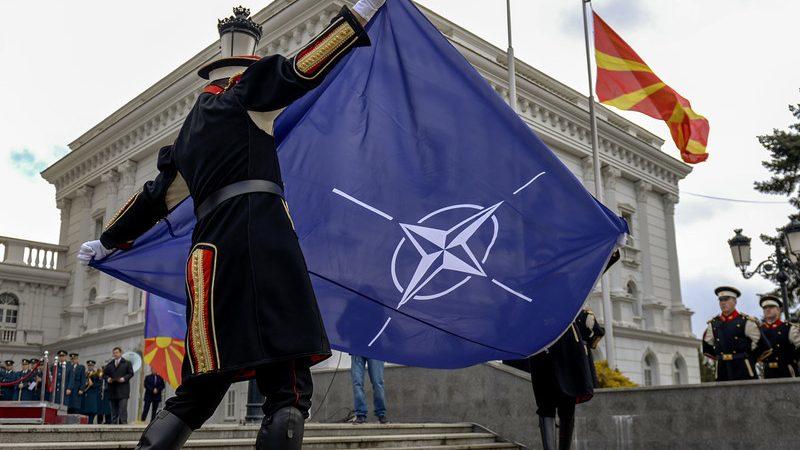
NATO flag being hoisted alongside the Macedonian flag in front of the government building in Skopje, The Former Yugoslav Republic of Macedonia. Image source: EPA-EFE

The Prespa Agreement, named after a lake that traverses the borders of Greece, North Macedonia and Albania, defined exactly what was meant by "Macedonia" and "Macedonian." For Greece, according to the agreement, these terms denote an area and people of Greece's northern region, who continue the legacy of the Ancient Macedonian Hellenic civilization, history and culture, as well as the legacy of Alexander the Great.

In reference to North Macedonia, these terms denote the modern territory of North Macedonia, the Slavic language and Slavic people with their own history and culture unrelated to the Ancient Macedonians. The agreement also stipulates the removal of North Macedonian irredentist efforts against Greek territory and to align them with UNESCO and Council of Europe's standards.

With Greece no longer blocking North Macedonia's attempts to join NATO and the European Union, no time has been wasted to elevate the Balkan country into the Atlanticist organization. There is no doubt that the Prespa Agreement, which caused political turmoil in Athens and Skopje, was signed only for North Macedonia's rapid entry into NATO.

The acceleration of North Macedonia into NATO is not only a key priority for the organization to reduce Russian influence in the Balkans, but to continue pressurizing Serbia that was bombed by NATO in 1999 in response to the Serbian military operation against the "Kosovo Liberation Army" terrorist organization. North Macedonia, Serbia and Bosnia are the only non-NATO members remaining in the Balkans, however it is important to remember that Bosnia is effectively a U.S. protectorate, while North Macedonia has been trying to join NATO since 1995 when Yugoslavia was completely destroyed in all but name.

Serbia has no such ambition to join NATO and is considered a problematic country as it is the only remaining bastion of Russian influence left in the Balkans and is preventing full Atlanticist hegemony over the region.

Syriza, the ruling Party of Greece at the time of the signing of the Prespa Agreement, knew full well that the Prespa Agreement was largely despised by the Greeks, but none-the-less pushed for it and signed it. It is very obvious that the Prespa Agreement was to accelerate North Macedonia primarily into NATO, especially as not only Syriza, but also the current ruling party of New Democracy is loyal to NATO, with North Macedonia's entry into the EU being only a consolation prize for Western powers.

Less than a month after signing the Prespa Agreement, North Macedonia received an invitation to join NATO on 11 July 2018 with the accession protocol made in February 2019. North Macedonia's accession into the EU on the other hand has made no progress since the Prespa Agreement was made.

For the Atlanticists, a rapid accession into NATO to contain and weaken Russian influence in North Macedonia and to also further constrain and pressurize Serbia was a higher priority than formalizing the Balkan country into the European neoliberal order as an official member. Although North Macedonia will undoubtedly join the EU eventually, it is not a matter of urgency as making the country into a NATO member.

The Prespa Agreement is highly unpopular in both countries as they both feel they have lost out and did not achieve their objectives of promoting their interests with the name issue. NATO was unwilling to risk the Prespa Agreement failing and the name issue re-emerging which would once again put on hold North Macedonia's accession into the organization.

North Macedonia cannot contribute to NATO in any meaningful way as it is a poor country of just over two million people and not close to the Russian border like the tiny Baltic states. Its accession into NATO is only for the purpose of weakening or preventing any Russian influence in the country and to further isolate Serbia.

Despite North Macedonia being an overwhelmingly Orthodox and Slavic country that had the potential to become another pro-Russia state in the Balkans alongside neighboring Serbia, since its separation from Yugoslavia in 1991, Skopje pursued a pro-Western policy and joined the NATO program Partnership for Peace as early as 1995 and became a European Union candidate a decade later.

Why North Macedonia has pursued such a Western-centric policy since its separation with Yugoslavia is not clearly understood, but it is certainly understood why NATO has accelerated North Macedonia's membership into its organization.

Paul Antonopoulos is a research fellow at the Center for Syncretic Studies.