Patrick Lawrence: Europe's Fate
By Patrick Lawrence / Consortium News If Emmanuel Macron got one thing done above all others during his recent summit with Chinese President Xi Jinping in Beijing, it was to put the question of Europe's place in the global order before a lot of people who would rather not think about it. The French president, as is his habit, once again questioned Europe's status in the Atlantic alliance, notably in his now-famous protest that Europeans cannot allow themselves to be "vassals" of the United States. "Strategic autonomy" must be the Continent's aspiration, Macron asserted for the umpteenth time. Suddenly, the future of the Continent is squarely on the table. Of all the responses to Macron's remarks, and there have been very many, those of Yanis Varoufakis are the most explosive I have seen.
|
May 07, 2023
Patrick Lawrence: Europe’s Fate


April 19, 2023
The chronicle of the revolutions foretold?
The chronicle of the revolutions foretold?
Branko Milanovic
10–12 minutes
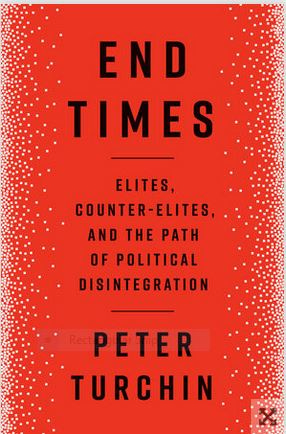
For almost two decades, Peter Turchin has been involved, with many colleagues and co-authors, in an epochal project: to figure out, using quantifiable evidence, what are the forces that lead to the rise, and more importantly, to the decline of nations, political turbulence and decay, and revolutions. This has resulted in the creation of an enormous database (CrisisDB) covering multitude of nations and empires over centuries, and several volumes of Turchin's writings (e.g., Secular Cycles (with Sergey Nefedov), War and Peace and War; I have read the former, not the latter).
End Times is Turchin's attempt to break to the broader public what he has learned from the complex work in the field that he calls Cliodynamics. It is a work of "haute vulgarisation" even if the adjective "haute" is sometimes inapplicable since, in his attempt to reach the broadest possible audience, Turchin has at times stylistically gone much too low assuming almost no prior knowledge amongst his readers. But this is a question of style.
What is the substance? To simplify, in my turn: Turchin's model of decay has one variable: inequality in income or wealth. That variable which is often adduced as a source of political discord is given a very concrete meaning by Turchin. (Here, I have to mention the often uncomfortable personal experience when people keen to praise my work on inequality would claim that it is important because high inequality leads to social conflict, yet without either them or me being able to pinpoint exactly how it does it. Now, Peter Turchin comes with an explanation).
Rising inequality means by definition that the median-income person will fall further behind the mean-income person, and increasingly behind the top 10% or the top 1 percent. The median-income person could be, as in today's United States (a county to whose analysis most of the book is dedicated), an insufficiently credentialed manufacturing or service sector worker; or it could be a semi-skilled laborer in the 19th century Great Britain, or a small landholder in the 1830s France and 1850s Russia. Thus, precise occupation or class does not matter: income position does.
What happens on the top of income distribution? Increased inequality means, again by definition, that people at the top are getting richer compared to the rest, or put differently, that the advantage of being in the top decile or top percentile is increasing. This, as every economist knows, implies that the "demand" for such top slots will go up. If the elite (the top decile or the top percentile) is composed, as in today's US, of executives, investment bankers, corporate lawyers there will be an increasing attempt to study the most lucrative fields and to adopt the type of behavior (including the beliefs) most likely to lead to joining the elite. If more people do so than there are elite positions, a game of empty chairs follows. Not everyone among the aspiring elite will make it. The split in the elite, created by the disappointed would-be elite fighting for top positions, comes next.
In conditions where (a) the distance between the median and the top goes up (what Turchin calls "immiseration" although it is important to note that this is a relative immiseration; i.e., the median-income person can in real terms become better off), and (b) there is elite overproduction, a pre-revolutionary situation ensues. Immiseration is not enough. To produce a breakdown, we have to have different elites fighting each other, with one of them enlisting the support of the "people" in order to win.
Even passing knowledge of the backgrounds of the most important revolutions in the modern era shows that Turchin's simple model provides a good fit. Take the French revolution: stagnation of income and recurrent famines occurred simultaneously with a divided elite (aristocracy and part of the clergy against the rising city merchant class); in Russia in 1917, it was one part of aristocracy against another which lost its landholdings and wealth after the abolition of serfdom and could not compensate it with well-paying state jobs. (The statistic of the number of revolutionaries who were themselves, or their families, the impoverished nobles is striking.) Or take the 1979 Iranian revolution: the sidelined clergy against the bourgeois elite, which, like in the Russian case, produced through its offspring the future revolutionaries.
The model fits well—almost too well—the current American reality. The median person is the "deplorable" (to quote Hillary Clinton), a populist (to quote the mainstream media), a Hillbilly (to quote J. D. Vance) or one of the candidates for the deaths of despair (to quote Anne Case and Angus Deaton). The disaffected, disenchanted American lower middle class has been studied extensively after Trump came to power. The current elite, whom Turchin dissects in an almost forensic manner, is composed of CEOs and board directors, large investors, corporate lawyers, "policy-planning network", and top elected officials (p. 203), that is, of all those who have money and who use it to gain voice and power. (Not unexpectedly, Turchin argues that the United States is a plutocracy that uses the tools of the general right to vote as a way to legitimize its power).
But that elite is not monolithic. An aspiring elite ("credential precariat") has been constituted. It has failed so far to reach the top and has ideologically defined itself in opposition to immigration, globalization, "woke" ideology. Turchin argues that this aspiring or would-be elite is in the process of taking over the Republican party and thus creating a political tool for an effective intra-elite competition. This is, of course, resented by the ruling elite that enjoyed an extraordinary good run between 1980 and 2008 as its view of the world (neoliberal capitalism, "credentialism", and identity politics) became espoused by both mainstream parties. Turchin regards the present political struggle in the US as the ruling class trying (desperately) to fend off an assault on its ideology and, more importantly, on its economic position, by an aspiring elite that is enlisting the support of the disaffected middle class.
It seems to be a battle of epic proportions. Many of the pre-revolutionary signs are there: dysfunctional political system, strong interparty splits, lack of political representation for the outsiders. Turchin approvingly quotes the seminal empirical work by Amory Gethin, Clara Martinez Toledano and Thomas Piketty arguing that in all Western democracies, the left-wing or social-democratic parties have become parties of the educated credential elites, while the working and middle classes have lost their influence and even representation.
Turchin is agnostic—as one should be—regarding what the outcome of the American political crisis will be. The American political system has shown itself to be extraordinary flexible and able to withstand serious shocks. In some ways, one could even think that Trump's various conscious and unconscious "subversions" redounded precisely to the advantage of the system because they showed system's resilience even when the President tried to "overthrow" it. But on the other hand, deep incomprehension and lack of interest in the other side's view is precisely one of the characteristics of pre-revolutionary times and the US has plenty of evidence of this.
Turchin's model applies to China (not discussed in the book) probably as well as to America. The relative immiseration of the median class has gone on for the past forty years. Indeed, it went hand-in-hand with its phenomenal increase in material well-being, to the clip of almost 10% per year, and is thus less noticeable. At the top end of the distribution, the political/administrative class that has historically ruled China is opposed, still very cautiously, by the rising capitalist/merchant class. In a paper by Yang, Novokmet and Milanovic, we have documented and analyzed probably the most radical change —short of a revolution—in the composition of the elite ever. That has occurred in China between 1988 and 2013. Economic growth has displaced the administrative class in favor of those linked with the private sector (capitalists).
Turchin's model of internal breakdown thus acquires a geopolitical dimension. The struggle for global supremacy between the US and China can then be visualized as the question of whose political system will crack first. If China's does, it will have to scale down its foreign ambitions, and accept the role of a subaltern power (to the United States) even in Asia. If the American political system collapses first, the US would move toward isolationism and would have to acquiesce into Chinese rising power in Asia, thus losing controlling role in the most dynamic part of the world.
Will Turchin's model's predictions turn out to be correct? We do not know, but I think, it is important to focus on the logic of the mechanism proposed by Turchin and to see the next couple of decades as a period of difficulties rather than to think, as some people who popularized Turchin's views did in the Summer of 2020, that social processes can be predicted with a precision of movement of celestial bodies.
Turchin's is a fascinating thesis worth reading about, and then either witnessing the chronicle how it unfolds, or perhaps participating in bringing about the outcome or staving it off —because Turchin does show that there the cases when the elite foresight and well-understood self-interest enabled it to ride off the time of troubles.
PS. A note. "Turchin's model" is based on the Structural-Demographic Theory of social change developed from work by Jack Goldstone (https://en.wikipedia.org/wiki/Structural-demographic_theory); to see how they applied the theory to the current USA, see https://www.noemamag.com/welcome-to-the-turbulent-twenties/."
April 06, 2023
What does it mean to be poor in Serbia?
What does it mean to be poor in Serbia?
Milena Antonijević
~3 minutes
In Serbia, as in EU countries, poverty is discussed from the aspect of risk, which is 21.2%, according to the latest available data. EURACTIV explores what it means to be poor in Serbia.
A fifth of the population has a monthly income below the poverty threshold, which, according to available data from 2021, amounted to 24,064 dinars, or a little over €200. The group's most vulnerable are the young and those over 65.
"A fifth of the population cannot reach basic life needs. In 2021, the minimum consumer basket amounted to an average of 39,622 dinars. However, the method of measuring income poverty does not include the availability of healthcare, education, and several other services in society," Professor Natalija Perišić, at the Faculty of Political Sciences in Belgrade, told EURACTIV.
Perišić explains that the right to social assistance (NSP), which those who do not have sufficient means of living are eligible for in theory, has been implemented in Serbia for decades. However, it is necessary to fulfil stringent conditions, which is indicated by the fact that the coverage of the population of NSP is 2.9%.
According to the National Employment Service data, at the end of February this year, 429,351 unemployed persons were registered.
"In the last ten years, the number of unemployed has been continuously decreasing," the Ministry of Labour, Employment, Social Affairs and Veteran Affairs told EURACTIV.
Perišić agrees that employment is the best way to fight poverty, which does not mean that employees are not poor.
In the Centers for Social Work, several social services have been developed, especially psycho-social assistance.
The Red Cross coordinates the work of soup kitchens in 77 cities and municipalities in Serbia, and 32,492 meals are prepared and distributed daily.
"From the funds provided in the republican budget, the Red Cross strives to distribute 50,500 servings of aid in the form of family food and hygiene packages to the most vulnerable citizens. Around 125,000 individuals in almost 3,000 populated places receive this help," the Red Cross explains.
The needs of the most vulnerable relate to food, hygiene products, shoes and clothes.
(EURACTIV.rs | Milena Antonijević)
March 24, 2023
Serbia marks 24 years since the beginning of NATO aggression
Serbia marks 24 years since the beginning of NATO aggression
8–11 minutes
The order for the attack was issued by Javier Solana, the Secretary General of NATO at the time, to the then commander of the allied forces, US General Wesley Clark, although there was no UN Security Council approval. It was an obvious precedent.
It is estimated that in July 1998, the so-called KLA (Kosovo Liberation Army) controlled approximately 40 percent of Kosovo and Metohija. At that time, there were more than 20,000 people in its composition. During this period, they control rural areas and obstruct roads. Attacks on the police, who were trying to guard traffic routes, important points, facilities and urban environments, happened on a daily basis. The Yugoslav Army was forced to help the police during the unblocking of Dečani in June 1998, and Orahovac in July 1998. By October, the police managed to liberate a number of villages in the central part of the province.
At the same time, there was a harsh campaign against Serbia in the Western media. There was, so to speak, a flood of untrue information about the events in Kosovo and Metohija. In the book "Modern Warfare", Wesley Clark later revealed that the planning of the NATO aggression against the FRY "was well underway in mid-June 1998" and that everything was ready a few months later.
The Council of the North Atlantic Alliance (NATO) on October 12, 1998, made a decision on the adoption of the order for the activation of forces. An agreement between Slobodan Milošević and Richard Holbrooke followed the next day. It is planned to reduce the number of soldiers of the Yugoslav Army in the territory of Kosovo and Metohija to the number from the beginning of 1998. It has been agreed that OSCE observers will monitor the situation, that is, the peace process in Kosovo and Metohija. The agreement also stipulated that no person would be prosecuted in state courts for crimes related to the conflict in Kosovo, except for crimes against humanity and international law.
After the meeting of the NATO Council on January 30, 1999, it was officially announced that NATO was ready to launch strikes against the FRY. The NATO aggression was preceded by insincere offers from the international community, as well as the deployment of additional NATO troops in Albania and Macedonia. Negotiations in Rambouillet were conducted from February 6 to March 19.
The FRY delegation did not sign the final text offered. This was followed by another arrival of Richard Holbrooke in Belgrade on March 22 for negotiations with Slobodan Milošević. The media reported that this last peace attempt also failed.
The level of demands sent to official Belgrade, which was confirmed even by Madeleine Albright, was raised all the time during the so-called negotiations, so that Serbia would be blamed. As interpreted by Vladislav Jovanović, announcements of the bombing had existed for ten years, since the time when Bob Dole promised independence in Pristina. Bill Clinton, the then president of the USA, told the delegation of American Serbs that he would not sign what was offered to Milosevic. A similar view was later expressed by Henry Kissinger.
FRY was attacked as the alleged culprit for the humanitarian disaster in Kosovo and Metohija. The immediate cause, actually the justification, were the events in Račak on January 15. And then the failure of the alleged negotiations conducted in Rambouillet and Paris. In reality, it was support for the terrorist organization of the Kosmet Albanians, the so-called KLA, which by then had already committed numerous crimes.
After the Serbian Parliament confirmed that it does not accept the decision on foreign troops on its territory and proposed that United Nations forces monitor the peace settlement in Kosovo and Metohija, NATO began airstrikes.
According to the first announcement of the General Staff of the Yugoslav Army, on March 24 at around 8:45 p.m., more than twenty objects were targeted in the first raid. The first missiles fell on the barracks in Prokuplje at 19:53. This was followed by an attack on Priština, Kuršumlija, and Batajnica.
On the same evening, US President Bill Clinton announced the need to "demonstrate NATO's seriousness in opposing repression", stressing the need to "intimidate Serbia and Yugoslavia" and "destroy Serbia's military capacities", so that, as he said, "actions against the Kosmet Albanians would not be taken". That same evening, British Prime Minister Tony Blair said that the NATO aggression was undertaken because "the people of Kosovo" asked for it. In order to further clarify that, by "the people of Kosovo" he means Kosmet Albanians.
Nineteen NATO countries began bombing from ships in the Adriatic, as well as from four air bases in Italy. First of all, the anti-aircraft defense and other facilities of the Yugoslav Army were targeted.
According to the data of the Ministry of Defense of Serbia, 2,500 civilians were killed during the NATO air aggression, among them 89 children and 1,031 members of the Army and police. According to the same source, around 6,000 civilians were wounded, of which 2,700 were children, as well as 5,173 soldiers and policemen, and 25 people were missing.
According to Serbian experts, 18,168 air takeoffs were recorded until June 10. According to NATO sources, there were 38,004 air surges, of which 10,484 were fire actions, while the rest were reconnaissance, anti-aircraft, and tankers. At first, around 70 fighter planes took part in the operations daily, and later that number was around 400 on a daily basis.
NATO's war losses in manpower and technology are denied. The then authorities in Belgrade claimed that more than a dozen aircraft were shot down, which was not confirmed. The Russian agency APN announced that NATO had lost over 400 soldiers and over 60 aircraft, while US President Bill Clinton stated in a speech on June 10, 1999 that NATO had suffered "no casualties". Aircraft F-117, F-16, unmanned aerial vehicles, cruise missiles, aircraft F 117, the so-called "invisible" until then symbol of the superiority of American technology, ended up in a field of the Srem village Budjanovci.
There is almost no city in Serbia that was not targeted during the 11 weeks of aggression. NATO carried out 2,300 strikes and dropped 22,000 tons of missiles, including 37,000 banned cluster bombs and those filled with enriched uranium. Apart from attacks from ships in the Adriatic, as well as from four air bases in Italy, operations were carried out from bases in the countries of Western Europe and the USA.
Infrastructure, economic facilities, schools, health institutions, media outlets, cultural monuments, churches and monasteries were destroyed, totaling about 50 percent of Serbia's production capacity. Various data were presented about the material damage caused during the NATO aggression. The then authorities in Belgrade estimated it at approximately one hundred billion dollars, the group of G17 economists estimated the damage at 29.6 billion US dollars.
In the bombing, 25,000 residential buildings were destroyed and damaged, 470 kilometers of roads and 595 kilometers of railways were disabled. 14 airports, 19 hospitals, 20 health centers, 18 kindergartens, 69 schools, 176 cultural monuments and 44 bridges were damaged, while 38 were destroyed.
A third of the country's electricity capacity was destroyed, two refineries in Pancevo and Novi Sad were bombed, and NATO forces used graphite bombs for the first time to disable the electricity system. The overall consequences for the health of the population and the ecological consequences are immeasurable.
The Chinese embassy in Belgrade was destroyed on May 7, 1999. The RTS building in Belgrade was destroyed on April 23. 16 people died and the same number were wounded. The Novi Sad Television building was hit on May 3, 1999, on the International Day of Media Freedom.
The aggression was stopped with the signing of the Military-Technical Agreement in Kumanovo on June 9, 1999, and the withdrawal of FRY forces from Kosovo and Metohija began three days later. The agreement determined the withdrawal of the military security forces of the FRY from Kosovo and Metohija, and the establishment of UNMIK, a United Nations mission.
On June 10, 1999, the Secretary General of NATO issued an order to stop the bombing. The last projectiles fell in the area of the village of Kololeč, not far from Kosovska Kamenica, at 1:30 p.m., and on the barracks in Uroševac around 7:35 p.m. It was the 79th day of the NATO aggression against Serbia, that is, the FRY.
The UN Security Council then adopted Resolution 1244. 37,200 soldiers from 36 countries were deployed and sent to the province as part of the KFOR mission.
March 23, 2023
Kosovo Has a Deal With Serbia—if the United States and Europe Can Save It
Kosovo Has a Deal With Serbia—if the United States and Europe Can Save It
Edward P. Joseph
10–13 minutes
Deal or no deal? That's the question baffling the Balkans.
After a pressure-packed summit on Saturday between the leaders of Kosovo and Serbia, the EU's foreign-policy chief, Josep Borrell, proclaimed, "We have a deal," one that promises to lead the two antagonists towards finally normalizing ties. But Serbian President Aleksandar Vucic refused to sign the ambiguous EU-brokered text and has since made statements qualifying and even abrogating key commitments.
Can Vucic ignore Belgrade's obligations in the implementation annex produced in Ohrid, North Macedonia, as well as the rest of the agreement negotiated in Brussels on Feb. 27, which the Serbian president also refused to sign? Why should Kosovo Prime Minister Albin Kurti immediately establish unspecified guarantees for Kosovar Serbs if Kosovo does not know for sure that Serbia will uphold its end of the bargain? Does Serbia tacitly recognize Kosovo under the agreement, or does this depend on further steps?
In short, a cloud of uncertainty hangs over the most important negotiations in the Balkans in more than 20 years. The Kosovo question sparked the violent dissolution of Yugoslavia in the 1990s, exposing the inability of the European Union to tackle security problems in its backyard. The standoff between Belgrade and Pristina is at the heart of the multi-decade transatlantic struggle to consolidate the region into the Western order, creating ample opportunity for Russia and China.
The torturous Western diplomacy between Serbia and Kosovo will surely come up during Chinese President Xi Jinping's three-day visit in Moscow. Whatever differences the two autocrats have over the war in Ukraine, Beijing and Moscow are firmly aligned against Kosovo's independence. Russian President Vladimir Putin and Xi will coordinate efforts to undermine the agreement, leaving Kosovo in limbo, the region in turmoil, and Serbia as a shared strategic partner of both Russia and China.
Given what's at stake if the agreement fails, this is not the time for wan congratulatory statements and standard rhetoric about the responsibilities of the parties. It is now Washington and Brussels—not just Belgrade and Pristina—that have to step up to their own responsibilities, particularly given the ambiguities tolerated in the deal. Three steps are vital to creating a foundation for success.
First, the EU must drop the pretense that it is only a facilitator between the parties—and Washington must drop the pretense that it is only a supporter following the EU's lead. The agreement itself includes "EU Proposal" in its title—one fully backed and advanced by the United States.
For the moment, Borrell maintains that implementation is up to the parties, reducing the EU's role to monitoring. In fact, no party has more formal obligations under the Brussels-Ohrid agreement than the EU itself. There are no less than five distinct tasks that the EU has accepted. None is more important than the twice-mentioned commitment for the EU to "chair" a joint committee to ensure and supervise the implementation of "all provisions." With a strict 30-day deadline to establish the Joint Monitoring Committee, Brussels will have to show uncommon mettle. Implementation requires decisive action—not ambiguity designed to avoid it.
Washington's promised active engagement in this early implementation test is essential. The Biden administration repeatedly pressured the Kosovo government over autonomy for the Kosovo Serb community. Belgrade's demand for "the Association of Serb majority municipalities" has nothing to do with the welfare of Kosovar Serbs and everything to do with undermining Kosovo's sovereignty. The reality is that autonomy is premature, given Serbia's influence over the Kosovar Serb polity and Belgrade's active hostility toward its neighbor.
Read More
Serb residents hold a poster portraiting Russian Prime Minister Vladimir Putin during a ceremony marking a historic battle at Gazimestan, near Pristina on June 28, 2009. The ceremony marked the anniversary of the 1389 Battle of Kosovo, where the Serbian army was defeated by the Ottoman Empire.
For the Kremlin, NATO's 1999 war against Serbia is the West's original sin—and a humiliating affront that Russia must avenge.
Vladimir Putin (R), then Russia's prime minister, walks with former U.S. President Bill Clinton at the state residence of the Russian president, Novo-Ogaryovo, outside Moscow.
There is evidence the Russian president is not ignorant of the security benefits of arms control.
People check out job advertisements at a career fair in Germany.
Why Europe's biggest economy can't get the immigrants it desperately needs.
Having pressed Kosovo to give up its only leverage with Serbia, the onus falls on the United States and EU to confine the scope of "self-management" to the needs of the Serb citizens of Kosovo, not the ambitions of Belgrade or its proxies in Kosovo's north. Kosovar Serbs desperately need autonomy—from Serbia as much as within Kosovo—in order to chart a fully successful future in the country.
Second, the EU must eliminate any lingering doubt about the binding nature of the agreement and all its provisions. Prodded by hasty commentary on the internet, Kosovar Albanians are worried that Vucic can walk away from the agreement because he didn't sign it, or simply choose those provisions he wishes to apply. Western officials have indulged Vucic in his dissembling due to the autocrat's need to face domestic critics. If Vucic is allowed to distort the terms or even the status of the agreement, the chances of implementation plummet.
Serbian citizens deserve to know the truth—and Vucic can survive it. When it comes to treaties and other agreements between states, what counts is the consent to be bound under international law. As Vucic has acknowledged, a signature can manifest this but is not essential. Article 11 of the Vienna Convention on the Law of Treaties makes this clear: "The consent of a State to be bound by a treaty may be expressed by signature, exchange of instruments constituting a treaty, ratification, acceptance, approval or accession, or by any other means if so agreed."
The plain text of the EU-mediated agreement—the basic agreement and the annex—shows the clear intention of the parties to be bound, comprehensively. In the second point of the annex, the parties "fully commit to honour all Articles of the Agreement and this Annex, and implement all their respective obligations stemming from the Agreement and this Annex expediently and in good faith."
This is strikingly different from the 2020 Washington agreement that was signed by Vucic and former Kosovo Prime Minister Avdullah Hoti in the Trump White House. That nonbinding deal didn't even properly name the parties, while the Brussels-Ohrid agreement openly refers to Kosovo and Serbia and labels them "the Contracting Parties." Unlike the grab-bag Trump accord, the Brussels-Ohrid texts are coherent. A preamble frames the core legal and political issues. The Ohrid annex includes several deadlines and a formal implementation mechanism—all proving the clear intention to be bound under law.
As the U.N.-deputized mediator, the EU is fully authorized to determine whether Vucic and Kurti assented to both documents without reservation. Gabriel Escobar, the U.S. State Department deputy assistant secretary overseeing the Western Balkans, has backed the EU position, insisting that the agreement is "legally binding."
Words are not enough. Brussels must follow through and formally amend the EU accession processes for Serbia and Kosovo to reflect their new obligations. To make it clear to the parties—and to Russia and China—that there is no ambiguity about the Brussels-Ohrid agreement, the EU should immediately register it with the U.N. Secretariat. This is fully consistent with the U.N. General Assembly's own call for "every treaty or international agreement, whatever its form and descriptive name … as soon as possible [to] be registered." This applies even to an "agreement that is being provisionally applied prior to its entry into force."
Swift registration will serve notice to Belgrade and Pristina that the EU will not tolerate gainsaying the content of the agreement—as Vucic has done, denying that Kosovo has a path to U.N. membership. Belgrade should have no qualms with registration at the U.N., given that Serbia launched the U.N. General Assembly process in 2008 that ultimately gave the EU its mandate over the dialogue with Kosovo in 2010. Indeed, the 2010 U.N. General Assembly Resolution, co-sponsored by Serbia, creates an implied opportunity for the EU to report on progress in the dialogue to the U.N.
Finally, Washington must press its EU partners to tackle the biggest loophole in the agreement: the denial to Kosovo of any true European path. Five EU states—Cyprus, Greece, Romania, Slovakia, and Spain—stubbornly refuse to recognize Kosovo, preventing Pristina from even applying for membership in the EU or NATO. It remains entirely unclear whether Serbia's de facto recognition in the Brussels-Ohrid agreement will lead the non-recognizers to change their stance. This is where formalities matter. Serbia's signature and, even better, ratification of the agreement could incline fence sitters to take the long-overdue leap and recognize Kosovo.
Time is of the essence. The United States and EU have now committed their credibility to an agreement that Russia and China have every interest in subverting. Getting just the four NATO non-recognizers—which excludes hard-liner Cyprus—to change their stance would make the Brussels-Ohrid agreement a game-changer; leaving Kosovo only partially recognized in Europe will leave the current, desultory game in place. If the process drags on into 2024, the fear is that a distracted Washington will lose focus, allowing the process to lapse back into crisis management.
The Biden administration needs to think outside the box. One approach is to convince Ukraine to recognize Kosovo on the basis of the Brussels-Ohrid agreement, presenting the non-recognizers with an awkward challenge: If the country whose borders are being savaged by a nuclear-armed foe can recognize Kosovo, why can't the likes of Spain do so as well?
Close transatlantic coordination and focus have brought Serbia and Kosovo to the verge of a breakthrough. With a bit more effort and imagination in the United States and Europe, the entire region can cross the threshold, permanently insulating the Balkans from Russian and Chinese influence.
March 12, 2023
Drecun: There is no chance of reaching the Belgrade-Pristina agreement in Ohrid
Drecun: There is no chance of reaching the Belgrade-Pristina agreement in Ohrid - Kosovo Online
4–5 minutes
The president of the Parliamentary Committee for Kosovo and Metohija, Milovan Drecun, points out that on March 18, at the meeting in Ohrid in North Macedonia, within the dialogue between Belgrade and Pristina, there will be no chance of achieving any significant progress, adding that Serbia remains firmly in the positionat it cannot accept and agree to "the membership of a fake state in the UN; we cannot recognize them in any way," RTS reports.
Serbia will not agree or remain silent on the issue of Pristina's entry into the United Nations, President Aleksandar Vucic said, nor will it recognize Kosovo's self-proclaimed independence.
The EU Special Representative for the Belgrade-Pristina dialogue, Miroslav Lajcak, said from Pristina that the Community of Serb-majority Municipalities would be formed according to one of 15 European models.
Milovan Drecun indicates that Miroslav Lajcak is not behaving in a way that would make it possible to reach any agreement between Belgrade and Pristina, especially with the statement "that now is not the time to form the Community of Serb-majority Municipalities."
"Well, how is it not? That is the primary condition we set, and it was also discussed at the previous meeting in Brussels. First, the implementation, the application of the agreement on the CSM from Brussels, and then everything else. Lajcak is now practically trying to defend Kurti's uncompromising stance, and on the other hand, the EU rewards him with visa liberalization," the president of the parliamentary committee points out.
In this sense, Drecun points out that instead of Pristina suffering appropriate punitive measures because, as he says, "Pristina otherwise does not understand the messages sent to it," they reward and encourage it to persevere in its positions.
Drecun believes that Lajcak is making contradictory statements that the CSM will not be formed on the basis of the Brussels Agreement but that some other modalities will now be sought in order, as he assesses, to allow Albin Kurti, due to criticism from the public and the opposition, to obtain any way out if he does not achieve mutual recognition.
"Our management team, which was formed in accordance with the agreement, informed Lajcak that the draft statute had been prepared in 2018 and twice more since then, most recently in April of last year. And all this time, he failed to convince Pristina that the draft statute should be considered. Don't explain the procedures to us now, but take the draft statute and put it on the agenda of the summit meeting between Presidents Vucic and Kurti, and then begin the process of forming the CSM," Drecun says.
What Serbia expects from the meeting in Ohrid
Commenting on Albin Kurti's statement "that he is going to Ohrid but that he will not accept the formation of the CSM," Drecun says that Kurti is a political adventurer.
"Instead of forming the CSM, he is taking a completely different path. Now he is going to Ohrid, so why are you going there, to try the Ohrid trout? Well, you can go on your own for that. The key point here is that some sort of agreement must be reached and progress must be achieved," Drecun emphasizes.
However, as for the meeting in Ohrid on March 18, he says that he does not expect anything from it, just as it was in Brussels.
"We will remain firm in our position that we cannot accept and agree with the membership of a fake state in the UN, and that we cannot recognize them in any way. I think that there will be no chance again to achieve any significant progress in Ohrid," Drecun concluded.
March 10, 2023
Let Kosovo be partitioned
Let Kosovo be partitioned
TransConflict
13–16 minutes
It's wrong to close down the partition option. If this is what the local parties can agree on, let Kosovo be partitioned. The US has finally accepted this logic. Others should now do the same.
By Timothy Less
At long last, the United States has decided to let Belgrade and Pristina resolve the question of Kosovo's status the way they want – if necessary, it seems, by partitioning the territory.
Its embassy in Prishtina has stated that 'sides in the dialogue will have unlimited freedom to decide about the destiny of their countries'. This follows an interview last month in which the American ambassador to Pristina refused to rule out partition, to the evident surprise of the interviewer.
About time.
The unresolved question of Kosovo's status has left the country in a debilitating state of limbo for nearly two decades.
However, attempts to resolve the issue have been persistently foiled by the insistence of the West, and particularly the US, on precluding the one thing which Serbia has consistently said it might accept in return for recognising the breakaway state – namely the Serb-dominated enclave in Kosovo's north.
Is Serbia being unreasonable in demanding this? Perhaps so. But that's beside the point. If Serbia is to shift its position and recognise Kosovo, which is the only way out of the current imbroglio, then its demand must be taken seriously.
Doing the deal
The attraction of any deal based on partition, of course, is that it is simply a formalisation of the reality on the ground.
Belgrade knows it has lost the south of Kosovo because its overwhelmingly-Albanian population will never accept a return to Serbian sovereignty. And Pristina knows it doesn't control the north which is dominated by Serbs and is functionally a part of Serbia.
So, the core of any such deal is a potential win for both sides, without either having to give anything new away. That bodes well for an agreement.
However, success or failure will ultimately depend on a resolution of various second-order issues, most obviously the status of those Serbs left behind in Kosovo, south of the river Ibar.
Belgrade will probably ask Pristina for some form of self-government for this community – probably less than the pending EU-mediated deal to establish an Association of Serb Municipalities, which would give some autonomy to Kosovo Serbs, but the minimum needed for a population numbering a few tens of thousands to maintain its basic way of life.
In return, Pristina will likely demand an end to the complex arrangements that give Serbs massively disproportionate influence in Kosovo's political institutions, including ten reserved seats in parliament and veto powers over matters of vital interest. Pristina will also want Serbia to do something for the Preshevo Valley, a region bordering Kosovo in southern Serbia, where the Albanian population is agitating to be part of discussions about Kosovo.
How Serbia responds to that remains to be seen. Potentially it will sacrifice Preshevo to prevent Albanians spreading to other parts of southern Serbia. Or it might agree to grant Preshevo whatever Pristina is willing to give Serbs in southern Kosovo. Alternatively, Belgrade and Pristina might agree not to make any special arrangements and support those who decide, all things considered, to make a new life across the border.
Around the edges there are also issues of monasteries, missing persons, financial compensation and more besides that each will put on the negotiating table.
But if both sides can find some basic equilibrium in what President Vucic has called a 'comprehensive package', and sell it to their domestic constituencies, then a deal based on 'partition for recognition' which ends the Kosovo conundrum is a real possibility.
Risks and opportunities
Good news, you would think.
But so far, reaction in European capitals has been overwhelmingly hostile to the idea of partition and focused exclusively on a set of perceived attendant dangers. There is generalised talk of ethnic tensions, separatism and renewed conflict in the region.
Naturally, there are risks involved, as there are in any process of conflict resolution. But these should be kept in perspective.
One oft-raised concern is that Serbia's annexation of the north would expose those Serbs left behind in the south to the risk of ethnic cleansing.
Would it, though?
An act of recognition by Serbia would fundamentally change the calculus in Kosovo.
Serbs have been targeted in the past because their presence complicates the Albanians' goal of independence. Not only have they given Belgrade leverage over Kosovo's internal affairs, but Western diplomats have insisted on diluting Kosovo's statehood to uphold the rights of the Serb community.
If, however, Serbia recognises Kosovo, then Albanians will have achieved their core political goal and have no obvious reason to bother the small Serbian population that remains. If anything, the risk of ethnic cleansing will be lower than now.
Another concern is that Kosovo's partition will set a dangerous precedent in a region beset by unresolved ethno-nationalist border disputes.
The greatest fear is for Bosnia where Serbs and Croats have made abundantly clear they do not want to be ruled from Sarajevo – just as Kosovo's Albanians do not want to be ruled from Belgrade.
If Kosovo, is partitioned, so the thinking goes, then why not Bosnia too?
Again, however, that is a questionable assumption. If the Balkans was governed by such simple processes of cause and effect, Republika Srpska would have declared its independence after Kosovo did the same in 2008.
Instead, the fate of Bosnia depends far more on politics inside the country and the wider geopolitical environment than it does on developments inside Kosovo. So, there is no immediate need for panic.
Moreover, to the extent that a deal on partitioning Kosovo did have repercussions, by focusing minds in Sarajevo on the prospect of the Bosnian state breaking up, there might finally be a chance of ending Bosnia's excruciating political deadlock.
As in any separatist conflict, the onus is on the Bosniaks, as the largest group and the one which wants to preserve the Bosnian state to find a modus vivendi with the Serbs and Croats, both of which want more autonomy.
To date, however, Bosniaks have refused point blank to discuss these demands, secure in the knowledge that the US stands behind them and that everything to do with borders is non-negotiable.
This has fuelled the frustration of the Serbs and Croats and recently generated worrying levels of heat: Croats demand a third entity, Serbs threaten to secede, and Bosniaks threaten Serbs with violence, which only increases their determination to break away. On its current trajectory, Bosnia is heading for some kind of bust up.
Since Serbs and Croats are manifestly not going to change their minds, the only way out of this malaise is the emergence of pragmatic leaders within the Bosniak community who are prepared to take Serb and Croat demands for greater autonomy seriously and name their price for agreeing to this.
And a game-changing deal in Kosovo could be the catalyst for this by demonstrating that borders are not inviolable, the US is no longer taking sides and that long-standing foes can resolve their disputes by peaceful negotiation rather than settling them on the battlefield.
The prize is not just something of value to Bosniaks but a way out of the current deadlock and even a chance for Bosnia to develop as a state, to everyone's benefit, most of all the Bosniaks themselves.
A deal in Kosovo could also offer lessons to Macedonia where Albanians have made similarly clear they will not accept second-class status in a state run for the benefit of Macedonians, but where a majority of Macedonians does not wish the country to become bi-national in character, manifest in their opposition to the proposed language law.
This ultimately leaves Albanians with only one option, which is some kind of split in which Macedonians do what they want on their land and Albanians do what they want on theirs. Again, a negotiated solution in Kosovo can offer a way out if pragmatic politicians in Skopje are willing to state their terms for giving the Albanians the autonomy they seek.
Many will object that deals are impossible in Bosnia and Macedonia and merely opening a discussion about fundamentals will automatically lead to war, presumably because they think Balkanites are inveterate barbarians who know only one way to solve their problems – with violence.
But the reason deals have hitherto been impossible is because the West has distorted the local balance of power by backing selected local clients and blocking any meaningful debate about the political arrangements in the region. If the West adopted a position of genuine neutrality, as the US is apparently now doing in Kosovo, then suddenly the impossible would become possible.
As for the resort to violence, the current negotiations over Kosovo clearly show that local parties can talk about fundamentals in a peaceful manner – especially since there is huge popular opposition to conflict following the traumas of the 1990s.
Finally, there is the spectre of the so-called Greater Albania – or, more accurately an Albanian nation state. If Kosovo was recognised by Serbia, Pristina would no doubt seek tighter relations with its more successful southern neighbour. The signs of ever-closer union are plain to see, not least this month when the two dismantled their border controls.
But is it really such a problem if Albania and Kosovo do eventually unite? Unless there is some hidden interest in denying Albanians the kind of national state which other Europeans take for granted, they have every right to have one, if that is their wish.
The only obvious casualty would be the ideology of multiculturalism, which would suffer a major setback in a region which has long been a laboratory for Western liberals to practice their social experiments. And that, one suspects, is the real motivation for much of the hostility towards partition.
At the same time, of course, the risks of a deal based on partition must be weighed against the risks of a deal not based on partition – which, given Serbia's bottom line, means no deal at all.
Kosovo itself will remain in a state of limbo and the north a flashpoint for conflict. And the EU will steadily lose its little remaining leverage as the prospect of membership fades into nothingness.
Indeed, after the EU-Balkans summit in Sofia in May, the General Affairs Council in June and the washout in London last month, it is clear that any enlargement of the union is now on permanent hold as European leaders focus their energies on arresting the EU's slow-motion demise.
It is not hard to foresee a scenario in which Serbia one day simply seizes northern Kosovo out of sheer frustration, triggering a crisis which leads to the revenge expulsion of Serbs in southern Kosovo and the reciprocal expulsion of Albanians from Serbia.
And that sort of violent shock really could trigger the kind of domino effect around the region which angst-ridden opponents of partition are predicting.
A new opportunity
Far from being a regional Armageddon, the new focus on partition offers a solution to the Kosovo problem, and one which has a genuine chance of success following the apparent lifting of the American veto.
In doing so, the US is to be applauded for finally recognising the two most obvious points about the Kosovo debate – that the only durable solution is one which accords with the wishes of the people on the ground. And that what really matters to those people are traditional concepts such as nationhood, sovereignty and territory.
Of course, there are risks to a deal based on partition because the consequence could be to open a new phase in the unfinished process of dissolution of the former Yugoslavia. Partition will also provide no instant panacea to the problems of poor governance and poverty.
But in the longer term, by disentangling their affairs in a peaceful, negotiated manner, Serbs and Albanians can finally embark on the long-frustrated process of state-building and address vital issues like democracy, the economy and the rule of law. With the foundations secured, construction of the house can finally begin.
Indeed, there is no reason why, in a couple of decades' time, Serbia and an enlarged Albania which incorporates Kosovo cannot be reasonably prosperous, moderately well-governed and strategically-important nation states, with close links to Russia, China, Turkey and the West, and constructive relations with their neighbours.
That seems a more inspiring vision than the current pathway which leads nowhere except continued political deadlock, economic stagnation and a fruitless struggle to join a declining EU, which probably ends with some kind of security breakdown when people's patience is fully exhausted.
Partitions and border adjustments may be an ugly solution to an ethno-territorial conflict, but Kosovo is not an aesthetic or moral problem but a political one. The overwhelming priority is to get Serbia to recognise Kosovo so life can go on, and Serbia has said that its price for doing so is the return of the northern enclave.
So, it's wrong to close down the partition option. If this is what the local parties can agree on, let Kosovo be partitioned. The US has finally accepted this logic. Others should now do the same.
Timothy Less is the director of the Nova Europa political risk consultancy and the leader of The New Intermarium research project at the University of Cambridge.
The views expressed in this article do not necessarily reflect those of TransConflict.
March 03, 2023
Putin & Zelensky: Sinners and saints who fit our historic narrative
|
February 04, 2023
Why ethnic tensions are flaring again in northern Kosovo
Why ethnic tensions are flaring again in northern Kosovo
Newsroom
4–5 minutes

Members of the Italian Carabinieri, part of NATO peacekeepers mission in Kosovo, stand guard at River Ibar Bridge, in the ethnically-divided town of Mitrovica, Kosovo, on December 27. [Florion Goga/Reuters]
Protesting Serbs in the ethnically divided city of Mitrovica in northern Kosovo erected new barricades on Tuesday, hours after Serbia said it had put its army on the highest combat alert following weeks of escalating tensions between Belgrade and Pristina.
Serbia's defence ministry said that given the latest events in the region and Belgrade's belief that Kosovo was preparing to attack Serbs and forcefully remove the barricades, President Aleksandar Vucic had ordered Serbia's army and police to be put on the highest alert.
Kosovo's government called on NATO peacekeepers to remove the barricades, but said it had the capacity and readiness to act.
Kosovo and Serbia intend to join the European Union and have agreed, as part of that membership process, to resolve their outstanding issues and build good neighbourly relations.
Here are some facts about the standoff:
WHY ARE THERE TENSIONS?
Kosovo won independence from Serbia in 2008, almost a decade after a guerrilla uprising against Belgrade's repressive rule.
Serbia, however, still considers Kosovo to be an integral part of its territory and rejects suggestions it is whipping up tensions and conflict within its neighbour's borders. Belgrade accuses Pristina of trampling on the rights of minority Serbs.
Ethnic Serbs, who do not recognise the Pristina government or Kosovan state institutions, account for 5% of Kosovo's 1.8 million people, with ethnic Albanians making up about 90%. The Serbs have vented their hostility by refusing to pay Kosovo's power operator for the electricity they use for example and frequently attacking police who try to make arrests.
WHY DID TENSIONS FLARE AGAIN?
Fresh ethnic tensions have erupted since Dec. 10 when Serbs erected multiple roadblocks and exchanged fire with police after the arrest of a former Serb policeman for allegedly assaulting serving police officers during a previous protest.
The stand-off comes after months of trouble over the issue of car licence plates. Kosovo has for years wanted the approximately 50,000 Serbs in the north to switch their Serbian car license plates to ones issued by Pristina, as part of the government's desire to assert authority over its territory.
On July 31, Pristina announced a two-month window for the plates to be switched over, triggering protests, but it later agreed to push the implementation date back to next year.
Ethnic Serb mayors in northern municipalities, along with local judges and some 600 police officers, resigned in November in protest at the looming switch.
WHAT DO THE SERBS WANT?
Serbs in Kosovo want to create an association of majority-Serb municipalities that would operate with greater autonomy. Serbia and Kosovo have made little progress on this and other issues since committing in 2013 to the EU-sponsored dialogue.
WHAT IS THE ROLE OF NATO AND THE EU?
NATO has about 3,700 troops stationed in Kosovo to maintain the peace. The alliance said it would intervene in line with its mandate if stability in the area were jeopardized. The European Union Rule of Law Mission in Kosovo (EULEX), which arrived in 2008, still has around 200 special police officers there.
[Reuters]
January 27, 2023
How to kill four birds with one stone: The West’s foreign policy challenge in Serbia
How to kill four birds with one stone: The West's foreign policy challenge in Serbia
Majda Ruge
10–12 minutes
The European Union and the United States pursue four broad foreign policy objectives in their relations with Serbia: contain Russia, contain China, normalise Serbia-Kosovo relations, and protect the sovereignty of Bosnia and Herzegovina. However, for many years now they have achieved little success on any of these matters. Several reasons explain this, some lying within Serbia and some within Western capitals. EU and US policymakers could change this dynamic, but it appears unlikely they will do so.
Western governments consistently treat Belgrade as the indispensable player on the major questions facing the Western Balkans. Whatever the issue at hand, Serbia's president, Aleksandar Vucic, is the first person they call. Part of this is understandable: power in Serbia is concentrated with Vucic, who has accrued considerable control to himself. And by any measure Serbia is the strongest country in the region. It enjoys sufficient political and financial leverage over unruly Serb politicians in Bosnia, northern Kosovo, and Montenegro to rein them in when they cause trouble.
Yet Western governments' record sheet is thin. Serbia has so far refused to participate in all rounds of EU sanctions against Russia and shows no sign of changing course on this. As an EU candidate country, Serbia is supposed to align with the bloc's foreign policy positions – but its recent compliance in this area has dropped to just 45 per cent, down from 64 per cent in 2020. China's influence in Serbia has grown rather than diminished, whether measured by investment, Chinese presence in the country's critical infrastructure, or political and cultural ties. Serbia continues to support Milorad Dodik, president of the Republika Srpska entity in Bosnia and Herzegovina, whose actions and rhetoric threaten the destruction of the country's central government. On Serbia and Kosovo, despite hype about a recent proposal by France and Germany, a sustainable solution remains unlikely. And on 23 January this week, Vucic gave a televised speech lasting an hour and a half whose contents give many reasons to doubt he is taking part in negotiations in good faith.
Meanwhile, Vucic effectively controls the media in Serbia, whose influence seriously narrows the space for solutions to these problems, trammelling the choices available to Serbia's politicians – including his own. He has built up an image of the West as an enemy and portrays himself as struggling heroically not to succumb to Western pressure to align with the EU's sanctions on Russia or offer concessions to Kosovo. This discourse is amplified by Russian television operations in the country: the EU-sanctioned Russia Today launched its operations in Serbia in November 2022, while Sputnik has never ceased to broadcast there. Just after a meeting last week between Vucic and EU and US representatives on the Franco-German proposal, Sputnik aired Vucic's 23 January address, in which he expressed pride in resisting alignment with EU sanctions on Russia. The speech was marked with bad-faith statements about Kosovo's prime minister, Albin Kurti, and the EU and US delegations he had just negotiated with.
Vucic effectively controls the media in Serbia, whose influence seriously narrows the space for solutions to these problems
If Brussels and Washington are taking note of all this, it is not apparent. Belgrade's refusal to align with EU sanctions has so far brought no serious consequences for its relationship with either the EU or the US. The public rhetoric of EU and American officials towards Serbia continues to assume that Serbia is a reliable partner and factor of regional stability, whatever harsher words may be spoken behind closed doors.
In short, Vucic's confidence that he can continue on his current course stems from the West's consistent failure to develop and exercise the potential leverage it has. Indeed, the president masterfully uses each of the key issues to obscure responsibility for not delivering on others.
Recognise Kosovo? Too difficult, given the right-wing nationalist opposition and public opinion (which Vucic has helped shape). After last week's Franco-German proposal meeting, he announced to the Serbian public that, thanks to him, recognition of Kosovo is off the table.
Deal with secessionism in Bosnia and Herzegovina? He claims to do this, yet up pops Dodik as a welcome guest in Belgrade, including in attendance at Serbia's largest military exercises, which showcase Serbia's military ability to defend "our country and our people". In a similar vein, Serbia's foreign minister is a regular guest at the unconstitutional 9 January celebrations in Banja Luka, which commemorates a wartime initiative to unify Republika Srpska and Serbia.
Decouple from Russia? He would like to, but 80 per cent of Serbia's population oppose sanctions on Russia – in part thanks to the media he controls constantly putting out pro-Russian messaging. Ditto for China, which became the largest single investor in Serbia in 2022 and whose popularity in Serbia has increased exponentially, again due to the government-controlled media.
A different approach: Possible, but unlikely
There will be little incentive for Serbia to change so long as there are no consequences for playing the West off in this way. But the main obstacle lies as much in Western capitals as in Belgrade. When push comes to shove, Western officials appear to have no desire to invest political capital in seeking sustainable solutions by addressing the root of the problems. Privately, for example, many Western officials suggest that Serbia is doing "enough" on Ukraine and that the West should not push it further into Russia's and China's arms.
Theoretically, the EU and the US could approach this differently, applying dual tactics towards Serbia – engagement and cold shoulder. They could each accompany engagement with the active use of political and economic leverage towards well-defined goals, such as ending Serbia's destabilising policy of meddling in the affairs of neighbouring states that host Serbian minorities. But they would also need to be ready to ensure there are consequences for failing to meet these goals.
Neither the EU nor the US lacks leverage in Serbia. Indeed, as the charts below show, Serbia is predominantly integrated into Western economic structures, conducting most of its trade with the EU, and receiving considerable foreign direct investment from the bloc. And while China has grown in importance, its contribution to Serbia's economy is insignificant compared to cumulative investment and trade from the EU. Russia is even less important – in 2021, 65 per cent of Serbia's exports went into the EU and only 3 per cent to Russia. Investment from the EU continues despite Serbia's poor foreign policy track record.


More broadly, key capitals such as Berlin and Washington could deliver a sharper response to Vucic's domestic anti-Western propaganda, increasing the costs to him of its use. For example, EU and US officials could stop giving him an audience each time they visit the region. Numerous sources over the years have suggested that a fear of missing out would have an impact on Vucic's behaviour. Playing on this could be one of the keys to changing the dynamic of the relationship.
To take another issue area: this week, Vucic publicly claimed the EU threatened to abolish the visa-free regime and withdraw all investment if he does not accept the Franco-German plan. This is likely exaggerated, given that the EU avoids using the visa-free regime as a threat and member states such as Germany claim not to have control over private investors. Yet a tougher approach along these lines is precisely what is needed, alongside additional sticks such as wider targeted sanctioning of nationalist criminal actors that foment instability the region, and their political patrons.
Indeed, still missing from the wider approach is the absolutely vital need to weaken the existing patronage system that links government officials with clandestine networks, whether in Serbia or beyond its borders in northern Kosovo, Bosnia, and Montenegro. Loosening the grip of criminal networks over the state and improving the transparency of governance would set off an important ripple effect across the region, where state capture and criminality often hide behind destabilising ethnic politics. The muddled jurisdictions and legal grey zones in Republika Srpska or northern Kosovo, which political leaders seek to legitimise by making demands for greater "ethnic autonomy," allow organised crime to flourish and entrench state capture. The history of post-Dayton Bosnia is full of examples that attest to the tight link between crime and nationalist politics.
Western policymakers should study these cases carefully before contemplating constitutional models in northern Kosovo such as the Association of Serb Municipalities. They should also be aware that, for Russia and China, untransparent and unaccountable governance models provide ideal environments in which to operate. This issue should therefore be one of the first areas for action for Western policymakers: resolving Serbia's and the region's rule of law problems would make operating there harder for Russia and China and weaken ethno-criminal networks of influence across the Western Balkans.
All this could be part of a new EU and US approach to the region, if the key Western powers were indeed keen to adopt a longer-term framework for action and invest greater political capital. Yet, for the time being, Western Balkans strongmen and wider associated networks will remain at liberty to manufacture instability in the region – part and parcel of their methods for holding on to power and remaining popular without being accountable.
The European Council on Foreign Relations does not take collective positions. ECFR publications only represent the views of their individual authors.
January 19, 2023
Hedging Its Bets: Serbia Between Russia and the EU
Hedging Its Bets: Serbia Between Russia and the EU
Dimitar Bechev
27–34 minutes
This publication is part of Europe's East, a Carnegie Europe project on European policy toward Eastern Europe and Russia.
"You cannot sit on two chairs at the same time, especially if they are that far apart." Hoyt Brian Yee, then U.S. deputy assistant secretary for European and Eurasian affairs, had a stark message to Serbia back in 2017: Belgrade had to make a choice between the West and Russia. Five years down the line, Serbian foreign policy is still looking both ways. So far, even Russia's brutal war in Ukraine has not caused Serbian President Aleksandar Vučić to alter course.
On the one hand, Vučić professes a sincere commitment to bringing Serbia into the EU and promoting regional integration through initiatives such as Open Balkan, a platform Serbia shares with Albania and North Macedonia. On the other, Serbia resists pressure to join Western sanctions against Russia and sever its long-standing ties to the country. Flights from Moscow and Saint Petersburg land daily at Belgrade airport. The city brims with middle-class Russians taking advantage of Serbia's visa-free regime and lax residence rules to move their businesses closer to the EU and avoid being mobilized and sent to the front in Ukraine. The Serbian-Russian connection appears as strong as ever. Yet at the same time, Serbia is winning plaudits in Brussels. "Serbia is well advanced on its EU path," tweeted European Commission President Ursula von der Leyen on a visit to Belgrade on October 28, 2022.
Serbia's Russian connection raises alarm across the region. The country's neighbors in the former Yugoslavia fear the wars of the 1990s could come back with a vengeance. In their eyes, the Russian aggression against Ukraine emboldens Serbian revanchism and endangers the Western-backed territorial status quo across the Western Balkans.
Dimitar Bechev
Dimitar Bechev is a visiting scholar at Carnegie Europe, where he focuses on Central, Eastern, and Southeastern Europe.
The Kosovar government, for one, paints Serbia as a mere extension of President Vladimir Putin's Russia. When nationalist Serbs set up barricades in northern Kosovo and fired shots at the police in July–August 2022, Kosovar Prime Minister Albin Kurti said that the risk of a new conflict between Kosovo and Serbia had increased. Before the February 2022 invasion of Ukraine, he said, the chances of a new war were low, but then the situation changed. "The first episode, a consequence of the fascist idea of panslavism that the Kremlin has, was Ukraine. If we have a second episode, for example in Transnistria, then the probabilities that a third war will develop in the Western Balkans [are] very high." Kurti was hinting at Vučić's repeated warning that Serbia would act to prevent a "pogrom" against Serbs in Kosovo. Although tensions have abated lately, thanks to the resolute mediation efforts of the EU, fears have not fizzled out. A fresh escalation in northern Kosovo, similar to the one witnessed in late December 2022, cannot be ruled out.
The threat Russia poses in the Western Balkans should not be exaggerated. Virulent nationalist rhetoric aside, Serbia is not beholden to the Kremlin but rather is hedging its bets, as it has done for a long time. Moreover, the United States and the EU are running out of patience, ramping up pressure on Vučić to come off the fence. In Belgrade, von der Leyen stressed that Serbia's progress toward EU accession was contingent on the country's alignment with the union's foreign policy. However belatedly, the war in Ukraine may mean that Yee's warning is finally heeded.
The Serbia-EU-Russia Triangle
Serbia's Janus-faced policy has deep roots and is reminiscent of Yugoslavia's Cold War nonalignment stance. Serbia depends on the EU both economically and politically. The union is, by a long stretch, Belgrade's leading trading and investment partner. Serbs can travel visa-free to the EU, where a vast diaspora has been living for decades. Vučić is seen more often in the company of von der Leyen, German Chancellor Olaf Scholz, or French President Emmanuel Macron than with Putin. Serbia is also an EU accession front-runner in the Western Balkans. Belgrade embarked on EU membership talks in 2014, with only Montenegro doing so earlier. As of October 2022, Serbia had opened twenty-two out of thirty-five policy chapters, including the crucial dossiers on judicial reforms and on justice and home affairs.
Yet Serbia's progress toward the EU is hardly a success. Accession negotiations are moving frustratingly slowly, and after eight years, just two chapters have been provisionally closed. By comparison, it took Croatia the same amount of time to complete full EU accession between 2005 and 2013. This lack of progress breeds frustration in Serbian society. A July 2022 survey by New Third Way, a research organization, found that 66 percent of Serbs felt closer to Moscow than to the West and that 40 percent favored an end to membership talks with the EU.
Along with the EU's perceived lack of commitment to enlargement, the Kosovo dispute is a key reason for these lukewarm public sentiments. Contrary to what the authorities in Belgrade say, it is clear that Serbia will not join the twenty-seven-strong bloc without recognizing Kosovo's sovereignty, as the EU is loath to import an unresolved conflict akin to the one in Cyprus. Serbia's membership negotiations kicked off only after a deal brokered in 2013 by then EU foreign policy chief Catherine Ashton committed Belgrade to normalize ties with Prishtina in exchange for greater rights for Serb-majority municipalities in Kosovo. Yet the dialogue between Serbia and Kosovo has long been at an impasse. Talks have been undermined by recurrent crises in the Serb-populated north of Kosovo, clashing interpretations of the original agreement, a Serbian campaign to convince states worldwide to de-recognize Kosovo, and an attempt in 2019–2020 by the administration of then U.S. president Donald Trump to override the EU and push an alternative deal based on a land swap.
Currently, EU High Representative for Foreign Affairs and Security Policy Josep Borrell is scrambling to relaunch the talks, with former Slovak foreign minister Miroslav Lajčák acting as a go-between, but it is an open question whether either Vučić or Kurti is serious about reaching a political settlement. Despite a tentative agreement on the loaded subject of Belgrade-issued car registrations, which triggered tensions in July–August 2022, both leaders seem to distrust the EU as much as they do one another.
This is where Russia enters the picture. Since Kosovo proclaimed independence in 2008, Moscow has stood by Belgrade's side in preventing the new state from gaining wider acceptance by the international community. Although Russia lost some diplomatic leverage when Belgrade turned to the EU as a mediator in 2010, Russia's permanent seat in the UN Security Council and ties to the Global South are of immense help to Serbia in isolating and pressuring Kosovo.
To be sure, the Russian approach has been unashamedly opportunistic, often at Serbia's expense. Moscow has selectively invoked a Kosovo precedent to justify its own actions, recognizing as independent states Georgia's breakaway territories of South Ossetia and Abkhazia in August 2008 and the so-called people's republics in Ukraine's Donbas region in February 2022. Yet Serbian public opinion appears unaffected by the contradictory messages coming from Moscow. As data from numerous polls suggest, a great majority of Serbs look at Russia as an ally and a desired partner, well ahead of the EU—not to mention the United States, which is faulted for taking Kosovo away from Serbia.
Serbia's flirtation with Russia—and with China—goes hand in hand with an authoritarian turn in domestic politics. Since becoming prime minister in 2014, Vučić has amassed an extraordinary degree of power thanks to his control over the media, the public sector, and the security apparatus. The opposition is fragmented and eviscerated, with Vučić and his party winning yet another presidential and parliamentary election in April 2022. Anti-Western nationalism is rampant and dominates the public sphere, as in the 1990s.
Serbia's democratic decline complicates relations with the EU, although the union's leaders prefer to engage with, rather than shun, Vučić. At the same time, he has nurtured links to other strongmen, such as Putin, Chinese President Xi Jinping, Turkish President Recep Tayyip Erdoğan, and Hungarian Prime Minister Viktor Orbán. Arguably, Orbán's Hungary presents an example for Serbia to emulate: a country that benefits mightily from EU membership, especially through lavish subsidies, while pursuing an illiberal political model at home and a multivector policy externally.
Serbia's Response to the War
On October 7, 2022, Belgrade awoke to the sight of billboards showing a portrait of a smirking Putin. The conservative movement Our People, whose name is a nod to Russia's war in Ukraine and evokes Slavic brotherhood, was using the billboards to convey to Putin the well-wishes of his Serbian brethren on his seventieth birthday. Weeks earlier, on August 28, thousands of right-wing protesters had marched through Belgrade in protest against EuroPride, a pan-European LGBTQ event taking place in Serbia; they carried outsize images of Putin and General Dragoljub "Draža" Mihailović, the controversial leader of the anticommunist Chetnik movement during World War II. Putin has been invited to join the Serbian nationalist pantheon, and his appeal goes well beyond the far-right fringe.
That appeal is demonstrated by the popular response in Serbia to the war in Ukraine. The 2022 New Third Way poll found that 59 percent of Serbia's citizens blame the West for the bloodshed, compared with 23 percent who fault Russia and 18 percent who believe that Moscow and Western powers share responsibility. According to another survey, conducted in June 2022 by the Center for Research, Transparency, and Accountability, a human rights organization, 72 percent of Serbians believe that Russia was forced to start the war because of NATO's intentions to enlarge.
These attitudes do not exist in a vacuum. Russia benefits handsomely from favorable media coverage in Serbia. As a whole, popular TV stations and print outlets paint the war as a clash between Russia and the United States, rather than an act of aggression against a sovereign state. Their message is amplified by Kremlin-sponsored outlets, such as the Sputnik news agency's Serbian service, which is soon to be complemented by an online Serbian-language TV news channel as part of the RT franchise. Russia is commonly portrayed as a victim of the West, much as Serbia was during the Yugoslav Wars in the 1990s. To Serbian nationalists, the war in Ukraine is therefore payback for the West's imperial arrogance and heavy-handedness. This view resonates strongly with the Kremlin elites' deeply held conviction that the 1999 bombing campaign against Serbia showed NATO's true colors as a vehicle of U.S. hegemony rather than a defensive alliance.
For his part, Vučić presents ties to Russia as a matter of necessity. In May 2022, Serbia concluded a new three-year supply contract with Russian energy giant Gazprom, securing deliveries through the winter of 2022–2023 at advantageous prices because of a formula linked to the price of crude oil rather than to the spot market: in early December 2022, Srbijagas charged just over €29 ($31) per megawatt-hour (MWh), compared with about €94 ($99) per MWh on the spot market.
Other Serbian officials have gone much further. In August 2022, Aleksandar Vulin, a longtime minister of the interior and defense, traveled to Moscow, where he met Russian Foreign Minister Sergei Lavrov and was decorated by the Russian Ministry of Defence. "Serbia led by President Aleksandar Vučić does not forget [the] centuries-old brotherhood [with Russia]," Vulin proudly announced. Then, on September 24, during the annual session of the UN General Assembly in New York, then Serbian foreign minister Nikola Selaković signed a memorandum with Lavrov on coordinating their two countries' foreign policies.
Regional Repercussions
Serbia's continued affair with Russia makes its neighbors fearful. This begins with Kosovo. Serbia's writ runs into northern Kosovo thanks to Belgrade's support for parallel institutions, a strong intelligence presence, and links to local organized crime and smuggling networks. In Bosnia and Herzegovina, Milorad Dodik, who in November 2022 was elected president of Republika Srpska (RS), has been hollowing out Bosnian state-level institutions and threatening to pull the Serb-majority entity from the common state and declare its independence. Serbia also holds influence over parties in Montenegro and the Serbian Orthodox Church is the largest denomination in that country.
This web of formal and informal connections has given rise to talk of a Serbian world (Sprski svet)—by analogy with the Kremlin-backed Russian world (Russkii mir)—in which Serbia exerts influence beyond its borders. Many non-Serbs see this formula as a code word for irredentism and revanchism.
Belgrade's regional influence is not a matter of political rhetoric only. Serbia has been upgrading its armed forces and procuring armaments. Nominally, such efforts are in line with the country's professed policy of neutrality and simultaneous engagement with NATO, Russia, and China. In practice, Moscow appears to be the beneficiary. Russia and its ally Belarus have provided Serbia with advanced equipment, including MiG-29 fighter jets. Between 2014 and 2021, Serbia conducted joint exercises with Russia and other Collective Security Treaty Organization (CSTO) members. Cooperation at the level of the security establishment is strong as well, given Serbian officials' regular exchanges with the likes of Nikolai Patrushev, the all-powerful chief of Russia's Security Council. So when Belgrade tabloids speculate that Serbia will regain Kosovo once the United States inevitably packs up and leaves, just as it left Afghanistan, their pronouncements are taken seriously elsewhere in the Western Balkans.
True to its habit of stirring up discord to undermine the West, Russian diplomacy has been hard at work to exploit anxieties caused by the Ukraine war. In March 2022, the Russian ambassador in Sarajevo, Igor Kalabukhov, stated that it was for Bosnia and Herzegovina to decide whether or not to join NATO but that if it did, Russia would be free to respond to this "threat." He warned that a putative entry into the Atlantic alliance would force Sarajevo to take a side in the West's military-political confrontation with Moscow.
Russia intervened in an escalation in northern Kosovo in July–August 2022 as well. As local Serbs built barricades in response to decisions by Prishtina to force drivers with Serbian-issued license plates to change them for Kosovar ones and to issue Kosovar entry and exit documents for Serbian ID holders, the Russian ambassador to Serbia, Alexander Botsan-Kharchenko, blamed the EU and the United States for the crisis.
On September 26, the ambassador joined Serbian Defense Minister Nebojša Stefanović and Chief of Staff Milan Mojsilović to inspect a Serbian army base in direct proximity to Kosovo's border. As ever, context matters: the visit came after weeks of media speculation about a possible Serbian military intervention in northern Kosovo to prevent what Vučić described as a concerted plan to cleanse Kosovo of Serbs. Naturally, the Serbian military and political leadership had publicly ruled out an invasion. Yet troops at the border, including the unit inspected by the Russian ambassador, were put on high alert. In the longer term, Russia is in a position to throw a wrench into the works of the EU effort to restart talks between Belgrade and Prishtina, too. Moscow is sure to oppose any agreement in the UN Security Council and bar Kosovo from joining the UN and has a lot of scope to continue playing a spoiler role.
The same applies to Bosnia and Herzegovina. Dodik met Putin in Moscow on September 20, 2022, to secure the Russian leader's endorsement ahead of the October Bosnian general election. Having won the RS presidency, Dodik could revive plans to repatriate powers away from Sarajevo and set up a parallel judicial council. In early January 2023, RS awarded Putin (in absentia) a medal of honor. Even though Russia did not veto the extension of the EU-led peacekeeping mission in Bosnia and Herzegovina, EUFOR, at the UN Security Council in November, the Kremlin retains that option in the future. Either way, Moscow holds substantial diplomatic and political leverage over the fragmented country.
Moscow's political influence is checked by economic trends caused by the Ukraine conflict, however. While the region is not particularly vulnerable to a cut-off of natural gas supplies—the six Western Balkan countries consume a meager 4 billion cubic meters (141 billion cubic feet) of gas annually—it is exposed to the secondary effects of the conflict. High gas prices in Europe also drive up the cost of electricity, increasing the burden on households and cash-strapped governments under pressure to provide social safety nets. Recessions in Germany and the other core EU countries will have negative fallout throughout the Western Balkans, where growth depends on exports to or financial flows from Western Europe.
The World Bank expects a slowdown of growth in the Western Balkans from 2022 onward, putting an end to the post-coronavirus boom in 2021. At worst, there might be a repeat of the early 2010s, when the eurozone crisis spilled over into the region. Economic stagnation will have deeper and longer-lasting consequences than Russian propaganda or interference in day-to-day politics in the Western Balkans and will mean that these countries will look not only to the EU but also to others, including China, Turkey, and the Gulf states, for assistance.
No Second Front
Despite Russia's disruptive moves, it faces an uphill task to fulfill its geopolitical agenda in the Western Balkans. Three obstacles for the Kremlin stand out.
First, the scenario of a full-blown Russian military intervention in the Western Balkans remains far-fetched. As during the 1998–1999 Kosovo War, Russia lacks the military capacity to wage expeditionary warfare in the former Yugoslavia. Its forces left Bosnia and Herzegovina and Kosovo as far back as 2003. At present, Ukraine is draining all Russian resources and keeping the Kremlin busy. For that reason, any putative operation in Southeastern Europe would have to involve Serbia not just in a supporting role but as a chief protagonist.
It is plain to everyone in Belgrade, apart from the most deranged propagandists, that such a gamble would generate enormous risks for both the country and Vučić personally, as he would be squandering his relationship with the West and would face harrowing economic sanctions. A gamble would not deliver much, either. NATO and the EU have reinforced their presence in the region to project stability and deter hostile actions. Since February 2022, both EUFOR and EULEX, the EU-run rule-of-law mission in Kosovo, have received reinforcements. KFOR, NATO's peacekeeping contingent in Kosovo, has declared its readiness to scale up its numbers, too. These deployments, backed by EU and NATO members as well as U.S. forces in Europe, create a major disincentive for Vučić to take undue risks.
Second, Serbia is not a full-fledged Russian ally. Rather than siding with Russia without any reservations, Belgrade is hedging its bets in international forums. Since March 2022, Serbian diplomacy has supported several UN General Assembly resolutions condemning the Russian aggression against Ukraine. On October 13, Serbia joined another 143 countries in condemning Russia's September annexation of the Ukrainian regions of Donetsk, Kherson, Luhansk, and Zaporizhzhia. Without voicing it publicly, the Serbian leadership has been wary of Russia's reference to a Kosovo precedent to justify the redrawing of borders, as that undermines Belgrade's own claim against what it considers a breakaway province.
On a practical level, Vučić is courting other powerful states and leaders and not relying exclusively on Putin. Serbia is procuring Chinese surface-to-air missiles. Long-standing plans for the purchase of Turkey's Bayraktar TB2 unmanned aerial vehicle were on the agenda during Erdoğan's September 2022 visit to Belgrade. Serbia has likewise signaled its interest in alternative gas supplies. Vučić attended the inauguration of works for a floating liquefied natural gas (LNG) terminal off the Greek coast near the port city of Alexandroupolis on May 9, 2022, as well as the launch of the Greece–Bulgaria interconnector pipeline on October 1. Once its current three-year deal with Gazprom expires, Serbia will be negotiating imports with Azerbaijan and LNG producers, to be delivered through another interconnector across the border with Bulgaria. Moreover, the visa-free access that Russians have to Serbia means that the country also provides an escape route and, in some cases, a safe haven for political opponents of Putin.
Third, Serbia has come under considerable pressure to impose sanctions on Russia. U.S. Ambassador to Serbia Christopher Hill arrived in Belgrade in late March 2022 explicitly with a mission to talk Vučić into joining the Western coalition. Hill has been vocal in local media, stressing the fact that Serbia has no reasons to support an attack against a sovereign country. Speaking to the national broadcaster RTS on October 19, Hill said Serbia had to think hard about where its interests lie and recognize they lie with the West.
The EU is doing its share, too. In early October, the EU imposed a full embargo on seaborne Russian crude oil, starting in December. That move cut supplies to Serbia, which depends on the Adria pipeline, linked to terminals on Croatia's Adriatic coast. The same month, the European Commission's regular report on Serbia's progress toward EU membership highlighted nonalignment with sanctions as a chief obstacle to Belgrade's ambitions to make headway in the accession talks. At the same time, Serbia has faced criticism from the commission over the liberal visa regime it applies to citizens of third countries, which allows Serbia to be used as a conduit for illegal migration to the EU. The Serbian government has also reintroduced visas for Burundians and Tunisians in order not to have its own nationals' visa-free access to the EU's passport-free Schengen zone removed. It is not inconceivable that the EU could use the same leverage to demand the termination of Serbia's visa-free regime with Russia, too.
Taken together, these factors narrow the wiggle room for Vučić. He was able to defer the decision on joining sanctions on Russia by delaying the formation of a new cabinet after the April 2022 elections. Constitutionally, it is the government, rather than the head of state, that has the power to impose sanctions. But with Prime Minister Ana Brnabić's new administration having been endorsed by the Serbian parliament and given the pressure from the EU and the United States, Serbia could be expected to accommodate at least some of the West's demands. The removal of Vulin and the Russia-connected technology minister Nenad Popović from the cabinet and the return of pro-Western figures such as Tanja Miščević, who is in charge of EU negotiations, are interpreted as signs of a potential shift.
Some off-the-cuff statements by senior Serbian officials hint that a change of course may be in the works. Former foreign minister Selaković said that Russia would show understanding and would not carry out reprisals if Serbia were forced to adopt sanctions. In response, Russia's Deputy Foreign Minister Alexander Grushko flew into Belgrade and publicly warned the government that any U-turn would be tantamount to "political suicide." If he decides to change tack, Vučić will probably outsource the decision to Brnabić and new Foreign Minister Ivica Dačić, the leader of the Serbian Socialist Party, who is considered to be closer to Moscow than the president is. Serbia has already taken some minor steps to align with the EU: it joined sanctions against Belarus and against Ukraine's former president Viktor Yanukovych, and it has not taken part in any military exercises with Russia or the CSTO since February 2022.
Dodik certainly depends on Russian support to a greater degree than Vučić does. But even he has not put all his eggs in Moscow's basket. One reason that Dodik has not come under EU sanctions for disrupting central-state institutions in Bosnia and Herzegovina is the veto exercised by Orbán. Since the start of the war, Dodik has carefully avoided a head-on collision with the West. In March, he addressed the European Parliament, a move intended to allay fears in Brussels that he would move forward with his secessionist plans. The setbacks Russia has suffered in Ukraine since have probably made Dodik even more risk averse—not to mention the fact that Vučić is unlikely to swiftly recognize a breakaway RS and risk a clash with the West. Still, Bosnia and Herzegovina's dysfunctional politics will continue to present Russia with opportunities to rock the boat.
Conclusion
The war in Ukraine has shed light on unresolved political issues and lasting fissures in the Western Balkans. Yet the region is not at risk of a direct assault by Russia. Much more concerning is Moscow's capacity to exploit indigenous problems and fan the flames of conflict. The economic effects of the war should not be underestimated, either. Serbia remains the hub of Russian influence in the region, but the EU and the United States have not exhausted their leverage. While Vučić will not burn bridges with the Kremlin, Serbia and Russia may drift apart.
In response to this situation, the EU has some cards to play. First, it should ramp up its economic assistance to the Western Balkans. The €9 billion ($10.6 billion) post-coronavirus recovery package promised to the region in October 2020 for the period 2021–2027 can buy Brussels influence at a time when growth is set to slow. But it has to be coupled with a smart strategic communications campaign targeted at societies that have grown cynical and are vulnerable to all manner of disinformation. The same goes for recent initiatives such as the €1 billion ($1.1 billion) in assistance to tackle the energy crisis in the Western Balkans, unveiled by von der Leyen in early November 2022. The EU should also double down on its effort to spur economic integration in the area, notably through the Common Regional Market scheme pushed by the Brussels-sponsored Berlin process. Alignment with the union's green transition agenda should be a central priority—and be supported financially by European funds as well as aid from international financial institutions, coordinated by the European Commission.
A deal on Kosovo, brokered by the European External Action Service as well as France and Germany, which have already produced a blueprint, would likewise go a long way in changing the region for the better. It would remove the most serious hurdle for both Belgrade and Prishtina on the path to EU membership. Kosovo would be able to integrate into NATO once the five nonrecognizers—Cyprus, Greece, Romania, Slovakia, and Spain—follow Serbia's example and accept Kosovo's sovereignty. A settlement would deprive Russia of a major lever, although the Kremlin would surely try to use the outcome in its favor.
Progress in the Balkan countries' membership talks with the EU would also have a beneficial impact. If Montenegro were to join the bloc toward the end of the 2020s, this would send a strong signal that the union is serious about the promise of accession it made back in 2003. In the short run, Kosovo's EU membership application, submitted in December 2022, along with the prospect of lifting visas for Kosovar citizens traveling to the EU from January 1, 2024, could play a positive role, too. Of course, progress in the accession path should be contingent on reforms in the economy and, more importantly, gains in the areas of the rule of law and democratic accountability in the candidate countries. The responsibility is shared by the EU and the region's political elites.
Carnegie does not take institutional positions on public policy issues; the views represented herein are those of the author(s) and do not necessarily reflect the views of Carnegie, its staff, or its trustees.

